



Quick Summary:
This blog gives you a 2026 lens to Cloud Business Intelligence, the organizational problems it solves, how real enterprises are using it across industries, and how to build the core architecture that helps you unlock the maximum potential of your cloud investments. Additionally, it helps you choose the right Cloud BI tools and avoid common implementation mistakes that add to hidden costs.
Introduction
The first quarter of 2026 is nearly ending, you’re drowning in quarter-end reports, but is every report arriving on time? Or is every report arriving in advance to help you jump on a market opportunity?
If you’re concerned about competitors acting faster on ideas that your team has barely touched and costs to keep up with them, you may need to rethink how much control you have over your organization’s data. Enter cloud business intelligence.
For years, business intelligence, or the capability to make critical decisions with data, was behind closed doors that limited businesses- expensive on-premises servers, complete reliance on IT and their availability, and dashboards that no one apart from two analysts understands. Meaning quarter-end reports would arrive days after an opportunity has passed, depending on these variables.
If this is still your reality, Cloud BI is your wake-up call. According to a report by Grandview Research, cloud BI held the largest revenue share of 53.6% in the global BI market valued at $40.13 billion in 2025, leaving on-prem behind in a first. Cloud BI makes real-time data accessible to anyone within the organization by moving your analytics infrastructure from physical servers to the cloud- meaning sales managers can get revenue reports by region at 7 am and operations leads can identify where a supply chain breaks before it escalates to a crisis.
This blog helps you understand what cloud BI really is, how i works, how you can contextualize it in your enterprise, where it beats traditional approaches, what it costs (including what other vendors don’t tell you), and how you can leverage it in the age of AI and data-driven decision-making.
What Is Cloud Business Intelligence?
Let’s understand cloud business intelligence with a simple example. While landing plane, a pilot does not wait for fuel gauge reports to arrive. They have every essential reading and parameter live and ready to use at the moment.
That’s exactly what Cloud BI does for your business- leaders don’t need to export spreadsheets, wait for IT specialists to access servers where analytics infrastructures are housed, or see an opportunity pass because here was a delay in decision making.
Cloud Data Analytics in your Business Context
Ever had your CFO walk up to a board meeting with 2 different revenue numbers for 2 different exports? Or your Ops Lead spending 48+ hours to find a discrepancy between two systems to just be a time zone difference? Embarrassing and helpless moments, right? But your moment to make an impression or the right decision has already passed.
That’s exactly what cloud data analytics fix by making business intelligence accessible to everyone in real time. Cloud BI pulls and consolidates data from different systems together and makes it accessible to right people whenever they need it via dashboards tailored to their needs. No more waiting for any particular browser or IT specialist.
What has made this possible is the shift from on-premise to cloud infrastructures- decoupling storage and compute (BigQuery and Snowflake mainstreamed this) that made it economically viable to query massive datasets without pre-provisioning hardware. Traditional BI needed expensive IT infra, specialist implementation teams, prohibitive budgets, and a long waiting period before an insight was delivered. Cloud BI removed these inefficiencies and limitations and made key insights actionable, allowing you to scale seamlessly as your business grows.
Key Takeaways:
- Cloud BI helps businesses overcome the limitations of traditional, on-premise infra systems.
- It makes real-time data accessible to anyone within your organization in real-time, equipping them with accurate insights needed to make the right decisions at the right time.
Business Intelligence on Cloud: A 2026 Overview
In 2026, the question is not about how behind businesses not using cloud BI are. They are already not part of the race. The real question is how cloud BI is being used in different business contexts to solve long-standing organizational problems.
Data-driven Decision Making Irrespective of Team Size
Retail giants like Walmart have been using cloud-based analytics for years. Given their scale and team sizes, it feels like a given. However, in 2026, companies need not wait for the Fortune 500 status to upgrade to cloud data analytics. Even businesses with 300-3000 employees, mid-sized logistics operators, and franchise networks are using the same stack to fill their data gaps and make up for a data team they can’t afford, nor wait for to make necessary decisions.
Transforming All-Round Operations
In healthcare, business intelligence and the cloud have seen rapid acceleration post the 2020 pandemic, perhaps faster than any other sector. US health systems like Common Spirit are using cloud analytics beyond the single purpose of operational efficiency- also including staffing forecasts, supply chain visibility, and payer mix analysis. Previously, these problems took a quarter to surface. Now, it’s a matter of weeks before teams know and work on targeted optimizations.
Cloud BI for Regulated Industries
Even compliance is no longer a barrier to moving data to the cloud. Regulated industries like healthcare, finance, and government contracts now function under HIPAA-compliant cloud infrastructure, SOC 2-certified platforms, and FedRAMP-authorized environments, so “we can’t move our data to the cloud” is no longer the bigger problem. Not moving to the cloud is the bigger setback that triggers a set of other problems.
Traditional BI vs Cloud BI Comparison: What You Should Know Beyond Theory
Traditional BI, or on-premise BI, dominated enterprise usage from 1990s to early 2000s. It refers to analytics infrastructures for which you own the hardware or have it on lease, and which your IT team maintains, upgrades, and secures. Enterprises with large budgets and experts to maintain these infrastructures used this as their go-to model.
The trade-off was always its rigidity- expensive to set up, maintain, difficult to access on demand and scale.
Cloud business intelligence flipped this model and eliminated everything that made it painful. Now, for your analytics capabilities, you don’t need to own the infrastructure. You can simply rent it from a third-party provider, who manages your infrastructure depending upon your solution provider- Amazon Web Services, Google Cloud, or Microsoft Azure. Your data will be processed and managed remotely, and your team will be able to access dashboards they need from any browser whenever they need.
You no longer pay for what you brought. You pay only for what you use.
The table below shows you a realistic comparison between the two models to help you understand each to its fullest, and decide which best suits your business needs.
| Factor | Traditional (on-premise) BI | Cloud BI |
| Upfront cost | High — hardware, licences, data centre space, dedicated IT staff. | Low — subscription-based, no hardware investment needed. |
| Ongoing cost | Predictable but rigid. Hardware refresh cycles every 3–5 years. | Pay-as-you-go, but watch data egress fees and premium tier creep. |
| Setup time | Weeks to months. Hardware procurement, server config, VPN setup. | Days to weeks. Cloud vendor handles infrastructure; your team focuses on data. |
| Scalability | Limited. Adding capacity means buying hardware — slow and expensive. | Near-instant. Scale up for peak demand, scale down to cut costs. |
| Remote access | Restricted. Typically requires VPN; not built for distributed teams. | Full access from any device, anywhere. Native to remote-first work. |
| Security | Full control over data location, access, and audit trails. | Enterprise-grade encryption and compliance — but data leaves your walls. |
| Data sovereignty | Data stays on your servers, in your jurisdiction. No third-party dependency. | Depends on vendor’s data centre locations and contractual guarantees. |
| Customisation | Deep customisation possible — tailor to niche workflows or legacy systems. | High for most use cases, but constrained by vendor’s feature roadmap. |
| Maintenance | Your IT team owns patching, upgrades, and performance tuning. | Vendor handles updates, patches, and infrastructure — automatically. |
| AI & advanced analytics | Requires significant in-house effort to integrate ML or AI capabilities. | AI features built into most major platforms and improving every quarter. |
| Vendor lock-in risk | No lock-in — you own the infrastructure and can switch tools freely. | High if data and pipelines become tightly coupled to one vendor’s ecosystem. |
How Does Business Intelligence on Cloud Actually Work?
Whenever your analyst asks you for more time to pull out a report you may want instantly, always know that the problem isn’t with the data. The data is there. The delay arises because of where it lives, who controls it, and how it can be accessed.
Your data pipeline in a traditional BI setup looks like this-
Your CRM——-ERP——-FINANCE SYSTEMS live in different systems—-
—–An Analyst manually extracts, cleans, and loads it into a reporting tool on your company’s internal servers.
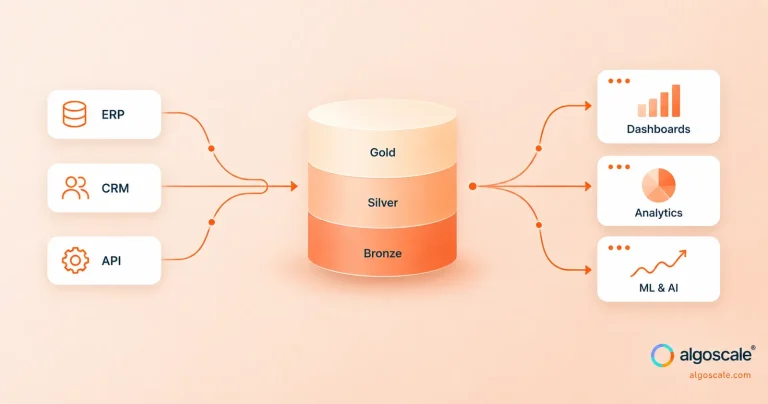
This process is full of bottlenecks, delays, and decisions made of yesterday’s insights. Cloud BI transforms this process completely. Here’s how it works:

Layer 1: Data Sources
You already have the data, but you just can’t reach it. Your CRM knows which deals closed last quarter. Your ERP knows what inventory moved. Your website knows which campaigns drove traffic. But none of these systems talk to each other. So, team members who need to get a clear picture waste their time reconciling and copying data from each source, rather than making decisions with it. Cloud BI begins working by eliminating these silos and automatically pulling everything together in one place.
Key Mistake To Avoid:
Missing a data audit to ensure that all your source systems have consistent data. Our experience with cloud BI implementations for enterprises start with this crucial step. For enterprises that miss this step, inconsistent date formats, duplicate customer records, different field names for different teams- all faithfully pass down the pipeline. Start with an audit before you select a tool.
Layer 2: ETL/ELT Pipeline
Any dashboard is as good as the data feeding it. Tools like Fivetran, Airbye, and dbt handle your ETL pipeline, where your raw data gets cleaned, standardized, and transformed into something analysts and executives can trust. This is the layer that determines the success of your analytics investments. For enterprises that get this right, accurate data backs their decisions. For most enterprises that don’t- decisions continue to be made on faulty data.
Key Mistake To Avoid:
This is the layer most cloud migration services fail to address, and migrations quietly fall apart, with teams not identifying what went wrong until debugging costs weeks. Prioritize documentation in this layer to avoid any black box in your pipelines- which translate to wrong and misleading numbers on your dashboard. For the 500+ ETL pipelines we have rectified, it all started with the same thing- data transformation logics written in a hurry, documentations are barely there, and teams feel their own dashboards have nothing to do with them in 6 months.
Layer 3: Cloud Data Warehouse
This is the layer that will finally put an end to the debate on numbers between your CFO and sales directors, or any teams quarrelling on the same report with different numbers- Finance calculates revenue one way, sales the other, both their logics are correct, but neither’s figures offer a trustworthy solution. A cloud data warehouse (think Amazon Redshift, BigQuery, and Snowflake) becomes the single source of ruth each team relies on- one definition, unified numbers, accessible in the same place.
Key Mistake To Avoid:
Poorly written queries that span billions of redundant rows. A cloud data warehouse bills you on compute, so every query means money. We’ve seen enterprise finance teams report compute costs higher than their proposed budgets because there was no query governance or cost monitoring in place.
Layer 4: BI and Analytics Layer
This is where your data converts from rows and columns to decisions. In the BI layer, tools like Looker and ThoughtSpot help you define what numbers siting in your data warehouse mean. This is he behind-the-scenes of self-serve analytics, reducing non-technical users’ reliance on specialists. Once the data team encodes definitions for how will churn get calculated, how to qualify a closed deal, and so on, and makes these available to everyone, sales managers and CFOs reviewing the same metric will function on the same logic.
Key Mistake To Avoid:
Inconsistent naming, overlapping metric definitions, and no governance to assign who can create new metrics creates more confusion than what you sought to eliminate. Cloud computing business intelligence cannot work without these considerations built into your semantic ETL/ELT layer by design.
Layer 5: Dashboards and End Users
This is the layer that leadership and key decision makers interact with. This is where Power BI consulting services (and also tools like Tableau, Looker, and Qlik)help you translate every other invisible layer before this one into live, interactive and visual reports that your team members can access from any browser or device in real time. Here’s where you shift from just reading old reports of what’s happened in your business to having actionable insights ready when they matter most.
Key Mistake To Avoid:
Dashboard proliferation- more dashboards than your team can understand, use, and rely on. We’ve been providing data visualization consulting services for more than a decade now. The one thing that badly limits enterprises’ control over their own data is missing to implement a dashboard governance policy that defines roles for who can build what and mandates regular audits of the data being used. We’ve brought back many enterprises from that graveyard of well-intended but barely used end-user layer with crystal clear dashboards, accurate reports, and standardized metrics teams can trust and rely on.
It goes without saying- to get your dashboards right (vs just pretty), you need all other layers underneath them to function right. Else, the whole data foundation is wrong.
See now, the delay in getting the report from the analyst was never in the data. It was in the architecture underneath it. It’s what cloud-based business intelligence changes by eliminating data silos, updating the live pipeline automatically, scheduling data cleaning to keep he ETL layer error free, and warehousing a single source of truth your organization agrees on.
Not Sure If Your Data Foundation Is Ready for Cloud BI?
Before you pick a tool or start a migration, it helps to know exactly what you’re working with. Our team can walk you through a quick architecture assessment — no jargon, no pressure.
Book a Free Assessment
Key Features of Cloud Business Intelligence Solutions
Discussed below are the essential features of cloud business intelligence solutions. We don’t just help you count features, we show you how each feature interacts within your enterprise ecosystem and impacts key business outcomes. This will help you make key decisions knowing exactly what they need-
1. Scalability and Elastic Infrastructure
The true mark of enterprise business intelligence really working the way it should is having the ability to run heavy analytical queries seamlessly during peak loads. Since Cloud BI eliminates hardware limitations, teams can scale compute and storage to match the demand and ensure they only pay for what they use.
2. Real-Time Data Access
Real-time data analytics are the result of cloud BI platforms directly connecting to cloud data warehouses. This eliminates the need for manual refreshes and ensures that dashboards reflect data as it gets updated.
3. Self-Service Analytics
Users can access data stored centrally by cloud business intelligence without any SQL or IT help. They can just access data on any browser via no-code drag-and-drop-interfaces and pre-built connectors that make analytics accessible to data analysts and non-technical users alike.
4. AI Capabilities
Business intelligence cloud solutions come with AI capabilities like natural language querying (users can direct their queries in natural human language), predictive modelling, and anomaly detection by directly cloud-native AI services, meaning they can run on ML models on warehouse data without needing any AI infrastructure to manage, provided the enterprise meets data maturity levels for all AI capabilities.
5. Advanced Data Visualization
Cloud business intelligence integrates real-time data from multiple sources into a unified view, made accessible through interactive dashboards. Beyond simple charts and graphs, it offers high-performance visuals like multi-dimensional charts, geospatial mapping, and custom dashboards tailored for every use case. Various data visualization tools like Power BI and Tableau make insights accessible and easy to understand for all users. You can explore our business intelligence dashboard examples to make data your most strategic asset and have it ready as and when you need it.
Must Read: What is Data Visualization?
What Are the Benefits of Cloud Data Analytics?
The shift to cloud-based BI was never about a technology upgrade. It was always about the liability the traditional alternative left enterprises with- waiting for weeks on end hat report what happened last month- and the cost of this delay which no enterprise can afford in 2026, that led to this shift.
A Gartner report says that 75% of organizations will shift from traditional BI to real-time analytics to eliminate the delay in decision-making.
So, when we discuss about the benefits of cloud-based BI, the conversation can never be about just features. It has to revolve around business impact that speed to insight, decision-making, and dynamic responding have.
1. Real-Time Data Access: Decisions Shift from Past Reporting to Future Intelligence
Traditional BI ran on batch processing, meaning leaders got yesterday’s reports day after. Modern cloud platforms process data continuously, so your dashboards for customer behaviour, sales performance, inventory levels, or any other use case offer today’s visibility now with live dashboards.
For SaaS companies, this means bad deployment detection and correction before customers find out, and for e-commerce and financial services, it means competitive differentiation with operational intelligence multiplying revenue opportunities by the hour with the domino effect of satisfied customers, proactive issue resolution, and hyper personalization approaches.
2. Cost Shift from CapEx to OpEx: Accessible BI for all Business Sizes
Mid-sized businesses could not even think of analytics with the prohibitive costs of traditional BI- the upfront investment of servers, licenses, implementation fees, IT specialist teams, and data centre space never made it to their budgets. Large enterprises needed to justify this expense as a capital project before building or getting returns from a capital dashboard.
A business intelligence cloud service transforms this into a subscription every business could afford, tailor, predict, and scale according to their needs. The costs for servers, IT, and space were completely eliminated as analytics became accessible and filled the gaps a 20-member data team could address for businesses who could afford them. With subscription-based BI, total cost of ownership reduced, and long capital budget approval cycles were out of the way to accelerate BI initiatives.
3. On-demand Scalability: Your Infra, Your Call!
Imagine running a Black Friday sale traffic on a traditional BI environment. Spontaneously doing it was impossible and if you wanted to do it this year, you’d have all the pre-requisites for it by the next year- capacity need identification, budget approval, hardware procurement and arrival, and IT configuration to make it work.
Pay-as-you-go analytics offer on-demand computing, meaning you can expand and contract your compute capacity based on demand- scale it up when needed, and pay for just that. No need to provision a year’s worth of hardware costs for a two-week festive demand.
4. AI and ML Enablement: Not Stitched Features, But Inherent Capabilities
In 2026, AI is embedded directly into the analytics layer, enabling users to interact with data through natural language queries and receive instant, intuitive insights. This has also shifted decision-making from reactive to proactive with automated anomaly detection and AI-generated recommendations.
Only cloud infrastructure can offer the necessary prerequisite for this- processing massive and continuously updated datasets. Cloud BI ensures data is always fresh and integrated, allowing AI models to deliver accurate, real-time insights at scale. According to Deloitte, organisations that have integrated AI into their BI workflows report a 35% reduction in time spent on routine reporting, freeing analytical capacity for higher-order work.
5. IoT Enablement: Cost Bracket to Exploding Data Volumes
IoT sensors, clickstreams, social signals, and real-time transactions generate far more data than any on-prem warehouse can handle cost-effectively. Manufacturers connecting sensor data from production lines can detect equipment degradation patterns before they escalate to complete failure. Logistics companies processing GPS and telemetry data from fleets can optimise routing in real time.
6. Remote Collaboration: Analytics Powering How Organizations Work Today
Remote or hybrid work being the norm means your product manager in Mumbai, finance lead in UK, and executives in New York access the same live dashboard simultaneously. Core architectures needed to adapt to not having everyone function from the same building.
Cloud BI is browser-native and device-agnostic by design. Collaboration features built into platforms like Power BI and Looker allow teams to annotate dashboards, share filtered views, and discuss data in context without switching tools. As such, browser–based business intelligence and Mobile BI removed the barrier of physical location from accessing analytics or collaborating. This means faster alignment of teams, no more working in silos, and an end to the debate on numbers.
7. Data Security at Enterprise Scale: Data Leaves Your Building, Not Your Control
Enterprises see data security and governance as their biggest concern when it comes to cloud business intelligence consulting services. But here’s the reality- I’s 2026, data leaving your building and shifting to the cloud undergoes more robust security measures than most enterprises spend on their entire IT operations.
From role-based access control, end-to-end encryption at rest and in transit, full audit trails, and compliance certifications including SOC 2, ISO 27001, GDPR, and HIPAA– data security and compliance in cloud gives enterprises complete control over their data, ensuring it is protected from unauthorized access and is always compliant-ready. Cloud BI service providers also help you implement robust data governance in cloud, so you have centralised control over who can access what data, including policy enforcement around data usage that on-premise systems cannot replicate with such efficiency.

Cloud BI Use Cases in the Real World: How Different Industries Are Using It
Discussed below are ways in which different industries are using business intelligence in the cloud to solve unique challenges and transition to data-driven decision making.
1. Retail and E-Commerce: Live Visibility into End-to-End Operations
Retail and e-commerce bear the biggest brunt of delays in decision-making with stiff competition, fierce battles for customer loyalty, high costs of customer acquisition, and thin profit margins. In this context, a one-day delay in sales data, inventory overstock sitting for weeks, and opportunities missed by the hour result in compromised competitive edge and bleeding revenue that plummets beyond repair very soon.
Retail data analytics offer live visibility across every layer of the operation. Be it store-level sales performance or SKU-level inventory to campaign attribution and customer lifetime value- retailers know exactly what’s happening when to prioritize, course correct and deliver when it matters. Additionally, demand forecasting models running on cloud data warehouses process point-of-sale data, weather patterns, social signals, and historical trends simultaneously- so retailers get restocking recommendations in real-time, not weekly- when the demand has shifted.
2. Financial Services: Real-Time Risk Monitoring and Fraud Detection
Financial institutions cannot afford to wait on delayed insights for fraud detection, credit risk assessment, regulatory compliance, and market volatility response because even a millisecond can translate to billions of dollars in losses. Their losses don’t just limit to missed revenue, but also regulatory penalties and reputational damage which may take years to fix again (if at all!).
Business intelligence on cloud gives real-time visibility into transaction data, customer behavior, and risk metrics across systems. Centralized data pipelines and live dashboards help banks to monitor anomalies, detect fraudulent patterns, and assess creditworthiness instantly. Advanced analytics models running on cloud infrastructure process high-volume transaction streams, enabling predictive risk scoring, AML compliance tracking, and dynamic portfolio management.
3. Healthcare: Data-Driven Patient Care and Operational Efficiency
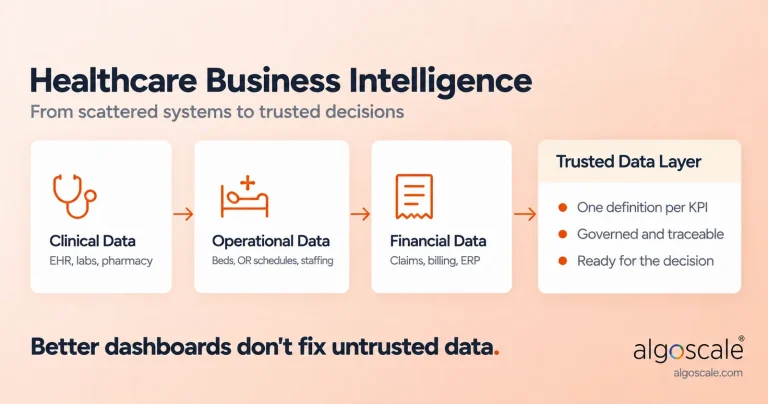
Healthcare providers constantly struggle to provide a care continuum with personalised and pre-emptive care because the data that makes this possible often lies scattered across multiple sources- electronic health records (EHR), diagnostics, billing systems, and patient monitoring devices.
Healthcare analytics cloud capabilities unify clinical data, operational metrics, and patient insights into dashboards accessible and updating in real time. Hospitals can track bed occupancy rates, treatment effectiveness, and patient flow while leveraging predictive analytics for early diagnosis and demand forecasting. This means better patient-centric care, empowered professionals to deliver better, streamlined compliance with secure data pipelines, and overall improved healthcare outcomes.

4. Manufacturing: Connected Intelligence
If there’s one industry that has always been data-rich yet lacking on data-driven decision making with underserved analytics, it is manufacturing. Production equipment sensors produce enormous amounts of operational data. Supply chains cover hundreds of suppliers interacting in several countries at once. Quality control leaves behind critical data points per batch. And yet, this data lives in silos, can be accessed only by engineers on the shop floor while supply chain managers, financial planners, and executives remain clueless.
Manufacturing cloud BI eliminates these data silos by offering a connecting layer between operational technology and informational technology. IoT sensor data from production lines feeds directly into cloud data platforms, where it is joined with procurement data, logistics feeds, and financial systems for a unified view of operations. Predictive maintenance models detect equipment degradation patterns before failure occurs. Supply chain analytics identify supplier risk signals weeks before a disruption becomes a crisis.
Also Read: Best Sites to Hire BI Developers
Hidden Cloud Business Intelligence Costs No One Tells You
As a cloud app solution provider that has helped enterprises in 25+ industries successfully migrate to the cloud leaving behind its complications, we can tell you that cloud BI failures leading to hidden costs do not surface immediately. You see them cripple your organization 6-18 months after go-live. Knowing what they are and how to avoid them can help you plan for a successful migration with the right partner:
1. Data Egress Fees
We’ve seen many enterprises calculate their cloud BI pricing by considering only what’s visible- warehouse subscription, BI tool licence, implementation fees. What their budgets and finance planners always miss is the egress fees- the fee cloud providers charge every time data leaves their infrastructure and goes to a different region, or feeds to a third-party analytics tool.
According to Gartner, egress fees can make up 10% to 15% of total cloud costs — and sometimes more depending on usage patterns. AWS, Azure, and Google Cloud charge around $0.085–$0.09 per GB for data transferred out, with certain companies paying as much as $20,000 per month before optimising their architecture, according to Google Cloud.

2. Vendor Lock In
One of the biggest hidden costs of cloud BI platforms come from vendor lock-in because cloud platforms are easy to adapt but equally difficult to leave. As your data pipelines, transformation logic, and dashboard infrastructure become tightly coupled to a single vendor’s ecosystem, leaving becomes increasingly difficult. High egress costs add to the complexity of switching between cloud providers.
IBM’s 2026 data trends report notes that many enterprises are trapped in the walled gardens created by leading hyperscalers.
3. Governance Debt
One of the biggest cost saving strategies for cloud BI is to have robust governance structures in place that balance the flexibility of creating new dashboards and data pipelines and ensure that this cloud benefit does not bite back. When any team can spin up a new data pipeline, define a new metric, or connect a new data source, an enterprise can easily reach a situation where they have sprawling and contradicting data no one trusts. We’ve seen many enterprises get no ROI from their BI investments because of this poor data quality.
.
4. Cloud Skills Gap
Cloud business intelligence isn’t a capability you can plug and play into your enterprise and expect it to work magically. Deploying it successfully requires data engineers who understand modern ELT pipelines, analytics engineers who can build reliable dbt models, BI developers who understand semantic layers, and data governance professionals who can enforce policy at scale. The hidden cost arises not just from hiring but also underutilizing the value of your cloud BI investment.

Best Cloud Based Business Intelligence Tools
Choosing a cloud BI tool needs your enterprise to look beyond its demo and analyse whether it meets your actual data architecture needs and how it can bring you insights, considering each tool’s implementation requirements have been met.
Discussed below are the top 3 tools for cloud-based BI:
1. Microsoft Power BI
Approximately over 5 million organizations deploy Power BI as their cloud BI tool. Any organization already running on Microsoft infrastructure naturally sees Power BI as their starting point as it offers integrations with the entire Microsoft ecosystem. Non-technical or business users prefer it for its drag-and-drop interface, while data analysts benefit from its underlying DAX language and data modelling capabilities that enable enterprise-grade analytics.
Pros:
- Competitive licensing cost within existing Microsoft agreements
- Regular feature releases including Copilot AI integration
- Mobile-native dashboards
- Broad connector library covering hundreds of data sources.
Cons:
- Steep learning curve for Power BI data models formula
- Poorly optimized data models and reports built without a semantic layer lead to error-prone decisions and scaling complexity.
Addressing the most common cause of Power BI implementation failure
If you are not seeing results from your Power BI investment, the culprit is not the tool itself. It’s the data foundation underneath. Most enterprises miss the necessary step of cleaning and transforming their data, establishing a robust governance and semantic layer, and standardizing definitions for calculations. This leads to utter chaos in results, and your data team begins to lose time in debugging DAX, rather than using it.
Algoscale’s Power BI consulting services are designed to address this state of chaos and transform it to clarity with scalable, cloud-ready BI architectures using Power BI alongside Azure Synapse and Data Lake, with governance frameworks, role-based access controls, and performance optimisation measures.
2. Tableau
Tableau is known for making complex data visually understandable. Its visualization capabilities span from geographic mapping to statistical overlays to custom calculated fields- ensuring enterprises can map each critical data point in specific contexts, and benefit from advanced analytics beyond simple charts.
Pros:
- Broad data source connectivity
- Industry-leading visualisation flexibility
- Deep integration with Salesforce CRM data.
Cons:
- Expensive licensing model.
- Tableau Server and Tableau Cloud configuration expertise is required to build production-grade Tableau deployments.
How to get maximum ROI from Tableau?
A clean, well-modelled data foundation is non-negotiable to make Tableau really deliver results for your enterprise. The tool subscription does not offer this. Enterprises make the common mistake of connecting Tableau to poor and unstructured source systems, and this leads them to unreliable dashboards no one trusts.
Algoscale’s Tableau consulting services offer cloud-native, fully automated data pipelines that ingest and transform data into analytics-ready formats before it reaches Tableau, ensuring your pipelines only feed on reliable data. We also offer active governance, dashboard auditing, and performance tuning as data volumes grow, so your Tableau investment is always ready to deliver.
3. Google Looker
Google Looker is a governance-first cloud-based business intelligence software platform built around LookML, a proprietary modelling language that encodes business logic, metric definitions, and data relationships in a centralised format. So, you define a metric on Looker once, and every dashboard across the organization works on the same metric.
Pros:
- Native Google Cloud integration with BigQuery
- Version control for data models through Git integration
- A governance model that scales to enterprise complexity.
Cons:
- Steep learning curve
- One of the most expensive licensing costs in the market.
- Integration overhead for organizations not running on Google Cloud infrastructure.
How to get the maximum from Looker?
A poorly architected LookML model with overlapping definitions, inconsistent dimension naming, or ungoverned metrics doubles the metric disagreement problem Looker is designed to solve. Algoscale’s governance and data architecture services alongside Looker implementations help you establish data ownership policies, lineage documentation, and access control frameworks, so your enterprise gets a trusted, single source of truth.
Not Sure Which Cloud BI Tool Actually Fits Your Setup?
Power BI, Tableau, and Looker all look great in a demo — but the right choice depends on your existing data infrastructure, team size, and how your data is structured today. Instead of guessing, let our team take a quick look and point you in the right direction.
Get a Free Tool Recommendation
Conclusion
Cloud business intelligence long ceased to be an optional investment. Its expansive application to solve all-round enterprise problems and role in equipping enterprises with the necessary capabilities of data-driven decision-making, scaling flexibility, and cost-efficiency at scale make it the core enterprise success driver in 2026. However, its benefits and direction towards these desired use cases completely depends on establishing the core data and architectural layers that make cloud BI securely work for your enterprise.
Algoscale meets you just there. Our certified cloud-migration experts and seasoned data engineering team support you before, during, and after moving business intelligence to the cloud, so the entire process neither wastes unnecessary resources nor complexities disrupt your existing operations. Get in touch with us to maximize the ROI of your cloud investments.
FAQs
1. What is the difference between cloud BI and a data warehouse?
They are different layers of the same architecture, not the same thing. A cloud data warehouse- Snowflake, BigQuery, Redshift, stores and processes your data. A cloud BI tool, Power BI, Tableau, Looker, sits on top of it and turns that data into dashboards and reports. Cloud BI platforms query data where it already lives without requiring you to copy or move it, keeping insights current and reducing pipeline complexity.
2. How much does cloud BI cost for a mid-sized business?
Entry-level costs range from $10–$30 per user per month for tools like Power BI and Looker Studio. Enterprise platforms like Tableau, Looker, Snowflake typically amount to $500–$3,000 per month depending on users and data volume. The hidden variable most businesses miss is that cloud costs can be slashed by up to 40% with proper architecture and governance, making implementation quality as important as tool selection in determining total spend.
3. How long does it take to migrate from traditional BI to cloud BI?
Migration follows a structured process: assess existing infrastructure, select a cloud BI platform aligned to your data architecture, extract and clean data using ETL or ELT pipelines, then train users and establish governance policies. For a mid-sized organisation with moderate data complexity, a phased migration typically takes three to six months. Organisations attempting full lift-and-shift migrations without this necessary structure naturally run into roadblocks that can prolong the migration.