

Artificial intelligence initiatives fail at a higher rate than the industry typically acknowledges, and data problems are the most common reason. Not model architecture problems. Not compute infrastructure problems. Data problems: inconsistent feature definitions across training and inference, training datasets contaminated by upstream data quality failures, model retraining pipelines that fail silently, and feature values computed differently at training time versus prediction time. The organizations that successfully deploy AI at scale share one characteristic: they built a serious, governed data foundation before focusing on models. That foundation is a modern data lakehouse.
A data lakehouse is uniquely suited as the data foundation for AI and machine learning workloads because it brings together the storage scale, data variety, schema flexibility, and governance controls that AI development requires. Unlike a data warehouse, which constrains data to rigid structured schemas, the lakehouse stores raw and processed data in open formats that data scientists can access directly with Python, Spark, or SQL. Unlike an ungoverned cloud data lake, the lakehouse maintains the data quality, versioning, and lineage controls that production AI systems depend on for reliability, auditability, and regulatory defensibility.
Why AI Workloads Have Fundamentally Different Data Requirements
Machine learning models learn statistical patterns from data, which means the quality, volume, diversity, and temporal consistency of your training data determines the quality of your model predictions. A system trained on biased, incomplete, or stale data will produce unreliable predictions regardless of its architectural sophistication. In regulated industries like finance and healthcare, the requirement for explainability and reproducibility adds another layer of complexity: you need to reproduce the exact dataset on which any given model version was trained, potentially years after the fact, to demonstrate compliance with model governance requirements.
Feature engineering, the process of transforming raw data into the numerical representations that ML algorithms consume, is where the majority of data engineering effort in AI projects is spent. Ensuring that feature transformations are computed consistently between training and inference, a problem known as training-serving skew, is one of the most persistent challenges in production machine learning. A lakehouse architecture that stores both raw event data and computed features in the same governed platform, accessible to both training pipelines and inference endpoints, directly addresses this problem by eliminating the data transformation logic duplication that causes skew.
Structuring Your Lakehouse for AI and ML Workloads
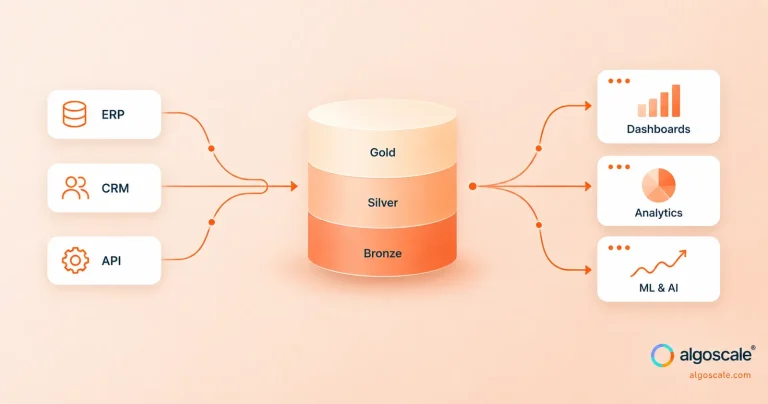
An AI-optimized data lakehouse extends the standard bronze, silver, and gold zone model to include a dedicated feature layer. The bronze zone holds raw, immutable event and transaction data exactly as received from source systems. The silver zone contains cleaned, deduplicated, and enriched records with consistent data types and validated schemas. The gold zone holds business-ready aggregates and entity-level summaries used for reporting and analytics. The feature layer, sometimes called a feature store, contains pre-computed ML features stored in the same cloud data lake format but organized around the entities and time windows that model training and inference consume.
Storing ML features in the lakehouse rather than in a separate database-backed feature store offers several advantages that compound as your AI program matures. Features stored as Iceberg or Delta Lake tables benefit from the same versioning, time travel, and data lineage tracking that your other lakehouse data assets enjoy. A data scientist who needs to understand why a model made a particular prediction can query the historical snapshot of the feature table as of the inference timestamp and retrieve the exact feature values that existed at that moment. This point-in-time correctness capability is increasingly required for AI governance audits and model validation processes in regulated industries.
Data Quality as an AI Production Reliability Concern
Data quality in a lakehouse used for AI is not solely a data governance concern. It is a production reliability concern for every AI system that consumes data from the platform. A model retrained on data containing null values in features where no nulls existed during initial training, or trained on a dataset that silently expanded to include a new data source with different statistical characteristics, can degrade in ways that are very difficult to detect until significant business harm has occurred. Automated data quality validation is therefore a production infrastructure requirement for AI, not an optional best practice.
Great Expectations, Apache Griffin, and Soda are data quality frameworks that can be embedded directly into your lakehouse data pipelines to validate data at every transformation stage and halt or quarantine data that fails quality thresholds before it reaches the feature layer. On an AWS data lakehouse, AWS Glue Data Quality provides a managed option for embedding validation rules in Glue ETL jobs and Glue Data Catalog workflows. On an Azure data lakehouse, Azure Monitor combined with custom data quality assertions in Azure Data Factory pipelines serves the same function. Logging data quality metrics to your lakehouse alongside the data itself enables trend analysis that surfaces gradual data drift before it becomes a model performance incident.
Training Data Versioning and Reproducibility
Apache Iceberg’s snapshot-based time travel allows you to query any version of your training dataset as it existed at any historical point in time. Combined with an experiment tracking system such as MLflow that records which data snapshot was used to train each model version, you can fully reconstruct the training environment for any model version months or years after the original training run. This reproducibility capability is not just good engineering practice. In financial services and healthcare, it is increasingly a regulatory requirement for AI systems that make consequential decisions about credit, clinical care, or insurance coverage.
Table 1: AI Workload Requirements vs. Data Platform Capability Mapping
| AI Requirement | Data Lakehouse (Iceberg or Delta) | Cloud Data Warehouse | Unstructured Cloud Data Lake |
| Large-scale training data access | Native Spark and Python reads from S3 or ADLS | Export required, slow at petabyte scale | Good access but no governance controls |
| Feature versioning and time travel | Native snapshots in Iceberg and Delta | Limited or entirely unavailable | Not available without additional tooling |
| Schema flexibility for experiments | Add or rename columns without data rewrite | Schema migration required and often slow | No schema enforcement by default |
| Point-in-time correct feature retrieval | Native snapshot queries at any timestamp | Complex to implement and maintain | Not natively supported |
| Data lineage for model governance | Built-in via open catalog metadata | Limited to SQL-level lineage only | Not available without additional tools |
| Streaming feature updates | Flink and Spark Structured Streaming native | Micro-batch load patterns only | Manual file drops only |
| ML framework compatibility | Spark, pandas, PyTorch, TensorFlow native | Requires JDBC export or file download | Direct file access, no type safety |
| Storage cost at 100TB plus scale | Very low (S3 or ADLS object pricing) | High (warehouse compute plus storage) | Low (but no governance overhead included) |
MLOps Integration: Connecting the Lakehouse to the Model Lifecycle
A scalable data foundation for AI does not stop at storage and feature engineering. It must integrate seamlessly with the broader MLOps lifecycle including experiment tracking, model registry management, continuous training pipelines, model deployment, and ongoing monitoring. MLflow integrates natively with both Databricks Delta Lake and open Iceberg-based lakehouses to provide experiment tracking that links training runs directly to the data artifacts they consumed. Model versions in the MLflow Model Registry can be annotated with the Iceberg snapshot ID of the training dataset, creating a complete, queryable lineage chain from raw source data through feature transformation to the deployed model version.
Continuous training pipelines that automatically retrain models when data drift is detected or when sufficient new training data has accumulated represent the operational maturity level most AI programs are working toward. On an AWS data lakehouse, Amazon SageMaker Pipelines can trigger retraining workflows based on S3 event notifications, scheduled intervals, or drift detection thresholds from SageMaker Model Monitor. On an Azure data lakehouse, Azure Machine Learning Pipelines serve the same function with native integration to ADLS Gen2 and Azure Synapse for data access and feature retrieval. Building these pipelines on top of a governed, versioned lakehouse ensures that every model retraining event is traceable, reproducible, and can be rolled back if the new model version underperforms.
Table 2: Storage Format Comparison for ML Training and Feature Engineering Workloads
| Storage Format | Read Speed (Spark ML) | Schema Flexibility | Time Travel Support | Best ML Use Case |
| Plain Parquet on S3 or ADLS | Excellent columnar performance | Manual schema migration required | Not available | Static datasets and simple one-off training |
| Apache Iceberg | Excellent with manifest pruning | Native evolution, no rewrite needed | Yes, snapshot-based | Governed feature stores and audit-ready AI |
| Delta Lake | Excellent with Z-ordering | Native with column mapping | Yes, version and timestamp | Databricks-centric and MLflow-integrated workflows |
| Apache Hudi MOR | Good with merge overhead at read | Supported with limitations | Yes, commit timeline | High-frequency updated feature tables |
| CSV or JSON files | Poor, no columnar optimization | Flexible but no enforcement | Not available | Prototyping and small-scale experiments only |
| TFRecord or HDF5 | Framework-specific throughput | Fixed schema by design | Not available | Deep learning with image and audio data |
Governance and Compliance for AI Training Data
AI governance is emerging as a distinct discipline within data management with its own regulatory context. The EU AI Act, the CFPB’s guidance on algorithmic decision-making in lending, and HIPAA’s requirements for de-identification in ML training datasets all create legal obligations that your data foundation must be designed to satisfy. Column-level masking in a governed data lakehouse ensures that ML training data does not expose PII or PHI directly to data scientists who do not require access to raw sensitive values to build accurate models. Synthetic data generation as an alternative to real patient or customer data is increasingly viable and works naturally with a lakehouse-based training data pipeline.
Automated sensitive data discovery through Amazon Macie or Microsoft Purview continuously identifies new datasets that require governance controls before they can be included in model training pipelines. Data lineage tracking documents where each training dataset originated, what transformations were applied, and which models consumed it. This documentation supports the model cards and data sheets that AI governance frameworks and emerging regulations increasingly require organizations to maintain for any AI system making consequential decisions. The data lakehouse, when governed correctly, provides the infrastructure backbone for all of these AI governance requirements without needing a separate purpose-built AI governance platform.
Build an AI-Ready Data Foundation with AlgoScale
Successful AI initiatives depend on more than advanced models; they require a scalable, governed, and reliable data foundation. Designing an AI-ready data platform involves integrating data from multiple sources, implementing robust data quality frameworks, enabling feature engineering, and establishing governance that supports both compliance and long-term scalability.
AlgoScale helps organizations build modern cloud-native data lakehouse architectures that power enterprise AI and machine learning initiatives. Our team designs scalable data pipelines, implements feature engineering workflows, integrates MLOps processes, and establishes governance frameworks that ensure trusted, high-quality data is available throughout the AI lifecycle. Whether you’re developing predictive analytics, generative AI applications, or enterprise machine learning solutions, we help create the data foundation needed for reliable and production-ready AI systems.
If you’re planning to modernize your data infrastructure or accelerate AI adoption, connect with AlgoScale to build a future-ready data platform that supports innovation, scalability, and long-term business growth.