

Every organization sitting on years of transactional data eventually hits the same wall. The old data warehouse that once felt cutting edge starts to groan under the weight of new data sources, real time reporting demands, and AI driven analytics that it was never designed to support. This is the exact moment when businesses start seriously evaluating data warehouse migration, and increasingly, that evaluation is leading them straight to Microsoft Fabric.
At Algoscale, we work with companies across the United States who are moving away from legacy platforms like on premise SQL Server warehouses, Teradata, or aging Synapse deployments. Almost every conversation we have today includes a question about Microsoft Fabric, and for good reason. It is quickly becoming the platform of choice for teams that want a unified, AI ready, and cost efficient home for their data.
This blog breaks down why Microsoft Fabric is reshaping how businesses think about data warehouse modernization, what makes it different from traditional approaches, and how a well planned data warehouse migration can set your organization up for the next decade of analytics, not just the next fiscal year.
The Growing Need for Modern Data Warehouse Migration
The reason this topic deserves attention in 2026 is simple. Data volumes are growing faster than most legacy systems can handle, and the tools businesses use to make decisions have changed dramatically. Five years ago, a nightly batch report was good enough. Today, teams expect near real time dashboards, self service analytics, and AI copilots that can answer questions directly from business data.
Traditional data warehouses were built for a different era of computing. They were designed around fixed capacity, rigid ETL pipelines, and siloed storage that kept structured and unstructured data apart. Microsoft Fabric addresses these gaps directly by bringing together data engineering, data warehousing, real time analytics, and business intelligence into a single software as a service platform. That is why so many IT leaders are no longer asking whether to modernize, but how quickly they can complete their data warehouse migration without disrupting daily operations.
What Is Microsoft Fabric
Microsoft Fabric is an end to end analytics platform that unifies several previously separate Microsoft tools, including Power BI, Azure Synapse Analytics, Azure Data Factory, and Azure Data Explorer, under one roof. Instead of stitching together multiple services and managing separate billing, security models, and storage layers, teams get a single environment built around an open data lake foundation called OneLake.
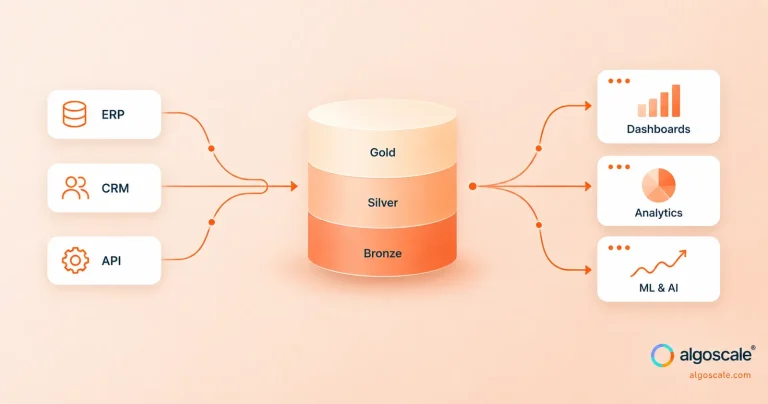
This matters enormously for anyone planning a data warehouse cloud migration. Rather than migrating data into yet another isolated system, Fabric lets organizations land their data once in OneLake and then use it across every workload, from data engineering to machine learning to executive reporting, without duplicating storage or building redundant pipelines.
The Real Problems With Traditional Data Warehouses
Before looking at what makes Fabric different, it helps to understand what organizations are actually trying to escape. Most legacy data warehouse environments share a common set of pain points:
Rigid scaling. Compute and storage are often bundled together, so scaling for a busy quarter means paying for capacity you do not need the rest of the year.
Data silos. Structured data lives in the warehouse, unstructured data lives in a separate data lake, and getting the two to talk to each other requires custom pipelines that are expensive to build and maintain.
Slow time to insight. ETL jobs that run overnight mean business users are often looking at yesterday’s numbers, not today’s.
Governance gaps. As more tools get bolted on over the years, tracking data lineage, access controls, and compliance becomes a patchwork exercise rather than a built in capability.
High total cost of ownership. Licensing, infrastructure, and the specialized staff needed to keep legacy systems running add up quickly, especially when multiple platforms need to be maintained side by side.
These are exactly the problems that a thoughtfully executed data warehouse migration to Microsoft Fabric is designed to solve.
Traditional Data Warehouse vs Microsoft Fabric: A Side by Side Comparison

| Capability | Traditional Data Warehouse | Microsoft Fabric |
| Storage model | Structured data stored separately from unstructured data, often in different systems | Unified storage through OneLake, supporting structured and unstructured data together |
| Compute and storage | Usually bundled, making scaling costly and inflexible | Decoupled compute and storage, allowing independent scaling |
| Tool integration | Multiple standalone tools for ETL, BI, and analytics that require manual integration | Native integration of data engineering, warehousing, real time analytics, and Power BI in one platform |
| Data latency | Batch based, often refreshed overnight | Near real time analytics through Fabric’s real time intelligence workloads |
| Governance | Fragmented across systems, harder to enforce consistently | Centralized governance and lineage tracking across the entire platform |
| AI readiness | Requires separate integration work to connect AI and machine learning tools | Built in support for Copilot and AI driven analytics across workloads |
| Licensing model | Multiple licenses across separate products | Single, consumption based capacity model |
| Best suited for | Organizations with stable, predictable, structured reporting needs | Organizations modernizing for AI, self service analytics, and scalable growth |
This table alone explains why so many CIOs and data leaders are prioritizing Microsoft Fabric services in their 2026 and 2027 technology roadmaps. It is not just a warehouse upgrade, it is a shift in how the entire data stack is organized.
How Fabric Simplifies Data Warehouse Cloud Migration

One of the biggest hesitations companies have around data warehouse migration is fear of disruption. Nobody wants to spend six months migrating data only to find that reports break, pipelines fail, or the finance team cannot close the books on time. Microsoft Fabric was built with this exact concern in mind.
Unified OneLake storage. Because Fabric stores all data in an open Delta Parquet format inside OneLake, organizations do not need to duplicate data across separate warehouse and lake environments. This single copy principle dramatically reduces the complexity of a data warehouse to data lake migration, since data engineers are not maintaining two versions of the truth.
Shortcut based ingestion. Fabric allows teams to create shortcuts to data sitting in Azure Data Lake Storage, Amazon S3, or Google Cloud Storage without physically moving it first. This means a phased migration is possible, where teams can start querying existing data through Fabric before every workload has been fully migrated.
Familiar SQL based warehousing. For teams coming from SQL Server, Synapse, or Teradata, Fabric’s Warehouse experience uses familiar T-SQL, which reduces the retraining burden on existing data teams during data migration in data warehouse projects.
Built in pipelines and Dataflows. Fabric includes low code and pro code options for building ETL and ELT pipelines, so migration teams are not forced to rebuild every transformation from scratch using unfamiliar tooling.
Native monitoring and governance. Microsoft Purview integration gives migration teams visibility into data lineage and quality from day one, which is critical when regulatory compliance is part of the migration scope.
Understanding Microsoft Azure Fabric in the Broader Azure Ecosystem
It is worth clarifying a common point of confusion. While people sometimes refer to it as Microsoft Azure Fabric, Fabric is technically a SaaS platform that sits within the Azure ecosystem rather than a traditional Azure infrastructure service. It draws on Azure’s underlying compute and storage but is managed and licensed differently, with a simplified capacity based pricing model rather than pay per resource billing.
For organizations already invested in Azure Active Directory, Azure Synapse, or Power BI, this integration is a major advantage. Identity management, security policies, and existing BI assets can often be carried over with far less rework than a migration to a completely new cloud provider would require. This is one of the practical reasons Fabric has become the default recommendation for Azure centric enterprises pursuing data warehouse modernization.
Data Warehouse to Data Lake Migration Made Practical

Historically, moving from a data warehouse to a data lake meant accepting a tradeoff. Data lakes offered flexibility and lower storage costs but sacrificed the structure, performance, and governance that warehouses provided. Fabric’s Lakehouse architecture removes much of that tradeoff by combining both models.
With Fabric, a data warehouse to data lake migration does not mean giving up SQL based reporting or strict schema enforcement. Instead, teams get the best of both worlds: raw and curated data can sit together in OneLake, while the Warehouse and Lakehouse experiences both read from the same underlying storage. Analysts can continue running familiar SQL queries, while data scientists can work directly with the same data using Spark notebooks, all without separate copies or brittle syncing jobs.
Comparing Migration Approaches: Lift and Shift vs Fabric Native Modernization
Not every data warehouse migration should follow the same playbook. The right approach depends on the timeline, budget, and how much of the existing architecture a business wants to preserve.
| Factor | Lift and Shift Migration | Fabric Native Modernization |
| Approach | Move existing schema and workloads to the cloud with minimal redesign | Rebuild pipelines and storage using OneLake, Lakehouse, and Fabric native tools |
| Speed to migrate | Generally faster initial migration | Takes longer upfront due to redesign work |
| Long term cost | Often carries forward inefficiencies from the old system | Lower long term cost due to unified storage and consumption based pricing |
| Scalability | Limited by the constraints of the original architecture | Built for elastic scaling as data volume and users grow |
| AI and real time readiness | Requires additional work later to enable AI and streaming | AI and real time analytics supported natively from the start |
| Risk profile | Lower short term risk, higher long term technical debt | Higher short term effort, significantly lower long term technical debt |
| Best fit | Organizations needing a fast exit from an expiring contract or unsupported system | Organizations planning for multi year growth and AI adoption |
Most organizations we work with at Algoscale end up choosing a hybrid path. They lift and shift the most business critical workloads first to reduce immediate risk, then progressively modernize using Fabric native capabilities once the initial migration has stabilized. This phased strategy tends to deliver the fastest time to value while still setting the foundation for long term data warehouse modernization.
Key Considerations for Data Migration in a Data Warehouse Project

Regardless of platform, successful data migration in data warehouse initiatives share a few common success factors that are worth calling out.
Start with a data audit. Before any migration begins, teams need a clear inventory of tables, dependencies, and reporting workloads that rely on the existing warehouse. Skipping this step is the single biggest cause of migration delays.
Prioritize by business impact. Not every table and report needs to move on day one. Ranking workloads by business criticality allows teams to migrate incrementally and validate results along the way.
Plan for parallel running. Running the old and new systems side by side for a defined period allows teams to compare outputs and catch discrepancies before fully decommissioning legacy infrastructure.
Invest in governance from the start. Retrofitting data governance after a migration is far harder than building it in from day one, especially in regulated industries like finance and healthcare.
Bring in migration specialists. Working with experienced data warehouse migration services reduces the risk of costly missteps, particularly around performance tuning, cost optimization, and change management for business users.
Why Businesses Are Partnering With Migration Specialists Like Algoscale
Microsoft Fabric is powerful, but powerful platforms still require thoughtful implementation to deliver real value. We have seen organizations attempt self led migrations that stall out because internal teams are stretched thin trying to keep daily operations running while also learning a new platform.
This is where dedicated data warehouse migration services make a measurable difference. At Algoscale, our approach typically includes a discovery phase to map existing data architecture, a phased migration plan tailored to business priorities, hands-on implementation using Fabric’s native tools, and post migration support to fine tune performance and cost. We have found that businesses who partner with a specialized team complete their migrations faster and with far fewer surprises than those who attempt a fully in house transition.
Looking Ahead: Data Warehouses in an AI First World
The shift toward Microsoft Fabric is really part of a bigger story. Data warehouses are no longer just reporting repositories, they are becoming the foundation for AI copilots, predictive analytics, and automated decision making. A platform that keeps structured and unstructured data separate, or that cannot support real time and AI workloads natively, will increasingly hold businesses back rather than support them.
Microsoft Fabric was built for this shift. Its unified storage layer, native AI integration, and simplified governance model make it a genuinely future oriented choice for organizations planning their next phase of data warehouse modernization. Companies that treat their data warehouse migration as a one time infrastructure project miss the bigger opportunity. The organizations that treat it as the foundation for AI readiness are the ones that will be best positioned over the next several years.
Accelerating Your Data Modernization Strategy
Choosing to modernize a data warehouse is never just a technical decision, it is a strategic one. Microsoft Fabric gives organizations a genuine path forward, combining the reliability of traditional warehousing with the flexibility of a modern data lake and the intelligence of built in AI tools. Whether your organization is exploring a full data warehouse cloud migration or simply trying to reduce the operational burden of a legacy system, Fabric offers a compelling and well supported destination.
If your team is evaluating Microsoft Fabric services or planning a broader data warehouse migration, Algoscale can help you assess your current environment, build a realistic roadmap, and execute the transition with minimal disruption to your business. The organizations that modernize now will be the ones best equipped to compete in an increasingly AI driven data landscape.