

If your organization is drowning in data but starving for insights, you’re not alone. Most enterprises today collect data from a dozen sources – CRMs, ERPs, IoT devices, marketing platforms, application logs – and struggle to bring it together in a way that’s usable, governed, and cost-efficient. This is exactly the problem an architected AWS data lake solves.
Amazon Web Services offers one of the most mature, flexible ecosystems for building data lakes at scale. But “using AWS” and “using AWS correctly” are two very different things – an unarchitected data lake quickly turns into a “data swamp”: an unstructured, ungoverned dumping ground that’s expensive to maintain and impossible to trust.
In this guide, we’ll walk through what an AWS data lake architecture looks like, the core AWS services involved, a step-by-step setup process, and the best practices that separate a scalable, secure data lake from a costly mess. If you’re evaluating whether to build this in-house or bring in a partner, our Data Lake Services team at Algoscale has implemented this architecture across industries including retail, healthcare, and BFSI.
What Is an AWS Data Lake?
A data lake is a repository that lets you store structured, semi-structured, and unstructured data at any scale in its raw or native format until it’s needed for processing or analytics. Unlike a data warehouse – which requires data to be structured and cleaned before it’s loaded (schema-on-write) – a data lake uses a schema-on-read approach, meaning you define structure when you query the data.
On AWS, this typically means using Amazon S3 as the storage layer, combined with services like AWS Glue, Lake Formation, Athena, EMR, and Redshift Spectrum to catalog, govern, process, and query that data.
If you’re still deciding between the two models for your use case, our earlier breakdown on data lake vs. data warehouse: which architecture is right for your business goes deeper into that decision.
For a primer on the fundamentals, see what is a data lake architecture: benefits and use cases explained.
Core Components of AWS Data Lake Architecture
A production-grade AWS data lake is built from purpose-specific services working together. Here’s what each layer typically looks like:
1. Storage Layer: Amazon S3
S3 is the backbone of every AWS data lake. It offers unlimited, durable, low-cost object storage and integrates natively with almost every other AWS analytics service. Data lakes on S3 are usually organized into zones:
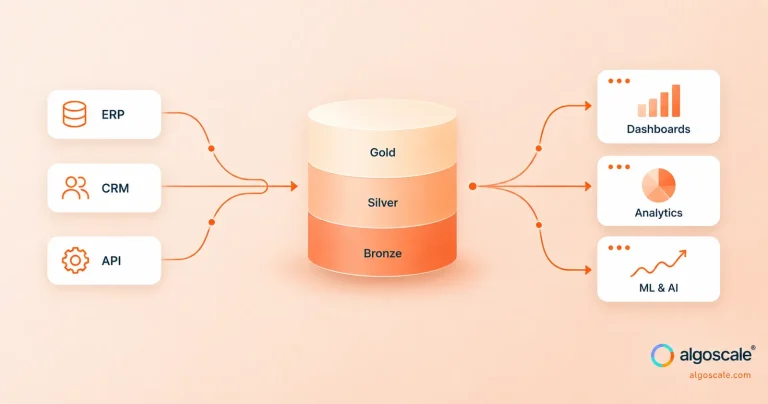
● Raw zone: Unprocessed data exactly as ingested from source systems
● Staging/cleansed zone: Data after initial validation, deduplication, and format standardization
● Curated/refined zone: Business-ready, transformed data optimized for consumption by BI tools or ML models
2. Ingestion Layer
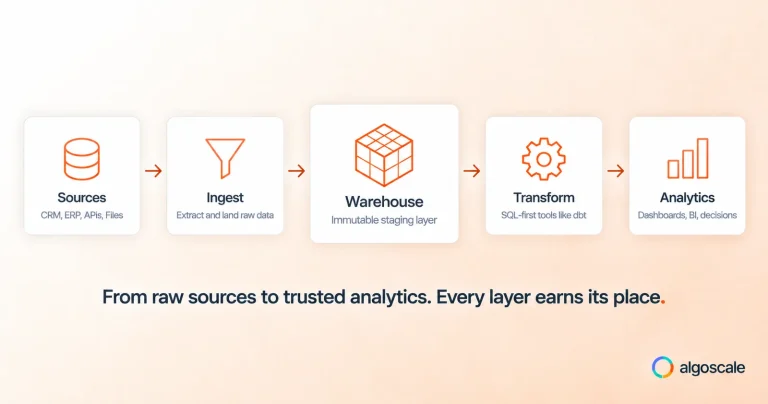
Data needs to get into S3 from wherever it originates. Depending on the source and latency requirements, this could involve:
● AWS Glue or AWS Data Pipeline for batch ingestion from databases and SaaS apps
● Amazon Kinesis Data Streams / Firehose for near-real-time streaming data
● AWS DataSync or Database Migration Service (DMS) for large-scale, one-time or ongoing migrations from on-prem systems
3. Governance: AWS Glue Data Catalog and Lake Formation
Once data lands in S3, it needs metadata so it can actually be found and queried. AWS Glue Crawlers scan your S3 buckets and automatically populate the Glue Data Catalog with table definitions and schemas.
AWS Lake Formation sits on top of this to centralize permissions, apply fine-grained access control (down to the row and column level), and manage data lake governance from a single console – critical for organizations in regulated industries.
4. Processing & Transformation
Raw data rarely arrives analytics-ready. This is where transformation happens:
● AWS Glue ETL jobs (Spark-based, serverless) for scheduled transformations
● Amazon EMR for large-scale, complex big-data processing using Spark, Hive, or Presto
● AWS Lambda for lightweight, event-driven transformations
5. Query & Analytics Layer
This is where the data lake starts delivering value to end users:
● Amazon Athena: Serverless, pay-per-query SQL against S3 data
● Amazon Redshift Spectrum: Query S3 data alongside your Redshift warehouse tables without moving data
● Amazon QuickSight: BI and visualization layer on top of Athena or Redshift
6. Security Layer
Security isn’t an add-on – it should be woven through every layer:
● IAM policies for granular access control
● S3 bucket policies and encryption (SSE-S3, SSE-KMS)
● Lake Formation permissions for table/column-level governance
● AWS CloudTrail for auditing and compliance logging
Step-by-Step: Setting Up Your AWS Data Lake Architecture
Step 1: Define Your Data Strategy First
Before touching the AWS console, map out what data sources you’re bringing in, who needs access to what, latency requirements (batch vs. real-time), and compliance obligations (HIPAA, GDPR, etc.). Skipping this step is the biggest reason data lake projects fail.
Step 2: Design Your S3 Bucket and Zone Structure
Set up buckets or prefixes for raw, staging, and curated zones. Use a well-thought-out naming and partitioning convention (e.g., partitioning by year/month/day/source). This dramatically affects query performance and cost later.
Step 3: Set Up Ingestion Pipelines
Configure Glue jobs, Kinesis streams, or DMS tasks depending on your source systems. Automate as much as possible using AWS Step Functions or Glue workflows to reduce manual intervention.
Step 4: Catalog Your Data
Run Glue Crawlers against each zone so your data is automatically discoverable and queryable through the Glue Data Catalog. Keep crawler schedules aligned with how your data actually changes to avoid unnecessary costs.
Step 5: Implement Lake Formation Governance
Set up Lake Formation permissions before opening the lake to teams. Define data access at the granularity your compliance requirements demand – it’s much harder to retrofit governance after the fact.
Step 6: Build the Transformation Pipeline
Use Glue ETL or EMR to move data from raw to staging to curated, applying business logic, deduplication, and quality checks along the way. This is also where you’d integrate data quality frameworks like AWS Glue Data Quality or Deequ.
Step 7: Enable Query and BI Access
Connect Athena and QuickSight (or your existing BI tool) so business users can start querying curated data without needing engineering support for every request.
Step 8: Monitor, Optimize, and Scale
Set up CloudWatch dashboards for pipeline health, S3 storage-class lifecycle policies (transitioning data to S3 Glacier), and regular cost reviews. A data lake isn’t a “set it and forget it” system – it needs ongoing tuning.
Best Practices for a Scalable AWS Data Lake
● Partition intelligently. Poor partitioning is the most common cause of slow, expensive Athena queries.
● Use columnar formats. Store curated data in Parquet or ORC instead of CSV/JSON – it drastically reduces query cost and improves speed.
● Apply lifecycle policies. Automatically move infrequently accessed data to S3 Glacier or Glacier Deep Archive to cut storage costs.
● Enforce schema evolution rules. Use the Glue Schema Registry to prevent breaking changes from downstream source updates.
● Separate compute from storage. This is one of AWS’s core advantages over traditional warehouses – use it by keeping processing engines decoupled from your S3 storage layer.
● Automate governance early. Don’t wait until you have a compliance audit to think about Lake Formation permissions.
For a look at hardening your architecture against the mistakes above, see our post on data lakehouse security best practices for cloud-native organizations.
Common Mistakes to Avoid
● Skipping the metadata layer. Data without a catalog is an expensive junk drawer.
● Ignoring cost monitoring. S3 storage is cheap; poorly optimized Athena queries and idle EMR clusters add up fast.
● Treating the raw zone as the only zone. Business users querying unvalidated data leads to bad decisions.
● Underinvesting in security from day one. Retrofitting fine-grained access control is significantly harder than building it in from the start.
● Building without an ownership model. Every zone and pipeline needs a clear data owner, or governance quietly falls apart.
Why Work With a Data Lake Implementation Partner
Building an AWS data lake architecture that’s genuinely scalable, secure, and cost-efficient takes more than spinning up an S3 bucket and a few Glue jobs. It requires experience across data engineering, governance, and cloud cost optimization simultaneously. At Algoscale, our Data Lake Services team has deployed AWS-native data lake architectures for enterprises handling everything from real-time IoT telemetry to multi-source retail analytics – helping teams cut query costs, accelerate time-to-insight, and stay audit-ready.
If you’re planning your data infrastructure investment, explore how we approach modern data engineering and analytics end-to-end from strategy through deployment.
You might also find our related post, top business benefits of implementing a data lake strategy.
For a look at how AWS fits into an enterprise data stack, see the AWS warehousing toolkit for enterprises.
Why Algoscale
● Pre-built accelerators. We don’t start every engagement from a blank slate – proprietary accelerators built from prior implementations speed up common data source integration and analytics patterns.
● Faster time to value. When focusing on core data sources and initial analytics use cases, our accelerators usually cut development time down to four weeks instead of the several months it often takes to build from scratch.
● Built on a scalable framework. Our way of working uses a scale-ready framework, so the architecture created for your first use case can expand smoothly as data grows and teams increase, instead of needing to start over.
● Microsoft Solution Partner for Data & AI. Algoscale is a Microsoft Solution Partner for Data & AI, with expertise in setting up Microsoft Fabric as a modern data warehouse.
Frequently Asked Questions
1. What’s the difference between an AWS data lake and Amazon Redshift?
Redshift is a managed data warehouse built for high-performance analytical queries on clean data. A data lake, typically built on S3, holds data of any structure at large scale and is more flexible across data types. Many setups use both together – S3 as the lake, Redshift Spectrum querying across both.
2. How much does it cost to build a data lake on AWS?
Costs vary significantly depending on data size, ingestion frequency, and query patterns. S3 storage itself is cheap (often under $0.023/GB/month for standard storage). The main costs are usually Glue ETL job hours, EMR cluster time, and inefficient Athena queries – all of which can be optimized with the right setup.
3. Do I need Lake Formation if I’m already using IAM for security?
he structured performance of a warehouse, often using Redshift Spectrum or similar query across both.
5. How long does it usually take to implement an AWS data lake?
A basic proof-of-concept can be built in a week, but a production-ready, governed setup with proper ingestion, cataloging, and security usually takes two to four months depending on the number of data sources and compliance needs.
6. Is AWS the best option, or should we consider Azure or GCP for our data lake?
AWS generally has the most complete and mature set of native data lake tools (S3, Glue, Lake Formation, Athena), making it a strong choice for many companies. But the best choice depends on your current cloud footprint, team skills, and specific needs.