

Cloud-native digital transformation is the shift from on-premises infrastructure and legacy systems to architectures that are built for the cloud from the start, elastic, API-driven, managed, and continuously updated by the cloud provider rather than maintained by an internal operations team. For US enterprises, this transformation has accelerated significantly over the past several years, driven by the economics of cloud computing, the availability of managed data services, and the pressure to access AI capabilities that require cloud-scale infrastructure to run at all.
But cloud-native transformation is not primarily a technology migration. It is a change in how the organisation uses data to operate and compete. The technical migration moving workloads from on-premises servers to Azure is achievable through standard infrastructure and cloud engineering work. Extracting the business value from those cloud investments faster decisions, better customer experiences, lower operational costs requires analytics. And analytics at enterprise scale in the Microsoft ecosystem means Power BI, built on a cloud-native data platform, delivered by a business intelligence consulting company that understands both the technical architecture and the business context it is serving.
What Cloud-Native Means for the Analytics Architecture
A cloud-native analytics architecture is fundamentally different from the traditional on-premises stack in three important ways. First, compute is elastic; it scales up when demand is high and scales down when it is not, which means organisations pay for analytical compute in proportion to usage rather than provisioning for peak load that sits idle 80% of the time. Second, data storage and compute are separated data sets in Azure Data Lake Storage and are processed by serverless query engines like Synapse Serverless SQL or Fabric Spark, rather than being coupled to a specific database server. Third, the platform manages Microsoft patches, updates, and scales the infrastructure; the organisation’s team focuses on data and analytics work, not infrastructure maintenance.
For Power BI, cloud-native means connecting to these elastic, managed data services rather than to on-premises SQL Server databases via a gateway. It means building datasets on top of Fabric Semantic Models that read directly from OneLake, rather than importing data from a warehouse that requires a dedicated VM. And it means taking advantage of capabilities Copilot integration, DirectLake mode, Fabric Notebooks that only exist in the cloud-native architecture. A power bi consulting team that has made this architectural transition with multiple clients brings the patterns and pitfalls that make the difference between a migration that delivers the promised benefits and one that replicates the on-premises constraints in a cloud wrapper.
Migrating Legacy BI to Cloud-Native Power BI
Most enterprises that are undertaking cloud-native transformation are also carrying a legacy BI estate: SSRS reports that have been running on on-premises SQL Server Reporting Services since 2010, SSAS Multidimensional cubes that finance teams rely on but no one fully understands anymore, Excel-based reporting processes that grew into unofficial data products, and Crystal Reports that are still used for customer invoicing. Migrating this estate to Power BI is not a one-to-one conversion exercise. The reports that should simply be converted are the ones that serve recurring, standard requirements. The reports that should be rebuilt from scratch are the ones where the business requirement has changed since the original report was written. And the reports that should be retired are the ones that no one uses but everyone is afraid to switch off.
AlgoScale begins every legacy migration with a report inventory and usage analysis: how often is each report run, by how many users, and from which systems does it draw data. This analysis typically reveals that 30–40% of legacy reports can be retired immediately because they have not been accessed in over twelve months. The remaining 60–70% are prioritised by business impact and migrated in waves high-impact operational reports first, lower-impact or scheduled distribution reports in later waves. Business intelligence consulting expertise ensures that each converted report is not just a visual replica of the original but a redesigned Power BI experience that takes advantage of the capabilities the legacy tool never had.

Microsoft Fabric: The Next Generation Cloud-Native BI Platform
Microsoft Fabric represents the most significant architectural shift in the Microsoft data platform since the launch of Azure. By unifying Azure Synapse Analytics, Azure Data Factory, Power BI, and data engineering capabilities into a single, SaaS-based platform with a shared storage layer OneLake Fabric eliminates many of the integration challenges that previously required significant plumbing work between separate Azure services.
For organisations currently on Power BI Premium, the migration path to Fabric is significant but manageable. For organisations starting their cloud-native analytics journey now, Fabric is the right starting point; it avoids building on an architecture that will need to be migrated in two to three years anyway. A bi consulting firm with active Fabric deployment experience can assess your current state, design the right migration path, and deliver the Fabric implementation in a sequence that minimises disruption to existing Power BI users while progressively moving the data engineering layer to the Fabric compute and storage model.
On-Premises BI vs Cloud-Native Power BI Total Cost and Capability Comparison
| Comparison Dimension | On-Premises BI (SSRS/SSAS) | Cloud-Native Power BI on Azure Fabric |
| Infrastructure Cost | Fixed hardware + licences + maintenance | Pay-per-use; elastic; no hardware ownership |
| Scalability | Limited to server capacity; expensive to scale | Elastic compute; scales in minutes to any load |
| Reporting Capabilities | Static paginated reports; no self-service | Interactive, self-service, real-time, and paginated |
| AI Integration | None without separate tools | Copilot, Azure ML, AutoML built into platform |
| Update Frequency | Quarterly or annual release cycle | Monthly Microsoft feature releases; always current |
| Disaster Recovery | Manual backup and restore; slow RTO | Azure geo-redundancy; near-zero RTO by default |
| Developer Experience | SQL Server and BIDS tools; steep setup | Browser-based; GitHub integration; collaborative |
Multi-Cloud Data Sources and Power BI Integration
Enterprise cloud-native transformations rarely land on a single cloud provider. Many US enterprises have AWS S3 data lakes from a previous cloud initiative, Google BigQuery environments from a specific business unit acquisition, Salesforce running on its own infrastructure, and SAP on Azure. Power BI connects to all of these AWS S3 via ODBC or ADF, BigQuery via a native certified connector, Salesforce via a built-in connector. But connecting to multiple cloud sources and producing coherent, performant, and governed reports from them requires architecture decisions that a bi consulting company with multi-cloud experience can navigate without creating a fragile, hard-to-maintain integration map.
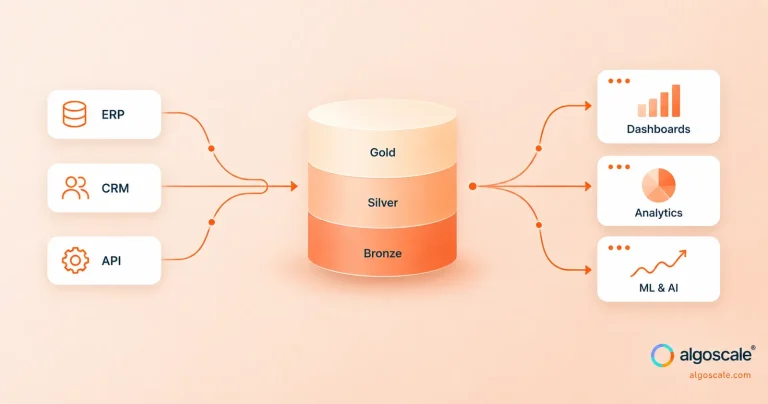
AlgoScale’s approach to multi-cloud Power BI integration uses Azure Data Factory or Fabric Pipelines as the central orchestration layer pulling data from each cloud source into OneLake on a defined schedule, applying the Medallion Architecture cleansing and transformation logic, and serving Power BI from the curated Gold layer. This approach means Power BI always reads from Azure, regardless of where the source data originated, which simplifies gateway management, security policy, and performance optimization substantially compared with DirectQuery across multiple external cloud endpoints.
Governance in a Cloud-Native Environment: Microsoft Purview
Cloud-native BI creates new governance challenges that on-premises environments never had to address. Data assets proliferate faster because the barrier to creating a new storage container or a new dataset is much lower. Shadow data assets tables created by individual data engineers or analysts without going through a formal approval process accumulate and create confusion about what is authoritative. Sensitive data can move across service boundaries without the controls that a traditional on-premises DBA would have enforced.
Microsoft Purview is the governance platform that addresses these challenges in a cloud-native Microsoft environment. It automatically scans and catalogues data assets across OneLake, Azure Data Lake, Synapse, and Power BI, creating a searchable, lineage-tracked data catalogue that anyone in the organisation can use to find authoritative data assets. Sensitivity labels applied in Purview flow through to Power BI datasets, controlling how data can be exported and who can access it. Data lineage shows the complete chain from source to report essential for regulatory compliance and for diagnosing data quality issues quickly. Business intelligence consulting firms that implement Purview as part of a cloud-native Power BI deployment give organisations the governance control they need to let the cloud’s speed and flexibility work for them rather than against them.

Embedded Analytics: Extending Power BI Beyond Internal Users
Cloud-native Power BI is not limited to internal business users. Power BI Embedded allows organisations to embed Power BI reports and dashboards into their own applications, customer portals, and SaaS products without requiring customers or partners to have a Power BI licence. For a software company that wants to add analytics to its product, or a financial services firm that wants to give clients real-time visibility into their portfolio, Power BI Embedded provides enterprise-grade analytical capability delivered as part of an owned application experience.
AlgoScale’s power bi consulting services include Embedded deployment for clients who want to extend their analytics investment to external audiences. This involves capacity sizing, authentication model design (A-SKU versus service principal authentication), row-level security for multi-tenant scenarios, and the API integration work that connects the host application to the Power BI REST API. The result is a customer-facing analytics product built on the same certified datasets and data model that internal users rely on, consistent, governed, and cloud-native from source to screen.
Cloud-Native BI Deployment Options Which Architecture Fits Your Stage?
| Organisation Profile | Recommended Architecture | Key Services | AlgoScale Engagement Type |
| Greenfield; no existing BI | Microsoft Fabric from day one | OneLake, Fabric Pipelines, Power BI Semantic Models | Architecture design + full build |
| On-prem SSRS; migrating to Azure | Phased: ADF + Synapse → Fabric migration | ADF, Synapse Serverless, Power BI, then Fabric | Legacy assessment + phased migration |
| Power BI Premium; evaluating Fabric | Fabric pilot; progressive migration | Fabric workspace; DirectLake mode; OneLake | Fabric readiness assessment + pilot |
| Multi-cloud (AWS + Azure + GCP) | Fabric + ADF multi-cloud ingestion | ADF cross-cloud connectors, OneLake, Power BI | Multi-cloud integration design + build |
| ISV / SaaS; customer analytics needed | Power BI Embedded on Fabric | Embedded capacity; service principal auth; API | Embedded architecture + tenant isolation |
| Regulated; GovCloud required | Power BI Government Community Cloud | GCC-H or DoD capacity; FedRAMP controls | Compliance architecture + security review |
Calculating the TCO of Cloud-Native BI vs On-Premises Reporting
Total Cost of Ownership comparisons between cloud-native Power BI and on-premises SSRS or SSAS deployments are frequently distorted by including cloud licence and compute costs while excluding the equivalent on-premises costs of hardware refresh cycles, software maintenance contracts, data centre overhead, and the IT staff time required to maintain the on-premises stack. A genuinely comparable TCO analysis needs to include all costs on both sides of the ledger over the same time horizon typically five years.
AlgoScale conducts TCO comparisons for clients that are evaluating the business case for moving from on-premises reporting to cloud-native Power BI. These analyses consistently show that the cloud-native option is cost-competitive at current usage levels and becomes significantly cheaper over a five-year horizon once hardware refresh, software licensing renewals, and the increasing cost of finding staff who want to maintain legacy BI platforms are included. The TCO analysis also captures the value side of the analytical capabilities that the cloud-native platform enables that were simply not possible on the legacy stack which is ultimately more persuasive to business leaders than the cost comparison alone.
Building a Cloud-Native BI Roadmap That Aligns With Your Organisation’s Pace
Not every organisation can or should migrate its entire BI estate to cloud-native Power BI on Fabric simultaneously. For large enterprises with extensive SSRS estates, a phased migration over twelve to thirty-six months is more realistic and less disruptive than a “big bang” cutover. The migration roadmap needs to be sequenced based on business impact, technical complexity, and organisational readiness not just by the technical ease of migration for the data engineering team.
AlgoScale develops cloud-native BI migration roadmaps that account for all three dimensions. We start with a migration readiness assessment that inventories the legacy estate, analyses usage data to identify which reports are genuinely relied upon, and assesses the complexity of migrating each data source to the cloud. The output is a sequenced migration plan that delivers the highest-value capabilities first, manages the risk of business disruption, and gives the internal team enough time to build cloud-native competency progressively rather than requiring everyone to learn everything at once. This structured approach, informed by experience across multiple cloud-native Power BI migration engagements, is what a bi consulting company with genuine cloud expertise brings to the table.
Why Choose AlgoScale for Cloud-Native Business Intelligence Consulting
Cloud-native digital transformation delivers the greatest value when organizations can turn data into timely, actionable insights. Achieving that requires more than migrating reports to the cloud it demands a modern business intelligence strategy built on scalable data platforms, governed analytics, and self-service reporting that empowers decision-makers across the enterprise.
At AlgoScale, we help organizations modernize their analytics ecosystem through end-to-end business intelligence consulting services. Our experts design and implement cloud-native BI solutions using Microsoft Fabric, Power BI, Azure data services, and modern data engineering practices to create secure, scalable, and high-performing analytics platforms. From legacy BI migration and semantic model design to governance, embedded analytics, and enterprise dashboard development, we build solutions that enable faster reporting, better collaboration, and data-driven decision-making.
Whether you’re migrating from traditional reporting platforms, adopting Microsoft Fabric, integrating data across multiple cloud environments, or building customer-facing analytics applications, AlgoScale delivers the technical expertise and strategic guidance to accelerate your cloud-native transformation. Connect with AlgoScale to build a modern business intelligence platform that empowers your teams with trusted insights, improves operational efficiency, and supports long-term business growth.