

About the Company.
A prominent U.S.-based insurance provider serving millions of policyholders. The organization operates at scale across policy issuance, claims processing, and regulatory reporting functions.
Solution Summary.
The client needed to modernize its reporting infrastructure to handle growing data volumes and improve agility across analytics functions. Algoscale designed and implemented a modern ETL architecture on Databricks, replacing the legacy stack with a scalable, schema-resilient pipeline. We leveraged Delta Lake for reliability, enabled auto-scaling compute for efficiency, and integrated with Azure Synapse and Power BI for real-time reporting capabilities.
Customer Challenges.
The client faced multiple operational and technical bottlenecks with its legacy SSIS/SQL-based reporting workflows. These included poor scalability for high-volume data loads, frequent pipeline failures due to rigid schema handling, and long data refresh cycles that delayed access to critical insights. The over-provisioned compute infrastructure further contributed to inefficiencies and high operational costs.
High Volume, Low Throughput.
Existing workflows couldn’t reliably process 100M+ rows/day, leading to frequent data lags.Delayed Reporting & Insights.
Latencies over 6 hours delayed KPIs related to claims, finances, and risk dashboards.Brittle Pipelines.
Frequent schema changes broke the ETL, requiring manual fixes and increasing downtime.Poor Collaboration.
On-prem SQL infrastructure lacked elasticity, leading to over-provisioned compute and higher costs.Limited Scalability.
Fragmented development between engineers and analysts caused delays and misalignment.
Algoscale Solution.
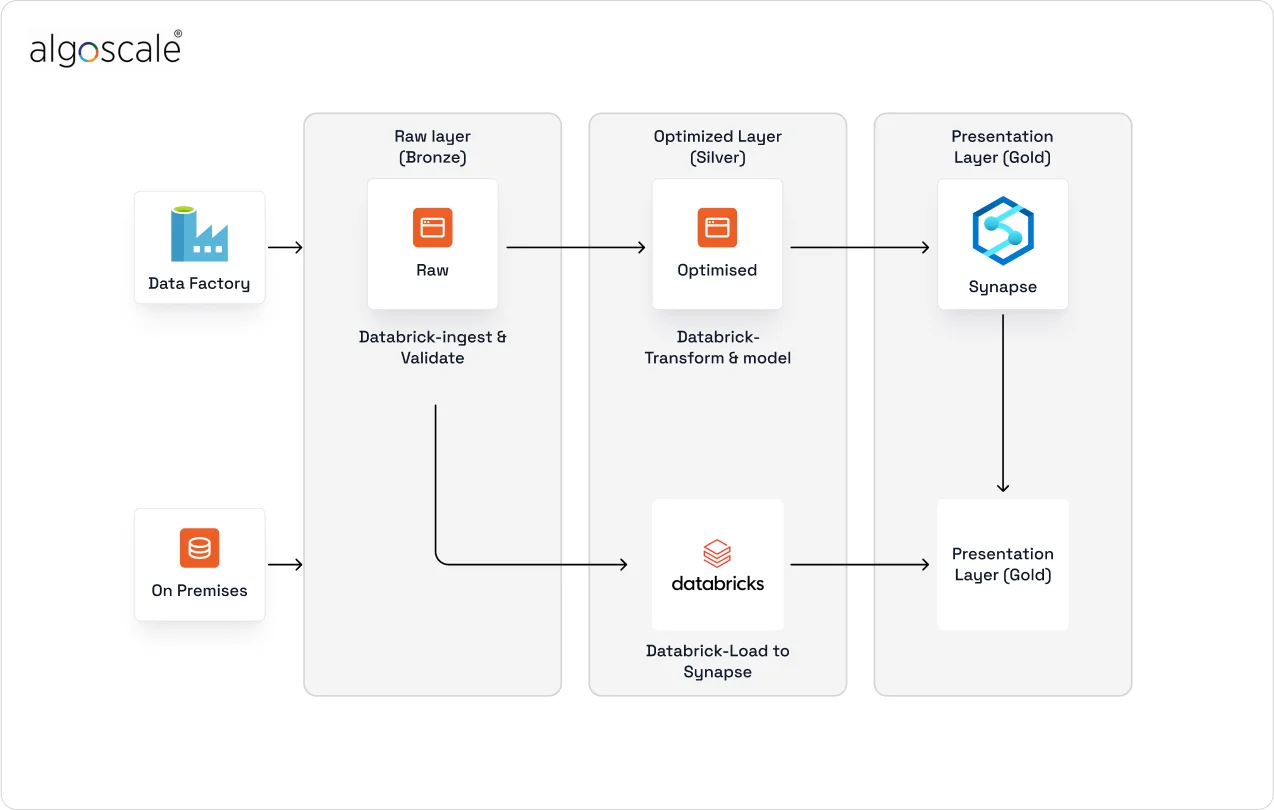
Algoscale engineered a scalable, cloud-native data platform using Databricks and Delta Lake to drive end-to-end automation, reliability, and performance.
Ingestion Modernization.
Ingested raw CSV/Parquet data from Azure Data Lake Gen2 using mounted paths into Databricks.Delta Lake Architecture.
Implemented Bronze → Silver → Gold architecture using Delta Lake with schema enforcement, ACID transactions, and time-travel.Dynamic Schema Handling.
Enabled schema evolution to handle changes without breaking jobs—removing manual effort.Real-Time Consumption.
Published Gold tables to Azure Synapse, enabling near real-time Power BI dashboards.Dev & Analyst Collaboration.
Leveraged shared Databricks notebooks to reduce back-and-forth and accelerate deliveryCost-Efficient Processing.
Used auto-scaling clusters to optimize batch load times while trimming infrastructure costs.
Algoscale Differentiators.
Metadata-Driven XML Parsing.
Dynamic ingestion framework powered by centralized schema registries enabled seamless handling of complex and evolving XML structures across multiple regions.End-to-End Delta Lake Governance.
Leveraged Delta Lake features like schema enforcement, ACID transactions, and time travel for reliable, auditable data pipelines with zero manual intervention during schema changes.Native Power BI Integration via Synapse.
Published curated Gold-layer datasets to Azure Synapse, ensuring fast, reliable connectivity to Power BI dashboards for real-time, business-ready analytics.Auto-Scaling Cluster Architecture.
Implemented compute clusters with auto-scaling policies to optimize resource utilization—supporting peak batch loads without over-provisioning.Collaborative Development Ecosystem.
Enabled seamless iteration between data engineers and analysts through shared Databricks notebooks and version-controlled development flows.
Powered by Arcastra’s™ Custom Agent - a backend automation agent that orchestrates ingestion, transformation, and governance across complex enterprise data stacks.
Workflow.