Healthcare Data Volume
A single hospital produced 137 terabytes of data in a day , according to Clinical Architecture, 2025 , ten times more than what would fit in a national medical library.

Healthcare produces one-third of the world’s data. More than half of it goes unused. This billion-dollar inaction compromises patient experience, compliance, healthcare delivery, and performance, preventing healthcare providers from offering personalised, value-based, and pre-emptive care expected today.
Algoscale’s healthcare data analytics services help you leverage your data to meet these outcomes while meeting CMS-0057-F, HIPAA 2.0, SaMD, Value-Based Care, and Quality-Measure Reporting needs.














Without data-driven decision making, healthcare is a scare because every patient visit, labs result, claims processing, or RPM generates data to add to your existing data sludge. Touch any healthcare interaction point and it will bleed more data than most organizations can ever manage.
Every ounce of data generated and gone unused can take your organization back by ten years in a month, if you consider how much data healthcare generates.
The cost of not using this data isn’t just slow operations- it’s regulatory gaps, compromised patient experience, and credibility that took years to build.
A single hospital produced 137 terabytes of data in a day , according to Clinical Architecture, 2025 , ten times more than what would fit in a national medical library.
97% of healthcare data goes unused , according to the World Economic Forum (2024) . Meaning revenue-boosting insights generate from your EHR, imaging systems, IoT integrations, but sit idle.
Healthcare took 279 days to detect and contain a data breach , longer than any industry, according to the HIPAA Journal 2025 . That’s 9 months of exposure before your team knows there’s a problem, multiplying regulatory and financial burden.
Healthcare has been the costliest year for data breaches for 14 years in a row, with an average breach costing $7.42 million per incident . Breach costs have ripple effects from patient experience to reputational damage, according to an IBM Cost of a Data Breach report.
Data exists, but as a liability or strategic asset, that’s what differentiates healthcare organizations that are still reactive, or have become pre-emptive.
Algoscale helps you:
Healthcare data analytics services built around how care works.
Your EHR has thousands of data points per patient. Your claims system has thousands more. Most organizations run them in parallel and wonder why the numbers never agree. We’ve spent years building analytics pipelines where clinical, claims, operational, and financial data come together, because a readmission you don’t see coming usually left footprints in all four.
In our experience working alongside clinical informatics teams, most EHR analytics projects fail because nobody mapped the data correctly. We go into your health systems where the data governance hadn’t been touched in four years and rebuild it into something that produces care quality dashboards, clinical decision support models, and patient outcome tracking that clinicians trust.
What we consistently find is that the risk stratification model already exists but gets buried in a vendor report. Across the population health programs we’ve built for ACOs, health systems, and MA plans, our healthcare data experts replaced the lag with live risk engines pulling from claims history, lab trends, ADT feeds and SDOH data, so high risk patients show up on a dashboard Monday morning, not after a preventable admission.
The number that surprises finance teams most is how long it’s been accepted as a baseline. Our revenue cycle analytics work builds root cause denial models, flags documentation gaps before claims drop, and tracks coding patterns that drift quietly for years. Revenue cycle directors our healthcare data analytics experts worked with have recovered material losses simply by fixing what the data was already trying to tell them.
Health plans we’ve partnered with usually have the same problem data spreads across adjudication systems and no utilization tool was ever designed. We consolidated claims, clinical, and member data into single analytics layer that supports medical loss ratio decisions, STARS and HEDIS reporting , and network adequacy analysis on your current numbers.
Clinical trial data tells you what happened in 800 patients. Real world data tells you what’s happening across 800,000. For pharma and life sciences organizations, we manage the full RWD/RWE lifecycle from sourcing, de-identification, data linkage and analysis for post market surveillance with audit trail documentation built in from the first data pull.
As your healthcare data analytics company, we build predictive analytics models trained on your patient population, validated by your clinical team, and deployed inside EHR alerts, care coordinator worklists, or real-time APIs with explainability built in, because a model a physician cannot interpret won’t change clinical behaviour.
Interoperability is rarely a technology problem; it’s a translational problem compounded by years of undocumented integrations. As FHIR R4 certified health data architects , we’ve built integration layers across Epic, Cerner, Allscripts, and athenahealth environments, all the data sources into a unified analytics-ready layer that holds together even when a source system updates without warning.
We’ve migrated health systems off on-prem warehouses, consuming higher maintenance budgets that still couldn’t produce a clean patient level report without a data engineer. The healthcare data warehouses we build on Snowflake, Databricks, AWS Health Lake, and Azure are structured for clinical and financial analytics from the schema up with PHI handling, RBAC, and audit logging in the architecture by design.
CMS deadline doesn’t move because your pipeline broke. As healthcare analytics advisors who’ve supported quality reporting across health plans, IDNs, and provider organizations, we build programs that run HEDIS,STARS, CAHPS, and eCQM calculations on schedule, flag data quality gaps weeks before submission windows open, and produce audit-ready documentation as a standard output.

Algoscale connected HubSpot, Azure SQL and Amazon S3 into one Databricks platform on Google Cloud, replacing weekly manual report pulls with real-time loan and sales dashboards in Looker.

Algoscale replaced commercial BI and semi-manual scripts with an open-source analytics stack on Apache Superset and AWS, and a risk dashboard that tracks defaults, fraud signals and compliance in real time.

Algoscale unified seven SaaS platforms into one governed Microsoft Azure and Fabric lakehouse, automating 131 KPIs and cutting weekly data extraction from twelve hours to one.
I’ve been tremendously impressed by their knowledge, skills and professionalism.
Neeraj and Algoscale enabled Perceptronix and my clients have the cutting edge solutions they need to solve the very real problem that they have. We really enjoy working with their development team — our projects are always well defined and managed by project leaders.
We are impressed with their good communication skills.
Algoscale Technologies, Inc. provided a transportation company with BI, big data consulting, and SI services. The team was tasked with improving the client’s traffic movement counts at several intersections.
We are extremely happy with the work that they’ve done.
They are responsive, the quality of the engineers and data scientists are very very good. They are challenged by us and ultimately always deliver. We find that the management team are really attuned to the kind of skills that we need.
…Algoscale is unwilling to settle for anything less than full customer satisfaction.
Algoscale Technologies, Inc. created an engine to capture data and an analytics platform to synthesize the information. They consulted on which technologies to use and provided maintenance.
100% of the deadlines set by Algoscale Technologies, Inc. have been met.
Algoscale Technologies, Inc. provides ongoing analytic, development, and data science support for an analytics firm.
Real problems. Real workflows. Real outcomes.
Data analytics in healthcare works best when it’s solving something specific, not a vague mandate to “be more data driven.” Here’s where we’ve seen it make the most tangible difference across clinical, operational, and financial workflows.
Readmission penalties cost US hospitals over $500M annually. The data to prevent most of them already exists; it’s in discharge summaries, lab trends, medication histories, and prior claims. Healthcare data analytics connects those signals into a risk score that flags high-risk patients before discharge, not after. Care teams, we’ve worked with use this to prioritize follow-up calls, schedule transitional care visits, and close care gaps that would otherwise go unnoticed until a 911 call.
Most denial patterns are visible in the data weeks before they become write-offs. Analytics applied to your claims pipeline can identify which payers are denying at higher rates, which CPT codes are getting flagged, and where documentation gaps are creating preventable rejections. The use case here is intervening early enough to fix the root cause before the claims drops.
A care gap isn’t just a quality measure problem, it’s a patient who hasn’t had a mammogram in three years, a diabetic whose HbA1c hasn’t been checked, a member who filled their prescription once and never refilled it. Analytics across claims, EHR, and pharmacy data surfaces these gaps at scale so care coordinators can act on them systematically rather than by chance. This is one of the highest ROI use cases of data analytics in healthcare, particularly for value-based care contracts.
Standard edit checks catch the obvious. What they miss is the provider billing at the 99th percentile of their peer group for a specific code, consistently, across two years. Or the duplicate claims pattern that spreads across member IDs just enough to avoid automated flags. Fraud, waste, and abuse detection analytics is about building models that think the way investigators think pattern first, not rule first.
One of the more powerful use cases of clinical analytics is getting the right information in front of the right clinician at the right moment , not in a report they’ll review on Friday, but inside the EHR workflow where the decision is being made. Sepsis early warning alerts, drug interaction flags, and length-of-stay predictions are data analytics applications that change clinical behaviour in real time, not retrospectively.
For health plans and PBMs, pharmacy spend is often the fastest moving cost line and the least understood. Analytics across drug utilization data can identify therapeutic substitution opportunities, flag members with high-risk polypharmacy patterns, track formulary adherence, and benchmark pharmacy costs against peer organizations. For pharma clients, the same data tells a different story real world adherence, therapy switching patterns, and outcomes by patient segment.
Clinical supply chain is an underused area for healthcare analytics most organizations are still managing it through a combination of gut feel and retrospective reports. Predictive analytics applied to procedure volumes, seasonal demand patterns, and vendor lead times can meaningfully reduce both stockouts and excess inventory. Post-pandemic, this has become a much higher priority for health system CFOs and supply chain directors alike.
Quality measure performance has a direct line to reimbursement for most health plans and provider organizations today. The challenge isn't knowing which measures matter — it's having clean enough data to calculate them accurately, identify where you're falling short, and close those gaps before the measurement period ends. Analytics built around your quality reporting calendar turns measure performance from a retrospective audit into something you can actively manage in-year.
Healthcare has crucial interaction touchpoints, none of which should function in silos. But each interaction touchpoint is led by a stakeholder sitting on a mountain of unused data. This leads to fragmented healthcare performance, with each stakeholder facing their unique data challenges with different data formats, varying regulatory scrutiny, and a different definition of success.
Our data analytics in healthcare industry serve every major role and empower them to function better in the care continuum.
Thousands of patients, hundreds of care pathways, and a greater number of payer contracts are just the tip of the iceberg for hospitals and health system leaders. Added to their operational complexity is a fast-changing regulatory environment that has left your reporting structure far behind. Your data is scattered across EHRs, billing system, lab platforms, and other sources that don’t talk to each other. Our data analytics for healthcare help you eliminate this by Unifying fragmented data across EHRs, billing, lab, and other systems into a single source of truth. Ensuring seamless interoperability to eliminate data silos. Offering real-time insights across care pathways for better visibility and improved clinical outcomes. Simplifying regulatory compliance with audit-ready data pipelines and automated change updates. Helping you transition from reporting what has happened to predictive intelligence that prevents problems from spiralling to your patients, and P& L statements. Get data analytics solutions tailored to your role
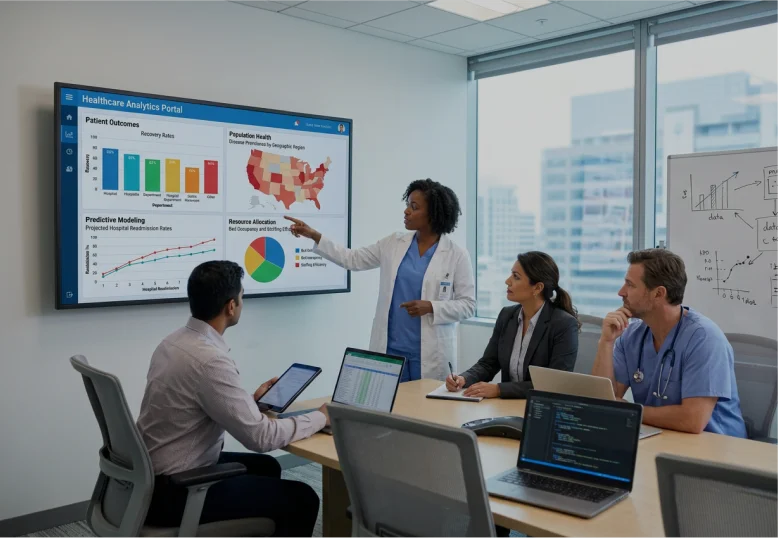
Gaps between projected payouts and what you really pay disturbing your operations? This, and many other problems you have been facing- including risk models trained on faulty claims data, prior authorization administration costs escalating more than they save- can be solved with data. It’s one of the core benefits of data analytics in healthcare. Here’s how we solve them: Real-time accurate analytics to bridge the gap between what you thought you’d pay vs what you actually pay. Cleaning and enriching claims data to improve risk models’ accuracy. Streamlining prior authorization costs with data-driven insights on administration and smarter automation. Aligning data across claims, member, and provider systems into a unified view for identifying unusual transactions faster. Enabling complete visibility across care patterns and outcomes for optimizing utilization management. Helping you transition from reactive to predictive member management to improve medical loss ratios, Star Ratings, and regulatory audit outcomes. Get data analytics solutions tailored to your role

Going from clinical trial to real-world impact has never been more scrutinized or data driven. Payers want proven effectiveness. Health systems want outcomes data before you’re added in their formulary. Regulators want Real World Data. So, your internal teams need data pipelines that support this complexity: We empower them by: Enabling end-to-end RWD ingestion to RWE generation for label expansions and regulatory submissions. Offering treatment pathway mapping and adherence modelling across patient populations for informed decision-making. Ensuring availability of evidence for FDA, CMS, and payer scrutiny. Accelerating clinical to commercial insights by integrating data from trials, real-world usage, and the market. Enhancing patient stratification and cohort identification to support precision medicine strategies. Get data analytics solutions tailored to your role

Most analytics projects in healthcare don’t fail in the build phase. They fail before it because nobody mapped the data environment, understood the compliance boundaries, or asked how the output would fit into an actual clinical workflow. VITALS is how we fix that: six stages, defined outputs, no black box periods.

Before any architecture decisions, we profile your data environment, what systems you have, what they produce, where data breaks, and what your compliance posture looks like. We’ve found that the gaps uncovered here are almost always the previous analytics project didn’t stick.Deliverable: Data landscape assessment, source system inventory, prioritized gap analysis.

EHR feeds in HL7, claims in 837 format, lab results through a separate interface, pharmacy data in a system nobody's touched since the last merger. We normalize data across clinical, claims, operational, and financial sources into a unified patient-level foundation FHIR R4 certified, built across Epic, Cerner, athenahealth, and third-party feeds.Deliverable: Integrated data pipeline and unified patient level data layer.

Connected data isn’t the same as analytics ready data. This stage handles normalization, deduplication, and structure with PHI handling, role-based access control, and audit logging built into the architecture here. By the time data reaches your analysts it’s already HIPAA 2.0 compliant, traceable, and access controlled.Deliverable: Clean, governed data warehouse structured for clinical and financial analytics.

With clean, connected data in place, we build what your teams will actually use- the clinical dashboards, predictive models, quality measure pipelines, risk engines, or FWA detection, depending on your roadmap. Two-week sprints, working demos at every cycle and every model validated against your clinical workflows before it goes live.Deliverable: Dashboards, models, and analytics pipelines validated against your workflows.

Most analytics programs get abandoned deployment, the model works in the data environment but never makes it into the EHR workflow or the care coordinator’s worklist. We treat launch as an integration challenge, not a handoff. We don’t call something launched until someone is using it.Deliverable: Live analytics program deployed into clinical and operational workflows.

HEDIS specs change. CMS updates its requirements. Source systems get upgraded Our sustain model keeps your analytics program current monitoring pipeline health, absorbing regulatory changes, retraining models, and expanding into new use cases as your data maturity grows.Deliverable: Ongoing monitoring, regulatory change management, and roadmap iteration.
Start small. Scale when you’re confident
Healthcare organizations don’t hand over their data infrastructure to a consulting partner on faith. We’ve built our engagement models around that reality, low commitment to start, clear value at every checkpoint, and no long term lock-in until you’ve seen what we can do.
We, as your healthcare data analytics partner scope a focused, high impact use case with a denial's dashboard, a risk stratification model, a HEDIS pipeline and deliver a working output in six to eight weeks. You evaluate the work, the team, and the process before committing to anything bigger.
A defined scope, a defined timeline, a defined cost. For health systems, payers, and life sciences organizations that have a specific analytics problem to solve, a data warehouse migration, a population health program build, an RWE analytics package. We work as your clinical data specialists from start to delivery with milestone-based checkpoints.
For organizations that need ongoing healthcare data consulting capacity without the overhead of building an in-house team, we embed a dedicated analytics team into your environment. Your team works exclusively on your roadmap under your direction, with Algoscale’s healthcare domain expertise behind every deliverable.
We own the full analytics function. You get the output of a mature healthcare analytics operation without building or maintaining one internally. This is what long-term partnerships with our health data advisory team typically evolve into after an initial engagement.
The tools change. The outcome doesn’t.
We’re technology agnostic. We work with what’s right for your data environment, not what’s convenient for us. Here’s what we work with across the healthcare data stack to deliver your desired outcomes.




























Answers to the most common questions regarding data analytics in healthcare from experts who have built, evolved, adapted, and delivered according to the domain’s rapidly evolving requirements.
 5.0 / 5 · 12 reviews
ISO 27001
5.0 / 5 · 12 reviews
ISO 27001 Clutch Champion 2025
 Clutch Global 2025
 Best Data Analytics Companies 2025
Our customers
Certified partners


Certifications
ISO 27001Clutch Champion 2025Clutch Global 2025Best Data Analytics Companies 2025