Faster Access to Enterprise Knowledge
Employees can find policies, procedures, product information, contracts and operational guidance through natural-language experiences, provided the underlying content is governed and access-aware.

Move generative AI from promising experiments to secure, useful systems that work inside your business.
Algoscale helps enterprises identify practical use cases, assess readiness, design the right architecture, connect AI to enterprise data and applications, and take production-ready solutions from pilot to scale.










Microsoft Partner
Azure Expert MSP
Our credentials include ISO 27001, Microsoft Partner, Azure Expert MSP and AWS Partner, Advanced Tier Services, alongside established engineering and delivery practices.
Generative AI consulting is the process of helping an organization identify, design, build and operate applications that use foundation models to create or transform content. Depending on the use case, that content may include text, code, summaries, recommendations, structured information, images or responses generated from enterprise knowledge.
The work goes well beyond selecting a model. A production solution also needs reliable data, clear access rules, retrieval or context management, application integration, evaluation, monitoring and a defined role for human review.
The starting point is the business process. A knowledge assistant, a document-processing workflow and an AI agent that updates an ERP system have different risks, architecture and delivery requirements. The consulting approach should reflect that difference.
A demo can show that a model produces an impressive answer. Production asks harder questions: Is the answer grounded in approved information? Can the system respect permissions? What happens when the source is missing? Can the application complete the task reliably, at an acceptable cost?
Deloitte’s 2024 State of Generative AI in the Enterprise survey found that 68% of organisations had moved 30% or fewer of their GenAI experiments fully into production. The study surveyed 2,773 senior leaders across 14 countries who were already involved in piloting or implementing GenAI.
That gap isn't simply about whether the technology works. It's about whether the surrounding business system is ready to support it at scale.
Pilots picked for novelty, then left without an owner
Use cases are selected because they're interesting, not because they solve a measurable business problem.
Ownership becomes unclear after the pilot, particularly when a solution moves from an innovation team into day-to-day business operations.
Foundations that can't carry the workload
Documents can be incomplete, duplicated, outdated or difficult to retrieve.
AI applications aren't connected to the systems where work actually happens, limiting their ability to move beyond generating answers.
Pilots become too dependent on a single model or vendor, making future changes harder and more expensive.
Risks and results nobody is tracking
Teams measure response quality but overlook operational metrics such as task completion, latency, cost, adoption and risk.
Security, access control, auditability and human approval are treated as afterthoughts. Deloitte's research specifically identifies data, governance, risk and compliance as challenges to scaling GenAI.
The answer isn't to add more prompts to a weak foundation. It is to design the complete system around the workflow, data, integrations, governance and controls required to make AI useful in production.
Talk to a Generative AI ConsultantGenerative AI consulting only creates value when it connects strategy with engineering. Our capabilities span the full GenAI lifecycle, from strategy and model selection to RAG, custom AI applications, agent development, integration and production optimization.
We identify high-value GenAI opportunities, assess feasibility and ROI, and prioritize use cases based on business impact, data readiness, risk and implementation complexity.
We evaluate and integrate foundation models based on your use case, balancing response quality, reasoning, context requirements, latency, cost, security and deployment needs.
We build RAG solutions that connect LLMs to trusted enterprise data using document processing, embeddings, vector search, hybrid retrieval, reranking and permission-aware access.
We build custom GenAI applications including enterprise knowledge assistants, AI-powered search, document intelligence, employee copilots, research tools and natural-language interfaces.
We optimize GenAI applications through prompt engineering, structured outputs, few-shot prompting, evaluation and fine-tuning where model customization delivers measurable value.
We build conversational assistants and copilots for customer support, employee productivity, sales and service workflows, combining LLMs with enterprise data, APIs and business logic.
We connect GenAI applications with enterprise data platforms, CRM, ERP, document repositories, APIs and custom applications, with identity, permissions, data access and auditability built in.
We establish the controls needed for production GenAI, including evaluation, observability, access control, data protection, guardrails, auditability, model monitoring and cost tracking.
We improve existing GenAI pilots and applications by addressing retrieval quality, model performance, latency, cost, reliability, adoption and maintainability.
Where generative AI tends to pay off first: knowledge access, document-heavy processes, support, software delivery, connected workflows and AI-enabled products, along with the controls each one needs.
Employees can find policies, procedures, product information, contracts and operational guidance through natural-language experiences, provided the underlying content is governed and access-aware.
Generative AI can extract, classify, summarise and compare information from invoices, claims, applications, agreements and reports. The strongest solutions combine model output with validation rules and human review where errors carry consequences.
AI assistants can help service teams retrieve relevant information, summarise conversations, recommend next steps and prepare responses. Customer-facing systems need additional controls for escalation, privacy, accuracy and brand consistency.
Engineering teams can use generative AI for code suggestions, test creation, documentation, code review and legacy-code analysis. Productivity gains depend on workflow integration, code quality controls and appropriate review.
When AI is connected to approved tools, it can prepare actions, route requests, update records or support exception handling. Action-taking systems require stricter permissions, logging and human approval than read-only assistants.
Generative AI can become part of a customer experience, internal product or analytics workflow. The value comes from fitting the model into a useful product journey, not from adding a chatbot to an existing interface.
A typical enterprise knowledge assistant brings together approved documents, metadata, access rules, retrieval, model services and a user-facing application. The objective is not simply to generate an answer. It is to help an employee find the right information, understand its source and know when to escalate or verify.

An LLM pipeline with DocumentIQ extraction, clause classification and human validation found the price escalations nobody was billing across 1,500+ agreements in six languages.
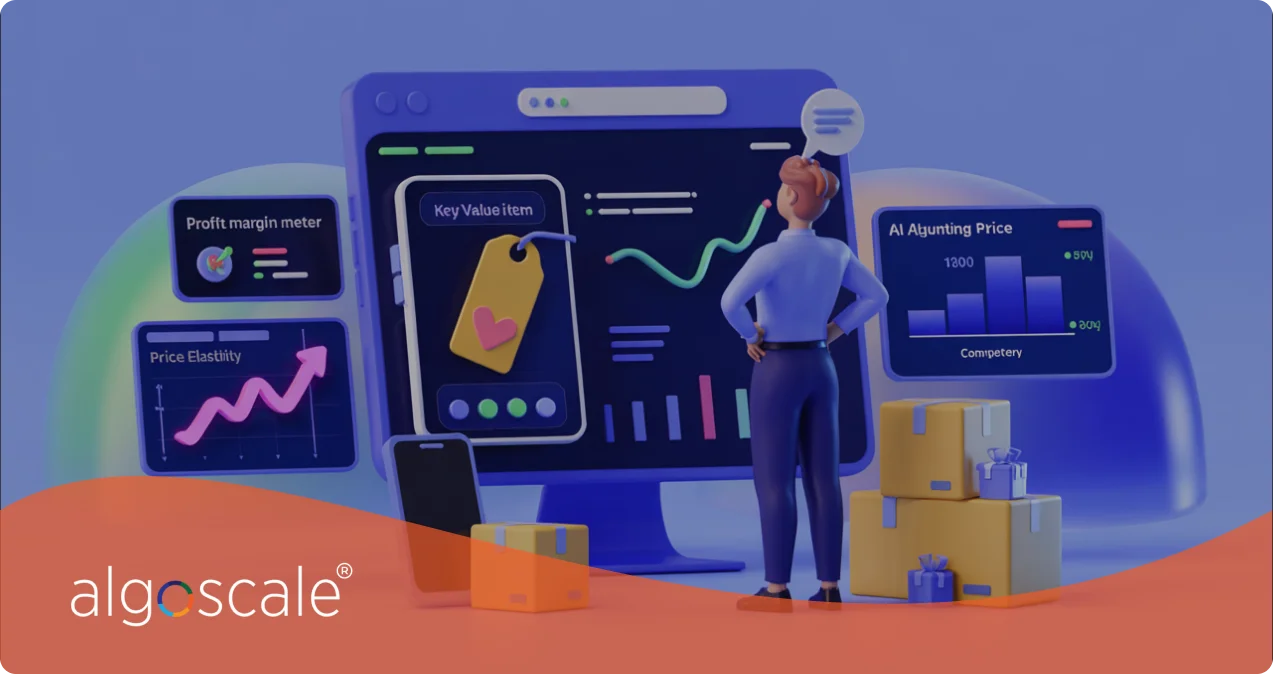
An AI product taxonomy and attribute-similarity matching compare equivalent products across retailers, with daily alerts on price changes, discounts, stock-outs and assortment shifts.
SHAP analysis found which image, video, headline and body features drove performance, and generated copy targeted the winning patterns.

We start with the business problem and work toward a solution that can be evaluated, governed and operated. The process is structured, but the scope stays focused on the use case.
We define the users, task, current process, business objective, constraints and success measures. We identify where human judgment must remain involved and what a useful first release should accomplish.
We examine source systems, data quality, permissions, security, integration points, regulatory requirements and likely failure modes. This prevents the pilot from being built on assumptions that will not survive production.
We select the appropriate approach, which may include RAG, fine-tuning, structured generation, tool use, workflow automation or agentic patterns. The architecture also covers application services, data flows, identity, monitoring and fallback paths.
We build a narrow but realistic version using representative data and real user tasks. Evaluation covers groundedness, relevance, safety, latency, cost, consistency and task completion rather than relying only on whether the response sounds convincing.
Before release, we establish access controls, logging, monitoring, feedback loops, escalation paths, human review and release processes. The system is deployed into the environment where users can actually adopt it.
Once the use case demonstrates value, we expand coverage, integrations and user groups. Reusable components can shorten the path for subsequent use cases, while ongoing evaluation helps detect changes in source data, model behaviour and operating cost.
Timelines depend on data readiness, integration complexity, security requirements, number of users, evaluation depth and the scope of the use case. The ranges below are common enterprise planning estimates, not fixed promises.
A narrowly scoped assistant using clean, accessible content may move faster. A regulated, customer-facing or action-taking system connected to multiple enterprise applications usually needs more time for integration, evaluation, security and change management.
The model is only one layer of an enterprise AI system. Reliability depends on how the application retrieves information, applies permissions, calls tools, handles uncertainty and records what happened.
For knowledge-intensive applications, retrieval-augmented generation can provide relevant enterprise content as context for the model. It is useful when information changes frequently or must remain outside model training. It does not solve poor source content, weak retrieval, missing permissions or unclear ownership by itself.
The architecture should be selected according to the use case. A read-only knowledge assistant should not carry the same permissions or operational complexity as an agent that can take actions in a business system.
AssistantsApplicationsEmployee portalsCustomer journeys
PromptsWorkflow logicTool callingAgent coordinationResponse handling
DocumentsMetadataEmbeddingsSearchGoverned data productsRetrieval pipelines
Foundation modelsModel routingStructured generationTask-specific model services
APIsCRMERPService platformsDatabasesEnterprise applications
IdentityAccessEvaluationMonitoringAudit logsCost controlsHuman escalation
There is no single model, framework or cloud platform that fits every enterprise use case. We help teams choose based on task complexity, data sensitivity, response quality, latency, cost, deployment options, integration requirements and operating model.
AWS, Microsoft Azure, Google Cloud, Azure OpenAI and Amazon Bedrock may support different parts of the solution, depending on the existing enterprise environment and deployment requirements.


Commercial and open models can be evaluated for reasoning, context handling, language coverage, structured output, privacy, cost and latency. A flexible model strategy reduces dependence on one provider and makes future changes easier to manage.

Python, APIs, workflow orchestration, agent frameworks, tool calling and structured outputs can be combined to create reliable application behaviour. The framework should serve the workflow rather than become the centre of the architecture.
Search services, vector databases, embeddings, document pipelines, metadata and access-aware retrieval support knowledge-based applications. Retrieval quality, source freshness and permission handling require as much attention as model selection.
Snowflake, Databricks, Microsoft Fabric, enterprise databases, governed data products and BI environments can provide the data foundation for AI applications, subject to the use case and security model.

Evaluation datasets, observability, prompt and model versioning, auditability, access management, cost monitoring and feedback loops help teams operate AI systems after launch.


I’ve been tremendously impressed by their knowledge, skills and professionalism.
Neeraj and Algoscale enabled Perceptronix and my clients have the cutting edge solutions they need to solve the very real problem that they have. We really enjoy working with their development team — our projects are always well defined and managed by project leaders.
We are impressed with their good communication skills.
Algoscale Technologies, Inc. provided a transportation company with BI, big data consulting, and SI services. The team was tasked with improving the client’s traffic movement counts at several intersections.
 Loren E. Chilson, PEPrincipal, Headway Transportation
We are extremely happy with the work that they’ve done.
They are responsive, the quality of the engineers and data scientists are very very good. They are challenged by us and ultimately always deliver. We find that the management team are really attuned to the kind of skills that we need.
…Algoscale is unwilling to settle for anything less than full customer satisfaction.
Algoscale Technologies, Inc. created an engine to capture data and an analytics platform to synthesize the information. They consulted on which technologies to use and provided maintenance.
100% of the deadlines set by Algoscale Technologies, Inc. have been met.
Algoscale Technologies, Inc. provides ongoing analytic, development, and data science support for an analytics firm.
How generative AI is used in healthcare, finance and banking, insurance, manufacturing and retail: the work it supports in each sector, the controls that sector needs, and a published Algoscale AI engagement from that industry.
Support administrative knowledge, document intelligence, information retrieval, summarisation and operational workflows while accounting for privacy, access control, auditability and human oversight.
Improve research, customer support, document review, compliance assistance, knowledge access and employee productivity around sensitive financial information.
Create technical knowledge assistants, maintenance support tools, troubleshooting workflows, document search and operational guidance for teams working with complex processes.
Assist with claims documentation, policy interpretation, underwriting research, customer communication and internal knowledge workflows. Source traceability and review controls are central to these use cases.
Connect AI to product, customer, order and inventory data to support product discovery, service, merchandising, content operations and personalised experiences.
Generative AI projects rarely sit inside one technology layer. Algoscale brings data engineering, analytics and BI, AI engineering and product development together so these connected requirements can be addressed as one system.
Our experience spans data, analytics, AI and product engineering, from architecture and implementation through deployment, optimization and ongoing development.
Our experience is grounded in production delivery. Across hundreds of data and AI deployments, we've worked through different data volumes, workloads, cloud environments, integrations and operational requirements.
We don't stop at a use-case list or a presentation. Recommendations account for data readiness, integration, application design, security, evaluation and production operations from the beginning.
Our approach considers what happens after launch: monitoring, access control, failure handling, cost, maintainability, user adoption and ongoing improvement. This keeps the engagement focused on a working business capability.
Algoscale works across AWS, Azure and Google Cloud, with technologies including Snowflake, Databricks, Microsoft Fabric, enterprise databases, APIs and modern application frameworks. The architecture follows the business requirement rather than forcing every use case into one stack.
When an AI initiative needs better data, new integrations, analytics or a customer-facing application, the required capabilities can be brought together. That reduces the coordination burden created when each layer is delivered by a separate partner.
What teams ask before starting: how generative AI consulting differs from traditional AI work, when to use RAG, timelines, ROI, hallucinations, security and the platforms it connects to.
 5.0 / 5 · 12 reviewsISO 27001
 Clutch Champion 2025
 Clutch Global 2025
 Best Data Analytics Companies 2025
Our customers


Certified partners


Certifications
ISO 27001Clutch Champion 2025Clutch Global 2025Best Data Analytics Companies 2025