


Imagine a world where discharge summaries write themselves, clinical notes are ready before the doctor finishes speaking, and synthetic patient data can train models without breaching privacy. That world isn’t decades away -it’s already here, thanks to the growing impact of Generative AI in healthcare.
Unlike traditional AI that simply predicts or classifies, Generative AI for healthcare brings something radically new to the table: the ability to create. It can generate radiology reports, summarize patient visits, assist in drug discovery, and even draft insurance documentation- transforming the way clinicians, researchers, and healthcare systems work.
And this isn’t just hype. According to McKinsey, generative AI has the potential to unlock $110 billion in annual productivity for the healthcare sector by 2030. A 2024 Deloitte survey shows that over 40% of healthcare organizations have already kicked off pilots or use cases involving generative AI- a number that’s rising fast.
But while the possibilities are exciting, they come bundled with tough questions around data privacy, bias, safety, and regulation. It’s a space where innovation must walk hand-in-hand with ethics and oversight.
In this article, we’ll break down the core features of generative AI in healthcare, explore real-world use cases, unpack the challenges and policy gaps and look ahead at the trends shaping the future of healthcare AI. If you’re curious about where healthcare’s headed next – this is the conversation to join.
What is Generative AI in Healthcare
Generative AI in healthcare is a branch of artificial intelligence that goes beyond analyzing data – it creates new, contextually relevant outputs based on that data. Think of it as an intelligent co-pilot that can draft, summarize, simulate or synthesize medical information.
While traditional AI models are built to detect patterns or make predictions, generative AI for healthcare can produce:
- Clinical notes from voice transcripts
- Discharge summaries based on EHR data
- Synthetic patient data mimics real-world scenarios
- Preliminary diagnostic text based on imaging or lab results
It relies on models like large language models (LLMs), transformers, and generative adversarial networks to understand and generate medically coherent content.
In simpler terms, generative AI is like a medical assistant trained on terabytes of data, capable of understanding clinical context and generating relevant, useful outputs in seconds. By integrating into workflows, generative AI acts as a silent assistant for physicians, including those with an MD degree, summarizing visits, flagging anomalies, and generating recommendations in real time—reducing cognitive load and enhancing decision support without disrupting clinician flow.
What makes it especially valuable in healthcare is its potential to reduce documentation burdens, accelerate research, and support clinical decision-making all while adapting to natural language and real-world workflows.
As the technology matures, it’s not just supporting healthcare professionals- it’s starting to collaborate with them.
Features of Generative AI in Healthcare
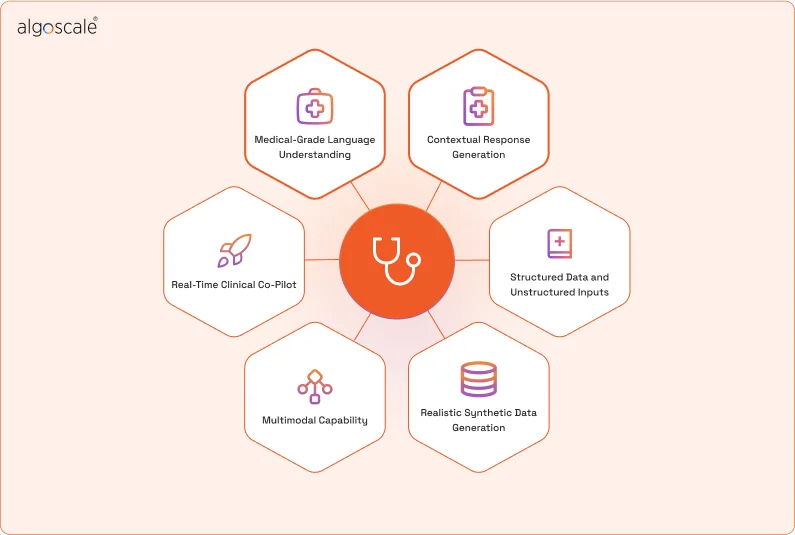
Generative AI is not just a buzzword- it brings a set of powerful, distinct capabilities that are transforming how healthcare is delivered, documented, and scaled. Here’s what sets it apart:
- Medical-Grade Language Understanding – Generative AI models trained on biomedical datasets and clinical language can comprehend complex medical terminology, abbreviations, and context. This allows them to generate documentation, reports, and summaries that match the tone and accuracy expected in clinical environments.
- Contextual Response Generation – Whether it’s drafting a discharge note or assisting in a differential diagnosis, generative AI doesn’t just spit out templates. It tailors output based on patient-specific data, clinician inputs, and clinical history – making the interaction feel personalized and clinically relevant.
- Structured Data and Unstructured Inputs – Generative AI can convert messy, free-form text-like a doctor’s spoken notes or a patient’s chat history- into structured, interoperable formats that fit directly into EHRs. This bridges the gap between human communication and digital systems.
- Realistic Synthetic Data Generation – For research and model training, generative AI can create synthetic patient datasets that reflect real-world variability – without risking privacy or compliance. These datasets are invaluable in rare disease modeling algorithm validation, and bias reduction.
- Multimodal Capability – Advanced models can process and generate content across text, audio, and image modalities. For example, pairing radiology images with automatically generated narrative interpretations, or integrating voice dictation into real-time note creation.
- Real-Time Clinical Co-Pilot – By integrating into workflows, generative AI acts as a silent-assistant summarizing visits, flagging anomalies, and generating recommendations in real-time reducing cognitive load and enhancing decision support without disrupting clinician flow.
Use Cases of Generative AI in Healthcare
Generative AI isn’t just a theoretical leap – it’s being applied now across clinical, operational, and R&D areas in healthcare. These use cases demonstrate its unique ability to generate content, streamline workflows, and drive innovation – beyond what traditional AI can do.
Fiction-free Radiology Reporting and Communication
Radiologists are leveraging generative AI to draft initial imaging reports and patient updates, tackling long-standing documentation burdens. Tools from providers like Bayer and Rad AI automate the generation of draft reports, while large language model systems generate patient-friendly summaries- allowing clinicians to focus on interpretation and patient interaction rather than typing,
Molecular Design & Accelerated Drug Discovery
Generative models accelerate drug discovery by designing molecules optimized for target binding, toxicity, and efficacy—within minutes.
This significantly cuts down the time and cost of preclinical R&D, opening new doors for treatments in oncology, rare diseases, and antimicrobial resistance.
Automated Clinical Notes & Ambient Scribe
AI scribes capture clinician-patient conversations in real time and convert them into SOAP notes, prescriptions, and follow-up instructions. Specialized AI platforms for clinical notes are particularly valuable in mental health settings, where documentation requirements are extensive and nuanced. This reduces physician burnout, shortens EHR interaction time, and helps maintain better patient-provider engagement during visits.
Generating Synthetic Patient Data for Model Training
To protect real patient identifies, healthcare organizations use generative AI to create synthetic datasets that mimic real-world variability. These datasets help train AI models, validate algorithms, and expand research capabilities—especially in data-scarce clinical areas.
Powering Conversational AI for Patient Triage and Support
LLM-powered virtual agents can engage patients in natural conversation, collect symptoms, assess urgency, and recommend next steps.
This lightens the load on front-desk staff, improves patient experience, and reduces wait times across outpatient and telehealth services.
Drafting Personalized Care Plans Based on EHR Insights
Generative AI can interpret structured and unstructured EHR data to draft individualized care plans aligned with clinical guidelines.
It helps clinicians deliver more personalized, consistent care and reduces variability in chronic disease management and post-discharge planning.
Streamlining Clinical Trial Design and Documentation
Generative models assist in drafting study protocols, patient eligibility criteria, trial summaries, and regulatory documentation. This accelerates trial setup, ensures compliance with evolving regulations, and frees up time for researchers to focus on strategy and innovation.
Enhancing Medical Image Reconstruction & Diagnostics
Generative AI is used to upscale low-resolution MRIs/CTs, reduce noise, and reconstruct missing slice data-enabling clearer, more accurate imaging in resource-limited settings. Early results show improved detection rates for subtle conditions like micro-hemorrhages and small lesions, outperforming standard preprocessing pipelines.
AI-Driven Genomics for Precision Medicine
Generative AI combines genomic, proteomic, and clinical data to predict disease trajectories or suggest personalized interventions- for example, identifying gene variants tied to pancreatic cancer survival. This empowers physicians to create customized prevention plans or treatment regimens tailored to a patient’s genetic profile.
Optimizing Remote Patient Care with Predictive Monitoring
Using continuous vitals data from wearables, generative models predict early deterioration or readmission risk in chronic conditions like heart failures or diabetes. Hospitals using RPM platforms report a drop in unplanned admissions by supporting preemptive, personalized interventions,
Advanced AI-Guided Robotic Surgery & Procedural Preview
Generative AI helps simulate surgical scenarios and generate real-time guidance overlays during operations- enhancing robotic-assisted precision in orthopedic and cardiovascular procedures. In practice, this leads to shorter operation times, fewer complications, and quicker patient recoveries.
Real-World Generative AI in Healthcare Examples
The promise of generative AI in healthcare isn’t theoretical anymore -it’s already reshaping diagnostics, documentation, and discovery across leading hospitals, biotech labs, and healthtech firms. The following real-world examples illustrate how generative AI is transforming care delivery, research timelines, and operational efficiency.
Bayer : Generative AI for Radiology Reporting
In partnership with Google Cloud, Bayer has launched an AI radiology assistant that streamlines imaging report generation. Integrated directly into PACS, the system auto-generates first-draft reports based on clinical context, past case data, and structured inputs – freeing radiologists from manual dictation and edits. It improves diagnostic efficiency, reduces clerical workload, and preserves workflow continuity, showing how generative AI can augment imaging departments without disruption.
Mass General Brigham : AI Voice Assistants & Note Automation
To tackle call center overload and clinician burnout, Mass General Brigham deployed AI voice agents and ambient scribes. The voice assistant handled over 40,000 patient calls in its first week, routing inquiries and gathering intake details,
Meanwhile, in clinics, generative AI transcribes real-time data consultations into structured SOAP notes, cutting documentation time and improving both provider satisfaction and appointment efficiency.
Insilico Medicine: Drug Discovery at Breakneck Speed
Insilico Medicine leverages generative AI across its Pharma.AI, Chemistry42, and TargetID platforms to accelerate drug discovery. Its AI-designed IPF drug reached human trials in under 30 months—half the conventional timeline.
By generating drug targets and molecules computationally, then validating them in the lab, Insilico is redefining how biotech firms approach early-stage R&D and derisking pharma pipelines.
MIT Jameel Clinic: AI-Discovered Antibiotics
The MIT Jameel Clinic used generative models to discover Halicin—an entirely new antibiotic effective against drug-resistant bacteria. Instead of traditional lab screening, researchers trained AI on molecular and activity data to generate novel compounds.
The clinic later uncovered Abaucin, targeting Acinetobacter baumannii. These breakthroughs reveal AI’s potential in combating antibiotic resistance and accelerating novel antimicrobial research.
Quibim & Siemens Healthineers: Imaging Biomarker Generation
Quibim, with Siemens Healthineers and Philips, developed AI tools that extract biomarkers from MRI/CT scans—quantifying lesions, mapping tissue characteristics, and predicting disease progression.
Tools like QP-Prostate and QP-Brain help detect early signs of cancer or neurological decline. Cleared for use in the U.S. and EU, they exemplify how generative AI is revolutionizing precision diagnostics through radiomics.
DeepMind & BioNTech: AI Lab Assistants for Discovery
DeepMind and BioNTech are building generative AI systems that simulate lab experiments, plan protocols, and predict chemical reactions—reducing trial-and-error in biomedical research.
These AI lab assistants improve experiment throughput, cut material waste, and accelerate drug candidate identification. The collaboration showcases how generative AI can complement human scientists in driving scientific breakthroughs.
Generative AI in Healthcare Challenges
While the promise of generative AI in healthcare is undeniable, its adoption is not without hurdles. From regulatory grey areas to model transparency issues, there are several limitations that healthcare providers, startups, and policymakers must address to ensure safe, effective, and ethical implementation.
Below are key challenges that must be navigated for responsible AI adoption in the healthcare ecosystem.
Lack of Explainability in AI-Generated Outputs
Generative AI models, especially large language models, often operate as black boxes- producing clinical insights or reports without a clear trace of how they arrived at those conclusions. In regulated environments like healthcare, the inability to explain AI reasoning can hinder trust, slow adoption, and pose legal risks if outcomes are challenged.
Bias in Training Data and Output
AI systems trained on biased, incomplete or non-representative datasets may reinforce health disparities. For instance, generative models trained predominantly on data from Western populations might underperform when diagnosing or recommending treatments for patients from other ethnic or socioeconomic groups.
Regulatory and Compliance Uncertainty
Generative AI technologies currently operate in a regulatory grey zone, Many lack formal FDA or CE approval pathways, and their adaptive nature complicates traditional validation. Navigating HIPAA, GDPR, and other data protection laws becomes even more challenging when patient data is used to train or fine-tune models.
Risk of Hallucinations and Clinical Inaccuracy
Generative models are known to “hallucinate”-producing information that sounds plausible but is factually incorrect. In healthcare, this could lead to dangerous outcomes, such as incorrect diagnoses, treatment suggestions, or misinterpretation of lab results, potentially putting patient safety at risk.
Data Privacy and Consent Concerns
Training and deploying generative AI models require large volumes of sensitive health data. Ensuring this data is anonymized, securely stored, and ethically sourced- with proper patient consent-is a critical concern, especially when AI-generated outputs could unintentionally re-identify individuals.
Integration with Clinical Workflows.
Even the most advanced generative AI tools can fail if they don’t align with real-world clinical workflows. Doctors and nurses already face tech fatigue, and introducing AI systems that demand major changes to their routine, interfaces, or data input methods can cause friction rather than improve efficiency.
Policy and Ethical Considerations
As Generative AI in healthcare moves from experimental to operational, it raises complex policy and ethical questions that go far beyond algorithm performance. Policymakers, hospital leaders, AI developers, and ethicists must collectively address how to govern these tools in a way that protects patients, respects rights, and maintains clinical integrity. The stakes are high – getting it wrong could erode trust, amplify inequities, or lead to unintended harm.
Establishing Accountability for AI Decisions
Who is responsible when a generative AI system makes an error that affects a patient’s care? There’s an urgent need to define legal and professional accountability across developers, providers, and institutions- especially in scenarios involving autonomous decision-making or AI-generated clinical documentation.
Ensuring Transparency and Explainability by Design
Ethical deployment of generative AI requires a clear audit trail of how models were trained, what data was used, and how outputs are generated. Explainability should be a built-in feature -not an afterthought – to help clinicians validate, question, or override AI-generated content with confidence.
Protecting Patient Data and Consent in Model Training
AI models often rely on real-world patient data to improve performance. However, this raises concerns about informed consent, data ownership, and secondary use of medical records. Strict governance protocols must be enforced to ensure patient privacy isn’t compromised in the pursuit of algorithmic optimization.
Avoiding Amplification of Health Inequities
Without deliberate efforts, generative AI could widen existing disparities in care. Models trained on biased data may misrepresent marginalized groups, deliver inaccurate outputs, or prioritize high-income settings. Ethical AI development requires active inclusion, diverse datasets, and fairness audits at every stage.
Key Features for Developing Generative AI in Healthcare
Building Generative AI for healthcare isn’t about repurposing ChatGPT for medical use- it’s about reengineering how intelligence is applied to care. These systems must not only understand the language of medicine but also its unspoken nuance: clinical risk, regulatory rigor, and human lives at stake.
Below are non-generic, high-impact features that make or break generative AI systems in real-world healthcare environments.
Clinical Intelligence > Generic Language Fluency
It’s not enough for a model to sound smart – it must be clinically smart. This means reasoning with differential diagnoses, flagging contraindications, and prioritizing evidence-based guidance. A generative system built for radiology should “think” like a radiologist – understanding modality-specific language, urgency cues, and anatomical implications.
It’s about depth of domain, not breadth of vocabulary.
Longitudinal Patient Context Embedding
Unlike a simple chatbot, healthcare AI must track the temporal narrative of a patient – pulling context across visits, specialities, and time. Embedding longitudinal data (like 3 years of EHR entries or evolving lab trends) into generation allows the system to produce clinically coherent, context-rich outputs instead of shallow, snapshot-based summaries.
Think of it as narrative memory—without it, AI advice can be dangerously out of context.
Evidence-Grounded Generation (EGG)
Every output must be tethered to a source- be it a guideline, peer-reviewed study, or real-world data. Models should be able to cite the why behind the what, linking generated text back to clinical protocols, trial outcomes, or biomedical literature.
No ”because the AI said so.” Every word should have a receipt
Task-Specific Prompting Infrastructure
Rather than letting clinicians write prompts ad hoc, the best GenAI systems offer pre-designed, medically structured prompt templates- tuned for tasks like “SOAP note generation”, “oncology case summarization”, or “patient education translation”. This ensures consistency, reduces risk, and helps models operate within the guardrails of clinical intent.
Prompting isn’t UX fluff – it’s clinical scaffolding.
High-Fidelity Multimodal Fusion
True GenAI in healthcare doesn’t stop at text. It synthesizes radiology scans, pathology slides, vitals, genomics, and clinician notes into one cohesive reasoning frame. For instance, a system that correlates lung CT patterns with blood gas levels and symptoms to draft an early ARDS alert-without waiting for human triangulation.
Multimodal isn’t a feature – it’s a clinical necessity.
Workflow-Conscious Integration
Great healthcare AI doesn’t demand new habits- it fits existing ones, Generative outputs should appear where clinicians already work: inside Epic, inside PACS viewers, or embedded in diagnostic dashboards. Whether through FHIR-based microservices or real-time ambient listening, seamlessness determines adoption.
A clinically brilliant model that disrupts workflow still fails.
Conversational Guardrails for Risk-Sensitive Domains
In high-stakes areas like oncology or cardiology, open-ended generation is risky. Models need conversational throttles: structured outputs, clinical disclaimers, scope boundaries, and escalation logic. Think of it as “AI with brakes”- intelligent enough to stop when unsure or refer to a human expert.
Guardrails shouldn’t just prevent harm-they should signal humility.
Evolving Medical Knowledge Sync
Medicine changes fast—yesterday’s best practice is tomorrow’s malpractice. Generative systems need pipelines for incremental medical updates: integrating new guidelines (e.g., ESC, NCCN), drug recalls, or emerging case definitions without retraining from scratch.
Static models in a dynamic field are a liability.
Trust-Centric Feedback Loops
Every interaction with a clinician is a trust transaction. Systems must capture feedback, show learning, and visibly improve. Whether it’s a flagged error in a generated summary or a physician rewording a discharge plan, human corrections should refine model behavior, not vanish into a void.
Trust isn’t built by being perfect—it’s built by improving visibly.
Ethical Default Settings
From day one, the system must prioritize privacy, fairness, and do-no-harm logic. It should resist over-personalization that reinforces bias, anonymize on-device, and defer to human review in ambiguity. These aren’t optional checkboxes—they’re foundational principles.
Generative AI in healthcare must earn the right to speak, not assume it.
Future of Generative AI in Healthcare
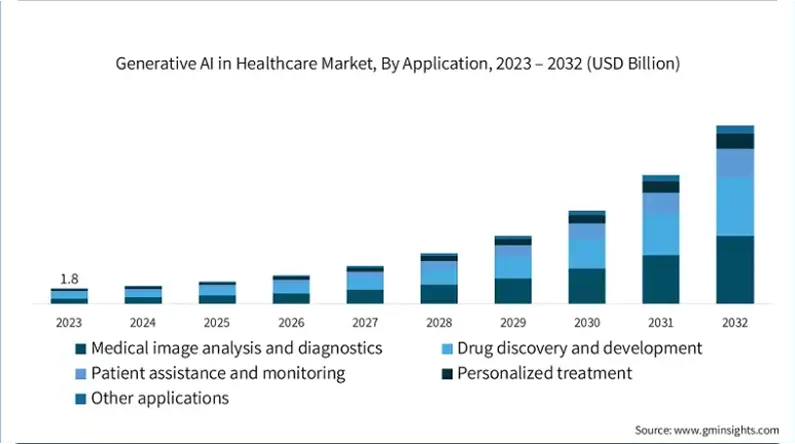
Generative AI is transforming healthcare with rapid adoption across diagnostics, drug discovery, personalized treatment, and operations. The market is expected to hit USD 39.8 billion by 2035 (Roots Analysis) and grow at a CAGR of 31.5% through 2032, with APAC leading the surge (SNS Insider).
Autonomous Clinical Agents Will Redefine Routine Care
Soon, we’ll see specialized generative AI agents managing entire clinical workflows—from symptom intake to scheduling diagnostics and sending personalized follow-ups. Acting like always-available junior clinicians, these agents will reduce administrative burden, prevent missed care, and allow human providers to focus on complex cases.
Personalized Medical Narratives Will Improve Patient Understanding
Instead of one-size-fits-all health instructions, AI will craft individualized narratives based on a patient’s health status, language preferences, and comprehension levels. This could dramatically improve treatment adherence and shared decision-making, especially in chronic care or post-surgical settings.
Digital Twins Will Transform Treatment Planning
Generative models will enable digital simulations of patient physiology and disease progression—allowing clinicians to experiment with treatment options in a virtual environment. These patient-specific “testbeds” could reduce trial-and-error in oncology, cardiology, and critical care.
Real-Time Research Companions Will Empower Clinicians
Imagine a clinician who no longer needs to Google or search PubMed. Generative AI will offer contextual insights drawn from the latest research—right within the clinical workflow. This will keep practitioners aligned with evolving guidelines and improve evidence-based care at scale.
Native AI-Driven Workflows Will Rewire Health Systems
Instead of retrofitting AI into existing systems, future hospitals will be designed with generative intelligence at their core. Documentation, billing, diagnostic decision-making—all will be co-authored by AI, drastically reducing operational drag and screen time for clinicians.
Federated AI Models Will Enable Secure Global Collaboration
Through federated learning, hospitals and research centers can co-train models without sharing sensitive patient data. This will enhance the accuracy and generalizability of generative AI across rare diseases, diverse populations, and low-data environments—while preserving privacy.
Generative AI Will Become a Lab Partner in R&D
In pharma and biomedical labs, AI won’t just assist with data—it will ideate, simulate, and iterate. From drug design to clinical protocol drafting, generative tools will shrink the time from research question to tested hypothesis, accelerating innovation in ways never seen before.
How Algoscale Facilitates Generative AI Deployment
The transition from pilot projects to production-ready generative AI in healthcare requires more than just models- it demands infrastructure, governance, domain understanding, and orchestration, This is where Algoscale steps in as a strategic partner, empowering healthcare organizations to harness the full spectrum of Generative AI for healthcare use cases-securely, ethically, and at scale.
From clinical data pipelines to intelligent agent deployment, Algoscale simplifies the end-to-end lifecycle of generative AI-from ideation to ROI.
Bridging the gap between Healthcare Expertise and AI Intelligence
Algoscale brings deep experience at the intersection of AI, life sciences, and data engineering. Unlike generic solution vendors, Algoscale works with hospitals, medtech companies, and digital health platforms to translate clinical challenges into AI-ready workflows. This includes:
- Structuring and anonymizing EHR, imaging, genomic, and device data
- Building foundation models tailored to medical language and imaging formats
- Ensuring HL7/FHIR interoperability across systems
- Applying reinforcement learning and prompt tuning to optimize AI accuracy in clinical environments
By anchoring generative models in domain-specific context, Algoscale ensures that outputs are not only accurate—but actionable in a regulated healthcare setting.
Arcastra™: The Orchestration Layer That Makes AI Production-Ready
At the heart of Algoscale’s deployment strategy is Arcastra™, a powerful AI orchestration platform that transforms experimental generative models into enterprise-grade healthcare agents.
Arcastra acts as the “mission control” for generative AI—managing model lifecycles, data access policies, workflows, and human-in-the-loop feedback, all within a secure, compliant environment.
Here’s how Arcastra supports generative AI deployment in healthcare:
- Workflow Orchestration: Automates tasks like note generation, report summarization, and triage—triggering the right model at the right time based on context.
- Role-Based Guardrails: Ensures only authorized personnel can approve or edit AI-generated content—critical in clinical and diagnostic environments.
- Real-Time Monitoring & Feedback Loops: Continuously learns from user feedback, clinical outcomes, and edge-case scenarios to fine-tune models without manual retraining.
- Multi-Agent Coordination: Seamlessly integrates multiple LLMs, voice models, and vision-based tools—allowing, for example, an AI scribe, AI radiologist, and drug discovery engine to operate within the same framework.
- Auditability & Compliance: Every AI output, decision, and revision is logged—ensuring transparency for HIPAA, FDA, and institutional review boards.
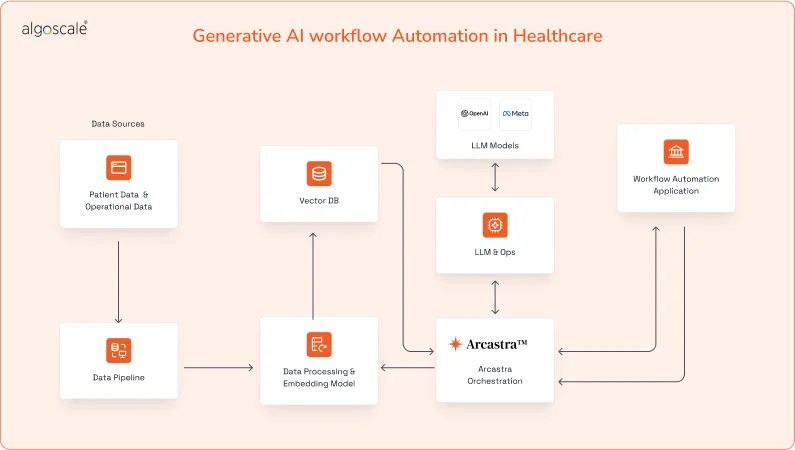
This architecture illustrates how Generative AI in healthcare workflow is orchestrated from raw data to actionable automation. At the core of this setup is Arcastra™, Algoscale’s orchestration engine, which governs the flow of data, coordinates model usage, and ensures regulatory-safe execution.
It connects seamlessly with workflow automation applications, enabling real-time decision support, task execution, and clinician assistive tools. With feedback loops built in, this system learns continuously-driving smarter outcomes with each interaction.
With Arcastra, healthcare organizations get more than model inference—they get a fully governed, interoperable system designed to scale.
Beyond Tools: Strategic Guidance & Customization
Algoscale doesn’t just build models—it partners with healthcare stakeholders across the AI lifecycle:
- Discovery Workshops: Identify high-impact generative AI use cases tailored to the organization’s strategic goals.
- AI Maturity Assessments: Evaluate readiness across infrastructure, data governance, and clinical adoption.
- Custom Model Training & Hosting: Whether it’s fine-tuning BioGPT for discharge summaries or customizing a vision-language model for surgical planning—Algoscale delivers.
- Change Management & Enablement: Ensures clinicians and operational teams understand, trust, and successfully adopt the AI systems deployed.
Why It Matters
In a domain where AI must be precise, explainable, and ethical, Algoscale delivers the orchestration, customization, and governance required to move from potential to performance.
With Generative AI in healthcare evolving rapidly, organizations that partner with infrastructure-forward players like Algoscale—and leverage orchestration platforms like Arcastra™—will be best positioned to lead.
To see how we’re also driving innovation in other sectors, check out our related services in Generative AI in banking and Generative AI in manufacturing.
Conclusion
From streamlining diagnostics to accelerating drug discovery and automating documentation, Generative AI in healthcare isn’t a distant vision—it’s happening now. But the difference between experimentation and real-world impact lies in how intelligently these systems are built, deployed, and orchestrated.
That’s where Algoscale comes in.
With deep expertise in AI development and healthcare data systems, Algoscale empowers healthcare organizations to move from pilot to production with confidence.
At the core of our deployment strategy is Arcastra™, our proprietary orchestration engine that acts as the glue between models, data pipelines, and automation layers. It ensures that your generative AI applications are not only scalable and compliant—but also deeply contextualized to your operations.
Whether you’re looking to build ambient AI scribes, predictive diagnostic systems, or automate repetitive clinical workflows—Algoscale + Arcastra™ gives you the infrastructure and intelligence to make it happen.
Ready to bring Gen AI to the frontline of healthcare?
Partner with Algoscale and turn your vision into scalable, secure, real-world impact.
Frequently Asked Questions
1. What is the difference between traditional AI and generative AI in healthcare?
Traditional AI typically focuses on classification, prediction, or automation based on existing data. Generative AI, on the other hand, creates new content—such as clinical notes, drug molecules, or treatment plans—by learning from complex medical datasets, making it ideal for creative, research-heavy, or language-based healthcare tasks.
2. Is generative AI safe to use in clinical environments?
While generative AI offers transformative potential, its safety depends on proper deployment, validation, and oversight. Solutions must be rigorously tested, audited for bias, and embedded with guardrails. At Algoscale, we use Arcastra™ orchestration to ensure each model output aligns with medical standards and workflows—minimizing hallucinations and ensuring auditability.
3. Can generative AI integrate with existing EHR and healthcare IT systems?
Yes. Modern generative AI platforms can be seamlessly integrated with Electronic Health Records (EHRs), Picture Archiving and Communication Systems (PACS), and other healthcare IT systems via APIs and secure data pipelines. Tools like Arcastra™ help manage this integration while maintaining compliance and interoperability.
How does generative AI handle sensitive patient data?
Data privacy and security are critical. Generative AI models used in healthcare must comply with regulations like HIPAA or GDPR. At Algoscale, we ensure data encryption, anonymization, and fine-grained access controls as part of every deployment, with Arcastra™ managing secure data flow and permissions across the pipeline.
5. What are some practical applications of generative AI already in use today?
Examples include AI-powered radiology report generation (Bayer), clinical note automation (Mass General Brigham), and AI-discovered drugs in clinical trials (Insilico Medicine). These implementations show that generative AI is no longer experimental—it’s being used to solve real clinical, operational, and research challenges today.
6. How can my organization get started with generative AI in healthcare?
Start by identifying a high-impact use case—like documentation automation, diagnostics support, or drug discovery—and consult with a specialized AI partner. Algoscale offers tailored workshops, pilot programs, and full-scale deployment strategies powered by Arcastra™, ensuring you move from idea to impact with clarity and speed.

Sai Aparna
Sai Aparna Pochiraju is a Content Marketer with nearly four years of experience in digital marketing. She specializes in content strategy and brand storytelling, helping businesses engage audiences and achieve measurable digital growth.