

About the Company.
A rapidly scaling, VC-backed Voice AI platform delivering conversational automation across messaging and voice channels. The company supports high-volume enterprise clients globally and requires robust backend infrastructure to support real-time product usage tracking, billing automation, and revenue performance dashboards, powered by Salesforce as the primary data source.
Solution Summary.
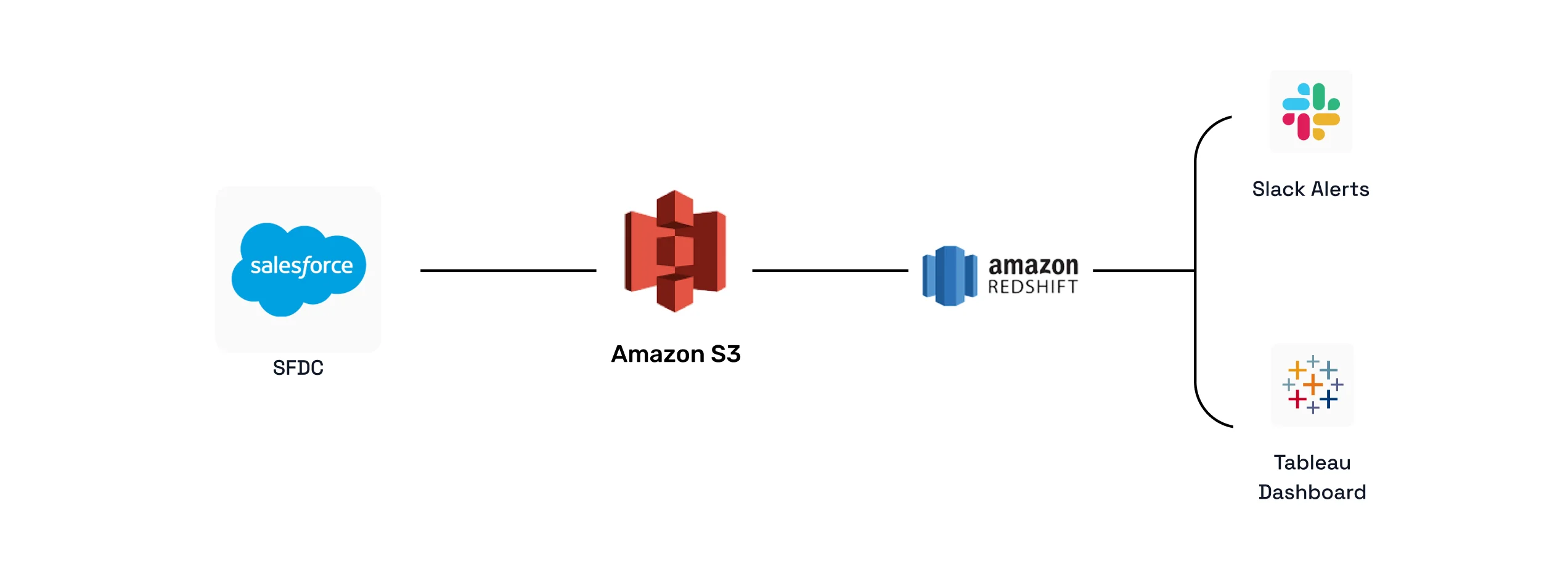
To meet the company’s demand for a cloud-native, scalable, and audit-compliant data infrastructure, Algoscale built a fully automated data pipeline to ingest complex Salesforce data, transform it into analytics-ready formats, and serve business teams with real-time Tableau dashboards, The pipeline was designed with low-latency ingestion, high-throughput data processing, and enterprise-grade monitoring and alerting.
Customer Challenges.
The customer operated in a complex environment with evolving business needs and a rapidly growing data footprint. As part of their digital transformation journey, several key challenges were identified that needed to be addressed to enable greater efficiency, scalability, and data-driven decision-making
Complex SFDC Schema.
Key data was distributed across multiple Salesforce objects with nested fields, making cross-object joins and flattening difficult.Manual, Error-Prone Billing Workflows.
Revenue operations depended on spreadsheets and manual reconciliations.Security Requirements.
Required granular access control including row-level security (RLS) for tableau and secure AWS resource management.Latency in Reporting.
Business stakeholders lacked visibility into updated metrics due to delays in data refresh.Scalability & Governance.
No orchestration layer for handling scheduling, failure recovery, data validation, or access control.
Algoscale Solution.
Algoscale, a leading Data Consulting and AI Services Company delivered an end-to-end, production-grade data pipeline using AWS-native tools and advanced orchestration principles. Key implementation components include:
Orchestration Setup and Infrastructure Provisioning.
- Deployed Apache Airflow initially on Kubernetes (EKS) for POC, then transitioned to AWS Managed Workflows for Apache Airflow (MWAA) for production
- Infrastructure provisioned with Terraform, including:
- S3 buckets for staging and archival
- Amazon Redshift clusters with reserved nodes
- Custom IAM policies for least-privilege access across services
- VPC with private endpoints for API traffic isolation
Redshift Optimization and Data Modeling.
- Built columnar, query-optimized fact tables in Redshift
- Configured:
- DISTKEY/SORTKEY strategies based on query patterns and joins
- Materialized Views (MVs) for frequently accessed dimensions and KPIs
- Automatic MV refresh schedules embedded in DAG logic
- Enabled Redshift workload management queues and Query Monitoring Rules (QMRs) for resource governance
Salesforce Data Ingestion.
- Developed modular Airflow DAGs with task separation for:
- Incremental ingestion using Salesforce REST API with SQL queries
- Pagination handling to support high-volume object pulls
- Dynamic schema mapping using Python and Pandas, to flatten nested JSONs and enforce typecasting
- Configured object-specific field filters to optimize API call efficiency and minimize payloads
- Developed modular Airflow DAGs with task separation for:
Data Transformation and Validation.
- Transformation layer included:
- JSON normalization and flattening
- Surrogate key creation for deduplication and historical tracking
- Partition logic for efficient Redshift loading
- Schema validation checks using PyDeequ and Pandera
- Implemented delta detection logic using hash comparison to skip unchanged records and reduce compute usage
- Transformation layer included:
Workflow Monitoring and Alerting.
- Integrated Slack-based alerting hooks for ingestion success/failure notifications, SLA breaches, and data reconciliation mismatches
- Used Airflow callbacks for task-level exception tracking and retries
- Created detailed execution logs and audit trails using custom logging modules pushed to S3 and CloudWatch
Tableau Integration and Governance.
- Integrated Tableau with Redshift using dedicated service accounts
- Implemented Row-Level Security (RLS) policies using user-region mapping tables
- Established a semantic layer for reusable calculated fields and filters
- Connected Tableau dashboards to version-controlled published data sources, ensuring reproducibility and audit-readiness
Algoscale Differentiators.
- Deep expertise in Salesforce API integration, schema mapping and incremental data extraction.
- Proficiency in orchestration engineering, building resilient DAGs with parallel execution, dependency management, and SLA enforcement,
- Production-ready implementations with built-in observability, self-healing workflows, and modular architecture
- Emphasis on data governance, with audit-compliant schema validation, filed-level filtering, and secure role-based access.
- Ability to tune large-scale Redshift workloads through detailed query profiting and cost-optimization.
Values Delivered.
Operational Accuracy.
Fully automated billing workflows, reducing manual errors by over 85% and eliminating reporting gaps.High Reliability.
Pipeline achieved a 99.9% daily success rate with robust failure recovery mechanisms.Real-Time Visibility.
Cut data lag from 6-12 hours to under 60 minutes, enabling near real-time Tableau dashboards refreshed up to 24 times per day.Scalable Architecture.
Pipeline scaled to handle 20+ Salesforce objects, 100K+ daily records, and integrated with downstream tools including Tableau and internal BI systems with zero reengineering.
Powered by Arcastra’s™ Custom Agent - a backend automation agent that orchestrates ingestion, transformation, and governance across complex enterprise data stacks. In this case, the agent seamlessly integrates Salesforce, Redshift, and Tableau with real-time monitoring, audit trails, and governed access- enabling downstream analytics agents to deliver high-accuracy, low-latency insights.
Workflow.