

Financial services institutions operate in one of the most data-intensive and tightly regulated environments in the world. Banks, insurers, capital markets firms, and wealth management platforms generate trillions of data points daily from transaction streams and market feeds to credit applications and customer interactions all while navigating a regulatory landscape that grows more complex with every reporting cycle.
The traditional answer to this challenge was a patchwork of purpose-built systems: a data warehouse for risk reporting, a separate fraud platform, a siloed ML environment, and a compliance data store that nobody could query in real time. The result was fragmented governance, duplicated data, delayed insights, and infrastructure costs that scaled faster than the business.
Databricks for financial services data platforms offers a fundamentally different model: a unified data intelligence platform where fraud detection, credit risk analytics, regulatory compliance reporting, capital markets analysis, and AI model training all run on the same governed, auditable data foundation. This guide covers the architecture, the use cases, and the partner criteria for making this transformation a reality.
Why Financial Services Firms Need a Modern Data Platform
The gap between the data capabilities of leading financial institutions and their peers is widening rapidly. Firms that have modernized their financial services data platform are delivering fraud decisions in milliseconds, generating credit risk analytics in minutes rather than days, and operationalizing AI models that were previously trapped in data science notebooks. Those still running on legacy architectures are losing ground in every dimension.
The Legacy Architecture Problem in Banking Data
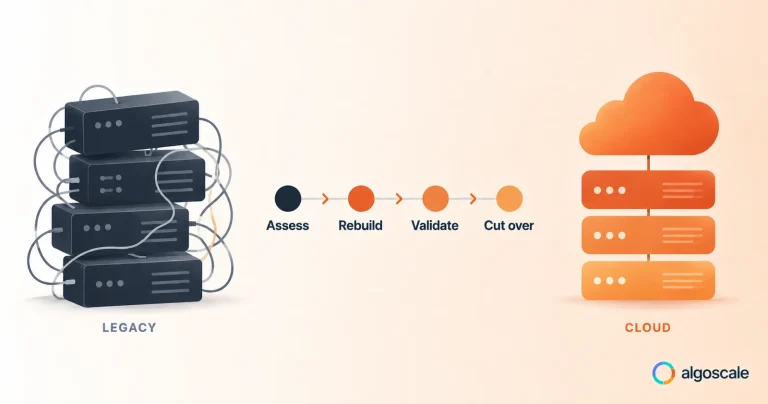
Most financial institutions built their data infrastructure in layers adding new systems over decades without replacing the ones underneath. The result is a technology stack where a single customer record may exist in seven different systems with seven different definitions, where risk data takes 48 hours to aggregate for regulatory reporting, and where the data engineering team spends more time reconciling siloed pipelines than building new capabilities.
Banking data modernization is not a discretionary investment it is a competitive and regulatory imperative. Regulators increasingly expect firms to demonstrate real-time data quality, complete lineage, and auditability across all risk metrics. Legacy systems structurally cannot meet these requirements.
Regulatory Pressure as a Data Catalyst
The regulatory environment for financial data has never been more demanding. BCBS 239 requires banks to demonstrate aggregated risk reporting capabilities with daily granularity. Basel III mandates capital calculations that require accurate, timely data across all exposure classes. MiFID II imposes transaction reporting obligations with T+1 deadlines. GDPR and equivalent regulations require documented data lineage, purpose limitation, and the right to erasure across petabytes of customer data.
Each of these requirements individually stresses legacy systems. Taken together, they make the case for a unified financial services data platform where compliance is an architectural feature, not a retrofit.
How Databricks Addresses Financial Services Data Challenges
The Databricks Data Intelligence Platform was purpose-built for the scale, latency, and governance requirements that financial services data engineering demands. Unlike generic cloud data warehouses, Databricks unifies batch processing, real-time streaming, machine learning, and SQL analytics on a single open platform with Unity Catalog providing the enterprise-grade governance layer that regulated industries require.
| ⚡ Real-Time Transaction ProcessingProcess millions of transactions per second with Apache Spark Structured Streaming and Delta Lake, enabling sub-second fraud scoring and real-time position calculations. | 🔐 Unified Data Governance (Unity Catalog)A single governance model across all workspaces with column-level PII masking, row-level security, automated lineage tracking, and full audit logs essential for GDPR, BCBS 239, and MiFID II. |
| 🤖 AI and ML at Financial ScaleTrain, deploy, and monitor credit risk models, fraud scoring engines, and AML pattern detectors with MLflow and Databricks Model Serving all on governed, lineage-tracked training data. | 📊 Open Format No Vendor Lock-inDelta Lake files are readable by any Parquet-compatible tool. Financial institutions retain full data portability and avoid the proprietary lock-in that drives up costs in legacy warehouses. |
| 🌍 Multi-Cloud and Hybrid ArchitectureDatabricks runs on AWS, Azure, and GCP with cross-region data sharing capabilities critical for global banks managing data residency requirements across jurisdictions. | 💰 FinOps for Financial DataDecoupled compute and storage eliminates the provisioned-capacity waste of traditional data warehouses. Pay only for compute consumed, with cluster policies enforcing cost guardrails at scale. |
Real-Time Fraud Detection and AML on Databricks
Fraud detection is one of the highest-value applications of a Databricks financial services data platform. Traditional rule-based fraud systems generate high false-positive rates and miss sophisticated fraud patterns that only emerge in aggregate behavioral analysis. A real-time fraud detection platform built on Databricks combines streaming transaction data, historical feature engineering, and machine learning scoring to deliver accurate, low-latency fraud decisions at transaction scale.
Real-Time Fraud Detection Architecture on Databricks
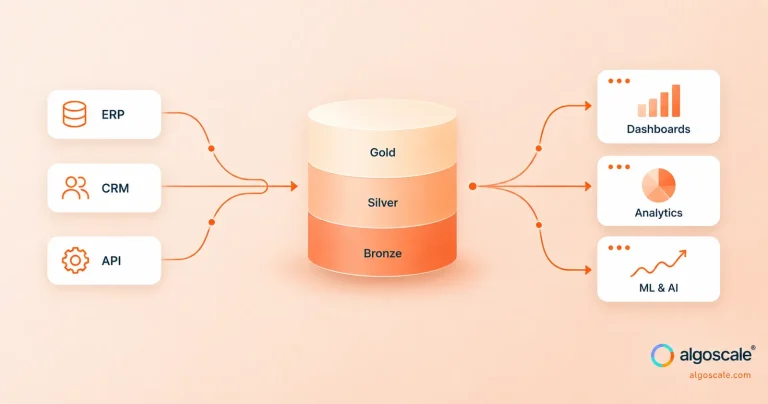
The architecture for a production fraud detection Databricks implementation follows a streaming-first medallion pattern. Transaction events arrive via Kafka or Event Hub and land in a Bronze Delta table within seconds. A Silver layer applies entity resolution (linking transactions to device fingerprints, IP addresses, and account histories) and computes real-time behavioral features using Spark Structured Streaming windowed aggregations. A Gold layer exposes a scored transaction stream where each event carries an ML-generated fraud probability.
| Layer | Fraud Detection Function | Latency Target |
| Bronze | Raw transaction ingestion from card networks, mobile apps, ACH, and wire transfers | < 500ms |
| Silver | Entity linking, velocity features (txn count per hour/day/week), merchant risk scoring | < 2 seconds |
| Gold | ML fraud score, decision (approve/flag/decline), alert routing | < 100ms |
| Feedback | Manual review outcomes fed back to retrain models; false positive rate tracking | Batch daily |
Machine Learning for Fraud Scoring
Databricks enables financial services firms to move from static rule engines to dynamic, self-improving fraud models. Gradient boosting models (XGBoost, LightGBM) and deep learning architectures (Graph Neural Networks for network fraud) are trained on historical transaction data, registered in the MLflow Model Registry, and deployed via Databricks Model Serving endpoints that respond in under 50 milliseconds.
Continuous model monitoring tracks feature drift and prediction distribution shifts, triggering automated retraining when model performance degrades an essential capability in fraud detection where attacker behaviour evolves faster than manual model update cycles.
• 90% fraud detection accuracy reported by AME Digital using Databricks ML on transaction and behavioural data
• $34M in incremental fraud identified annually after deploying unified Databricks fraud analytics platform
• 34% reduction in operational costs attributed to automated fraud decisioning replacing manual review queues
AML Data Platform and KYC Architecture
Anti-money laundering (AML) and Know Your Customer (KYC) workloads require a different data architecture than transactional fraud. An AML data platform on Databricks centralises transaction monitoring, customer risk scoring, SAR (Suspicious Activity Report) workflows, and correspondent banking analytics on a single governed platform.
Graph analytics capabilities using GraphX or the Databricks partner ecosystem enable network-based AML detection where unusual money movement patterns are identified not by individual transaction rules but by the topology of fund flows across accounts, entities, and counterparties. This approach catches layering and structuring schemes that rule-based systems consistently miss.
Credit Risk Analytics and Loan Decisioning
Credit risk analytics is the engine of profitability for banks and lending institutions. A modern credit risk analytics platform on Databricks replaces fragmented SAS, Excel, and legacy warehouse workflows with a unified environment where data ingestion, feature engineering, model training, regulatory stress testing, and executive reporting all run from the same governed data foundation.
ML-Powered Credit Scoring
Traditional credit scoring relies on a narrow set of bureau features (FICO, VantageScore) computed on a monthly snapshot. A Databricks financial services data platform enables next-generation credit scoring that incorporates alternative data sources transaction patterns, payment timing, cash flow volatility, and behavioural signals updated in near real-time as new data arrives.
ML credit models trained in Databricks consistently outperform traditional scorecards on Gini coefficient and KS statistic metrics, enabling financial institutions to extend credit to previously underserved segments while maintaining or improving portfolio risk metrics.
| 📈 Better Gini CoefficientsML credit scoring models on Databricks typically improve Gini coefficients by 8–15 points over traditional bureau-only scorecards, translating to lower loss rates at equivalent approval rates. | 🔄 Real-Time Score RefreshDelta Lake enables credit scores to be refreshed continuously as new transaction data arrives, not just on monthly bureau refresh cycles capturing risk signals before they become delinquencies. |
| 📋 Explainability for RegulatorsSHAP value explanations integrated into the MLflow model card provide the adverse action reason codes required by Equal Credit Opportunity Act (ECOA) and GDPR Article 22. | 🌍 Alternative Data IntegrationOpen banking transaction data, rental payment history, and telco signals can be ingested and feature-engineered in the same Databricks environment as traditional bureau data. |
IFRS 9 and Stress Testing on Databricks
IFRS 9 requires financial institutions to compute Expected Credit Loss (ECL) across all financial instruments on a forward-looking, scenario-weighted basis. This requires point-in-time probability of default (PD), loss given default (LGD), and exposure at default (EAD) models across millions of facilities, run against multiple macroeconomic scenarios quarterly.
On legacy platforms, IFRS 9 computation cycles often take 48–72 hours. On Databricks, distributed Spark computation across a tuned cluster reduces ECL calculation time to 2–4 hours for portfolios of comparable size enabling finance teams to run additional sensitivity scenarios and improve model accuracy without extending reporting windows.
Retail and Commercial Credit Portfolio Analytics
Gold-layer aggregations in a credit risk data lakehouse support portfolio-level reporting vintage curves, roll rate matrices, concentration analyses, and early warning indicator dashboards delivered to business stakeholders via Databricks SQL dashboards that refresh on the arrival of new data rather than on fixed overnight schedules.
Regulatory Compliance: BCBS 239, Basel III, GDPR, and MiFID II
Regulatory compliance is the most demanding data engineering workload in financial services. A regulatory compliance data platform must deliver accurate, auditable, lineage-tracked data for risk reporting, capital calculations, transaction reporting, and privacy compliance across jurisdictions, business lines, and asset classes within tight regulatory deadlines.
Databricks Unity Catalog transforms regulatory compliance from a manual, error-prone process into a systematic, automatable capability that is embedded in the platform architecture.
BCBS 239 Compliance and Risk Data Aggregation
BCBS 239 (Basel Committee on Banking Supervision Principles for Effective Risk Data Aggregation and Risk Reporting) requires global systemically important banks to demonstrate that risk data can be aggregated accurately and rapidly including on an ad hoc basis in stress scenarios. The 11 principles cover data governance, data architecture, accuracy, completeness, timeliness, adaptability, and distribution of risk reports.
A Databricks financial data governance architecture directly addresses BCBS 239’s core requirements. Unity Catalog provides automated column-level lineage every risk metric can be traced back to its source system with full transformation history. Delta Lake’s transaction log provides the immutable audit trail required for data accuracy attestations. Workflow orchestration with Databricks Workflows ensures that aggregation processes complete within defined SLA windows.
| BCBS 239 Principle | Databricks Capability | Implementation Approach |
| Data Governance | Unity Catalog ownership, stewardship, and policy enforcement | Assign data product owners; implement approval workflows for schema changes |
| Data Architecture | Delta Lake open format; single source of truth per risk domain | Enforce one Bronze table per source; Silver as canonical risk store |
| Accuracy & Integrity | Delta ACID transactions; DLT data quality expectations | Expectation constraints on all Silver writes; automated reconciliation jobs |
| Completeness | Auto Loader source coverage monitoring; lineage gap detection | Alert on missing source data; completeness metrics in Unity Catalog |
| Timeliness | Streaming ingestion; SLA monitoring via Databricks Workflows | Alert on pipeline latency; escalation workflows for missed SLA windows |
| Adaptability | Unity Catalog schema evolution; parameterised reporting pipelines | Support ad hoc scenario runs; API-driven report configuration |
| Distribution | Databricks SQL dashboards; scheduled PDF delivery via API | Role-based dashboard access; automated regulatory report generation |
GDPR and Data Privacy Controls
GDPR compliance on a financial data platform requires column-level masking for PII fields, documented data retention policies, and the ability to action right-to-erasure requests across all data stores. Unity Catalog’s dynamic data masking ensures that analysts querying customer data see masked values (e.g., hashed account numbers, truncated dates of birth) automatically without any changes to queries or downstream reports.
For right-to-erasure (Article 17), Delta Lake’s GDPR-grade deletion capability enables targeted row-level deletion by customer identifier across all Delta tables in the lakehouse, with changes propagated to downstream Silver and Gold tables through lineage-aware pipeline reruns.
MiFID II Transaction Reporting and EMIR Compliance
MiFID II requires investment firms to report all transactions in financial instruments to national competent authorities on T+1 timelines with 65 required data fields per transaction. EMIR imposes similar obligations for derivatives. These reporting regimes require a data platform that can ingest trade data from execution management systems, enrich it with reference data (LEI, ISIN, venue identifiers), validate it against regulatory schemas, and submit reports within the required window.
A Databricks MiFID II reporting pipeline ingests trade events via structured streaming, applies reference data enrichment at the Silver layer, runs regulatory validation rules via Delta Live Tables expectations, and generates submission files at the Gold layer all with full lineage and audit trail for regulatory examination.
Capital Markets and Market Risk Analytics on Databricks
Capital markets firms, investment banks, broker-dealers, hedge funds, and asset managers operate some of the world’s most demanding data workloads. Market data volumes run to terabytes per day. Risk calculations (VaR, CVA, PFE) require Monte Carlo simulations across thousands of scenarios. P&L attribution requires reconciling positions across dozens of trading books, multiple asset classes, and competing valuation models.
A capital markets data platform on Databricks handles these workloads natively, replacing the fragmented combination of on-premises risk engines, cloud VMs, and overnight batch jobs with a unified, elastic compute environment.
Market Data Ingestion and Management at Scale
Real-time market data from Bloomberg, Refinitiv, ICE, and exchange direct feeds arrives at rates of millions of events per second during peak market hours. Databricks Auto Loader and Spark Structured Streaming ingest these feeds into Bronze Delta tables with sub-second latency, maintaining a complete tick history that supports both real-time risk calculations and historical analytics (backtesting, time-series modelling).
Value-at-Risk (VaR) and Counterparty Risk Calculations
Monte Carlo VaR and Historical Simulation VaR calculations are embarrassingly parallel; each scenario is independent of the others. Databricks’ distributed Spark architecture is ideally suited for these workloads: a 500-scenario VaR calculation that takes 6 hours on a single on-premises server completes in 12 minutes on a Databricks cluster with appropriate parallelisation. Credit Valuation Adjustment (CVA) and Potential Future Exposure (PFE) calculations benefit from the same architecture.
• Historical Simulation VaR across 5,000 scenarios for a 10,000-instrument portfolio: from 4 hours to 18 minutes on Databricks
• Monte Carlo CVA calculation for 500,000 OTC derivatives: from overnight batch to 45-minute intraday run
• Intraday P&L flash reporting: real-time position aggregation replacing 3-hour end-of-day batch cycle
Position Management and P&L Reporting
Gold-layer aggregations in a capital markets lakehouse support front-office and risk management reporting: real-time position summaries by trader, desk, and book; P&L attribution by risk factor; limit utilisation monitoring with automated breach alerts; and Greeks aggregation for options portfolios. Databricks SQL dashboards deliver these views to trading desks and risk managers with refresh latencies of seconds rather than hours.
Insurance Analytics and Wealth Management on Databricks
Insurance Analytics Platform: Claims, Fraud, and Actuarial Modelling
Insurance carriers generate data across the full policy lifecycle underwriting applications, policy issuance, premium payments, claims submissions, claims investigations, and renewals with each touchpoint involving structured, semi-structured, and unstructured data (documents, images, audio recordings). An insurance analytics platform on Databricks unifies these data sources in a lakehouse architecture where actuarial models, claims processing workflows, and fraud detection all operate on the same governed data.
| 🔍 Claims Fraud DetectionML models trained on historical claims data identify suspicious patterns, duplicate submissions, inflated valuations, staged accidents with higher accuracy than rule-based systems and lower false positive rates. | 📐 Actuarial Modelling at ScaleGeneralized Linear Models (GLMs) and gradient boosting for pricing, reserve estimation, and catastrophe modelling run in Databricks with 9x performance improvements over legacy SAS-based actuarial workflows. |
| 🔄 Straight-Through ProcessingLow-severity claims routed through automated ML-powered decisioning reduce average claims cycle time from 8 days to under 4 hours for eligible claims. | 🌍 Regulatory Solvency ReportingSolvency II and IFRS 17 reporting pipelines run on the same Delta tables as actuarial models eliminating reconciliation between reporting and pricing environments. |
Wealth Management Data Platform: Customer 360 and Portfolio Analytics
Wealth management firms compete on the quality of personalised advice and the sophistication of portfolio analytics. A wealth management data platform on Databricks enables Customer 360 a unified, continuously updated view of each client’s holdings, risk tolerance, life stage, tax situation, and engagement history that powers both advisor-facing tools and automated portfolio recommendation engines.
Northwestern Mutual deployed a Databricks-based advisor platform serving 10,000 financial advisors and millions of customers, reducing data load time from 7 hours to 2 hours and compressing time-to-market for new analytical capabilities from 4–6 weeks to 1–2 weeks.
• Personalised portfolio recommendations powered by ML models trained on Client 360 data
• Real-time portfolio rebalancing triggers based on market events and client life-stage changes
• Tax-loss harvesting analytics running as automated Databricks Workflows jobs on daily portfolio snapshots
• Advisor performance analytics and client retention risk scoring in Databricks SQL dashboards
Financial Data Governance with Unity Catalog

Financial data governance is not a checklist exercise; it is an architectural requirement that determines whether a financial services data platform can scale to meet regulatory obligations, enable cross-team data sharing, and support the AI and analytics ambitions of the business. Unity Catalog provides the governance infrastructure that makes all of this possible on Databricks.
Data Lineage for Regulatory Audits
Unity Catalog automatically captures column-level lineage for every transformation in the Databricks platform from source system ingestion to final regulatory report. This lineage graph is queryable, enabling compliance teams to answer regulators’ data provenance questions in minutes rather than weeks. When a source system changes its schema, the impact on downstream risk metrics is immediately visible through the lineage graph, enabling proactive remediation before reporting deadlines are missed.
Column-Level PII Masking and Row-Level Security
Financial institutions handle vast quantities of personally identifiable information (PII) account numbers, tax identification numbers, dates of birth, transaction histories, and more. Unity Catalog’s dynamic data masking applies masking functions at the column level, governed by user-role membership. A data analyst querying a customer table sees hashed account numbers; a compliance officer with the appropriate grant sees the full values. No changes to queries, pipelines, or reports are required; the masking is applied transparently at the engine level.
Cross-Border Data Residency and Sovereignty
Global financial institutions must ensure that customer data is processed and stored in compliance with jurisdictional data residency requirements EU data must not leave EU regions, certain data must remain on-premises in specific countries. Unity Catalog’s workspace federation model enables a single governance policy layer across multiple cloud regions and workspace configurations, making cross-border data residency compliance manageable at scale.
Databricks Financial Services Architecture: Best Practices
Building a production-grade financial services data platform on Databricks requires architectural decisions that balance performance, governance, cost, and regulatory compliance. The following best practices represent lessons from deployments across banking, insurance, capital markets, and wealth management.
| Architecture Decision | Recommended Approach | Why It Matters |
| Storage Format | Delta Lake for all tables Bronze through Gold; never raw Parquet in production | ACID transactions, time travel, and schema enforcement are non-negotiable in regulated environments |
| PII Handling | Column masking in Unity Catalog; no application-level masking logic | Centralised masking cannot be bypassed; masking logic is not duplicated across pipelines |
| Streaming vs Batch | Streaming-first for fraud, positions, and alerts; batch for risk aggregations | Streaming reduces detection and reporting latency; batch is cost-efficient for large aggregations |
| Cluster Architecture | Job clusters for scheduled workloads; serverless SQL for interactive analytics | All-purpose clusters left running are the leading cause of unexpected Databricks cost overruns |
| Model Governance | All models registered in MLflow Model Registry with challenge model comparisons | Regulatory model risk management (SR 11-7 equivalent) requires documented model lifecycle |
| Lineage | Auto-capture via Unity Catalog; no manual lineage documentation | Manual lineage is always out of date; automated lineage is always accurate and queryable |
| Disaster Recovery | Multi-region Delta table replication; point-in-time restore tested quarterly | Regulators require documented, tested recovery procedures for critical data infrastructure |
How AlgoScale Delivers Databricks for Financial Services
AlgoScale has built its financial services data engineering practice on a single principle: compliance-first architecture is not a constraint on innovation, it is the foundation that makes innovation sustainable. Every Databricks financial services engagement we deliver begins with regulatory requirements and governance design, then layers analytics, ML, and operational capabilities on top of that foundation.
Our Financial Services Delivery Framework
• Phase 1 – Regulatory Mapping and Data Inventory (2–3 weeks): Map applicable regulations (BCBS 239, Basel III, GDPR, MiFID II, Solvency II, IFRS 9/17) to data requirements; inventory all source systems and assess data quality, lineage gaps, and governance readiness
• Phase 2 – Compliance-First Architecture Design (2–4 weeks): Unity Catalog taxonomy, PII classification and masking policies, data residency architecture, lineage capture strategy, and regulatory reporting pipeline design
• Phase 3 – Core Platform Build (4–8 weeks): Cloud infrastructure provisioning, Unity Catalog deployment, Auto Loader ingestion for priority data domains, Bronze and Silver medallion layers for risk and customer data
• Phase 4 – Use Case Development (4–12 weeks): Fraud detection ML pipeline, credit risk scoring, BCBS 239 / Basel III reporting, MiFID II transaction reporting, or capital markets analytics in priority order by business value
• Phase 5 – AI and Advanced Analytics (4–8 weeks): MLflow infrastructure, Model Registry governance workflows, model serving endpoints, and model risk management documentation aligned to SR 11-7 / ECB model risk requirements
• Phase 6 – Optimisation, Enablement, and Handover (3–4 weeks): FinOps review, performance tuning, team training (engineers, quants, compliance, analysts), and full documentation package
The Future of Financial Services Runs on a Modern Data Foundation
The case for Databricks as the foundation for a modern financial services data platform is clear. No other platform combines the streaming performance required for real-time fraud detection, the governance capabilities required for BCBS 239 and GDPR compliance, the ML infrastructure required for credit risk and AML model deployment, and the analytics performance required for capital markets and actuarial workloads all on a single, open, auditable architecture.
Financial services firms that build on Databricks gain a platform that scales with their data volumes, adapts to new regulatory requirements without architectural redesign, and enables the AI-driven capabilities real-time fraud prevention, dynamic credit pricing, personalized wealth management that differentiate leaders from laggards.
The question is not whether to modernise your financial services data platform. It is whether you have the right partner to do it with the governance, precision, and regulatory awareness that your industry demands.