


Key insights
- Throwing raw data into a cloud bucket is not architecture. If you get the structural model wrong early, your compute costs will spiral before a single analyst runs a query.
- Choosing between dimensional modelling and Data Vault 2.0 is the single most consequential architectural decision your engineering team will make. Get this wrong and every downstream pipeline inherits the mistake.
- Modern cloud warehouses have killed the case for traditional ETL. Land raw data first, transform in place using SQL-first tools, and never lose the ability to reprocess history.
- Silent data downtime is more dangerous than a loud pipeline crash. Broken records slipping quietly into your analytical tables will poison executive reporting for weeks before anyone notices.
- Governance cannot be bolted on after launch. Role-based access, dynamic masking, and column-level lineage must be baked in from sprint one or your compliance team will block go-live.
- Scope creep is the single fastest way to blow your budget. Lock each sprint’s requirements ruthlessly and push every new dashboard request to the backlog.
- A data warehouse is not a project with a finish date. It is a living software product that must evolve continuously alongside your business operations.
According to recent market forecasts by Research and Markets, the global cloud data warehouse sector is projected to hit an incredible $14.53 billion in 2026. Businesses are pouring massive budgets into modern data architecture. Yet, speak privately to most data engineering leads, and they will admit their shiny new platforms are struggling. Dashboards load sluggishly, analysts argue over conflicting revenue figures, and pipelines break every time a source system changes a column name.
The reality is that provisioning cloud infrastructure is simple, but figuring out how to build a data warehouse that actually scales with your business is exceptionally difficult. An out-of-the-box software licence cannot fix broken business logic. If you want your analytics to drive genuine commercial growth, you need a highly disciplined data warehouse implementation.
This guide breaks down exactly how top-tier engineering teams approach this challenge. We will explore the architectural choices, the hidden technical debt, and the specific data warehouse best practices you must follow to guarantee a successful rollout.
Adopting the Right Data Warehouse Implementation Methodology
Historically, IT departments treated data projects like building a bridge. They would spend eight months gathering requirements, six months writing code, and three months testing. In our experience, by the time the platform finally launched, the business had already changed its operating model entirely. This rigid, waterfall approach is exactly why most legacy projects we’ve post-mortemed ended up failing.
Today, successful teams rely on an agile data warehouse implementation. Instead of trying to boil the ocean and migrate every single company metric at once, you focus on high-priority business domains. You might start purely with the marketing department. Your engineers build the raw ingestion layers, model the tables, and deliver a working revenue dashboard in four weeks. Once the marketing team signs off on the accuracy of those numbers, your engineers move on to finance.
This iterative data warehouse implementation methodology proves value early, keeps stakeholders engaged, and allows your technical team to pivot quickly if source data proves to be messier than anticipated.
In our experience, the typical timeline breaks down roughly as follows: discovery and blueprinting takes 2-4 weeks, cloud setup and pipeline engineering runs 4-8 weeks, and the first domain go-live lands around week 8-12. Each subsequent business domain adds 2-3 weeks. Most mid-market teams reach a production-ready first release within 3-4 months.
Choosing Your Core Data Warehouse Design Patterns
Throwing raw tables into a cloud bucket is a recipe for disaster. The foundation of any robust enterprise data warehouse implementation is the structural model you choose. We’ve watched compute costs spiral out of control within weeks when teams get the architecture wrong early on.
When evaluating data warehouse design patterns, you generally choose between two primary schools of thought. The first is dimensional modelling, famously championed by the Kimball Group. This approach relies on a central fact table surrounded by descriptive dimension tables, creating a star schema. This is incredibly fast for business analysts to query.
The second approach is Data Vault 2.0, which separates business keys, relationships, and descriptive attributes into distinct Hub, Link, and Satellite tables. This pattern is exceptionally resilient to frequent changes in source systems, making it a popular choice for massive, highly complex enterprise environments.
Whichever path you choose, you must adhere to strict data warehouse modeling best practices. Every table must have a clear grain. Naming conventions must be uniform across every department. Above all, you must enforce stringent data warehouse schema best practices to avoid common data warehouse design mistakes.
One of the most dangerous data warehouse anti-patterns is building massive, fully flat tables that contain a hundred wide columns. While this might seem easy for an analyst to read initially, it creates severe data duplication. Updating a single customer address suddenly requires scanning and rewriting millions of rows, driving your cloud processing bills through the roof.
Shifting from Legacy ETL to Modern ELT
A major architectural dividing line in modern implementations is how you handle data transformation. Traditional warehouses relied heavily on ETL (Extract, Transform, Load). You pulled data out of source software, ran complex transformations on a dedicated middle server, and then pushed the finished tables into the warehouse. This created an awkward bottleneck where every business logic change required updating external server code.
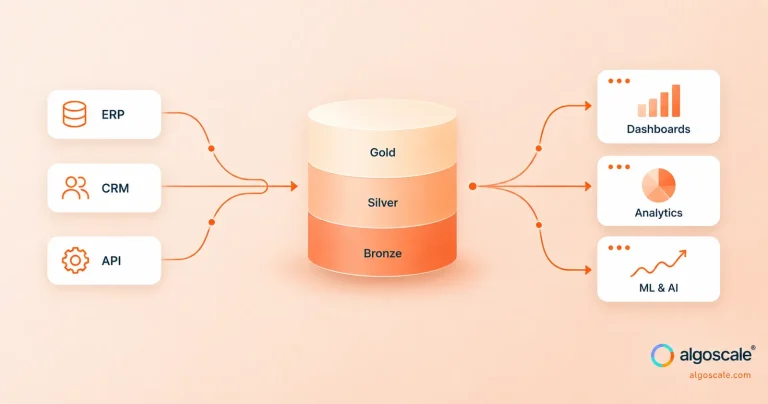
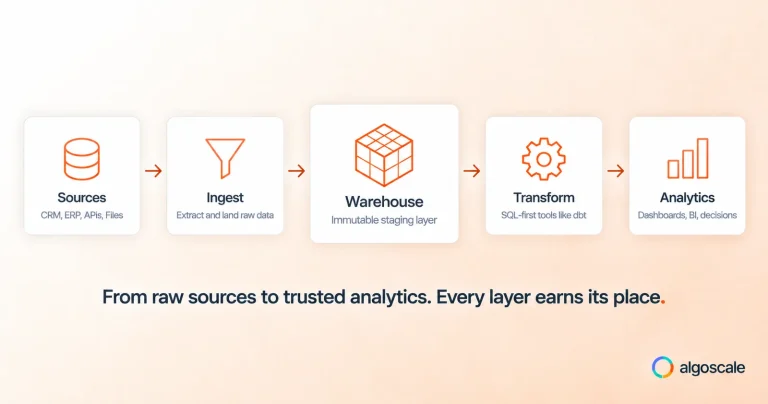
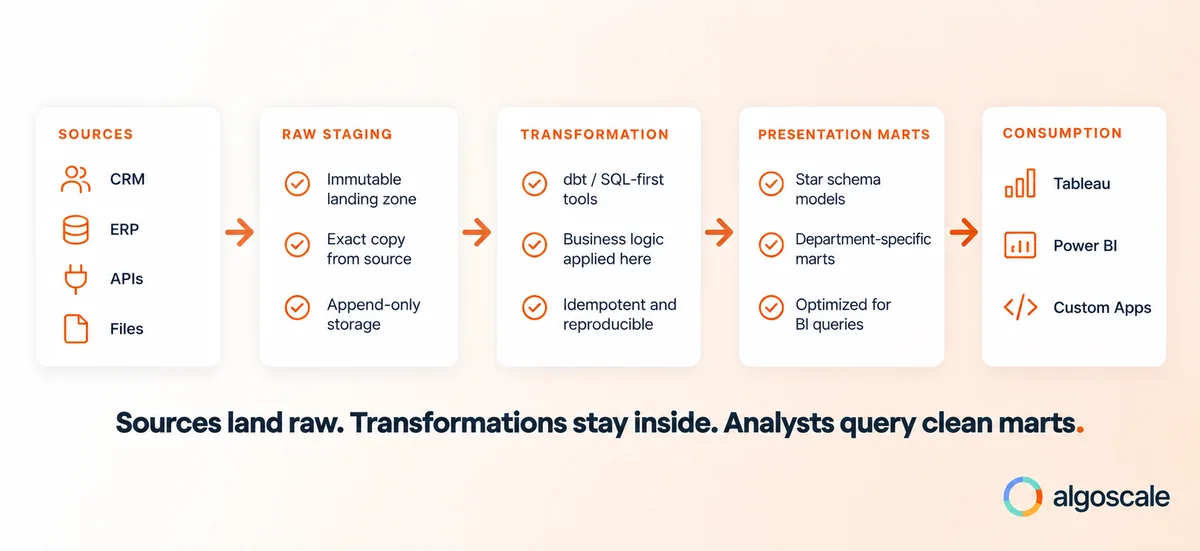
Modern cloud warehouses have flipped this dynamic on its head by adopting ELT (Extract, Load, Transform). Because platforms like Snowflake and BigQuery have scalable compute engines, you land your raw source records directly into an immutable staging layer first without modifying them.
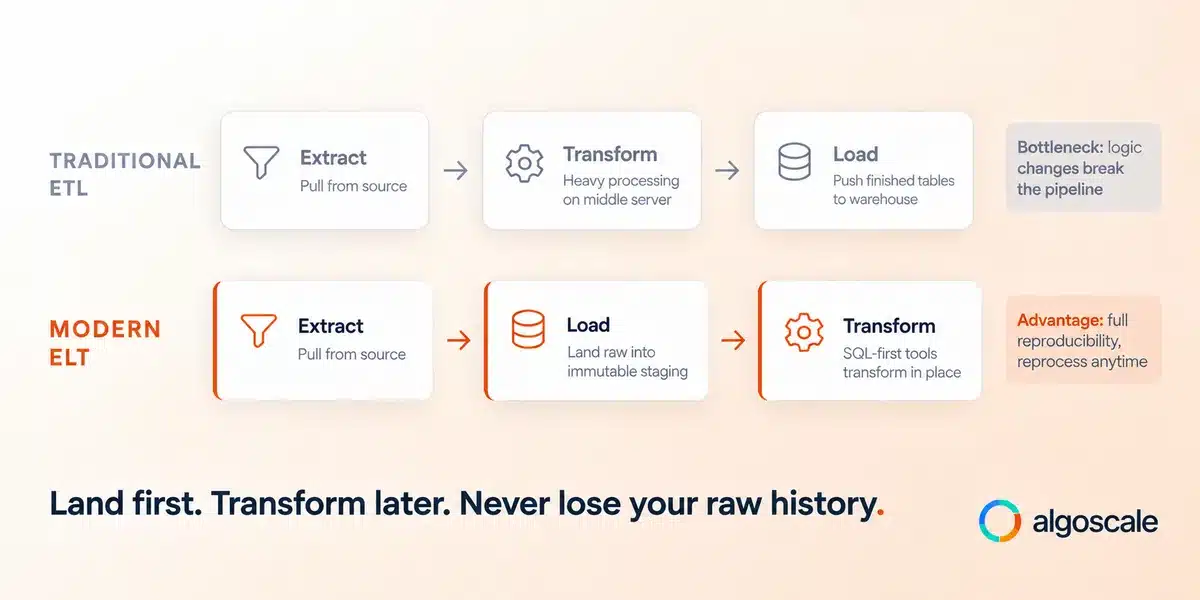
Once the data is safe inside the warehouse, you run your transformations in place using SQL-first tools like dbt. This gives your engineering team two major advantages:
- Complete Reproducibility: If a business metric definition changes six months from now, you do not need to re-extract historical data from upstream APIs. You simply update your transformation script and re-run it against your historical raw staging tables.
- Idempotent Pipelines: Your transformations can be run multiple times on the same input data without producing duplicate records or unexpected side effects, which prevents messy pipeline recovery headaches when a batch job fails midway.
The Essential Data Warehouse Implementation Checklist
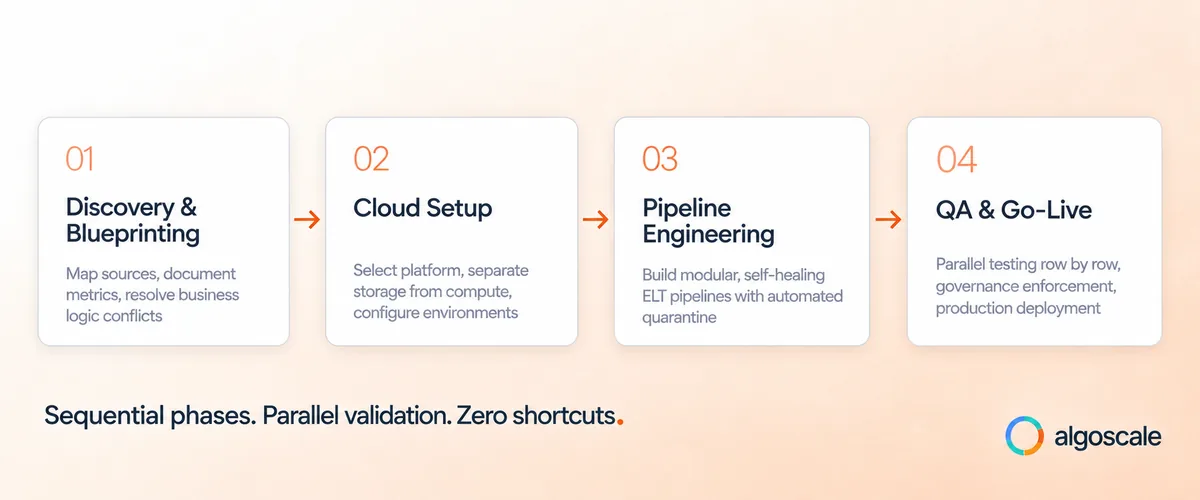
A successful rollout requires strict project sequencing. We’ve seen projects where missing a single step resulted in corrupted data reaching the executive board within the first week of go-live. To keep your project tightly managed, your architecture team should follow a comprehensive data warehouse implementation plan.
1. Discovery and Blueprinting
Before writing a single line of SQL, your team must complete a rigorous data warehouse design checklist. You need to map every source system, document the frequency of data updates, and understand exactly how the business calculates its core metrics. If marketing defines “total revenue” differently than finance, you must resolve that discrepancy before you start building.
2. Selecting the Cloud Environment
Your infrastructure dictates your engineering limits. A modern cloud data warehouse implementation allows you to separate your storage costs from your processing power. For instance, executing a Snowflake data warehouse implementation gives your team the ability to spin up dedicated compute clusters for different departments. The data engineering team can run incredibly heavy transformation scripts in the background without slowing down the live dashboards being viewed by the CEO.
3. Engineering the Pipelines
Extracting data from your source systems and loading it into the warehouse is where most projects stumble. Following data warehouse ETL best practices is non-negotiable. You must build pipelines that are modular and self-healing. If a third-party API suddenly drops a column, your pipeline should flag the error and quarantine the bad records automatically, rather than failing silently or corrupting your downstream reporting tables.
4. Rigorous Quality Assurance
Testing cannot be an afterthought. Strong data warehouse testing best practices require you to run parallel validation tracks. You feed historical data into the new warehouse and compare the outputs against your legacy system row by row. The issues parallel testing catches are never the obvious ones. In our experience, it is the subtle rounding errors, missing decimal places, and timezone shifts that quietly poison reports for weeks.
Data Governance and Granular Security by Design
Security and governance are often treated like a fire drill at the tail end of a project. Data engineers spend months building tables, only for a compliance officer to block the go-live because sensitive customer details sit exposed to internal analysts.
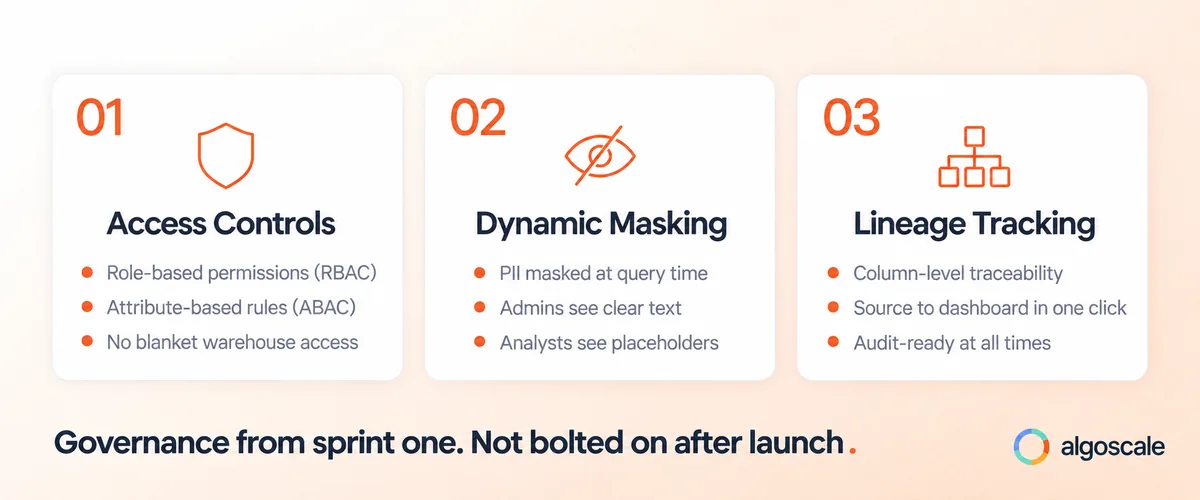
Baking governance directly into your implementation avoids this last-minute scramble. You need to enforce three foundational control layers from sprint one:
- Role-Based and Attribute-Based Access Controls (RBAC/ABAC): Set up structured user roles instead of granting blanket warehouse access. Marketing analysts should only access anonymised customer engagement metrics, while finance retains isolated access to billing and revenue tables.
- Dynamic Data Masking: Personally identifiable information (PII) such as payment records, phone numbers, and home addresses should be masked dynamically at query time. Authorised administrators see the clear text, while standard reporting tools view masked placeholders.
- End-to-End Lineage Tracking: Business users need to trust the numbers on their screen. Capturing automated column-level lineage allows you to trace any metric back to its source system, timestamp, and transformation logic with a single click, keeping audits straightforward and stress-free.
Continuous Observability to Stop Silent Data Downtime
Testing your pipelines during development is essential, but production data is unpredictable. Source software updates without notice, third-party APIs experience sync delays, and ingestion volumes fluctuate wildly.
The biggest risk to an enterprise warehouse is not a loud pipeline crash that throws an alert. It is silent data downtime, where broken or empty records slip quietly into your analytical tables, poisoning reports for weeks before someone notices.
Mature engineering teams embed automated observability rules into the platform. These checks run continuously in production:
- Freshness Monitors: Alerts trigger immediately if an ingestion job has not received fresh records within an expected time window.
- Volume Anomaly Detection: Automated monitors flag instances where an upstream system suddenly pushes half its normal daily record volume.
- Distribution and Null Value Checks: Automated rules fail the build if critical foreign key columns or transaction amounts suddenly show an influx of null values.
By catching structural anomalies in the raw staging layer, you quarantine bad data before it ever has a chance to contaminate your downstream presentation marts.
Managing Data Warehouse Implementation Cost and Challenges
Even with a perfect plan, you will inevitably hit roadblocks. The most common data warehouse implementation challenges stem from dirty legacy data. In every engagement, without exception, our teams uncover undocumented logic, manual spreadsheet overrides, and completely missing customer records. Plan for it. Cleaning this data takes significant time, which can quickly inflate your overall data warehouse implementation cost.
On a healthcare platform we built, data cleaning alone consumed roughly 40% of the total project effort. The client had over a decade of purchasing data spread across spreadsheets: 2 million rows across 300 data points, 160,000 invoices in scanned images, and product naming conventions that differed across every region. We had to build a product master from scratch, standardize 80,000+ products across 10,000+ suppliers, and classify spend categories that had never been formally taxonomized. The warehouse itself was the easier part. The cleaning was the project.
As a general benchmark, departmental implementations with 3-5 sources typically run $50K-$100K over 6-10 weeks. Mid-market rollouts across 10-20 sources land in the $150K-$400K range over 3-6 months. Enterprise-scale projects with 30+ sources can reach $400K-$1M+ over 6-18 months. The biggest cost variable is never the platform licence; it is the data cleaning underneath.
To keep the budget under control, you must be ruthless about scope creep. The pattern that derails implementations most often is what our teams call ‘just one more’ creep: one more dashboard, one more data source, one more metric added mid-sprint. You have to lock down the requirements for each agile phase and push new requests to the backlog.
Furthermore, you must establish strict cloud financial operations from day one. Modern cloud warehouses charge based on compute consumption. If an analyst writes a poorly structured query that scans three terabytes of data by mistake, your company pays for that compute immediately. Implementing automated guardrails, query timeouts, and dedicated compute warehouses for different user groups are fundamental data warehouse implementation best practices that protect your budget.
Structuring a Sustainable Data Estate
Building a data warehouse is never a one-off project. It is the creation of a living, breathing software product that must evolve continually alongside your business operations. A solid data warehouse design methodology ensures that when your company acquires a new competitor, launches a fresh product line, or adopts a new CRM system, your engineering team can integrate the new data sources seamlessly without tearing down the existing infrastructure.
However, executing this level of architectural precision requires deep technical experience. The most expensive implementations we have seen are the ones where an internal team attempts cloud-scale architecture for the first time without any external guidance.
At Algoscale, our data engineering specialists guide enterprises safely through every phase of their platform modernisation. From mapping out complex dimensional models to executing high-performance Snowflake migrations, we build resilient data estates that scale securely.
Frequently Asked Questions
What are the essential steps for a data warehouse implementation?
Start with discovery and blueprinting, then select your cloud environment, engineer the pipelines, build your transformation layer, run parallel quality assurance, enforce governance, and deploy with continuous observability.
Why is agile methodology preferred over waterfall for data warehouse projects?
Agile delivers working analytics within weeks for a single business domain. This catches source data problems early and keeps stakeholders engaged instead of waiting months for a monolithic launch.
How do you choose the right data warehouse design pattern?
Star schema works best for fast BI queries with stable sources. Data Vault 2.0 is the stronger choice when source systems are complex and schemas change frequently.
How can businesses control data warehouse implementation costs?
Lock sprint scope ruthlessly, enforce compute guardrails and query timeouts from day one, separate storage from compute, and push every new data source request to the backlog.
What are the best practices for building ETL pipelines?
Use ELT over traditional ETL on modern cloud platforms. Land raw data first, transform in place with SQL-first tools, and build self-healing pipelines that quarantine bad records automatically.
Why is parallel testing critical during implementation?
Without comparing new warehouse outputs against your legacy system row by row, subtle rounding errors, timezone shifts, and missing decimal places slip into production and poison reporting undetected.