


Key insights
A successful data warehouse migration requires strategic replatforming rather than a basic lift-and-shift transfer to prevent legacy bottlenecks from inflating cloud compute costs. Enterprises must first audit existing infrastructure, archive unused data, and redesign schemas for cloud-native performance. The most critical phase involves translating fragile legacy code into a modern ETL migration strategy, ensuring high-fidelity data extraction and transformation. To prevent operational downtime, engineering teams must run parallel pilot testing to guarantee data parity before executing a phased, departmental cutover. This disciplined approach protects enterprise data integrity and maximises the long-term commercial ROI of your new analytics infrastructure.
Moving your analytics infrastructure to the cloud promises faster query speeds and lower operational costs. Yet research from McKinsey highlights a reality. Most enterprise cloud projects miss their deadlines and blow past their initial budgets. The underlying cloud hardware is almost never to blame. These failures usually happen because teams completely underestimate the difficulty of untangling decades of undocumented business logic.
A true data warehouse migration is not a basic storage transfer. You are relocating the intelligence your entire company relies on to function. Simply pointing old data structures at a modern cloud platform transfers all your existing bottlenecks into a brand new environment. Your finance team will still wait hours for their reports to load, but you will now pay a premium for cloud compute power to generate them.
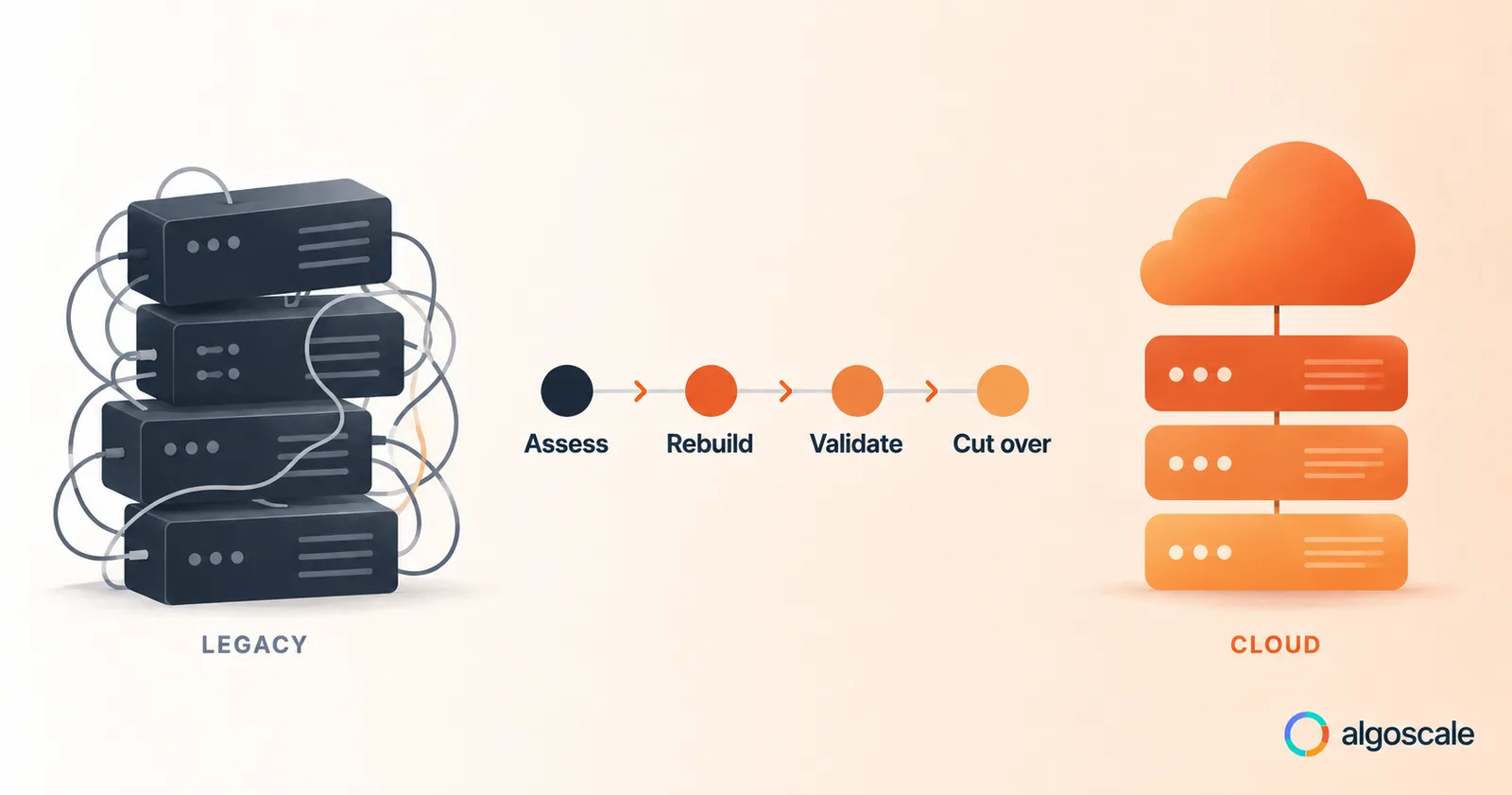
Protecting your daily operations requires a highly disciplined data warehouse migration strategy. The process demands mapping out legacy dependencies, rewriting fragile extraction jobs, and running parallel tests to guarantee complete data parity. Building a solid foundation means identifying the hidden risks early and sequencing the transition so your business runs without a single hour of interruption.
The Reality of Legacy Systems
Before you start provisioning cloud servers, you have to look honestly at what you are leaving behind. A legacy data warehouse migration is notoriously difficult because older systems are usually held together by duct tape and hope.
Over the years, different developers write custom scripts, create overlapping tables, and build undocumented workarounds to fix immediate problems. When you decide to execute an EDW migration, all that technical debt suddenly blocks your path. The most common data warehouse migration challenges stem directly from this lack of visibility.
If your engineering team does not know exactly which downstream dashboards depend on which upstream tables, turning off the old server will inevitably break a critical business report. Nobody wants to be the person who accidentally deletes the marketing department’s daily revenue tracker. This fear of breaking things often paralyses IT departments, causing them to delay necessary upgrades until the old hardware literally runs out of space.
What Changes Depending on Your Source System
The source system dictates how much of your existing logic survives the move. Two companies migrating identical data volumes to the same cloud platform can face completely different projects depending on what they are leaving behind.
Teradata environments are usually the hardest. Years of BTEQ scripts and primary index definitions encode performance decisions that have no equivalent in a cloud platform. Your engineers cannot port that logic. They have to understand why each decision was made and then solve the same problem differently.
Oracle warehouses bring a different problem. PL/SQL packages often contain business rules that were never documented anywhere else, sitting alongside layers of materialized views that downstream reports quietly depend on. Untangling that ownership question is slower than the code conversion itself.
Any partner who quotes you a schedule before examining your source system is guessing.
Choosing Your Core Migration Path
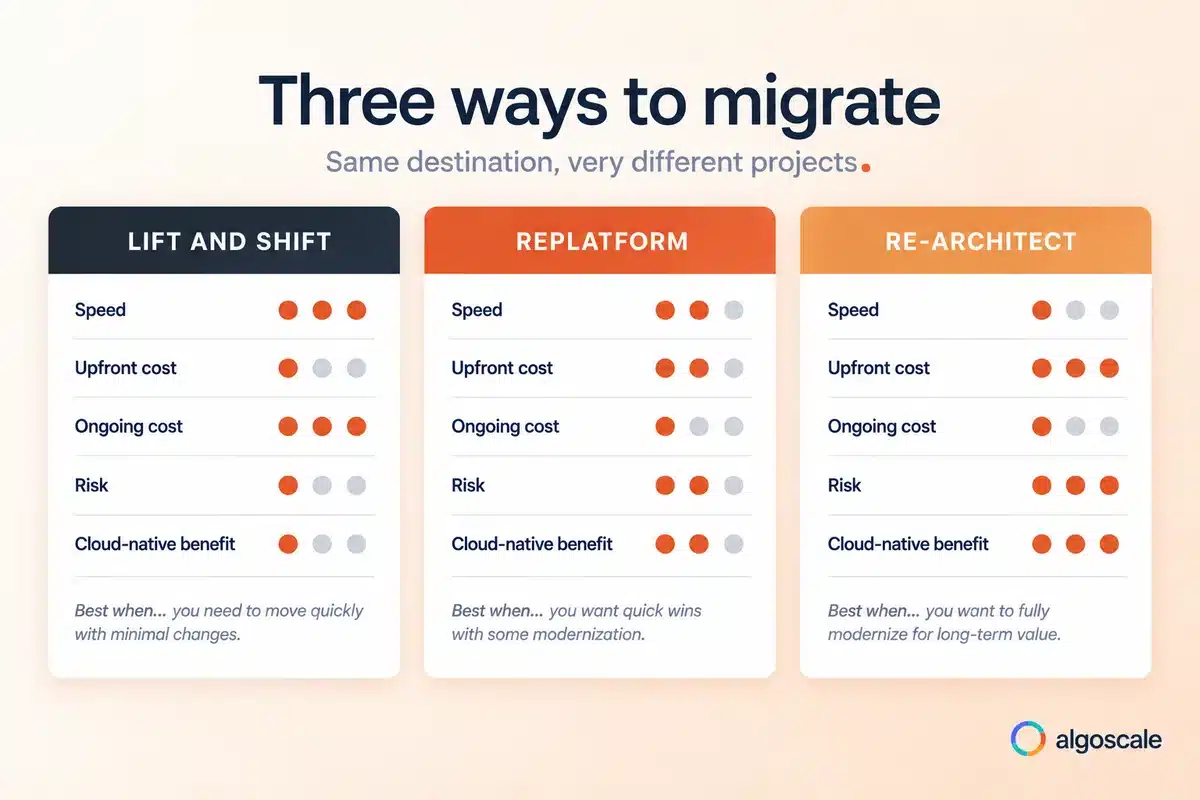
Your overarching data migration strategy dictates how disruptive and how expensive the project will be. Technical architects typically choose between two main approaches when moving to the cloud.
The Trap of Lift and Shift
This method involves picking up your existing data models, tables, and processing jobs and dropping them exactly as they are into the new cloud environment. It sounds appealing because it is fast. You exit your expensive on premises data centre quickly.
However, a lift and shift cloud data warehouse migration rarely allows you to use native cloud features. Cloud databases process information differently than traditional servers. If you force a modern platform to run old, inefficient SQL code, it will consume massive amounts of compute power. You end up with a system that is just as slow as your old one but costs significantly more to run every month.
The Value of Data Warehouse Replatforming
Instead of copying old mistakes, data warehouse replatforming involves redesigning your underlying architecture to suit the new environment. You might restructure messy tables, drop unused data, and rewrite clunky batch scripts into efficient streaming pipelines.
While this requires a heavier initial investment in engineering time, it dramatically reduces long term maintenance costs. The platform performs better, queries run faster, and your cloud bills stay predictable. For most enterprise teams, a phased replatforming approach is the safest and most lucrative path.
The Essential Data Warehouse Migration Steps
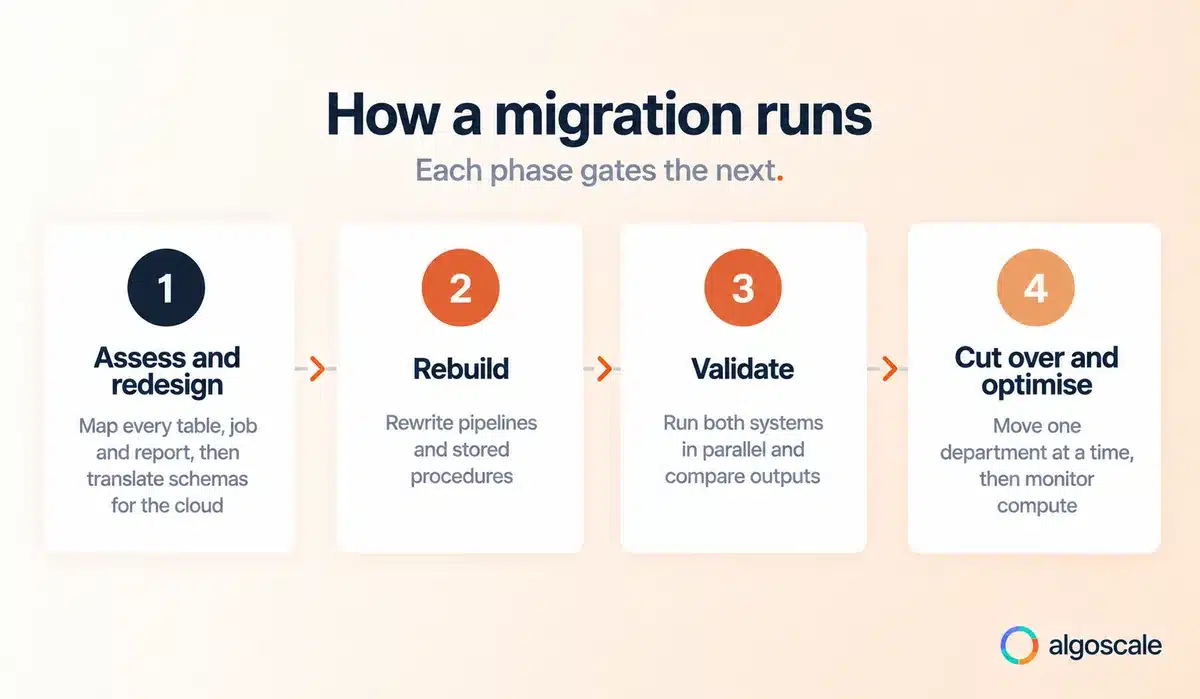
A successful data warehouse migration follows a strict sequence, starting with a comprehensive infrastructure assessment and schema redesign tailored to the new cloud environment. Engineering teams must then cleanse legacy data and develop robust ETL pipelines to guarantee secure, high-fidelity data extraction and transfer. The process concludes by validating data parity through parallel pilot testing, executing the final production cutover, and actively optimizing post-migration compute usage.
1. Comprehensive Estate Auditing
You cannot move what you do not understand. Begin by auditing your entire current data estate. Identify every source system, every scheduled job, and every downstream business intelligence dashboard.
You will likely find tables that nobody has queried in three years. Deprecate this unused data immediately. There is absolutely no commercial reason to spend time and money moving information that your business no longer uses.
2. Schema Translation and Design
Your new cloud warehouse will process data using different rules than your old system. You need to map your existing data types carefully to the new environment. A timestamp format in an old SQL Server database might behave differently in the cloud. This phase is also the perfect time to fix poor naming conventions and implement robust column level security rules to protect sensitive customer details. If you are also reconsidering the underlying data model, see our comparison of star, snowflake, and data vault approaches before you finalize the new schema.
3. Engineering Your ETL Migration Strategy
Your data pipelines are the lifeblood of your analytics. Your ETL migration strategy is arguably the most complex part of the entire project. Legacy ETL tools often rely on proprietary code that simply does not translate to modern cloud orchestrators.
You must rewrite these extraction and transformation scripts carefully. Your engineers have to ensure the new pipelines can handle the exact same data payloads without dropping records, duplicating rows, or scrambling text fields during transit. This is where data engineering effort concentrates, and it is driven by object counts rather than terabytes. If you are also deciding between transformation approaches, see our ETL vs. ELT architecture comparison.
Accelerating the Build with Modern Tooling
Doing all of this work manually is a recipe for human error and engineering burnout. Thankfully, intelligent tooling makes the process significantly smoother today.
Using automated data warehouse migration software helps translate legacy SQL dialects into modern syntax automatically. These tools can parse thousands of lines of old stored procedures and convert them in minutes. This saves your engineering team months of tedious manual rewriting and significantly reduces the chance of syntax errors.
For instance, if your strategic goal is to migrate a data warehouse to Snowflake, you can leverage dedicated conversion tools that automatically map legacy relational data types to Snowflake’s highly optimised columnar format. A proper Snowflake migration allows you to separate your storage costs from your compute costs entirely. This means your data engineers can run incredibly heavy transformation jobs in the background without slowing down the crucial executive dashboards being viewed by your finance team. Snowflake is just one strong destination among several — if the platform choice itself is still open, our comparison of Snowflake, BigQuery, Synapse, and Redshift lays out the tradeoffs.
Mitigating Disaster Through Rigorous Validation
Writing the new code is only half the battle. Testing is the safety net that protects your commercial reputation. If you deliver corrupted revenue numbers to your board of directors, the entire project will be deemed a failure regardless of how elegant the underlying cloud architecture is.
Thorough data warehouse migration testing requires running your legacy system and your new cloud system in parallel.
During this parallel run phase, you feed the exact same raw data into both environments simultaneously. Your engineers then compare the analytical outputs row by row. This exercise catches the subtle rounding errors, missing decimal places, and timezone discrepancies that frequently occur when switching database engines. By proving that the new cloud system generates the exact same numbers as the old hardware, you build trust with your business stakeholders and actively mitigate the most severe data warehouse migration risks.
Designing a Seamless Cutover Strategy
The final hurdle is the actual transition. Your data warehouse cutover strategy dictates exactly how and when you switch the business over to the new platform.
A big bang cutover, where you switch everything off on Friday night and turn the new system on by Monday morning, is incredibly risky. If a critical pipeline fails over the weekend, rolling back to the old system is highly complex and stressful.
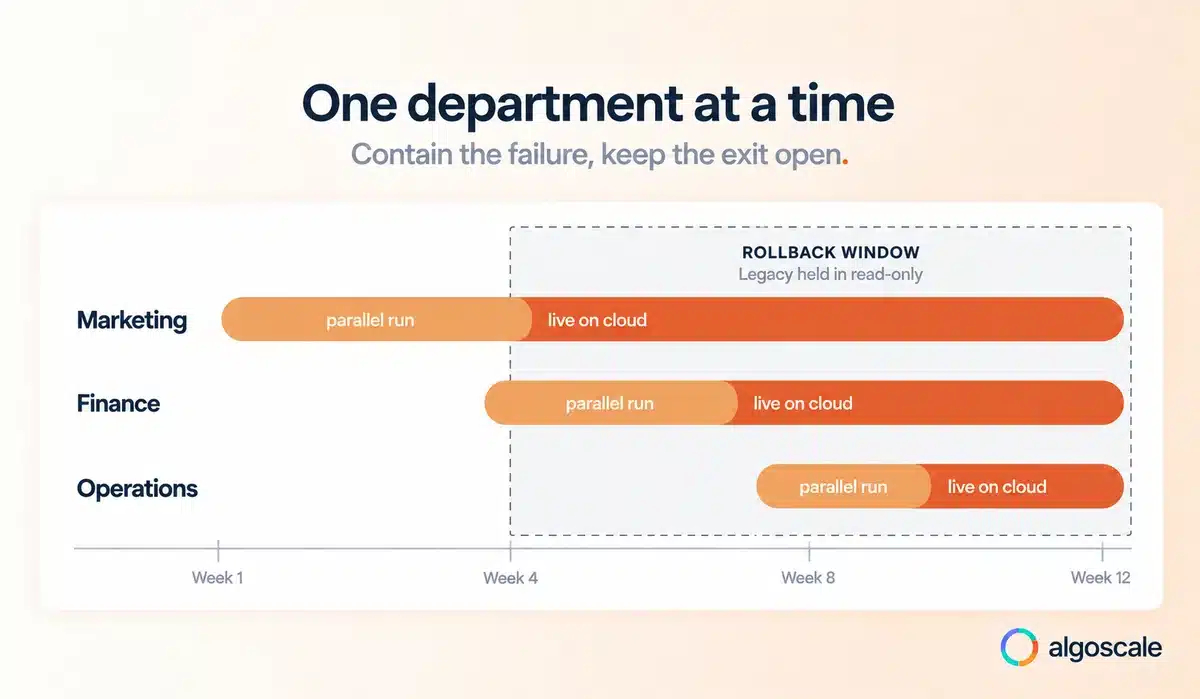
Instead, successful enterprises use a phased cutover. You might point the marketing team’s dashboards to the new warehouse first, while keeping finance and operations on the legacy system for one more month. Once marketing signs off on the performance and data accuracy, you migrate to the next department. This isolates any potential issues to a single business unit. It allows your engineering team to fix bugs calmly without the entire company grinding to an operational halt.
Planning Your Rollback Window
A phased cutover protects you only if you can actually reverse it. Most teams assume the legacy system remains available as a safety net, then decommission it far earlier than they should.
Keep your old warehouse running in read-only standby for the duration of the phased rollout, not just for the department currently migrating. Reporting problems rarely surface on day one. They appear at month end, when a quarterly calculation runs for the first time against the new platform and produces a number nobody can reconcile.
The harder question is when rollback stops being possible. That point arrives sooner than most teams expect, and it is not a date on your project plan. It arrives the moment a migrated department writes data into the cloud platform that has no equivalent on the legacy system. A new dimension, a revised hierarchy, or a corrected historical record all create the same problem. Reverting now means losing work, not just switching a connection string.
Define that threshold before your first department moves. Decide which writes are permitted during the overlap period and which must wait until the entire migration completes. Documenting this in advance costs an afternoon. Discovering it during an incident costs considerably more.
Your Enterprise Migration Checklist
To keep your project strictly on track, your architecture team should continuously reference a clear data warehouse migration checklist. While every business operates differently, your baseline checklist should include the following core milestones:
- Audit all existing tables, views, and downstream reports to map dependencies.
- Identify and archive stale data that no longer provides commercial value.
- Finalise the cloud architecture design and secure necessary user access roles.
- Translate legacy schemas into modern cloud native formats.
- Rewrite and validate all historical ETL pipelines using modern orchestration tools.
- Execute parallel load testing to verify data parity across both systems.
- Train your business analysts on the new cloud query syntax and BI tools.
- Execute a phased cutover by moving one department at a time.
- Monitor cloud compute costs closely during the first thirty days of live production.
Secure Your Cloud Transition with Algoscale
Executing a data warehouse migration to cloud platforms is a massive logistical challenge. It demands deep technical expertise, meticulous planning, and a thorough understanding of enterprise data governance. Relying entirely on an internal team that has never executed a transition of this scale often leads to costly delays and unexpected cloud infrastructure bills.
At Algoscale, our data engineering specialists guide businesses safely through every phase of their cloud transformation journey. Whether you are replatforming a brittle on premises server or executing a highly complex migration to a modern data lakehouse, we ensure your data remains secure, accurate, and fully operational throughout the entire process. Our data warehouse consulting services cover the full engagement, from architecture through migration.
Stop letting legacy infrastructure dictate your analytical speed.
Tell us which source system you are leaving, how many stored procedures and reports depend on it, and what your reporting calendar looks like. Our engineers will map the sequence with you.
Frequently Asked Questions
Why do enterprise data warehouse migrations often fail?
Most failures come from undocumented business logic rather than the cloud platform itself. Teams underestimate how many scheduled jobs, custom scripts and downstream reports depend on tables nobody has mapped, so engineers spend weeks reverse engineering logic that should have taken days to port.
What is the difference between a lift-and-shift approach and replatforming?
Lift and shift moves your existing tables and jobs into the cloud unchanged, while replatforming redesigns them for the new environment first. Lift and shift exits your data centre faster but carries old inefficiencies into a platform that charges you for every inefficient query.
How long does a data warehouse migration take?
Timelines depend on object counts rather than data volume, because the number of stored procedures, ETL pipelines and downstream reports drives engineering effort far more than terabytes do. Single-domain pilots complete in six to eight weeks, while enterprise migrations across multiple source systems commonly run three to nine months and occasionally a full year.
Why is parallel testing critical during a cloud data migration?
Parallel testing proves the new platform produces identical numbers before anyone depends on it. Feeding the same raw data into both systems and comparing outputs row by row catches the rounding differences, timezone shifts and type-cast discrepancies that only appear once the engines differ.
What is a phased cutover strategy, and why is it safer than a big bang approach?
A phased cutover moves one department at a time rather than switching everything over a single weekend, so any failure is contained to one business unit and your engineers can fix it calmly. A big bang leaves rollback as the only option, under pressure.
How can automated tooling accelerate the ETL migration process?
Conversion tools parse legacy stored procedures and translate them into modern syntax in minutes rather than months, and they flag what they cannot convert so your engineers know exactly which objects still need manual rewriting rather than discovering it after the first production load.