


Key insights
- Agile Methodology Wins: The modern process of data warehouse design relies on iterative sprints. It delivers functional analytics in weeks rather than waiting a year for a global rollout.
- Star Schema Dominance: When evaluating star schema vs snowflake schema which is better, the star schema wins. It requires far less compute power to query.
- Hybrid Architectures: Successful enterprise data warehouse design blends Data Vault integration with Kimball dimensional modelling. Open table formats like Apache Iceberg keep the stack portable across clouds.
- Predictable Costs: Building a warehouse from scratch requires an upfront investment between $120,000 and $350,000.
- Security and AI Readiness: Embed access controls, lineage tracking, and compliance at the design stage. Separate ML compute from BI compute to serve both workloads without contention.
- ELT Over ETL: Modern cloud warehouses should load raw data first and transform in place. This eliminates pipeline breakage from upstream schema changes and leverages compute you are already paying for.
According to recent market analysis, global public cloud spending continues to hit a massive number rapidly. Gartner forecasts worldwide public cloud end-user spending to reach an estimated $850 billion in 2026, representing a 21.3% increase from the previous year.
Businesses are throwing huge budgets at modern data platforms. They expect instant commercial insights. But engineering leaders keep hitting the same frustrating wall. They buy expensive cloud environments. Yet their dashboards still load at a snail’s pace. Different departments still argue over conflicting revenue figures.
Cloud hardware is rarely the actual problem. The architecture is. Throwing massive compute power at poorly structured tables is a very expensive mistake. If you want analytics to drive real growth without blowing up your monthly AWS bill, mastering data warehouse design is critical.
Whether you are migrating an old on-premises server or working out how to design a data warehouse from scratch, this guide breaks down the structural blueprints. We also cover practical methodologies and the exact costs you need to build a resilient data foundation in 2026.
The Process of Data Warehouse Design
Building a modern analytical platform is no longer a rigid IT project. According to our experiences with projects across global enterprises, teams that try to gather perfect requirements for six months usually fail. By the time they write a single line of SQL, the business model has already changed.
Today, successful engineering teams rely on agile data warehouse design. The process of data warehouse design has to be iterative. You pick a high-priority business domain like marketing. You design the ingestion pipelines. You model the tables. Then you deliver a working dashboard within a single quarter.
When you sit down to design data warehouse structures, the workflow usually follows these exact steps:
1. Business Requirement Mapping
You have to understand how the business actually calculates its metrics. This is step one. If marketing defines total revenue differently than finance, you must fix that logic gap before building anything. You sit down with the stakeholders and document their daily reporting needs. You find out exactly which source systems hold the truth.
2. Data Warehouse Logical Design
Before you touch the physical database, you map out entities and relationships. This abstract blueprint ensures different data sources will eventually connect. It is a visual representation of your business rules. A solid data warehouse logical design prevents chaotic overlaps when multiple engineering teams work on the same project simultaneously.
3. Physical Data Warehouse Database Design
Here you translate the logical blueprint into actual cloud infrastructure. You define storage types and compute clusters. You set partitioning strategies specific to your chosen platform. A good data warehouse database design takes query patterns into account. If your users always filter by date, you partition the physical tables by date to save processing time.
4. Pipeline Engineering
You write the scripts that pull raw data from your source systems into the warehouse. This step connects your raw operational software to your new analytical foundation.
Choosing Your Data Warehouse Architecture Design
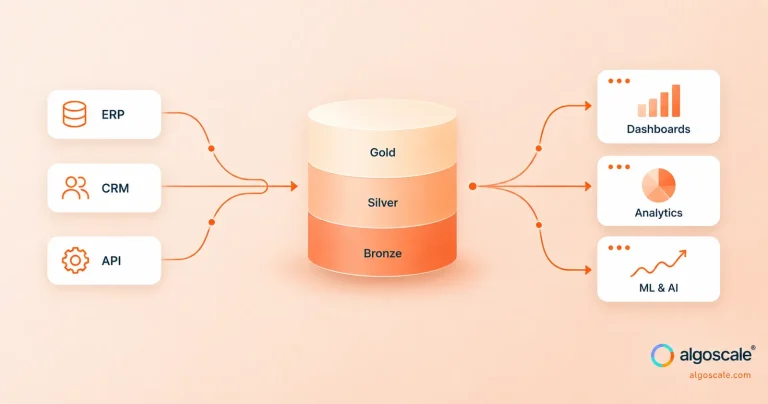
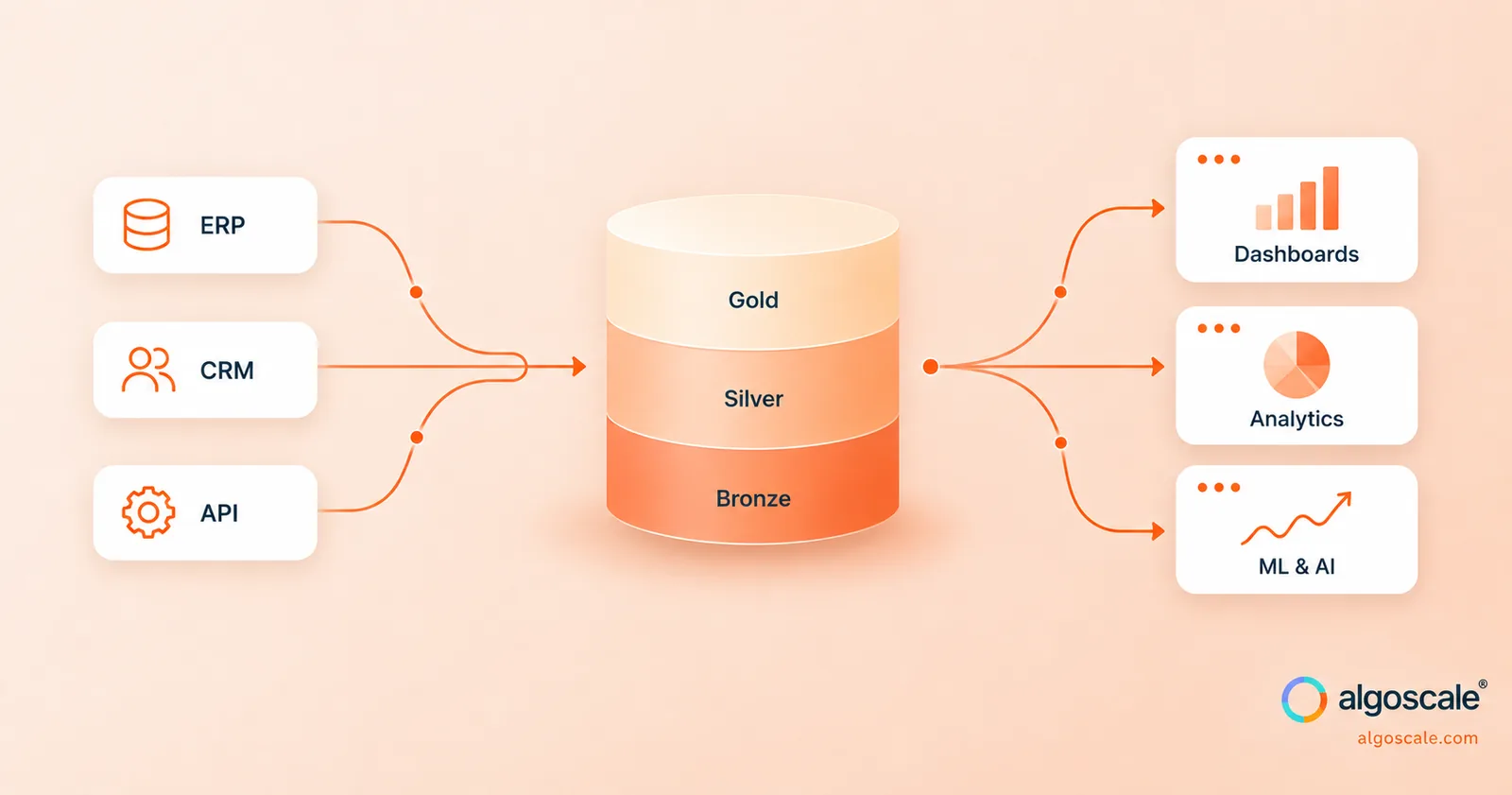
The foundation of any robust platform is the overarching architecture. Right now, data warehouse architecture design is heavily dominated by the Lakehouse model. This is often implemented using a Bronze, Silver, and Gold layer setup.
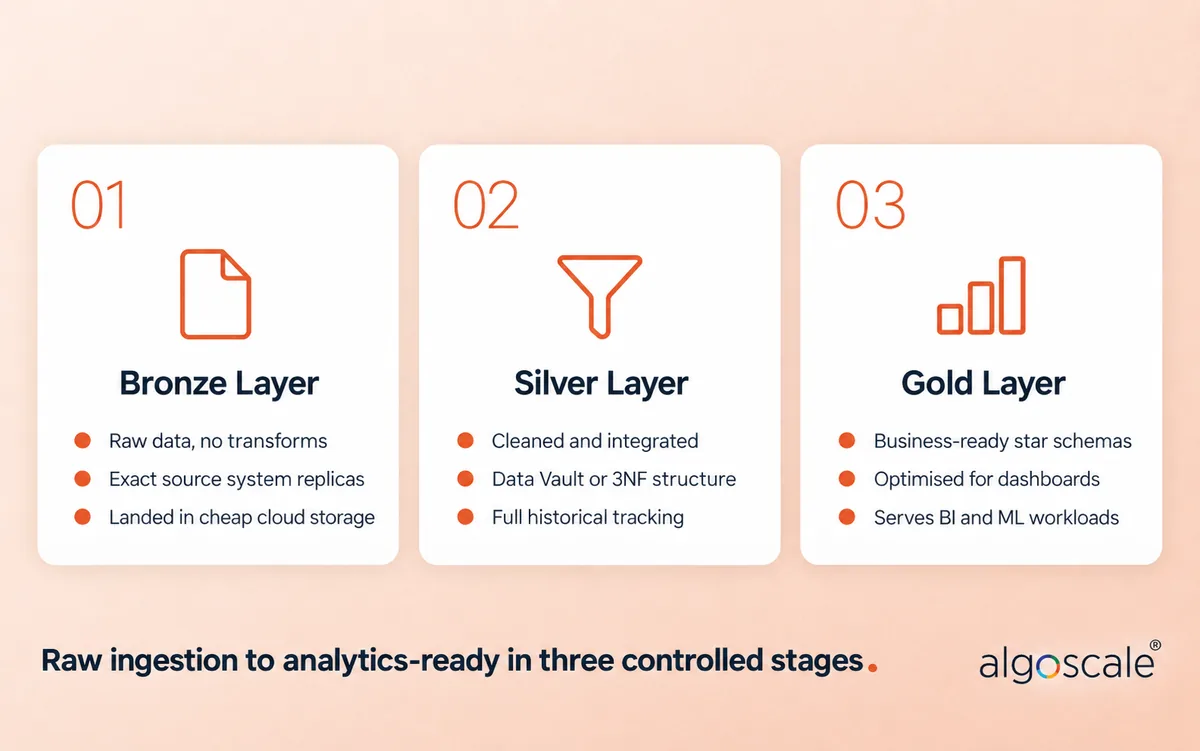
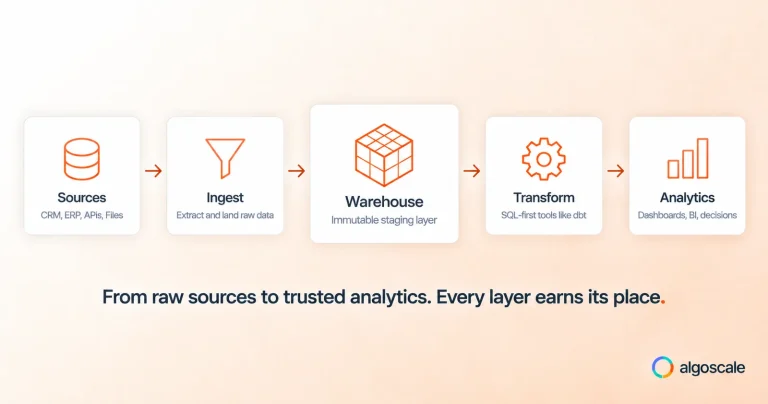
ELT is the standard data loading approach for cloud data warehouses in 2026. It loads raw data into cheap cloud storage first, then transforms it in place using the warehouse engine’s own compute power.
Traditional ETL transforms data before it enters the warehouse. This forces pipeline engineers to anticipate every business rule and data shape upfront. If a source API drops a column or changes a date format, the entire pipeline breaks before data reaches storage. ELT eliminates this fragility. Raw data lands safely first. Transformation logic runs inside the warehouse itself, using compute you are already paying for. Schema changes in source systems no longer cause pipeline failures at 3 AM.
For incremental loading, Change Data Capture is now the standard method. CDC tracks only the rows that actually changed rather than reloading entire tables nightly. This cuts processing time dramatically and keeps your warehouse closer to real time without full streaming infrastructure costs.
The only scenario where traditional ETL still makes practical sense is when strict compliance rules require data to be scrubbed before it touches any analytical environment. For every other use case, ELT on a modern cloud platform is the faster, cheaper, and more resilient choice.
Data Warehouse Design Patterns: Inmon vs Kimball Approach
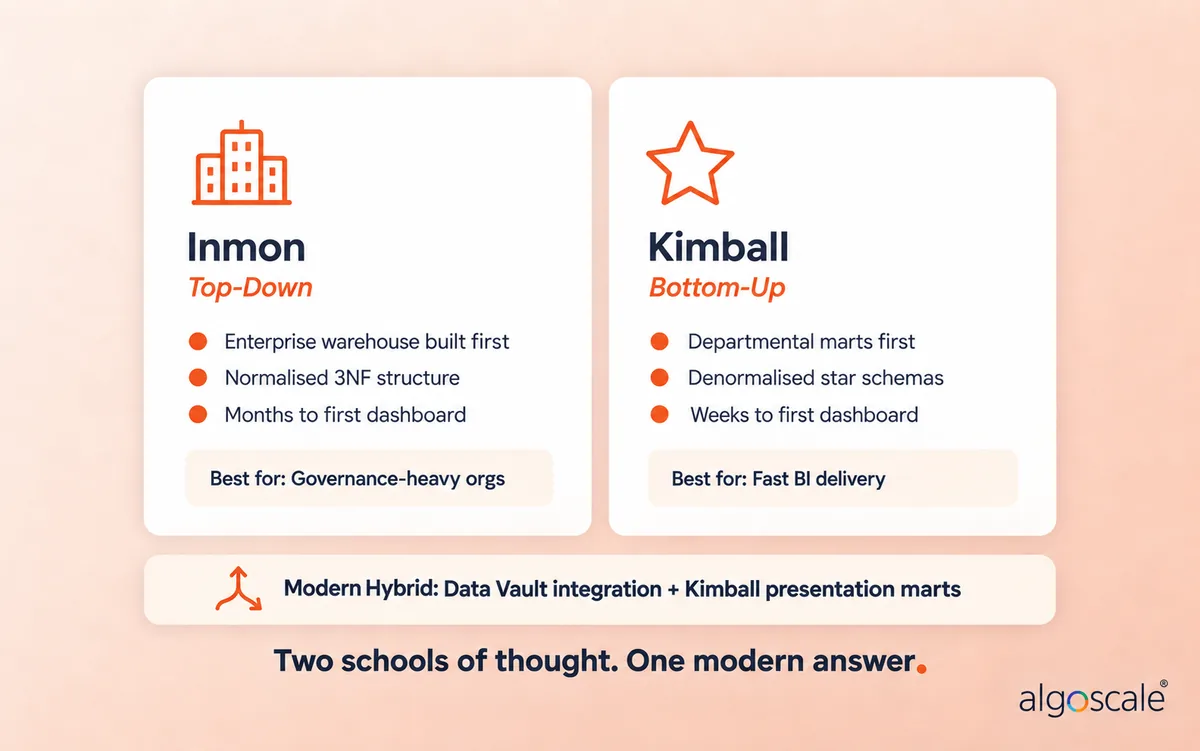
When structuring your tables, you have to pick a foundational methodology. The debate over the Inmon vs Kimball approach has shaped data engineering for a long time.
The Kimball approach works bottom-up. It focuses on delivering fast business value by building department-specific data marts first. It is agile and incredibly fast to deploy. Business teams love this because they see results within weeks.
The Inmon approach works top-down. It focuses on building a massive and highly normalised enterprise data repository first. Only then do you spin off specific reporting marts. It ensures strict data integrity but takes much longer to build.
In modern enterprise data warehouse design, we rarely see a pure textbook implementation of either. Most teams use a hybrid model. They use Data Vault principles for the core integration layer to handle messy source systems. Then they apply Kimball’s dimensional modelling for the final presentation layer where analysts actually run their queries.
Designing for Multi-Cloud Portability
Vendor lock-in is one of the most expensive long-term architectural mistakes in data warehouse design. If your schema depends entirely on platform-specific features like Redshift distribution keys or BigQuery partitioning syntax, migrating later means rewriting your entire physical layer.
Open table formats solve this at the storage level. Apache Iceberg and Delta Lake store data in open Parquet files on cloud object storage rather than inside a proprietary engine. Any compute layer can read them. This gives organisations the freedom to switch platforms or operate multi-cloud without a full data migration.
At the schema level, the most effective portability strategy is keeping your logical design completely platform-agnostic. Define star schemas, naming conventions, and transformation logic in tools like dbt that generate platform-specific SQL at deploy time. The design stays portable. Only the compiled output changes per cloud provider.
We have seen migration costs drop significantly when organisations design for portability from the start. The engineering effort to abstract away platform-specific features upfront is a fraction of what a forced migration costs two years later.
Dimensional Modelling and Schema Choices
If you are new to this field, you might ask what is dimensional modeling in data warehouse architecture?
Dimensional modelling is a design technique that separates data into two distinct types of tables. Fact tables hold measurable business events like a transaction amount or a website click. Dimension tables hold the descriptive context like the store location or the customer name.
This leads directly into a very common architectural question. Star schema vs snowflake schema which is better?
A star schema surrounds a central fact table with fully denormalised dimension tables. It looks just like a star. Because the dimensions are flat, analysts only need to execute a single join to get their answers. It is incredibly fast and remains the gold standard for cloud reporting.
A snowflake schema takes those dimension tables and normalises them further into sub-dimensions. It saves a tiny amount of storage space. However, it forces the database to execute complex joins during every query. That slows down dashboards significantly.
In 2026, cloud storage is incredibly cheap but cloud compute is expensive. Because a star schema requires less computational effort to query, it is almost always the better choice. We strongly recommend it for the presentation layer.
Real-World Case Study: Databricks XML Data Processing
Theoretical designs often collapse under the weight of actual enterprise complexity. According to our experiences with projects at Algoscale, you need a unified approach to see real returns. Vague promises do not fix broken systems.
We recently partnered with a global life sciences enterprise. They generated massive and complex XML data feeds. Their legacy ingestion systems simply could not keep up with the volume. They had fragmented XML structures and manual workflows. Their analytics teams lacked real-time visibility. We have seen this constantly in heavy industries.
Our engineers executed a comprehensive enterprise data warehouse design focused on automation. We built a region-aware ingestion pipeline on Databricks. We developed a flexible XML parsing engine using PySpark. We sourced the parsing rules from a Delta Table schema registry. The solution included strict governance via Unity Catalog and role-based access control.
The result was an 80 percent reduction in manual reporting effort. We accelerated their XML data processing by 40 percent. They gained complete visibility into key metrics with query latency under 280 milliseconds. They stopped guessing and started making decisions based on solid, accessible facts.
Adapting Designs for Specific Industry Workloads
Different business models need vastly different structural approaches. A generic template simply will not work. You have to adapt the framework to the specific commercial reality of your sector.
E-Commerce Data Warehouse Design
An e-commerce data warehouse design must handle incredible volume. If a retailer processes millions of clicks and checkouts daily, the architecture must support wide tables. These tables need to capture nested JSON arrays like a single order with multiple distinct line items. The design also has to integrate smoothly with recommendation engines. You cannot afford slow table locks when tracking Black Friday sales spikes.
Data Warehouse Design for Real-Time Analytics
Traditional batch processing is not enough for modern finance companies. Data warehouse design for real-time analytics requires streaming tools like Apache Kafka. Instead of loading flat files nightly, you stream event logs continuously into a raw staging layer. You process them using micro-batches to power live operational dashboards. Fraud detection models rely heavily on this exact architecture.
Platform-Specific Nuances: Redshift Data Warehouse Design
Your chosen cloud provider dictates your engineering rules. A proper Redshift data warehouse design requires a deep understanding of distribution keys. If you choose the wrong key, Amazon Redshift will constantly shuffle data across its compute nodes. That destroys query performance and drives up your AWS bill rapidly. You must align your sort keys with the exact filters your business analysts use most frequently.
Designing for AI and Machine Learning Workloads
A modern data warehouse must serve machine learning pipelines alongside business intelligence dashboards. These two workloads have fundamentally different design requirements and must be separated at the architecture level.
BI dashboards need pre-aggregated, tightly modelled star schemas with minimal joins. ML feature stores need wide, denormalised tables with granular row-level detail and full historical depth. Serving both from the same table structures degrades performance for one or both. Separating ML compute from BI compute prevents training jobs from consuming cluster resources that analysts depend on for dashboard responsiveness.
Feature engineering pipelines typically need direct access to the Silver integration layer, not the clean Gold presentation layer. Data scientists want the messy, granular, historised data sitting in your integration tables. Your architecture must allow controlled read access to that layer without bypassing governance rules.
Reverse ETL is the outbound counterpart. Once models generate predictions or scores, those outputs need to flow back into operational systems like CRMs and marketing platforms through structured, scheduled pipelines with the same quality controls as your ingestion layer, not through ad hoc exports.
Implementation Costs and Timelines
Vague budget estimates are totally useless when planning an infrastructure upgrade. We have seen this happen far too often. Leadership needs exact figures to approve a migration. Based on 2026 industry benchmarks and our direct engineering deployments, here is exactly what you should expect.
Pricing Breakdowns
Basic Replatforming: Moving a simple legacy database to the cloud typically costs between $40,000 and $75,000. This assumes minimal transformation logic changes.
Enterprise Implementation: Building a multi-department warehouse from scratch ranges from $120,000 to $350,000. This includes custom pipelines, Data Vault modelling, and BI integration.
Ongoing Cloud Costs: A mid-market company usually spends around $5,000 to $8,000 monthly on cloud compute. Large enterprises routinely spend $40,000 to $60,000 every month. Implementing strict FinOps controls is absolutely mandatory to stop these recurring costs from spiralling.
Realistic Delivery Timelines
MVP Delivery: Delivering the first functional business domain takes exactly 8 to 12 weeks. You get a working dashboard in three months.
Full Enterprise Rollout: Unifying complex global systems across HR, finance, and operations requires 6 to 9 months of dedicated engineering work.
To speed up these timelines, engineers rely on a modern data warehouse design tool stack. Visual modelling software like SqlDBM helps architects map relationships before writing code. For transformation logic, dbt has become the absolute industry standard. It handles the SQL transformations elegantly and provides automated documentation.
Core Data Warehouse Design Principles
To ensure your investment does not turn into an unmanageable data swamp, you must enforce strict data warehouse design principles. These data warehouse design best practices separate successful platforms from expensive failures.
Separate Storage from Compute. Always select a cloud platform that allows you to scale your processing power completely independently of your storage capacity. Snowflake and Databricks do this perfectly.
Enforce Idempotent Pipelines. Your data pipelines must be able to run multiple times safely without creating duplicate records. If a job fails at 3 AM, your engineers should be able to restart it without corrupting the historical tables.
Implement Granular Security Early. Do not bolt security on at the very end. Use role-based access controls and dynamic data masking from day one. You have to protect sensitive customer details immediately.
Track Column-Level Lineage. Business users will always question the numbers on their dashboards. You must have automated lineage tracking in place. This lets your analysts trace any metric back to its original source system instantly.
Security and Governance by Design
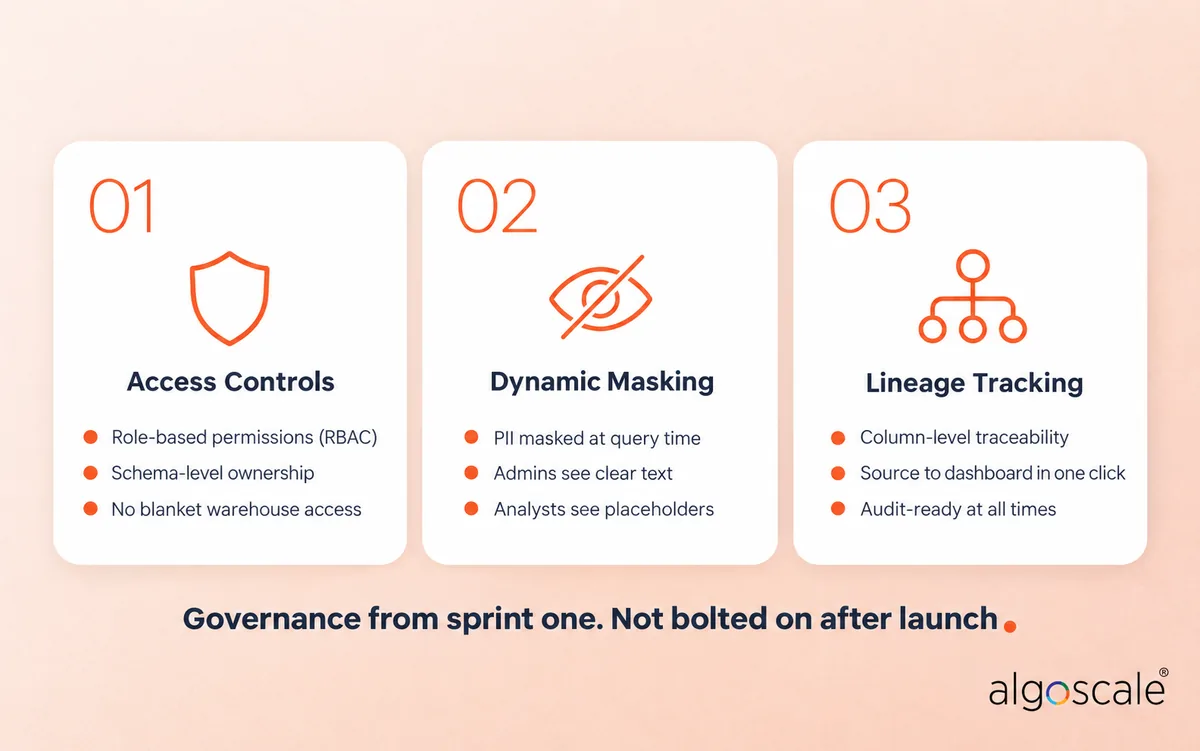
Data warehouse security must be embedded at the design stage, not added after deployment. Retrofitting access controls into a production warehouse is always more expensive and more error-prone than building them in from the start.
Role-based access control is the foundation. Every table, schema, and pipeline should have clearly defined ownership and explicit permissions from day one. Marketing analysts should never accidentally query raw financial records. Data engineers should not have unrestricted write access to production presentation tables.
Dynamic data masking protects sensitive information without restricting workflow. When analysts query customer tables, fields like email addresses or national identifiers are masked automatically based on their assigned role. Teams work with realistic data structures without exposing personally identifiable information.
Column-level lineage tracking is what makes data trustworthy at the executive level. When a finance director questions a revenue figure on their dashboard, automated lineage lets your team trace that exact metric back through every transformation step to the original source system in minutes rather than days.
Any organisation operating in healthcare, financial services, or handling European customer data must account for GDPR, HIPAA, or equivalent regulatory frameworks in the first architectural decision, not the last.
Building a resilient data foundation demands deep architectural foresight. Our data specialists at Algoscale help enterprises navigate this exact complexity. Contact our team today to map out a data architecture that actually supports your long-term growth.
Frequently Asked Questions
What is the very first step in designing a data warehouse?
The first step is business requirement mapping. You must define your core metrics and align departmental definitions before designing any technical architecture.
Is dimensional modelling still relevant today?
Yes. While data lakes handle raw ingestion, dimensional modelling remains the undisputed standard for the final presentation layer.
How long does it actually take to build a data warehouse?
An agile MVP focusing on a single department takes 8 to 12 weeks. A comprehensive enterprise rollout takes 6 to 9 months.
Why should we use ELT instead of traditional ETL?
ELT loads raw data into the warehouse first, then transforms it using the engine’s own compute power. This eliminates pipeline breakage caused by unexpected schema changes in source systems. Traditional ETL transforms data before loading, which is only preferable when compliance rules require scrubbing data before it enters any analytical environment.
How much does a basic cloud migration cost?
Moving a simple legacy database to the cloud typically costs between $40,000 and $75,000 depending on the pipeline complexity.
Which schema is better for cloud reporting?
A star schema is vastly superior for analytics. It minimises complex table joins and perfectly suits modern columnar cloud databases.
Do we need a specific design for real-time data?
Yes. Real-time analytics require streaming integration tools like Kafka and micro-batch processing rather than nightly flat file loads.
How do you design a data warehouse for machine learning workloads?
ML needs wide, denormalised tables with row-level granularity, not the pre-aggregated star schemas that dashboards use. Separate ML compute from BI compute to avoid resource contention, and use reverse ETL to push model predictions back into operational systems.
What is the biggest mistake in data warehouse design?
Skipping logical design and jumping straight to pipeline code. Teams that build before aligning metric definitions across departments end up with conflicting numbers on different dashboards.