


Key insight
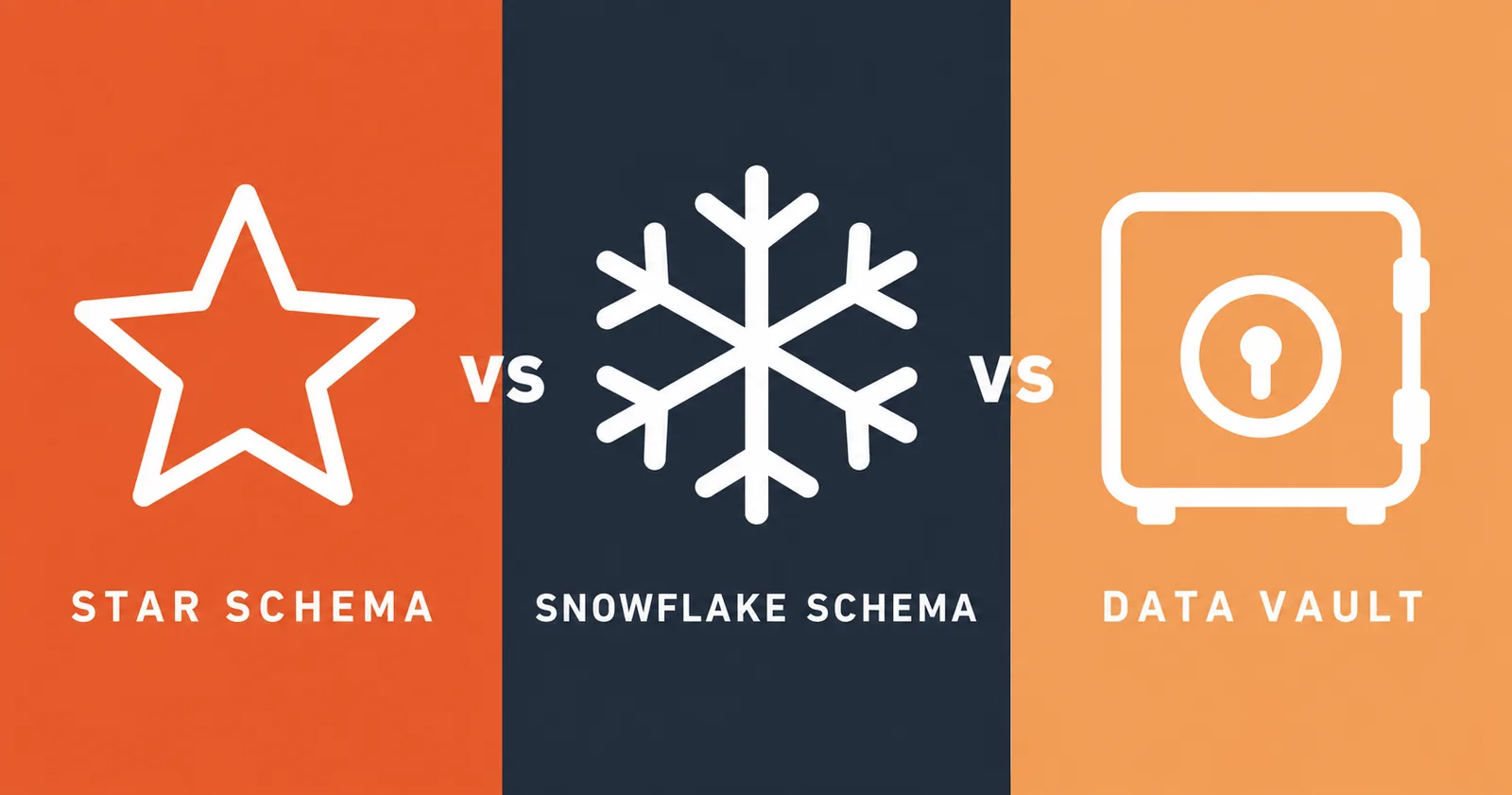
When evaluating a star schema vs snowflake schema, organizations must balance query speed against data integrity. A star schema prioritizes lightning-fast business intelligence reporting through denormalized tables, whereas a snowflake schema enforces strict relational rules for safe database updates. However, for massive enterprise integration, data vault modeling is the superior foundation. It separates business keys, relationships, and historical context into Hubs, Links, and Satellites, effortlessly handling chaotic schema drift. The most effective modern strategy is a hybrid Medallion Architecture: a resilient Data Vault for backend data ingestion, transformed into a Star Schema for frontend business analytics.
According to recent research by Gartner, nearly 80% of enterprise data and analytics initiatives fail to deliver their expected business outcomes. The culprit is rarely a lack of technology. Cloud platforms like Databricks and Snowflake offer incredible processing power, but throwing raw compute at poorly structured tables is a highly expensive mistake. It inflates your monthly cloud bills rapidly while dashboard performance continues to suffer. Getting the fundamentals of your data warehouse right from the start avoids that trap entirely.
Structuring your information correctly is the single most critical architectural choice your engineering team will ever make. For decades, Ralph Kimball’s dimensional design was the undisputed industry standard. Today, things are vastly more complex. The rise of real-time event streaming, machine learning workloads, and constantly shifting software sources has reopened the classic debate of star schema vs snowflake schema. At the same time, data vault modeling has emerged as the preferred foundation for massive, complex enterprise environments.
How do these three distinct approaches handle the pressure of real-world production loads? Let us examine how they function, where their limits lie, and how to choose the exact right framework for your specific operational needs.
The Star Schema: Simple, Fast, and Familiar
Back in the 1990s, the star schema took over the business intelligence world. It is still the default choice for most analytical reporting, and the reason is entirely down to its simplicity.
At the centre of this model sits a fact table. Think of this as a ledger of events. It holds the numerical measurements of a specific business action, like a retail transaction or a website click. Radiating outward from this centre are dimension tables. These hold the descriptive context. They answer the who, where, when, and why of the event stored in the fact table.
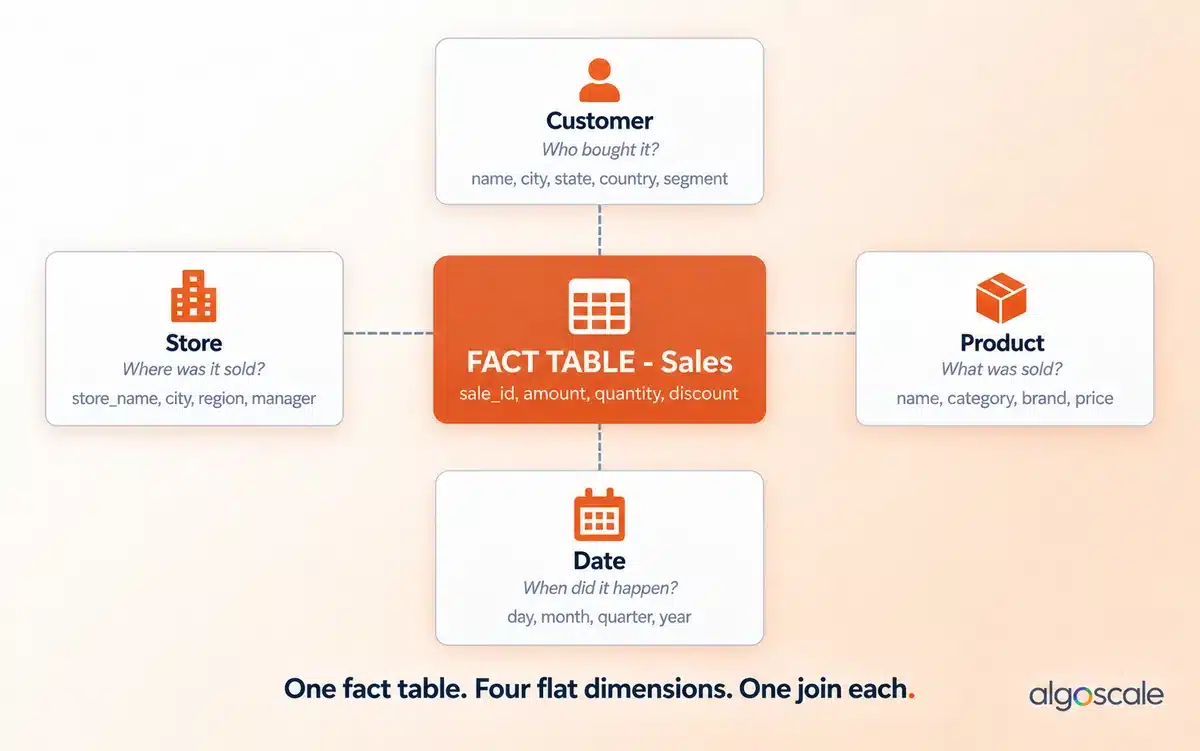
When technical teams start evaluating this setup, someone always asks: is star schema normalized or denormalized? The answer is that it is heavily denormalised on purpose. Dimension tables intentionally repeat descriptive text to avoid making the database do extra work. For example, rather than splitting your regions, cities, and postcodes into separate linked tables, a customer dimension keeps all those geographical fields bundled together on a single row.
Why Analysts Keep Choosing the Star
Querying this setup is incredibly easy. Because the surrounding dimension tables are flat, you rarely need more than a single join to connect the fact table with a dimension. Your analysts do not have to write fifty lines of SQL just to find out how many shoes sold in London last November.
-- STAR SCHEMA: 2 joins
SELECT p.category, SUM(f.amount)
FROM fact_sales f
JOIN dim_customer c ON f.customer_key = c.customer_key
JOIN dim_product  p ON f.product_key  = p.product_key
WHERE c.city = 'London'
  AND f.sale_date >= '2024-11-01'
GROUP BY p.category;

-- SNOWFLAKE SCHEMA: 5 joins (same question)
SELECT p.name, SUM(f.amount)
FROM fact_sales f
JOIN dim_customer c   ON f.customer_key = c.customer_key
JOIN dim_city     ci  ON c.city_key     = ci.city_key
JOIN dim_state    st  ON ci.state_key   = st.state_key
JOIN dim_product  p   ON f.product_key  = p.product_key
JOIN dim_category cat ON p.category_key = cat.category_key
WHERE ci.city_name = 'London'
  AND f.sale_date >= '2024-11-01'
GROUP BY p.name;
Business intelligence tools like Power BI and Tableau absolutely love this layout. They are built from the ground up to navigate it. Plus, modern cloud storage engines compress repeated text beautifully, which means the old worries about wasting disk space on duplicate text simply do not matter anymore.
The Maintenance Catch
The friction kicks in when your source systems change frequently. Imagine your company decides to completely restructure its sales territories. Because the dimension tables are denormalised, updating that territory information means running heavy batch jobs to modify millions of rows. In our experience, keeping these slowly changing dimensions accurate across multiple departmental datasets can quickly turn into an operational nightmare for your data engineers.
The Snowflake Schema: Enforcing Relational Rules
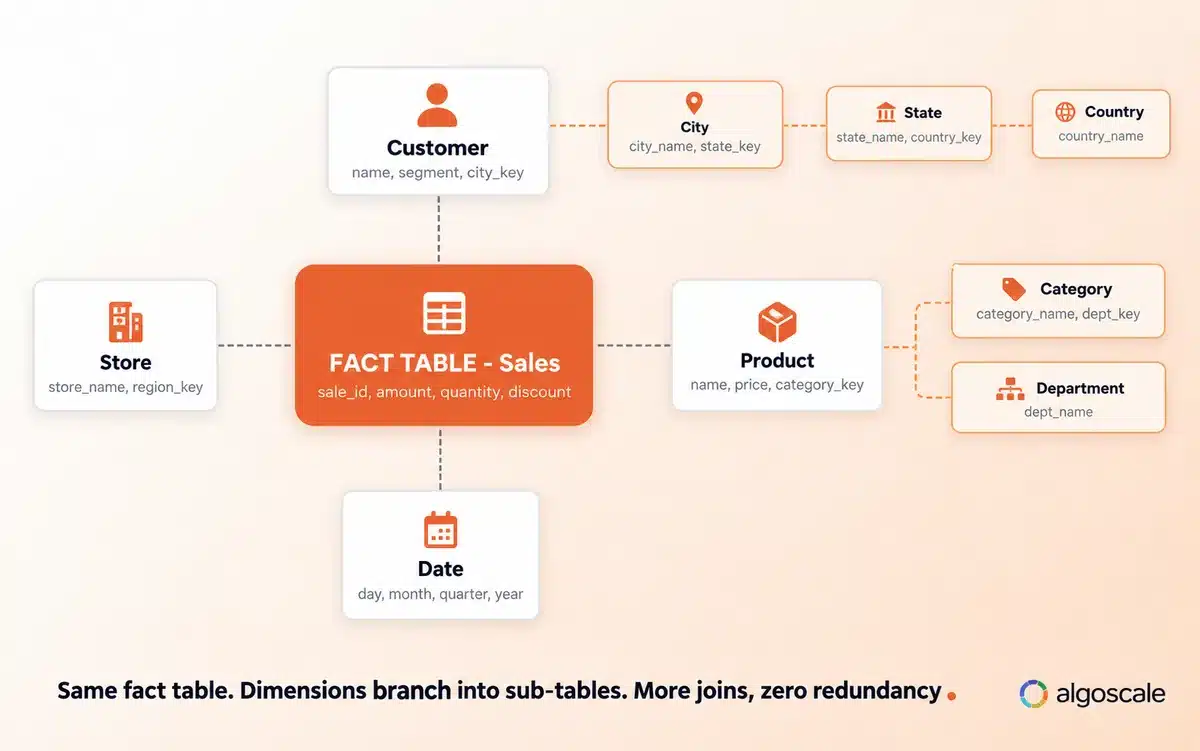
From what we have seen, the star-vs-snowflake performance gap has narrowed with modern columnar engines, but the snowflake data model still goes in the exact opposite direction structurally. It applies strict database normalisation rules to your analytical dimensions, usually breaking them down into what developers call third normal form.
In this design, the central fact table stays exactly the same. The change happens in the dimensions. Instead of holding city and country names directly on a customer record, the customer table holds a reference key. That key links to a city table. The city table links to a state table, and the state table links to a country table. When you draw this out on a whiteboard, the branching tables look exactly like a snowflake.
| Schema model | Structural layout | Query performance | Data integrity and updates | Storage efficiency |
|---|---|---|---|---|
| Star schema | Denormalized (flat dimensions around one fact table) | Lightning-fast (requires minimal joins) | Heavy maintenance during major updates | Low (prioritizes speed over space) |
| Snowflake schema | Normalized (branching sub-dimensions) | Noticeably slower (complex multi-table joins) | Exceptionally clean and safe to update | High (eliminates data redundancy) |
| Galaxy schema | Multiple fact tables linked by shared dimensions | Fast to moderate (supports broad enterprise queries) | Moderate maintenance across shared dimensions | Moderate |
| Starflake schema | Hybrid (combines flat and normalized dimensions) | Variable (optimized for stable vs. volatile data paths) | Highly balanced | Moderate |
Not sure which schema fits your environment?
Tell us how many source systems you are integrating, how often their schemas change, and what your dashboards have to answer. Our data architects will tell you whether star, snowflake, data vault, or a hybrid Medallion setup is the right fit.
Real-World Use Cases: Which Schema Fits Your Build?
- Star schema: the undeniable champion for business intelligence dashboards and user-facing analytics. It is perfect for standard retail sales reporting, daily KPI tracking, and environments where non-technical users query data through self-service tools like Tableau or Power BI. If your source systems are generally stable and dashboard loading speed is the absolute priority, choose the star.
- Snowflake schema: ideal for financial institutions, highly regulated industries, or organizations managing deeply complex, shifting product hierarchies. If your marketing or product classifications change daily and you need to enforce strict relational discipline to avoid massive, resource-heavy batch updates, normalization provides the necessary safety net.
- Galaxy schema (fact constellation): built for cross-departmental analytics. This is necessary when an executive team needs to compare logistics delivery times (fact table A) directly against raw customer sales (fact table B). By using shared, conformed dimensions such as a universal date or location table, a galaxy schema connects different business silos without forcing unrelated metrics into a single, messy fact table.
- Starflake schema: the pragmatist’s choice for dynamic commercial platforms. It offers a surgical approach: keeping highly stable data such as dates and basic geographic regions flat for fast querying, while aggressively normalizing volatile data such as rapidly shifting promotional campaigns, dynamic pricing tiers, or complex customer demographics to protect database integrity.
Once you have settled on a modeling approach, the next decision is usually platform. If you are weighing where to run these workloads, see our comparison of Snowflake vs. Databricks for choosing the underlying analytics engine.
Enter the Enterprise Standard: What is a Data Vault?
Dimensional models are fantastic for answering specific business questions. But they were never meant to serve as a massive integration hub for fifty different operational systems that change their layouts without warning. In practice, once you cross 15 to 20 source systems with schemas shifting monthly or more, you need something much more robust.
So, what is a data vault exactly?
A data vault architecture is an agile, detail-focused design pattern built specifically for large-scale enterprise integration. Instead of organising your data around reporting metrics, it strips everything down to its core components. It separates business keys, relationships, and context into distinct, highly controlled table types. Modern setups rely on the data vault 2.0 methodology, which uses hash keys to allow massive, parallel data loading.
Breaking Down the Architecture
Every data vault separates your incoming information into three specific buckets.
First, you have Hubs. Hubs track unique business entities, like a Customer or an Invoice. A Hub contains almost nothing. It only holds the immutable business key, a generated hash key, the time it was loaded, and the record source. It never stores names, addresses, or amounts.
Second, you have Links. Links represent the transactions or relationships between Hubs. A Link table maps out associations, such as a customer purchasing a product. By separating relationships from the core entities, your warehouse will not break when the business changes its operating model.
Finally, you have Satellites. Satellites store all the descriptive, point-in-time attributes. When a customer moves house, the pipeline does not overwrite their old address. Instead, it appends a brand new record with a fresh timestamp to the Satellite table. You keep a perfect historical record automatically.
-- Old address stays. New row appended. Nothing overwritten.
INSERT INTO sat_customer_mainframe (
    customer_hash_key,
    load_date,
    record_source,
    hash_diff,
    name,
    address,
    phone
)
VALUES (
    'a1b2c3d4',
    '2024-11-15 09:30:00',
    'MAINFRAME_CRM',
    'x9y8z7w6',
    'John Smith',
    '42 New Oxford Street, London',  -- moved house
    '+44 20 7946 0958'
);

-- Query full address history - every version preserved
SELECT name, address, load_date
FROM sat_customer_mainframe
WHERE customer_hash_key = 'a1b2c3d4'
ORDER BY load_date DESC;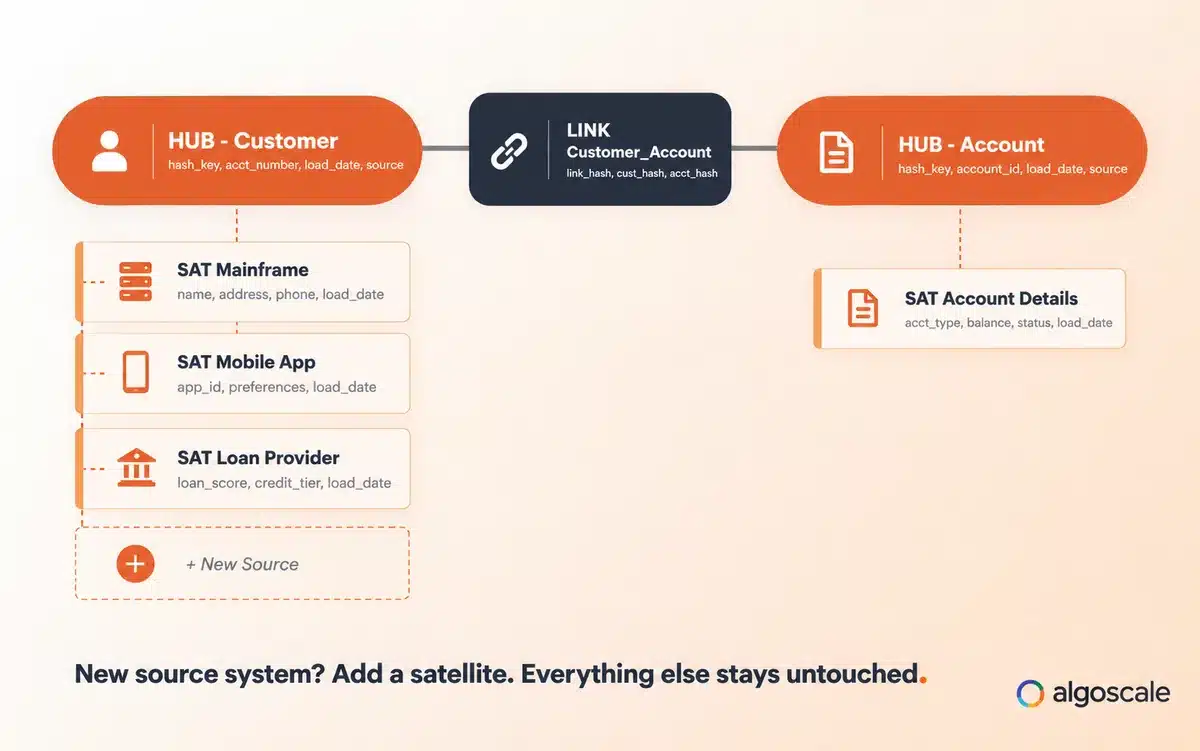
A Data Vault Modeling Example in Action
Let us look at a practical data vault modeling example. Imagine a retail bank trying to merge records from a legacy mainframe, a brand new mobile app, and an external loan provider.
The pattern we see fail most often is trying to use a star schema here. You end up writing complex transformation logic upfront to force all three systems into a single customer dimension. The moment the mobile app developers add a new feature, your pipeline breaks.
With a data vault, things are much smoother. Your Hub Customer table stores the master account number. Your Link Customer Account table tracks which checking or savings accounts belong to them.
Then, you create separate Satellites for each source. You have a Satellite for the mainframe data, a Satellite for the mobile app data, and a Satellite for the loan data. Everything is append-only. If the mobile app introduces five new data fields next week, your engineers just deploy a new Satellite table to catch them. The existing tables, ingestion pipelines, and downstream queries remain completely untouched.
Data Vault vs Dimensional Modeling: Making Sense of It All
Looking at data vault vs dimensional modeling should never be treated as a winner-takes-all competition. They solve entirely different problems, and they belong at different stages of your data lifecycle.
Dimensional modeling shines at the very end of the pipeline. It is the presentation layer where business users actually query their metrics. But trying to use a star schema to ingest raw, chaotic data from dozens of different systems is a guaranteed path to engineering burnout.
Data Vault excels at the chaotic ingestion boundary. It preserves the exact historical fidelity of your source systems. It handles sudden schema drift without causing downtime. Crucially, it creates an immutable audit trail that keeps your compliance and legal teams perfectly happy, which is also where data governance work pays off.
The Modern Lakehouse: Building the Best of Both Worlds
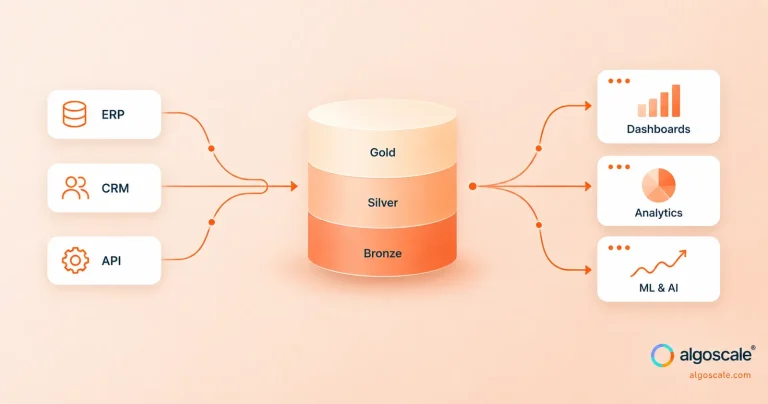
Modern data engineering does not force you into a corner. The smartest data teams we have worked with use a multi-tiered approach, often called a Medallion Architecture, to get the benefits of every model.
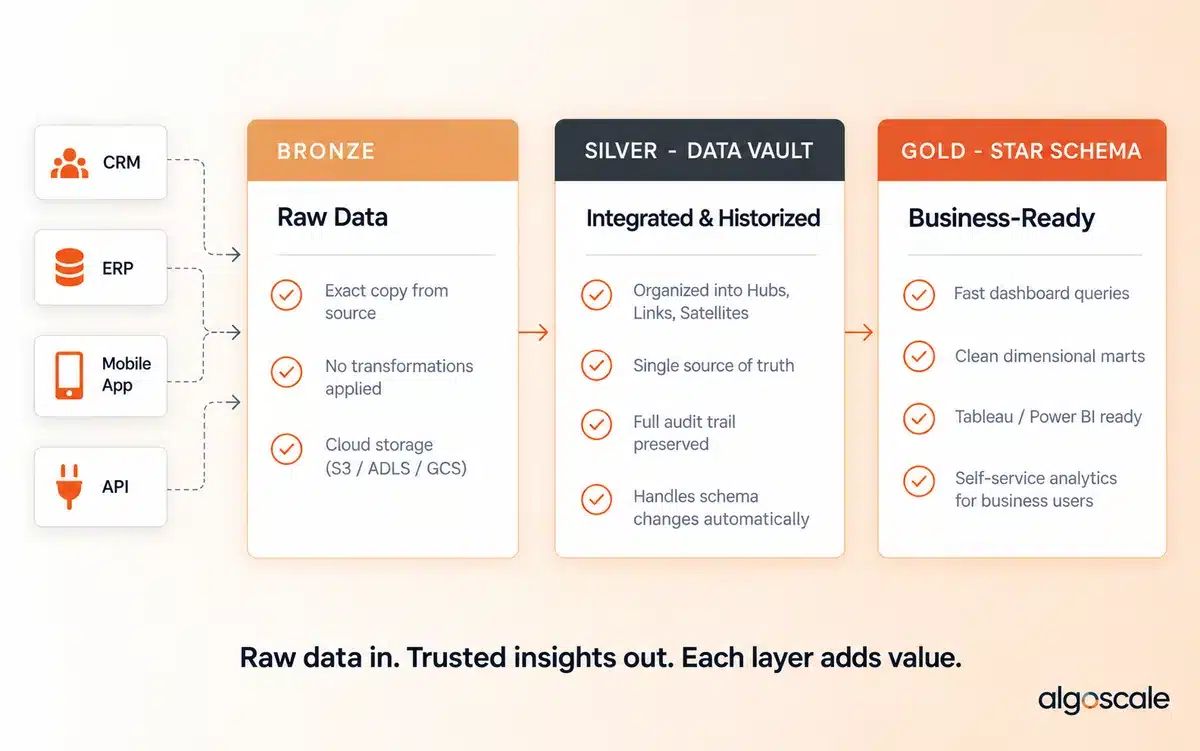
It typically works like this. Unaltered raw data lands directly in cheap cloud storage, often a data lake. This is your Bronze layer.
Next, that raw data gets cleansed, hashed, and loaded into an enterprise Data Vault. This becomes your Silver layer. The Hubs sort out the business keys across your different systems, the Links track the relationships, and the Satellites keep a perfect historical log of every change. This acts as your single, undeniable version of the truth.
Finally, you have the Gold layer. We always recommend against letting your business analysts query the Data Vault directly. Joining dozens of Hubs and Satellites requires incredibly complex SQL, and dashboard performance degrades immediately. Instead, your engineers use automated transformation tools to read the Data Vault and construct clean, simple star schema presentation marts.
This hybrid pattern gives you total auditability and engineering resilience in the background, while delivering fast, intuitive dashboards to the business teams on the front end.
Choosing the Right Path for Your Business
Your choice of architecture has to reflect your operational reality. Do not just pick a template because a blog post said it was popular.
Use a star schema if your main goal is getting clean dashboards in front of business users quickly, and your source systems are generally stable. Lean towards a snowflake schema if you have deeply complex product hierarchies and you want to enforce strict relational discipline to avoid data anomalies. For the bigger picture of how this decision fits into your overall data warehouse architecture, see our complete guide.
Invest in Data Vault 2.0 if you are managing an enterprise platform that pulls messy data from dozens of shifting systems, or if you operate in a highly regulated industry where audit trails are legally required. Building a data warehouse foundation that lasts requires a careful balance between rapid reporting and long-term maintainability.
Conclusion
At Algoscale, our data engineering consultants specialise in designing architectures that fit your actual commercial needs. Whether you need to refactor brittle legacy pipelines into a resilient enterprise Data Vault, or you want to build lightning-fast dimensional reporting models in the cloud, we know how to turn your raw data into a strategic asset. If a platform migration is part of that plan, our data warehouse migration strategy and steps guide walks through schema translation, cutover planning, and validation in detail. Get in touch with our team today to map out a data estate that will actually scale with your ambitions.
Frequently Asked Questions
What is the main difference between a star schema and a snowflake schema?
Star schema uses flat, denormalized dimensions for faster queries. Snowflake schema normalizes dimensions into branching sub-tables, reducing redundancy but requiring more joins.
Is a star schema normalized or denormalized?
Heavily denormalized on purpose. Dimension tables intentionally repeat descriptive text like city, state, and country to avoid extra joins.
What is a data vault architecture?
An agile integration pattern that separates business keys (Hubs), relationships (Links), and historical attributes (Satellites) to handle complex, multi-source enterprise environments.
When should you choose a data vault over a dimensional model?
When managing 15+ source systems with frequent schema changes, strict audit requirements, or regulated industries where full historical traceability is legally required.
What is a galaxy schema (fact constellation)?
Multiple fact tables sharing conformed dimensions like date and location, enabling cross-departmental analytics without forcing unrelated metrics into one messy fact table.
How can you combine Data Vault and Star Schema in a Medallion Architecture?
Raw data lands in Bronze storage. The Silver layer uses Data Vault for resilient integration. The Gold layer transforms it into star schema marts for fast BI queries.