


For years, “data lake” was the default answer to “where should we put all our data.” It’s still a reasonable answer for plenty of situations. But a genuine shift has been happening across data teams: companies that built a data lake five or six years ago are increasingly layering lakehouse capabilities on top of it, or building new projects as lakehouses from day one instead.
This isn’t just vendors pushing a new buzzword. There are specific, practical forces driving this shift, and understanding them helps clarify whether your own organization is actually feeling that pressure yet – or whether a plain data lake is still perfectly adequate for where you are right now. If you’re trying to figure out where your company sits in this shift, our Data Lake Services team at Algoscale has conversations about exactly this question regularly.
The Historical Split, Briefly
For a long time, companies ran two separate systems: a data lake for cheap, flexible storage of raw and unstructured data, and a data warehouse for the clean, structured data business teams actually trusted for reporting. This wasn’t a mistake – it was a reasonable tradeoff given the technology available at the time. But it required real, ongoing engineering effort to keep both systems in sync, and it created the familiar problem of two teams pulling “the same” number from different systems and getting different answers.
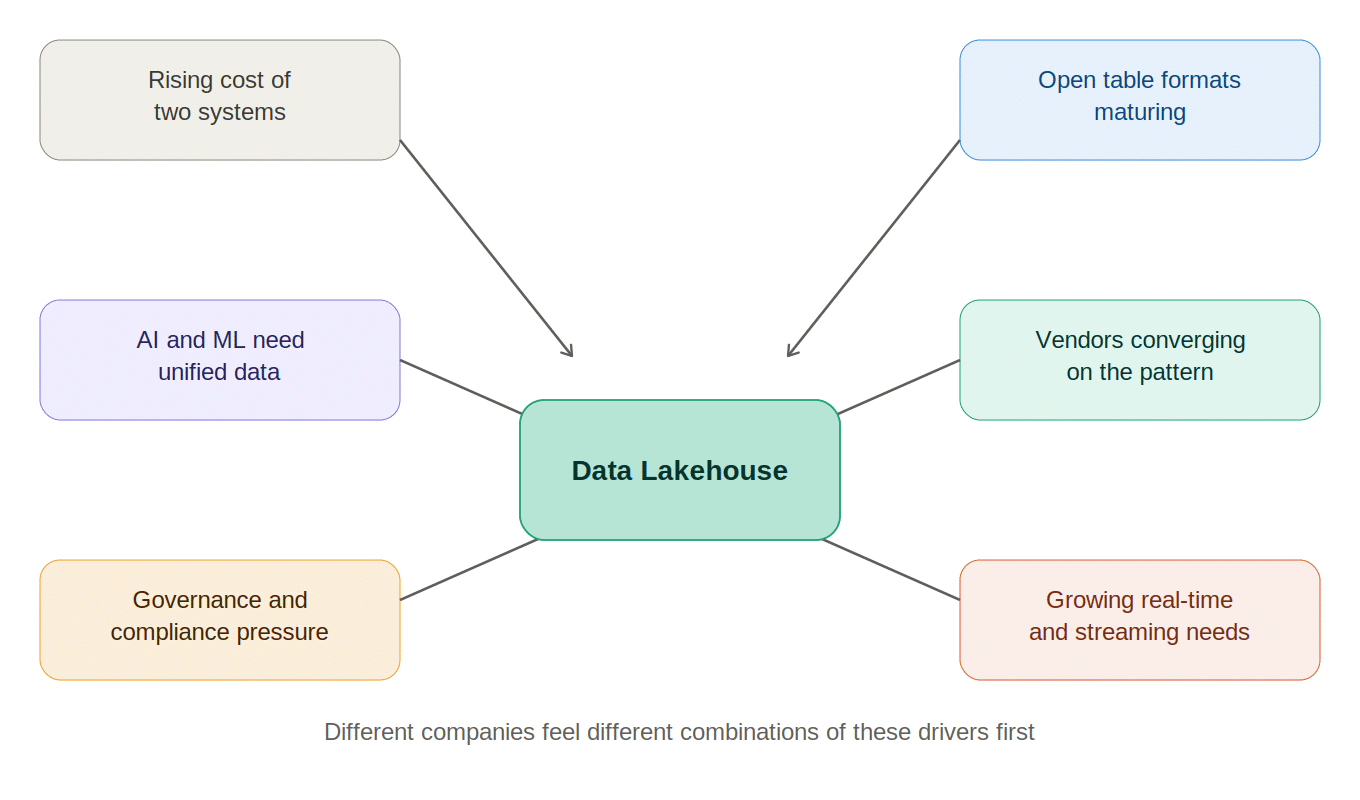
What’s Actually Driving the Shift
Rising Cost of Maintaining Two Systems
Running a data lake and a data warehouse in parallel means paying for two storage systems, two sets of compute, and the engineering time to build and maintain pipelines keeping them roughly in sync. As data volumes grow, that duplicated cost grows with it. Consolidating onto a single lakehouse architecture removes a meaningful chunk of that ongoing overhead, which is a straightforward enough argument that finance teams tend to notice it as much as engineering teams do.
Open Table Formats Reaching Real Maturity
Delta Lake, Apache Iceberg, and Apache Hudi have moved from early, somewhat experimental technology to genuinely production-hardened tools with broad ecosystem support. A few years ago, adopting a lakehouse pattern meant betting on relatively new, less-proven technology. That’s no longer really true – these formats are now supported natively across major cloud platforms and query engines, which removes a lot of the risk that made companies hesitant to commit earlier.
AI and Machine Learning Demanding Unified Data
Machine learning and AI initiatives need large volumes of data that’s both clean enough to trust and flexible enough to include unstructured and semi-structured sources – exactly the combination a lakehouse is built to provide. Traditional data warehouses were never designed for this kind of workload, and companies trying to bolt AI initiatives onto a warehouse-only architecture often hit friction that a lakehouse avoids by design. Our post on how generative AI benefits from a data lakehouse foundation goes deeper into this specific driver.
Cloud Vendors Converging on the Pattern
Databricks, Snowflake, AWS, Microsoft Azure, and Google Cloud have all built toward the lakehouse pattern in their own ways over the past several years – whether through native open table format support, unified catalogs, or platform consolidation like Microsoft Fabric. When most major platforms are independently converging on the same architectural pattern, that’s a meaningful signal that it’s solving a real, widely shared problem rather than being one vendor’s marketing angle. Our comparison of Snowflake vs. Databricks for enterprise analytics shows how differently two major platforms have approached the same underlying pattern.
Governance and Compliance Pressure
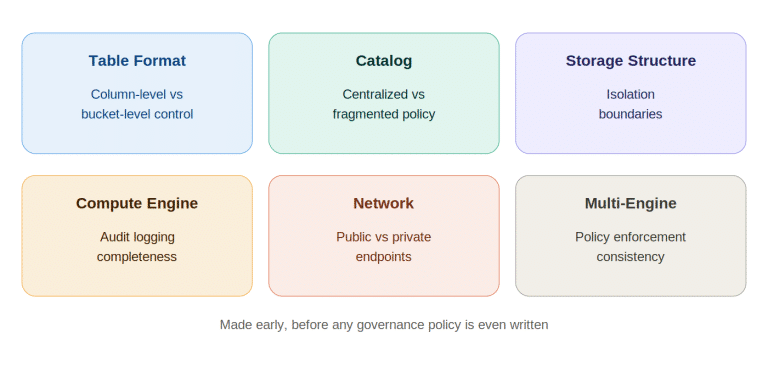
As data privacy regulations and industry-specific compliance requirements have grown more demanding, having data spread across two loosely-synced systems makes governance meaningfully harder – you need consistent access control, audit logging, and classification across both, rather than just one. A single, well-governed lakehouse simplifies proving compliance considerably compared to reconciling policy across two separate systems. Our post on data lakehouse security best practices for cloud-native organizations covers what this governance model actually looks like.
Real-Time and Streaming Needs Growing
More companies need at least some data available in near-real-time – fraud detection, live operational dashboards, personalization – rather than purely batch-updated overnight. Traditional warehouse architectures weren’t built with streaming as a first-class citizen, while modern lakehouse table formats support streaming and batch writes to the same tables natively, without needing a separate real-time architecture running in parallel.
Signs the Shift Is Happening at Your Company
● You’re maintaining a data lake and a data warehouse and increasingly resent the pipelines that keep them in sync
● Different teams have started quietly building their own “trusted” versions of the same dataset
● A machine learning or AI initiative has stalled specifically because the data isn’t accessible or clean enough
● Compliance reviews take longer than they should because data governance policy differs across systems
● You’re evaluating a new cloud platform and noticing every serious option now supports lakehouse patterns natively
None of these individually means you need to act immediately, but if several are true at once, it’s a reasonable signal that the shift other companies are making is relevant to your situation too, not just an industry trend happening elsewhere.
What This Shift Looks Like in Practice
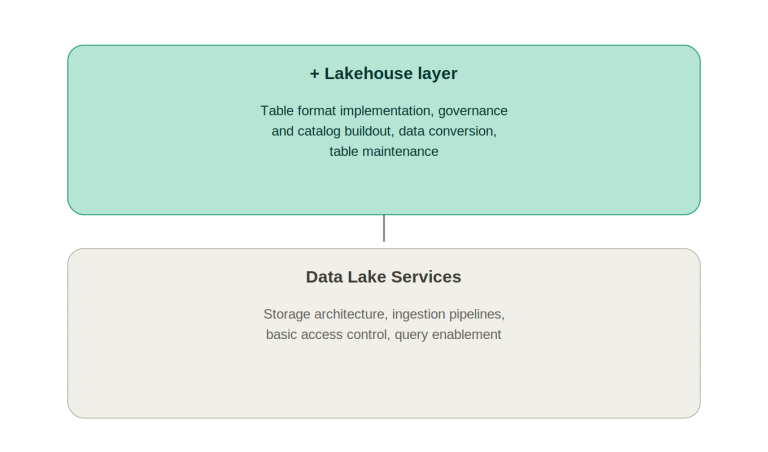
The move rarely happens as one dramatic cutover. A more typical pattern: a company starts by adding an open table format to a subset of their existing data lake – often the tables causing the most friction, like the ones multiple teams query for reporting. That subset starts behaving reliably, with real schema enforcement and a governed catalog, while the rest of the lake continues operating as it did before. Over time, as trust builds and the team gets comfortable with the new pattern, more of the lake gets migrated onto the lakehouse structure, and new pipelines get built directly on it rather than the old flat storage approach.
This gradual pattern is worth knowing about specifically because it lowers the perceived risk of getting started. Companies don’t need to commit to a full architectural overhaul on day one – they can prove the value on a contained, high-impact piece of their data first.
What Companies Give Up by Not Moving
Staying on a purely two-system architecture isn’t a mistake, but it does have a real, ongoing opportunity cost. Engineering time spent maintaining sync pipelines is time not spent on new capabilities. Slower, less trustworthy access to unified data means AI initiatives take longer to get off the ground, if they get off the ground at all. And the “which number is right” problem doesn’t resolve itself – it tends to quietly erode trust in data-driven decisions across the organization the longer it persists.
Is This Hype, or a Genuine Shift?
It’s worth being honest here: not every company needs to move immediately, and “lakehouse” has absolutely been used as a marketing term by vendors selling products that don’t fully deliver on it. A small company with modest data volumes and a single, well-functioning warehouse may have little to gain from this shift right now. The signal to actually pay attention to isn’t the term itself – it’s whether the specific problems described above (duplicated infrastructure cost, governance friction, AI initiatives blocked by messy data) are problems your organization is genuinely experiencing. If they are, the shift is solving a real problem for you specifically, regardless of how the industry talks about it in general.
How to Know If Your Company Should Move
The clearest signal isn’t company size or industry – it’s whether you’re already paying the costs of the two-system split described above, in either direct infrastructure spend, engineering time, or blocked AI and analytics initiatives. Organizations feeling more than one of these pressures at once tend to see faster, clearer returns from making the move than those doing it purely because it’s the current industry direction.
Making the Move on Your Own Timeline
Deciding whether and when to move from a data lake to a lakehouse architecture is a decision worth making deliberately, based on your organization’s actual pressures rather than industry momentum alone. At Algoscale, our Data Lake Services team helps companies assess this honestly – including telling clients when they’re not yet ready to make this move, not just when they are.
To see the broader range of data engineering and analytics work we do beyond this specific shift, take a look at what Algoscale builds across the data stack.
Why Algoscale
● Pre-built accelerators. We don’t start every engagement from a blank slate – proprietary accelerators built from prior implementations speed up common data source integration and analytics patterns.
● Faster time to value. For a focused initial scope covering core data sources and first analytics use cases, our accelerators typically compress development timelines to around four weeks, rather than the several months a from-scratch build often takes.
● Built on a scalable framework. Our implementation approach follows a repeatable, scale-ready framework, so the architecture built for your first use case extends cleanly as data volume and teams grow, rather than requiring a redo.
● Microsoft Solution Partner for Data & AI. Algoscale holds Microsoft Solution Partner status for Data & AI, including specific expertise implementing Microsoft Fabric as a modern data warehouse.
Frequently Asked Questions
1. Is every company eventually going to need to move to a lakehouse?
Not necessarily on a fixed timeline. Companies with modest data volumes, few teams depending on shared data, and no immediate AI initiatives may reasonably stay on a simpler architecture for a long time. The shift matters most for organizations actually experiencing the specific pressures driving it.
2. How urgent is this move if we’re already feeling the pain of two separate systems?
It depends on how much that pain is actually costing you in engineering time, infrastructure spend, or blocked initiatives. It’s rarely an emergency, but it’s also not something that resolves on its own – the costs tend to compound rather than diminish over time.
3. Do we need to fully migrate away from our data warehouse to make this shift?
No. Many companies run a lakehouse alongside an existing warehouse for a transition period, gradually moving workloads over rather than doing a single disruptive cutover.
4. Is this shift specific to any particular industry, or is it happening broadly?
It’s happening broadly, though the pace and specific drivers vary. Regulated industries often feel the governance pressure most acutely; companies investing heavily in AI feel the unified-data pressure most; cost-sensitive, high-data-volume companies feel the infrastructure consolidation pressure most.
5. What’s the biggest risk in following this shift too early, before we’re ready?
Moving before your team has the skills or bandwidth to properly design governance and structure tends to just relocate existing problems into new infrastructure, rather than actually solving them. Readiness matters more than timing relative to industry trends.
6. How do we tell the difference between genuine lakehouse capability and vendor marketing using the term loosely?
Look for the actual technical substance: ACID transactions, schema enforcement, a real catalog, and genuine multi-engine support on open formats. If a platform can’t clearly explain how it delivers these, the “lakehouse” label may be more marketing than architecture.