

Every organization sitting on a growing pile of data eventually faces the same fork in the road: build the capability internally, or bring in specialists who already know the terrain. With Microsoft Fabric now consolidating data engineering, data warehousing, real-time analytics, and BI into a single SaaS platform, that decision has become sharper and more consequential. Get it right, and you accelerate time-to-value. Get it wrong, and you end up paying twice once for the wrong approach, and again to fix it.
This post breaks down what an in-house team and a Microsoft Fabric consulting partner each bring to the table, so you can match the option to where your organization actually stands.
What “Going In-House” Really Means
Building an in-house Fabric team means hiring or upskilling data engineers, analysts, and administrators who live inside your organization day to day. They know your business context intimately, the quirks in your source systems, the politics of who owns what data, the reporting cadence leadership actually cares about.
Where In-House Shines
● Deep institutional knowledge. No onboarding curve for business logic; your team already knows why finance’s numbers never match marketing’s.
● Long-term ownership. The people who build the pipelines are the people who maintain them, which tends to produce more sustainable architecture decisions.
● Full-time availability. No contract hours to track or engagement scope to renegotiate every time priorities shift.
● Culture fit. Internal teams absorb your governance norms and security posture naturally, rather than needing them documented and explained.
Where In-House Struggles
● The learning curve is real. Fabric is new enough that even experienced Power BI or Synapse teams need real time to get comfortable with OneLake, Lakehouses, Dataflows Gen2, and the unified capacity model.
● Hiring is slow and expensive. Fabric-certified talent is scarce, and competing for it against every other company doing the same migration is not cheap.
● Risk of costly missteps. Capacity sizing, workspace architecture, and governance decisions made early are hard to unwind later. A team learning on the job can bake in expensive mistakes.
● Opportunity cost. Every week spent figuring out Fabric fundamentals is a week not spent on the actual business problems the platform was meant to solve.
What Microsoft Fabric Consulting Services Bring
A consulting partner specializing in Microsoft Fabric has typically run the same migration, the same capacity planning exercise, and the same governance setup across dozens of clients. They’re not learning the platform on your dime — they’re applying patterns they’ve already validated.
Where Consulting Shines
● Speed to value. Experienced consultants can architect and stand up a working Fabric environment in a fraction of the time it takes a team encountering the platform for the first time.
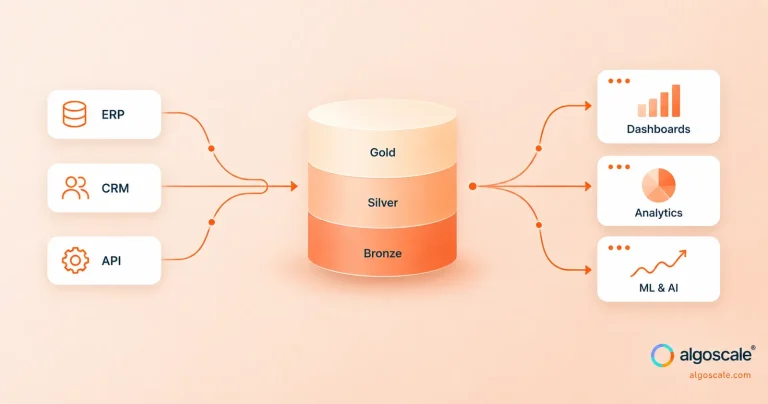
● Proven best practices. From medallion architecture decisions to capacity/SKU sizing to CI/CD for Fabric items, consultants bring patterns that have already been stress-tested elsewhere.
● Access to specialized skill sets. Real-time intelligence, complex Dataflows, and DAX optimization for large semantic models are all deep specialties that are hard to justify hiring for full-time.
● Objective, outside perspective. Consultants aren’t tangled in internal politics, which can make it easier to push through architecture decisions that a purely internal team might struggle to get consensus on.
Where Consulting Has Trade-Offs
● Cost per hour is higher. Consulting rates reflect the expertise, and for ongoing, indefinite work that adds up.
● Context ramp-up. Even the best consultants need time to understand your specific data landscape and business rules before they can move fast.
● Knowledge transfer risk. If the engagement doesn’t include a deliberate handoff plan, your internal team can be left maintaining a system they didn’t build and don’t fully understand.
● Availability constraints. Consultants are typically engaged for defined scopes and hours, not always on standby for the fires that come up between sprints.

Figure 1: Relative strengths of in-house teams vs. Fabric consulting across key decision factors.
A Side-by-Side Comparison
| Factor | In-House Team | Fabric Consulting Services |
| Time to first working solution | Slower — learning curve | Faster — proven playbooks |
| Upfront cost | Lower (existing salaries) | Higher (consulting rates) |
| Long-term cost | Can be lower once skilled up | Depends on engagement length |
| Business context | Strong from day one | Needs ramp-up time |
| Fabric-specific expertise | Builds over time | Available immediately |
| Governance & architecture risk | Higher, especially early on | Lower, based on prior experience |
| Flexibility for ongoing changes | High — full-time presence | Bound by contract scope |
| Knowledge retention | Naturally internal | Requires explicit transfer plan |
The Hybrid Model: Often the Smartest Path
In practice, most organizations that get the most value out of Microsoft Fabric don’t choose one path exclusively they blend them. A common and effective pattern looks like this:

Figure 2: A phased hybrid approach — consulting-led start, embedded transfer, in-house ownership.
● Engage a Fabric consulting partner for the initial architecture and migration — capacity planning, Lakehouse/Warehouse design, security and governance setup, and the first set of production pipelines.
● Embed internal team members in that engagement from day one — not just as observers but as active contributors, so knowledge transfers as the work happens rather than in a rushed handoff at the end.
● Transition to in-house ownership for day-to-day operations — incremental development, and business-as-usual support, while keeping the consulting relationship available for periodic architecture reviews or specialized problems.
This approach captures the speed and proven patterns of consulting expertise while building durable internal capability, rather than permanent dependency.
How to Decide
Ask yourself a few honest questions:
● How urgent is this? If leadership needs a working Fabric environment in the next quarter, going pure in-house is a risky bet.
● Do you have existing Power BI, Synapse, or Azure data engineering skills to build on? If yes, your ramp-up curve is shorter and in-house becomes more viable sooner.
● Is this a one-time migration or an ongoing platform investment? One-time, well-scoped projects favor consulting. Continuous, evolving data platforms favor building internal muscle — ideally with consulting support at the start.
● What’s your risk tolerance for architecture mistakes? Early Fabric decisions around capacity, workspace structure, and governance are expensive to reverse. If you can’t afford to get this wrong, expert guidance upfront pays for itself.
● What’s your budget shape? Can you absorb a higher upfront consulting cost for a faster, lower-risk rollout, or does your budget favor a slower, salary-based build-out?