

The terms business intelligence consulting and data analytics consulting are often used interchangeably – sometimes by the firms that offer both. But the confusion they create has real consequences. An organisation that needs a governed enterprise reporting platform and hires a data analytics consultancy that specialises in Python-based machine learning will likely end up with impressive models that the business cannot interpret or act on. Conversely, an organisation with genuine predictive modelling needs that hires a pure business intelligence consulting firm may get beautifully designed Power BI dashboards built on yesterday’s data, with no forward-looking analytical capability.
Understanding the distinction – and the overlap – between these two disciplines is essential for making the right investment and finding the right partner. This article defines both, identifies where they intersect, and explains how AlgoScale, as a bi consulting firm with both capabilities, approaches engagements where the boundary between BI and analytics is genuinely blurred.
What Is Business Intelligence Consulting?
Business intelligence consulting focuses on designing, building, and governing the systems and processes that give business users access to historical and current operational data in a form they can interpret and act on. The deliverables of a BI engagement typically include: a data model (usually a star schema with certified shared datasets), a set of interactive reports and dashboards in a tool like Power BI, a governance framework that controls who can access what data and who can publish to which workspace, and a training programme that enables business users to self-serve on the platform.
The primary audience for BI deliverables is the business user: the finance manager who needs a budget versus actual dashboard, the supply chain director who needs an inventory position report, the sales VP who needs pipeline coverage by region. These users want answers to known questions, expressed in business terms, updated frequently, and accessible without requiring a data science background. Power bi consulting services are the most common form of business intelligence consulting in the US enterprise market today, because Power BI occupies the reporting and analytics layer of the Microsoft data platform that most mid-to-large enterprises have already adopted.
What Is Data Analytics Consulting?
Data analytics consulting encompasses the design and delivery of analytical solutions that go beyond reporting historical data. It includes statistical analysis, predictive modelling, machine learning, natural language processing, computer vision, and experimentation frameworks. The tools most commonly associated with data analytics consulting are Python, R, Jupyter Notebooks, Databricks, Apache Spark, and cloud ML platforms like Azure Machine Learning, AWS SageMaker, or Google Vertex AI.
The primary audience for analytics deliverables is the decision-maker who needs to know not just what happened, but what is likely to happen next and what action will produce the best outcome. A demand forecasting model that predicts next quarter’s sales by SKU. A customer churn model that identifies at-risk accounts thirty days before renewal. A recommendation engine that surfaces the next best product for each customer at the moment they are most likely to buy. These deliverables require a data science team with statistical expertise, software engineering skills, and the ability to translate model outputs into business decisions that non-technical stakeholders can act on.

Where They Overlap: The Integration Layer
The most powerful analytics environments are ones where BI and data analytics work together, rather than existing in separate silos. The output of a machine learning model is only valuable if it reaches the people who can act on it. For most enterprise organisations, that means surfacing model outputs in Power BI – as a predicted churn score on a customer record, a forecasted demand figure on a supply chain dashboard, or a fraud probability on a transaction report. Building this integration requires both BI consulting expertise (to design the semantic model and reports that consume the model output) and data analytics expertise (to build, train, and deploy the model in the first place).
This integration layer – where ML model outputs become Power BI measures that business users can interact with – is where the distinction between the two disciplines becomes less important than the quality of the team that can navigate both. AlgoScale provides this cross-disciplinary capability as a single engagement team, meaning clients do not have to manage two separate consulting relationships and navigate the handoff between them.
Business Intelligence Consulting vs Data Analytics Consulting – Key Differences
| Dimension | Business Intelligence Consulting | Data Analytics Consulting |
| Primary Goal | Report and visualise historical and current data | Model patterns; predict and prescribe outcomes |
| Typical Tools | Power BI, Tableau, SSRS, DAX, Power Query | Python, R, Databricks, Azure ML, Spark, SQL |
| Primary Audience | Business users; operational managers; executives | Data scientists; ML engineers; strategy teams |
| Output Type | Dashboards, reports, KPI scorecards, data models | ML models, forecasts, recommendations, experiments |
| Data Requirement | Cleaned, governed, structured historical data | Large labelled datasets; often raw or semi-raw |
| Governance Focus | Workspace access, RLS, OLS, dataset certification | Model lineage, feature store governance, MLOps |
| Time Horizon | What happened; what is happening now | What will happen; what should we do about it |
| Typical Duration | 4–16 weeks for a defined scope | 3–6 months for a full ML pipeline plus integration |
Which Does Your Organisation Need Right Now?
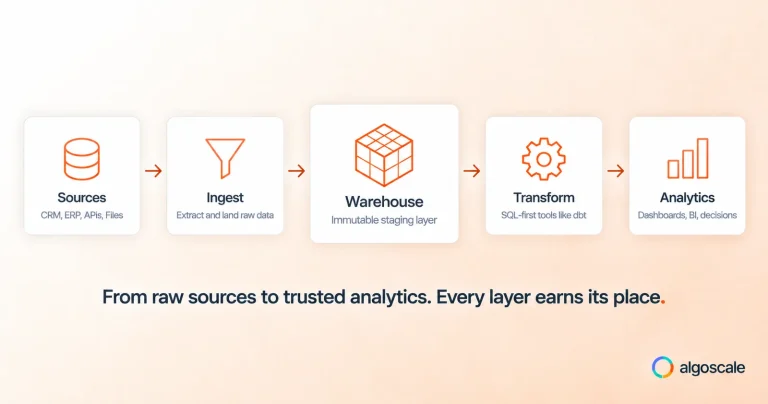
Most organisations reach a point where they genuinely need both disciplines. But they rarely need them simultaneously from day one, and the sequencing matters. Attempting to build machine learning models on top of unreliable, inconsistently governed data is an exercise that consistently underdelivers. The model learns the inconsistencies in the data, not the business patterns it was meant to capture, and the predictions are wrong in ways that are difficult to diagnose. The right sequence for most organisations is: first, establish a reliable Power BI semantic layer with certified, governed data that the business trusts. Then, extend that foundation to support ML pipelines that read from the same curated tables.
If your organisation has not yet built a consistent, governed Power BI reporting environment, that is where business intelligence consulting should begin. If your environment is mature and you are ready to extend into predictive analytics, AlgoScale can transition the same engagement team into the ML integration layer without requiring a new selection process or a disruptive handoff between firms.
The Case for a Single Partner Across Both Disciplines
Managing two separate consulting relationships – one for BI and one for data analytics – creates coordination overhead, integration risk, and accountability gaps. When ML model outputs do not appear correctly in Power BI dashboards, both firms can point to the other as the source of the problem. When the data model needs extending to support a new ML feature, the BI firm and the analytics firm need to agree on changes that affect both their scopes. When a business user asks why a prediction is incorrect, neither firm may have visibility into the end-to-end chain that produced it.
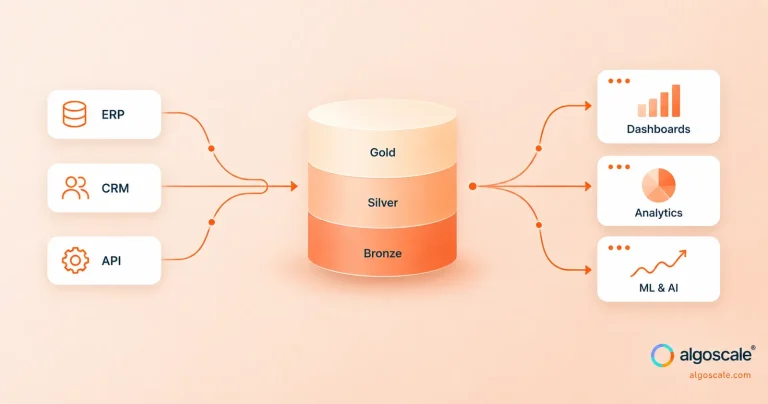
A single bi consulting firm with genuine data analytics capability eliminates these coordination costs. The same team that designs the Power BI semantic model also designs the ML feature store that feeds it. The same architect who specifies the Gold layer tables in the data lakehouse also specifies the scoring pipeline that writes model outputs to those tables. And when the business asks a question that spans both the historical dashboard and the forward-looking forecast, there is one team that owns the answer. That is the model AlgoScale provides as a full-stack bi consulting company.

Choosing the Right Consulting Engagement – Decision Scenarios
| Business Scenario | Right Consulting Type | Key Deliverable | AlgoScale Capability |
| Need exec dashboards and KPI tracking | BI Consulting | Power BI reports + certified datasets | Yes – core capability |
| Need demand forecasting by SKU | Data Analytics Consulting | Azure ML model + forecast table | Yes – data science team |
| Need churn prediction visible in CRM dashboard | Both disciplines integrated | ML model + Power BI customer record view | Yes – single engagement team |
| Need to replace SSRS with Power BI | BI Consulting | Power BI report conversion + governance | Yes – conversion specialists |
| Need real-time fraud scoring with alerts | Data Analytics + Real-time BI | Streaming ML + Power BI push dashboard | Yes – combined capability |
| Need a governed self-service BI platform | BI Consulting – CoE Setup | Dataset certification + training + CoE | Yes – CoE framework delivered |
How to Evaluate Whether a Firm Offers Both Disciplines or Just Claims To
Many consulting firms describe themselves as offering both business intelligence and data analytics capabilities. The question worth asking is: can they demonstrate delivered work in both disciplines, or is one of them primarily a sales capability? When evaluating a firm that claims both, ask for specific case studies that show ML model delivery alongside Power BI integration – not separate engagements where a data science team did one project and a BI team did another, but integrated engagements where ML outputs were surfaced in Power BI dashboards consumed by business users who made decisions based on them. That integration is the hard part, and it is where firms without genuine cross-disciplinary depth typically struggle.
AlgoScale’s engagements that combine business intelligence consulting with data analytics consulting involve the same core team across both workstreams – a Power BI data architect who understands what the ML pipeline needs to produce in order for the semantic model to consume it correctly, and data scientists who understand what a Power BI semantic model can and cannot do with model outputs. That shared understanding is what eliminates the integration friction that plagues multi-vendor analytics programmes.
Building Internal Capability While Working With a BI Consulting Firm
Engaging a bi consulting firm is most valuable when it builds the internal team’s capability, not just the organisation’s data assets. The most effective model is one where internal team members participate in the engagement as active contributors – working alongside the consulting team during the design and build phases, reviewing architecture decisions, and taking ownership of specific components rather than observing from the side. This apprenticeship model is more demanding on the internal team’s time during the engagement but produces a team that can operate and extend the environment independently after the engagement closes.
AlgoScale’s power bi consulting and data analytics engagements include a defined capability transfer component: code review sessions, design documentation walkthroughs, and specific module ownership by internal team members from early in the project. Clients who invest in this model consistently report higher satisfaction with the long-term outcome of the engagement – because the knowledge stays in the organisation even when the consulting relationship ends.
Communicating Analytics Value to Non-Technical Stakeholders
One of the most important but least discussed skills in both business intelligence consulting and data analytics consulting is the ability to communicate the value of analytical work to stakeholders who do not understand the technical details. A Power BI report that took three weeks to build tells no story about its own value. A machine learning model with an AUC of 0.87 means nothing to the sales director who needs to understand whether to trust the churn predictions it is producing. The consultants who deliver the most sustained impact from analytics programmes are the ones who can bridge the technical and business worlds – translating data model decisions into business outcomes and model performance metrics into decision-making confidence levels.
AlgoScale’s power bi consulting and data analytics consulting engagements include executive presentation support at key milestones: a one-page business case summary at the end of discovery, a visual architecture overview at the end of design, and a value demonstration session at go-live that shows business stakeholders exactly how the environment answers their most important questions. This communication layer is not an optional extra – it is what secures ongoing executive sponsorship and budget for the analytics programme, and it is what determines whether the organisation continues to invest in its analytical capability after the initial engagement concludes.
Why Choose AlgoScale for Power BI Consulting Services Over Data Analytics Consulting?
Whether you need Power BI consulting services to build trusted dashboards, business intelligence consulting to establish a governed reporting environment, or advanced analytics that combines AI with enterprise reporting, choosing the right partner is the key to long-term success. AlgoScale helps organizations design scalable Power BI architectures, integrate complex data sources, implement strong governance, and transform raw data into actionable insights that drive measurable business outcomes.
Partner with AlgoScale to build a modern analytics ecosystem that supports smarter decisions, faster growth, and enterprise-wide data confidence. Contact our Power BI consulting experts today to discuss your business intelligence strategy and accelerate your analytics journey.