


Key Insights
- Data warehouse automation (DWA) uses metadata, reusable engineering patterns, code generation, orchestration, testing, and operational controls to reduce repetitive work across the data warehouse lifecycle.
- The foundation of effective DWA is architecture, not tooling. Automation works best when source systems, data ownership, modelling standards, security, quality rules, metadata, deployment, and monitoring are already defined.
- Metadata-driven automation is central to scalable DWA. Metadata about sources, tables, keys, load patterns, quality rules, security classifications, and dependencies can drive parts of ingestion, transformation, testing, documentation, and orchestration.
- ETL/ELT automation is only one part of data warehouse automation. A broader DWA approach can also automate modelling patterns, data quality checks, lineage, documentation, deployment, monitoring, and change management.
- Data Vault automation is well suited to repeatable modelling patterns. Hubs, links, satellites, keys, historisation, and loading logic can be generated from metadata, while business definitions and modelling decisions still require human oversight.
- Not everything should be automated. Business definitions, ambiguous entity resolution, critical security decisions, complex exceptions, and unvalidated architecture require engineering and business judgement.
- Data warehouse automation tools operate at different layers. AWS Glue, Snowflake Dynamic Tables, Databricks Lakeflow, Microsoft Fabric Data Factory, dbt, Airflow, and infrastructure-as-code address different parts of the data lifecycle and shouldn’t be treated as interchangeable, and dedicated DWA platforms such as WhereScape, VaultSpeed, Qlik Compose and TimeXtender focus on model-driven code generation across the warehouse.
- The right starting point is a repeatable pattern, not an enterprise-wide rollout. Test automation against a small number of similar sources, measure onboarding effort and defects, refine the pattern, and then scale it.
- Automation can amplify poor architecture. If metadata, business logic, data quality, security, or incremental loading patterns are wrong, automation can reproduce those problems at a much larger scale.
- The core principle is simple: automate the mechanics, but keep control of the architecture and business meaning.
A data warehouse can be automated.
That doesn’t mean it should be.
The real value of data warehouse automation (DWA) isn’t simply generating pipelines faster. It’s reducing repetitive engineering work while keeping architecture, data quality, security, lineage, and business logic under control.
That distinction matters.
Enterprise data warehouses rarely fail because someone couldn’t write another SQL transformation. They become difficult to operate because every new source introduces another pipeline, another set of mappings, another testing requirement, another deployment dependency, and another place where business logic can drift.
Automation can address much of that.
But only when the architecture underneath it is sound.
For data leaders and architects evaluating an automated data warehouse, the question shouldn’t be “Which data warehouse automation tools should we buy?”
A better question is:
Which parts of our data platform are repeatable enough to automate, and which decisions still require engineering judgment?
That is where DWA becomes useful.
What Is Data Warehouse Automation?
Data warehouse automation is the use of metadata, reusable engineering patterns, code generation, orchestration, testing, and operational controls to automate parts of the data warehouse lifecycle, from ingestion and modelling through to testing, deployment and monitoring.
Instead of manually building every data pipeline from scratch, engineers define patterns and rules that can be applied repeatedly.
For example, metadata might describe:
- where a source table comes from
- its business domain
- primary and foreign keys
- ingestion method
- target schema
- refresh frequency
- incremental load logic
- sensitive or regulated fields
- data quality rules
- dependencies
- ownership
That metadata can then drive pipeline generation, transformation logic, documentation, testing, and monitoring.
This is the foundation of a metadata-driven data warehouse.
The important distinction is that automation doesn’t remove engineering. It changes where engineering effort goes.
Instead of repeatedly writing the same mechanics, engineers spend more time defining the patterns, controls, and architecture that those mechanics follow.
That is a much more scalable model.
Why Are Enterprises Looking at Data Warehouse Automation?
The amount of data engineering work required to maintain modern analytics environments keeps growing.
The 2025 State of Analytics Engineering report from dbt Labs found that 57% of respondents spend most of their workday maintaining or organizing data sets, while data quality was reported as a major challenge by more than half of respondents.
The problem isn’t necessarily a lack of tools.
It’s repetition.
A new source might require ingestion, schema mapping, transformations, quality checks, documentation, orchestration, access controls, deployment and monitoring. Multiply that across hundreds of tables and dozens of source systems and manual processes become expensive to maintain.
That repetition is exactly what data warehouse automation is designed to absorb.
How Does Data Warehouse Automation Work?
A useful DWA architecture usually has several layers working together.
1. Source Discovery and Metadata Collection
Automation starts by understanding the data.
Enterprise environments can contain ERP systems, CRMs, operational databases, SaaS platforms, APIs, partner feeds and legacy applications.
The automation framework needs to know what exists before it can decide what to do with it.
Metadata can capture information such as:
Source → Table → Column → Data Type → Key → Target → Load Pattern → Quality Rule → Security Classification
This metadata becomes more than documentation.
It becomes executable context.
For example, AWS Glue provides a Data Catalog that can act as a central metadata repository, while crawlers can discover schemas from supported data sources. That metadata can then be used by downstream data processing workflows.
That’s a simple example of the principle behind a metadata-driven data warehouse.
2. Automated Data Ingestion
Once source metadata and ingestion rules are defined, pipelines can be generated or configured according to established patterns.
The pattern could determine whether a source uses full loads, incremental loads, change data capture, event-based ingestion, scheduled batch processing, or API extraction.
This is where ETL/ELT automation usually begins.
But ingestion shouldn’t be treated as the entire automation strategy.
A pipeline that moves data from Salesforce into Snowflake isn’t an automated data warehouse by itself.
It’s an automated ingestion process.
DWA goes further.
3. Automated Transformation
Transformation is another strong candidate for automation because many enterprise transformations follow repeatable patterns.
Consider standardisation.
Dates need consistent formats. Currency needs conversion. Source-specific naming needs to be mapped into enterprise conventions. Common dimensions need to be conformed.
These patterns can be encoded.
Modern platforms are also moving toward more declarative approaches.
For example, Snowflake Dynamic Tables allow engineers to define the desired result and target freshness while Snowflake manages the underlying refresh process.
Databricks provides another example through Lakeflow Declarative Pipelines and AUTO CDC capabilities, which support automated change-data-capture processing and common SCD Type 1 and Type 2 patterns.
The technology differs.
The architectural idea is similar:
Define the intended behaviour once, then let the platform execute the repeatable mechanics.
What Is Metadata-Driven Data Warehouse Automation?
Metadata-driven automation is arguably the most important concept behind scalable DWA.
Imagine onboarding 50 source tables.
The traditional approach might involve creating individual pipelines, transformations, tests and documentation for each one.
A metadata-driven approach asks:
What information would allow the system to generate most of that work consistently?
| Metadata | Automation it can drive |
| Source system | Connection and ingestion pattern |
| Table name | Pipeline and target naming |
| Primary key | Incremental/merge logic |
| Load type | Full, incremental or CDC processing |
| Data classification | Security controls |
| Target layer | Transformation behaviour |
| Quality rules | Automated tests |
| Dependencies | Pipeline orchestration |
| Owner | Operational routing |
| Refresh frequency | Scheduling |
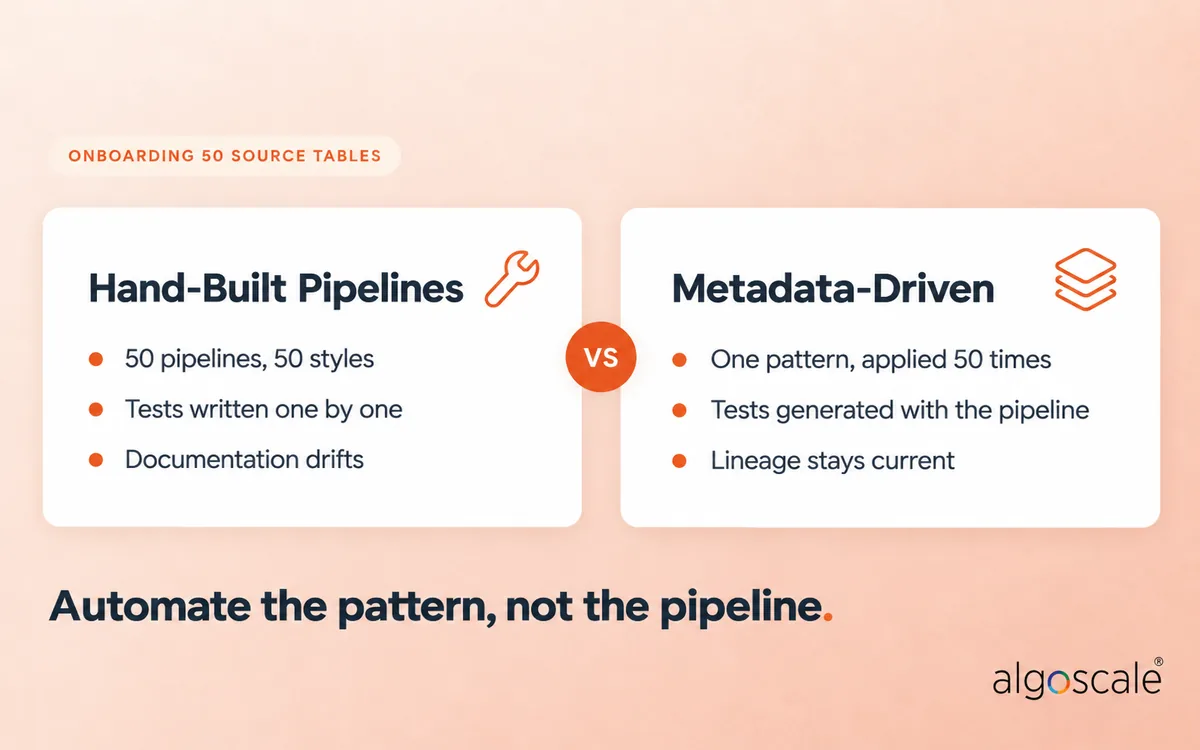
This is where DWA starts becoming an engineering system rather than a collection of shortcuts.
The metadata needs governance too.
If incorrect metadata generates incorrect pipelines, automation simply scales the mistake.
Data Warehouse Automation and Data Vault
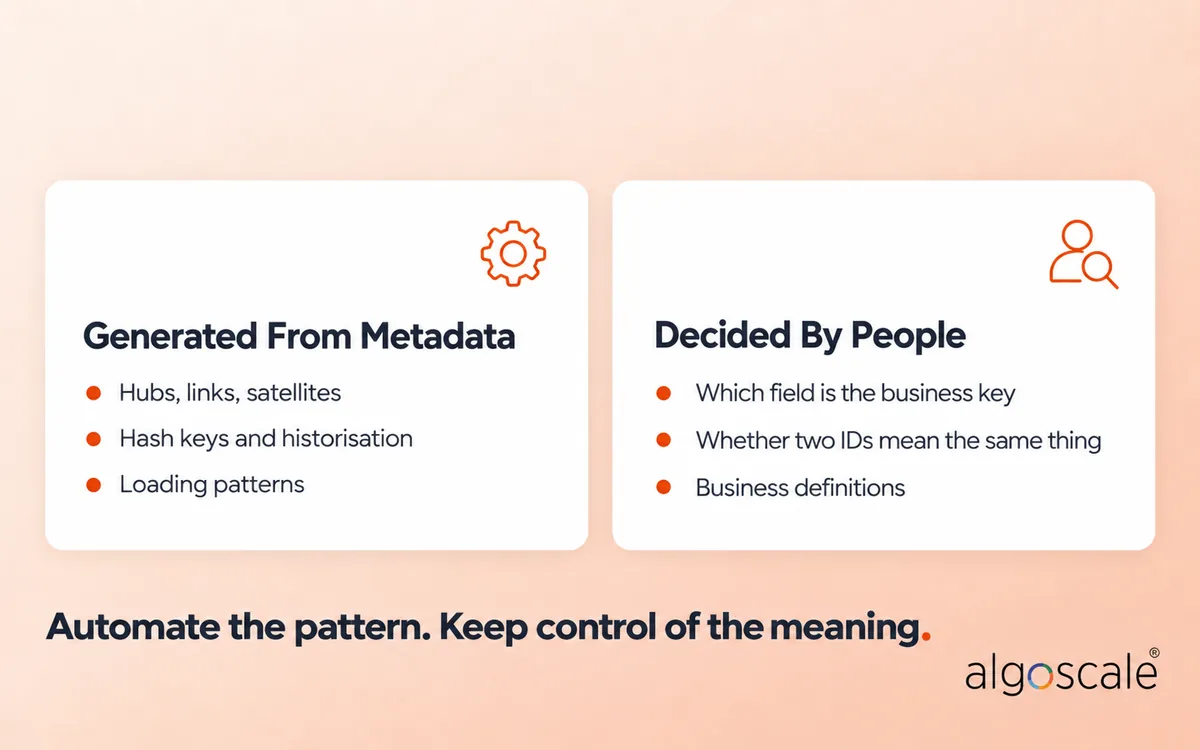
Data Vault automation is one of the areas where automation can provide substantial value because Data Vault contains highly repeatable structural patterns.
Hubs.
Links.
Satellites.
Hash keys.
Historisation.
Loading patterns.
Much of the physical implementation can be generated from metadata.
For example, source metadata can identify business keys, relationships and attributes. A framework can then generate parts of the Data Vault structures and loading logic consistently.
That can dramatically reduce repetitive development.
But there’s a boundary.
Automation can identify that customer_id exists.
It can’t automatically decide whether two differently named customer identifiers represent the same business concept.
It can’t reliably determine whether a field should be treated as a business key simply because its name contains “ID.”
It also can’t resolve ambiguous business definitions without input from people who understand the organisation.
That’s why data vault automation works best when the modelling conventions are already defined.
The same applies to dimensional models. Star schemas, conformed dimensions and SCD patterns can be generated too, but only once the grain and the business definitions have been agreed.
Automate the pattern.
Keep control of the meaning.
What Should You Automate in a Data Warehouse?
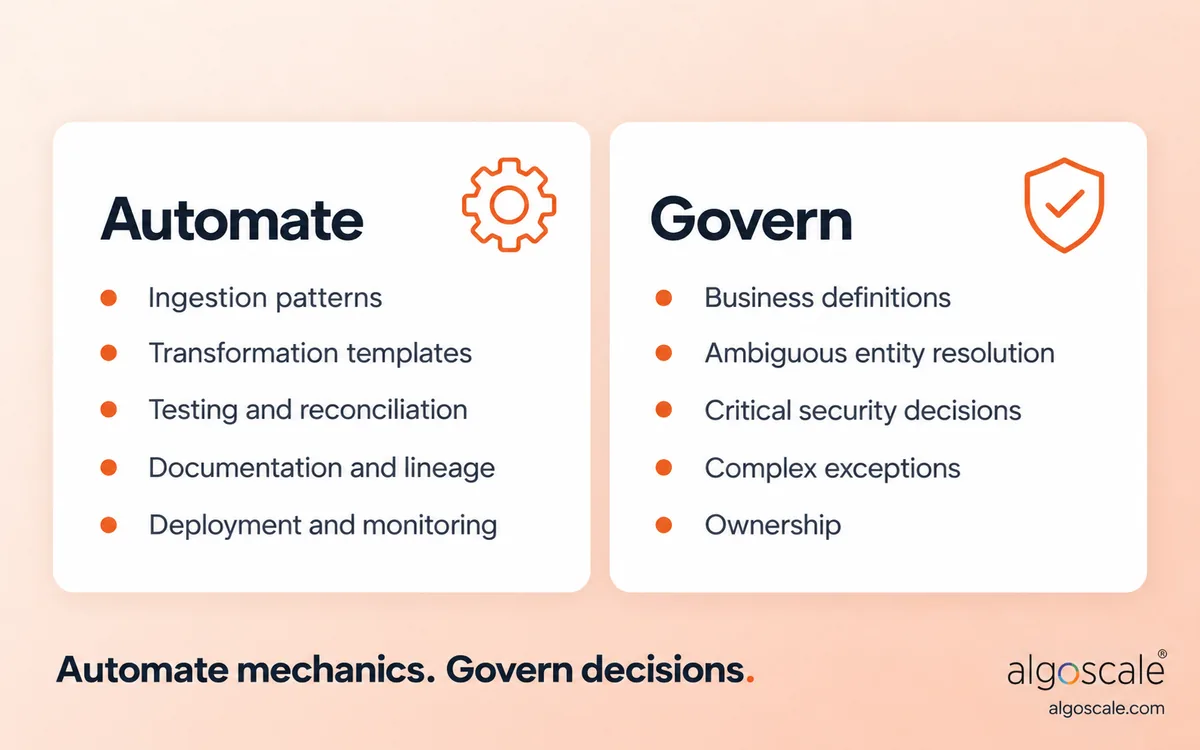
The strongest candidates for automation are tasks that are repetitive, predictable, rules-based and easy to validate.
That includes:
Data ingestion
Connection setup, standard ingestion patterns, scheduling and repeatable extraction logic can often be automated.
Transformation templates
Standard cleansing, naming, type conversion, staging and common modelling patterns are strong candidates.
Testing
Null checks, uniqueness checks, referential integrity, accepted values, freshness and schema-change detection can be automated. So can reconciliation against existing reports, which matters most during a migration, when the new pipelines have to prove they produce the same numbers as the old ones.
Documentation and lineage
Metadata can generate or maintain documentation and lineage information as pipelines evolve.
Deployment
CI/CD pipelines, infrastructure-as-code and environment promotion can remove manual deployment steps.
Monitoring
Pipeline failures, freshness breaches, volume anomalies and data quality issues can trigger automated alerts.
The common thread is predictability.
If an engineer has to make the same decision every time, ask whether that decision can become a rule.
What Shouldn’t Be Fully Automated?
This is where DWA projects often go wrong.
Automation is powerful.
It is also very good at repeating bad decisions.
You shouldn’t blindly automate:
- business definitions
- ambiguous entity resolution
- critical security decisions
- complex exceptions
- poorly understood source systems
- unvalidated data models
- organisational ownership decisions
- architecture decisions that haven’t been tested
Consider a slowly changing dimension.
Automating the SCD Type 2 mechanics can make sense.
Automating the assumption that a particular customer attribute should be historised without understanding the business requirement does not.
The difference is subtle.
And expensive to ignore.
A useful rule is:
Automate mechanics. Govern decisions.
What Are the Benefits of Data Warehouse Automation?
The value of DWA becomes clearer when measured across the warehouse lifecycle rather than just development speed.
Faster source onboarding
Once ingestion and modelling patterns exist, new sources don’t have to start from zero.
More consistent engineering
The same rules can be applied across pipelines instead of relying on individual engineers to implement them differently.
Easier change management
When metadata and transformation rules are centralised, changes can be propagated through established patterns.
Better documentation
Documentation can become part of the engineering process instead of a separate task that gets forgotten after deployment.
More engineering capacity
Engineers spend less time recreating standard pipeline mechanics and more time solving architecture and business problems.
Improved operational control
Testing, lineage, monitoring and deployment can become integrated parts of the automated workflow.
That’s the real promise of an automated data warehouse.
Not fewer lines of code.
A more repeatable operating model.
Data Warehouse Automation Tools: What Should You Evaluate?
There isn’t one universal list of the “best” data warehouse automation tools.
That’s the wrong way to evaluate the category.
Different tools automate different layers. Some are dedicated DWA platforms that generate warehouse structures and loading logic from a model. Others are platform capabilities that automate one part of the lifecycle.
| Platform or tool | Automation area |
| WhereScape | Warehouse design, code generation and deployment, including dimensional and Data Vault models |
| VaultSpeed | Metadata-driven Data Vault modelling and code generation |
| Qlik Compose | Warehouse automation alongside CDC-based ingestion |
| TimeXtender | Metadata-driven integration, modelling and preparation |
| AWS Glue | Cataloguing, discovery and ETL |
| Snowflake Dynamic Tables | Declarative transformation and refresh |
| Databricks Lakeflow | Pipeline orchestration and CDC patterns |
| Microsoft Fabric Data Factory | Data integration and orchestration |
| dbt | SQL transformation, testing and documentation |
| Apache Airflow | Workflow orchestration |
| Infrastructure-as-code | Environment and infrastructure provisioning |
These tools aren’t interchangeable.
A warehouse architecture might use several of them together.
The important question is therefore not “Which tool is best?”
It is:
Which layer of the data lifecycle are we trying to automate, and what architectural control do we need around it?
That question produces a much better technology decision.
Build or Buy a Data Warehouse Automation Framework?
This is another decision data leaders shouldn’t make based purely on licence costs.
Building an internal automation framework can make sense when an organisation has highly repetitive data patterns, a mature engineering team, strong platform ownership, stable architecture standards, and enough long-term volume to justify framework development.
Buying or adopting existing capabilities can make more sense when the organisation wants to reduce engineering overhead and use established platform functionality.
There is also a third option.
Use existing platforms for what they already automate well, then build a thin internal layer for organisation-specific standards.
That can include metadata conventions, governance rules, templates, quality controls and deployment patterns.
The goal isn’t to build another platform because building platforms is fun.
You don’t want to create a framework that exists to maintain pipelines that exist to maintain another framework.
Start with the repetitive problem.
Then automate it.
When Data Warehouse Automation Goes Wrong
DWA doesn’t fix poor architecture. It amplifies it.
If source systems aren’t understood, automation can onboard bad data faster. If naming conventions aren’t defined, automation can produce inconsistent structures at scale.
If incremental loading isn’t designed properly, automation can multiply duplicate or missing records. If access controls aren’t built into the architecture, automated provisioning can create security exposure across hundreds of assets.
If business logic isn’t governed, generated transformations can produce technically correct but commercially misleading datasets.
This is why architecture has to come before automation.
Before automating a warehouse, teams should establish:
Source systems → Data ownership → Target architecture → Modelling standards → Security → Quality rules → Metadata → Deployment → Monitoring
Then automate the repeatable parts. Otherwise you’re simply automating ambiguity.
How Do You Know If Your Data Warehouse Is Ready for Automation?
Before investing in DWA, look at the architecture underneath it. Do you have clearly identified authoritative source systems, agreed business definitions, and clear ownership for your data? Are your naming and modelling conventions documented, and do you know which datasets require full loads, incremental processing, or CDC? You should also have security classifications for sensitive data and quality rules that can be applied consistently across datasets.
The operational side matters just as much. Your team should have a defined deployment process across development, testing, and production, along with enough lineage to trace an important metric back to its source. If several of these pieces are still unclear, automation probably isn’t your first problem. Architecture is.
A Practical Approach to Implementing Data Warehouse Automation
A large-scale automation programme doesn’t need to begin with hundreds of sources. A better starting point is one repeatable use case that gives the team enough scope to test the automation pattern without introducing unnecessary complexity.
For example, take three similar operational sources and map the complete workflow from source discovery and metadata through ingestion, the raw layer, quality checks, transformation, testing, documentation, deployment and monitoring. The objective isn’t just to get the pipelines running. It’s to understand how much of the process can genuinely be standardised and where engineering judgement is still required.
Once the pattern is running, measure the results. How long does it take to onboard a source? How much manual code is still required? How many defects are introduced? What happens when the source schema changes? These measurements help identify which parts of the workflow are worth automating and which need a different architectural approach.
The pattern can then be refined before it is extended to additional domains and source systems. This matters because the first implementation often exposes gaps in metadata, modelling, quality controls or deployment practices that aren’t obvious during architecture discussions. Finding those issues with three sources is considerably easier than discovering them after the same pattern has been rolled out across the enterprise.
Start with a repeatable pattern. Prove it. Then scale it.
Where Does AI Fit Into Data Warehouse Automation?
AI is increasingly becoming part of the data engineering workflow, but it shouldn’t be confused with DWA.
The 2025 dbt Labs report found that 70% of respondents use AI for analytics development, while 50% use it for documentation.
AI can help generate SQL, documentation, tests, mappings and transformation suggestions.
Useful.
But generated code still needs architectural context.
An AI system can generate a technically valid SQL transformation that uses the wrong business definition. It can suggest a join that creates duplicate records. It can produce a query that works in development but performs poorly at production scale.
So AI can accelerate the engineer.
It doesn’t remove the need for engineering standards.
In a mature DWA environment, AI is another automation layer operating within defined architecture and governance.
How Algoscale Approaches Data Warehouse Automation
Data warehouse automation sits within a larger engineering problem: designing the data architecture, building the pipelines, establishing governance and then operating the platform reliably.
Algoscale’s data and analytics practice spans data strategy, data engineering, data lakes and warehouses, governance, Microsoft Fabric and BI, with the broader delivery model moving from strategy and architecture through build, integration, deployment and optimisation.
That matters because automation should fit the platform rather than dictate it.
Algoscale’s S.C.A.L.E. framework is positioned as a reusable, Terraform-driven enterprise data platform accelerator covering infrastructure, ingestion, governance, data layers, orchestration and consumption. It is designed to work with platforms such as Snowflake, Databricks and Microsoft Fabric rather than replace them.
That approach is visible in a recent AWS data warehouse modernization for a US-based physical security and fire systems integrator operating across 14+ subsidiary companies.
The organisation had grown through acquisitions. Each subsidiary ran its own ERP instance, alongside separate CRM, HR and financial planning systems. Revenue, billing and backlog were calculated differently across subsidiaries, and reporting depended on exporting and reconciling data in Excel every week.
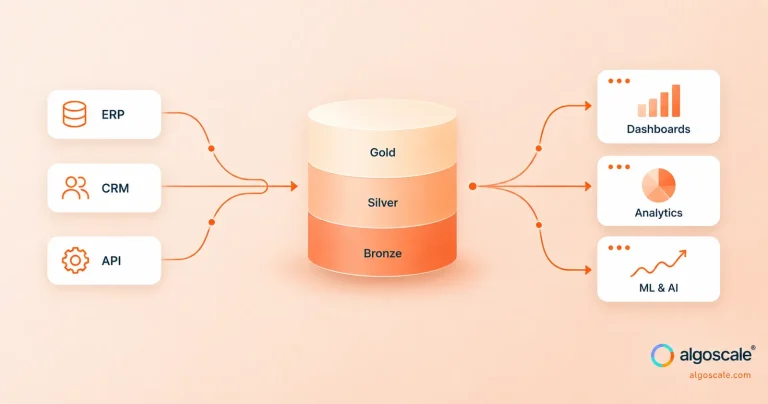
Algoscale built the warehouse on a Medallion architecture on AWS, with CDC ingestion from 14+ Microsoft Business Central instances and Dynamics 365 CRM through AWS DMS, AWS Glue PySpark jobs for each KPI domain, AWS Step Functions orchestration with retry logic, and row-level and column-level security per territory through AWS Lake Formation.
The repeatable parts were automated. The decisions weren’t.
Existing Power BI DAX measures were reverse-engineered, rebuilt in the data layer and reconciled against the existing dashboard outputs. Customer accounts that were duplicated and inconsistently named across subsidiaries were resolved through a custom master data management service with a brand dictionary and confidence scoring. It’s the entity resolution problem described earlier, handled with explicit rules instead of assumptions.
The result was a pipeline that runs twice daily with no manual triggers, 20+ Power BI KPI dashboards across Finance, Operations, HR and Sales, and a 70% reduction in reporting preparation time.
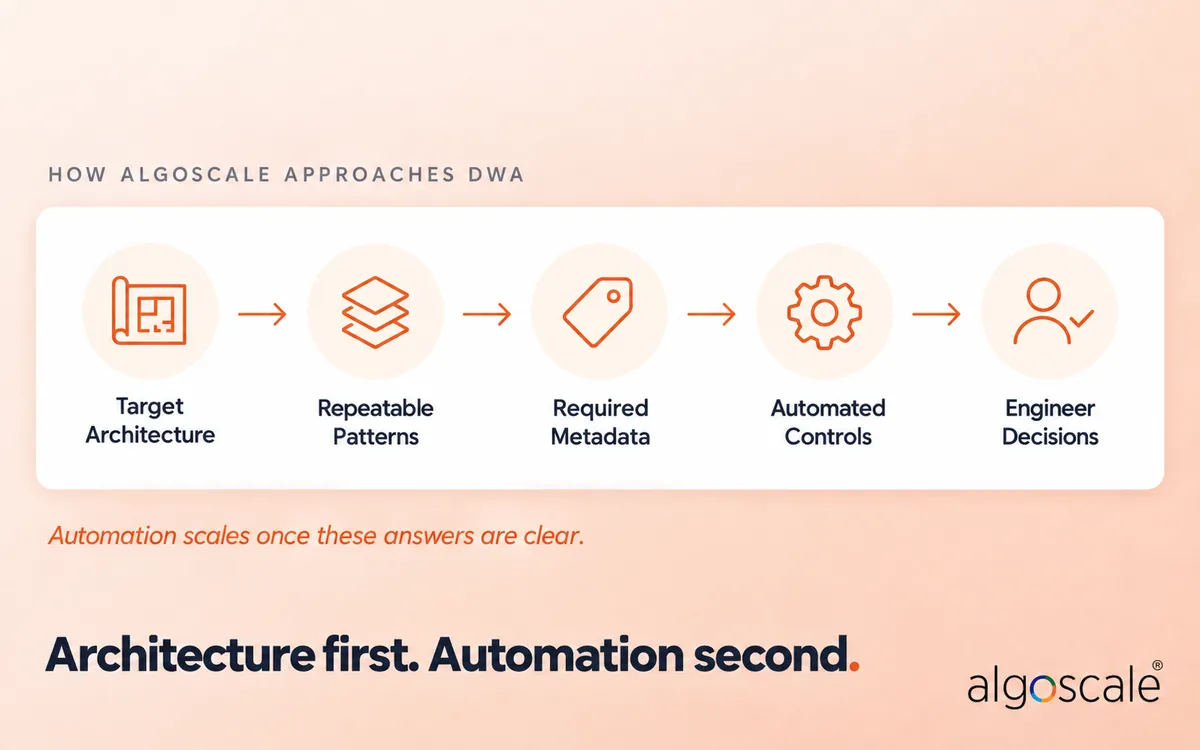
For an organisation considering DWA, the engineering work typically starts with the questions underneath the automation:
- What should the target architecture look like?
- Which patterns are genuinely repeatable?
- What metadata needs to exist?
- Which controls should be automated?
- Where should engineers retain decision-making authority?
Once those answers are clear, automation becomes much easier to scale.
Frequently Asked Questions About Data Warehouse Automation
What is data warehouse automation?
Data warehouse automation uses metadata, reusable patterns, code generation, orchestration and automated controls to reduce manual work across data warehouse development and operations. It can cover ingestion, transformation, testing, documentation, deployment and monitoring.
What is the difference between ETL automation and data warehouse automation?
ETL automation focuses primarily on moving and transforming data. Data warehouse automation is broader and can include modelling, testing, documentation, orchestration, deployment, lineage and monitoring across the warehouse lifecycle.
How does Data Vault automation work?
Data Vault automation uses metadata and predefined modelling patterns to generate repeatable structures such as hubs, links, satellites, keys and loading logic. Business definitions and modelling decisions still require human governance.
Which data warehouse automation tools should enterprises consider?
The appropriate tools depend on the architecture. Options include AWS Glue, Snowflake Dynamic Tables, Databricks Lakeflow, Microsoft Fabric Data Factory, dbt, Apache Airflow and infrastructure-as-code tools. These technologies automate different parts of the data lifecycle. Dedicated DWA platforms such as WhereScape, VaultSpeed, Qlik Compose and TimeXtender focus on generating warehouse structures and loading logic from a central model.
Can data warehouse automation reduce data engineering costs?
It can reduce repetitive engineering effort, particularly when the organisation has many similar sources and repeatable workloads. The actual financial impact depends on architecture, implementation quality, scale and how much manual work is replaced.
Should companies build or buy a data warehouse automation framework?
The decision depends on engineering maturity, workload repetition, platform ownership and long-term maintenance requirements. Organisations with highly standardised workloads may benefit from internal frameworks, while others may get more value from existing platform capabilities.
Is data warehouse automation suitable for Snowflake, Databricks and Microsoft Fabric?
Yes. All three platforms provide capabilities that can support different forms of warehouse or lakehouse automation. The implementation approach differs by platform, so automation should be designed around the target architecture rather than treated as a platform-independent checklist.
Can data warehouse testing be automated?
Yes. Structural checks, freshness checks, rule-based validation and reconciliation against existing reports can all be automated and run as part of every load. What still needs people is deciding which rules matter and what an acceptable result looks like.
Final Thought: Automate the Mechanics. Keep Control of the Architecture.
Data warehouse automation can make enterprise data engineering significantly more repeatable.
But automation isn’t the architecture.
It works best when the architecture already has clear patterns for ingestion, modelling, governance, security, quality, deployment and operations.
Technology will keep changing.
The principle won’t.
Automate what is repeatable. Govern what requires judgement. Build the architecture first.
That’s how an automated data warehouse becomes an engineering advantage rather than another layer of complexity.