


Key Insights
- Financial Impact: Integrating generative AI tools across global banking operations has the potential to generate between $200 billion and $340 billion in annual value, primarily through productivity gains and automated risk assessment.
- Creation vs Prediction: Traditional AI models score and predict risk based on past data. Generative AI creates net-new assets, such as drafting compliance reports, synthesising client portfolio updates, and writing software code.
- Mandatory Explainability: Banking regulators require transparent decision-making. Generative models must be engineered with strict audit trails and human-in-the-loop oversight to ensure they do not produce biased lending criteria.
- Proprietary Grounding: Leading institutions like Morgan Stanley do not rely on public knowledge for their AI. They restrict their generative models to search and summarise only approved internal research, giving every answer a traceable source and keeping client data inside the bank.
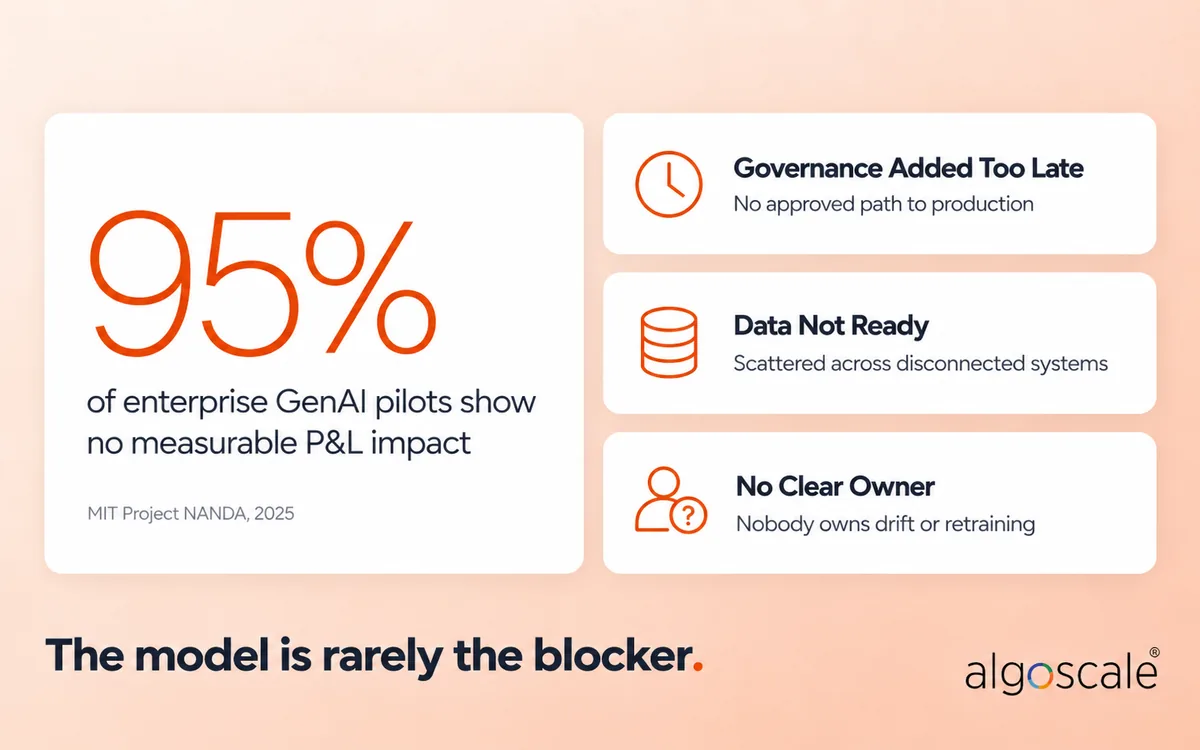
- The Production Gap: Most generative AI pilots never reach production. MIT’s Project NANDA found that 95% of enterprise pilots showed no measurable P&L impact. In banking, the blockers are usually legacy core systems, model risk sign-off and data governance, not the model itself.
Financial institutions process millions of unstructured documents daily. Bankers spend hours reading through complex tax returns, scanning market research, and manually writing compliance reports.
Now, imagine a system that reads a 50-page loan application in two seconds, cross-references it with credit policies, and generates a complete risk assessment before an underwriter even opens the file. That is the operational reality of generative AI in banking.
Unlike traditional machine learning models that simply score credit risk or flag a fraudulent transaction, this new wave of technology creates. It drafts personalised portfolio summaries. It synthesises regulatory alerts. It writes secure internal code.
The financial upside is massive. Analysts at McKinsey estimate that scaling generative AI banking tools could add up to $340 billion in annual value across the global banking sector.
The question has shifted from “Should we adopt GenAI?” to “How fast can we scale it?”
However, you cannot just plug a public language model into a core banking system. Deploying this technology brings immediate challenges regarding algorithmic bias, strict data security, and regulatory explainability. In this guide, we break down the core features, highlight the most profitable generative AI use cases in banking, and explain how institutions can safely build these tools.
What Is Generative AI in Banking?
At its core, generative AI for banking is a branch of artificial intelligence that understands dense financial data and creates highly relevant text, code, or synthetic data in response. Think of it as a highly trained financial co-pilot.
Banks sit atop oceans of structured and unstructured data: PDFs, call transcripts, transaction histories, and more. GenAI models, particularly Large Language Models (LLMs) and custom domain-specific variants, are capable of digesting these diverse datasets and generating insights that previously required human analysts.
Traditional banking algorithms detect patterns. They spot a weird transaction and block the card. Gen AI in banking takes the next step. It generates a plain-English narrative report explaining exactly why that transaction looked suspicious, summarising the customer’s historical behaviour for the fraud investigator.
By integrating directly into existing banking workflows, these systems act as silent assistants. They reduce cognitive load, cut down on routine paperwork, and free up advisors to actually speak with clients.
The difference is easiest to see side by side.
| Traditional AI | Generative AI | |
|---|---|---|
| What it does | Scores, classifies and predicts | Drafts, summarises and explains |
| Typical output | A credit score or a fraud flag | A risk memo or an investigation narrative |
| Data it handles best | Structured transaction data | Documents, call transcripts and emails |
| Where it sits | Behind the decision | Alongside the person making it |
Most banks will run both. The predictive model flags the transaction. The generative model explains it.
Why Is Generative AI in Banking Important?
In an industry where milliseconds impact market positions and regulatory gaps cost millions, generative AI is no longer a curiosity. It’s a competitive necessity. Banks and financial institutions are not merely adopting GenAI to optimise. They’re using it to redefine how banking is done.
Replacing Rigid Playbooks with Dynamic Intelligence
For decades, banking operations followed fixed workflows: document review, compliance checks, customer onboarding, credit assessments, each siloed and governed by static rules. Generative AI is breaking those silos. Models are now capable of interpreting legal language, drafting financial documents, summarising earnings calls, and even generating audit-ready compliance reports.
This isn’t just automation. It’s augmentation. An AML officer can prompt the GenAI system with “flagged transaction history” and receive a narrative report that would otherwise take hours to compile. A wealth manager can input client sentiment data and receive tailored investment briefs generated on the fly.
Unlocking New Dimensions of Customer Experience
Imagine a virtual assistant that doesn’t just answer “What’s my balance?” but interprets spending patterns and advises:
“You’re on track to exceed your discretionary budget this month. Would you like to move $500 from your emergency fund instead of triggering an overdraft?”
Elevating Risk, Compliance, and Audit Operations
Risk and compliance are where GenAI shows its most immediate ROI. These functions are traditionally human-heavy, document-laden, and burdened by regulatory volatility. Now, AI copilots are parsing complex regulations, comparing them against internal policies, and suggesting gaps.
Core Features of Gen AI for Financial Institutions
Deploying generative AI for banks is completely different from letting staff use public chatbots. Enterprise financial systems require a distinct, highly secure set of capabilities.
- Financial Language Understanding: These models are fine-tuned on corporate finance data. They understand the difference between a margin call and a capital gain. This allows them to draft reports that meet strict professional standards.
- Structured Data Conversion: Banking data is often messy. A generative model can take a scattered transcript from a wealth management call and instantly convert it into structured data that maps perfectly into a CRM platform.
- Real-Time Advisory Co-Pilot: By sitting alongside wealth managers during client interactions, the AI surfaces relevant market insights or generates tailored investment recommendations on the fly, basing its answers entirely on the bank’s approved internal research.
Generative AI Models That Find Application in the Finance Industry
The financial sector is undergoing a structural AI shift: not just adopting generative models, but integrating them into the core of product design, compliance automation, investment strategy, and customer engagement. Generative AI integration services are playing a crucial role in enabling this adoption across financial operations.
| Model type | What banks use it for | Examples |
|---|---|---|
| Large language models | Report drafting, Q&A assistants, document summaries, regulatory interpretation | OpenAI GPT models, Anthropic Claude, Google Gemini, Meta Llama |
| Document intelligence | Extracting data from loan files, invoices and contracts | Azure AI Document Intelligence, Google Document AI |
| Conversational AI | Customer and employee assistants across voice and chat | Amazon Lex, Google Dialogflow, Kasisto KAI |
| Code generation | Faster development and legacy code documentation | GitHub Copilot, Amazon Q Developer, Gemini Code Assist |
| Synthetic data | Training fraud and credit models without exposing customer data | Mostly AI, Gretel, Syntho |
| Risk and fraud platforms | Transaction monitoring, AML and scenario analysis | Feedzai, SymphonyAI |
These generative AI tools, platforms, and generative AI development services are integral to modernising the finance industry.
Generative AI Use Cases in the Banking & Financial Industry
We are past the experimental phase. The following generative AI banking use cases highlight how the technology is actively streamlining workflows and driving revenue right now.
1. Automated Credit and Loan Underwriting
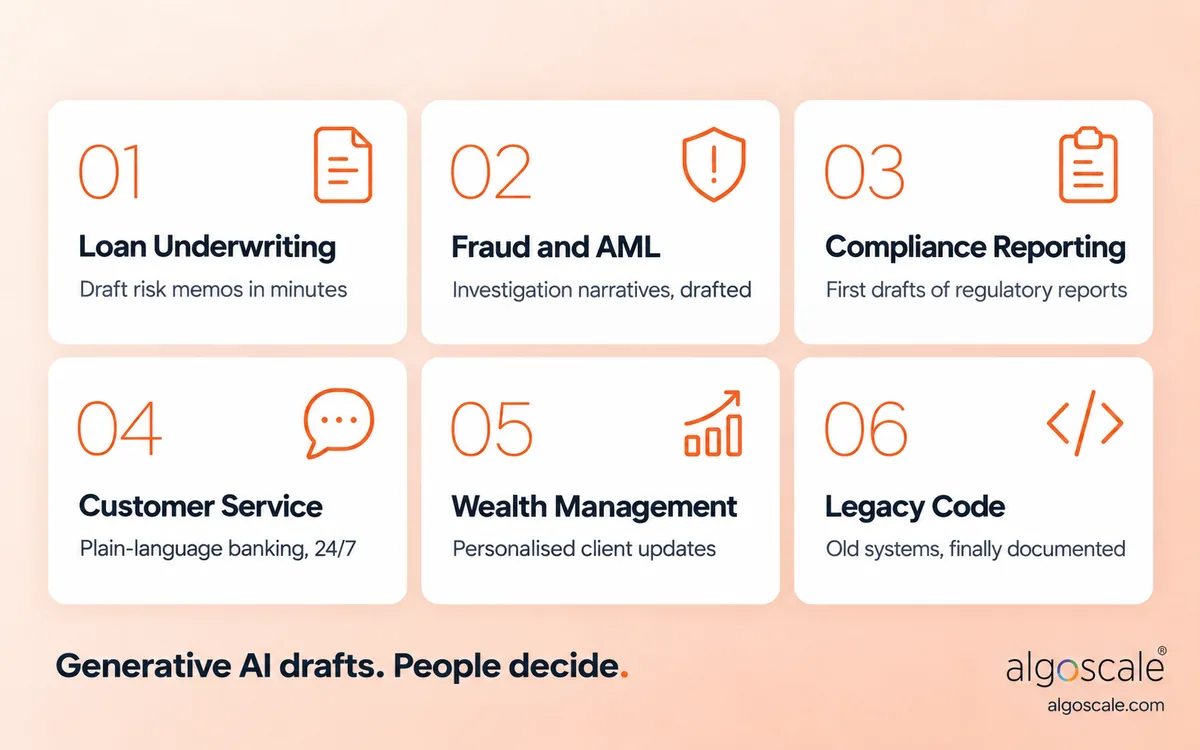
The application of generative AI in lending completely changes how credit decisions happen. Instead of a human analyst spending days reading through unstructured business plans and tax returns, the AI reads the documents automatically. It cross-references the data against current bank policy and generates a comprehensive draft risk assessment in minutes.
This not only accelerates decision-making but ensures greater consistency and compliance.
2. Fraud Investigation and AML
When traditional systems flag a transaction, an investigator must manually compile a report. One of the most effective gen AI use cases in banking involves the system automatically generating a narrative summary of the event. It links the exact data points and historical behaviours that triggered the alert, saving the investigator hours of manual data gathering.
The same pattern applies to anti-money laundering. The model drafts the Suspicious Activity Report narrative from the investigator’s findings, and a human still reviews, signs and files it. Generative models can also simulate transaction patterns to help detection engines recognise threats that rule-based systems have never seen.
3. Regulatory Compliance and Policy Intelligence
Compliance teams drown in paperwork. Generative AI models are being trained on policy updates, legal notices, and compliance manuals to provide real-time alerts and clause-level risk summaries, and to draft the initial versions of mandatory compliance reports.
These models reduce compliance risk and free up legal teams for higher-order tasks.
4. Customer Support Chatbots and Voice Assistants
Banks are deploying generative AI chatbots and voicebots trained on institution-specific data to deliver conversational banking experiences. These assistants not only respond to routine questions (account balances, branch hours, transaction issues), but also offer empathetic, human-like dialogue in multiple languages.
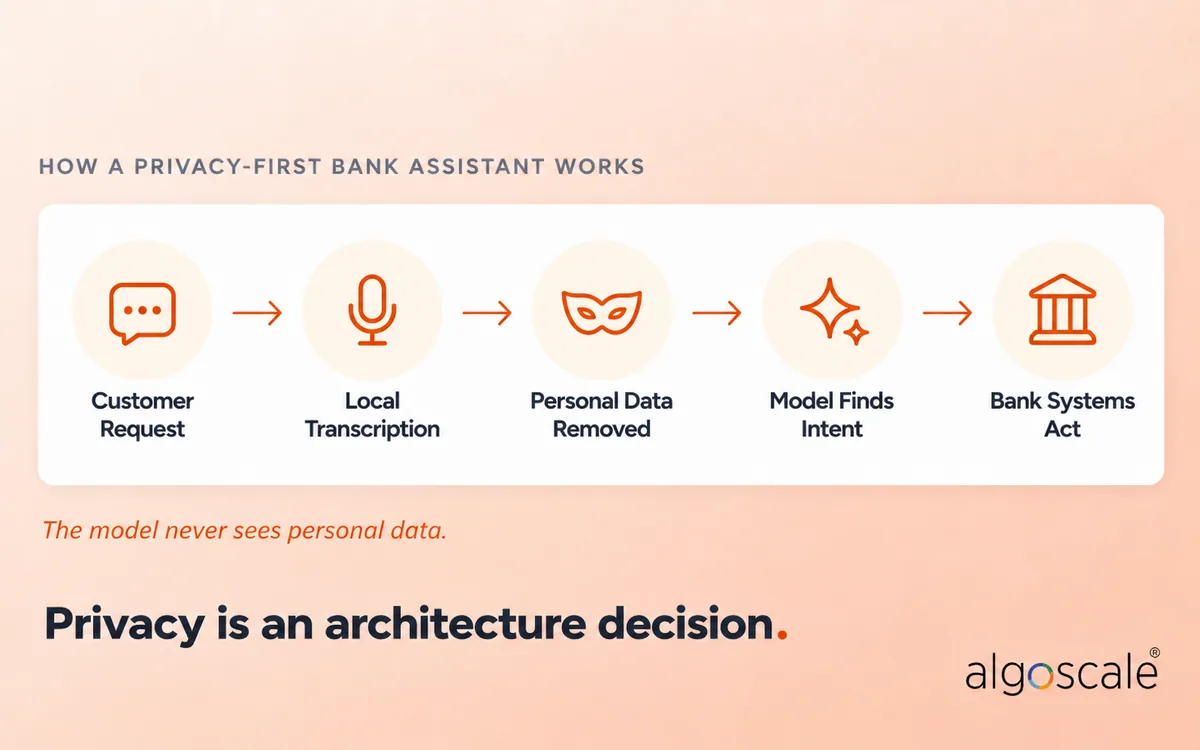
The strongest deployments never let the model see raw customer data. Personal details are stripped and tokenised before a request reaches the model, and the bank’s own systems carry out the action.
5. Personalised Wealth Management and Recommendations
Wealth managers handle hundreds of clients, making deep personalisation nearly impossible. AI models change this. They scan daily market movements, cross-reference them with a specific client’s portfolio, and draft a highly personalised email explaining exactly how a recent geopolitical event impacts their specific holdings.
For retail customers, LLMs generate tailored suggestions for savings, retirement planning, or investment diversification.
6. KYC and Customer Onboarding
Onboarding a business customer means reading incorporation documents, ownership structures and proof of address. Generative models extract the key details, check them against what the customer has declared, and flag mismatches for a compliance analyst to review.
Clean files move faster. Complex ones reach a human sooner.
7. Automated Financial Report Generation
Generative AI can ingest structured data (like balance sheets or cash flow statements) and unstructured data (such as market commentary or CEO transcripts) to automatically generate polished financial reports, investment decks, and earnings summaries.
8. Synthetic Data Creation for Model Training
Privacy and data scarcity often hinder model training in finance. GenAI solves this by creating synthetic datasets that mimic real-world financial behaviour without exposing sensitive information. These datasets are used to train models in areas like credit scoring, anti-money laundering (AML), and risk profiling.
9. Automated Marketing Campaigns and Personalisation
Whether it’s generating personalised email copy, designing banner ads, or creating A/B tested landing pages, GenAI helps banks reach customers with content that adapts to demographics, behaviour, and intent, all while staying compliant with financial advertising regulations.
10. Scenario Forecasting and Stress Testing
Banks use generative models to simulate economic crises, market crashes, and liquidity shocks. These “what-if” engines help CROs and CFOs understand vulnerabilities across asset classes, geographies, or client segments.
11. Legacy Code Modernisation
Many core banking systems still run on decades-old code that few engineers fully understand. Generative AI can read that code, document what it does, and draft modern equivalents for engineers to test.
It does not replace the modernisation plan. It makes the old system understandable enough to plan one.
12. AI-Powered Financial Education and Wealth Coaching
GenAI is also democratising financial literacy. Banks are launching AI tutors that guide users through complex topics like compound interest, portfolio diversification, or tax planning. These assistants adapt based on user comprehension levels and regional financial norms.
Real-World Generative AI Examples in Banking
The intersection of generative AI and banking is highly visible across major global institutions. These generative AI examples in banking prove that the technology is ready for enterprise deployment.
Morgan Stanley’s AI Assistant
Morgan Stanley partnered with OpenAI to build an internal assistant for its wealth advisors. The tool ingested hundreds of thousands of pages of internal research and policy documents. Today, when an advisor needs a quick answer about a specific market trend, the AI generates a fully cited, accurate response based exclusively on Morgan Stanley’s proprietary data.
Adoption followed. Morgan Stanley reports that 98% of its financial advisor teams have adopted the assistant.
JPMorgan Chase & LLM Implementation
JPMorgan has actively deployed large language models to assist its investment teams. By using AI tools like their thematic investing product to process vast amounts of financial data and news, their analysts can identify market signals and make faster, more informed trading decisions before the broader market reacts.
Wells Fargo’s Fargo Assistant
Wells Fargo’s customer-facing assistant, Fargo, handled more than 245 million interactions in 2024, over double the bank’s original forecast.
The architecture is the real story. Customer speech is transcribed locally, then scrubbed and tokenised by the bank’s own systems before any language model is called. The model never sees personal data. It only works out what the customer wants, and Wells Fargo’s own systems do the rest.
Generative AI in Banking: Key Benefits
Faster Decision-Making Across Core Processes: GenAI empowers banks to synthesise data across silos, summarise long-form documents, and generate contextual responses within seconds, whether it’s accelerating KYC verifications, risk assessments, or loan approvals.
Cost Reduction and Operational Efficiency: By automating labour-intensive tasks such as document generation, report writing, and customer query resolution, generative AI frees up human teams to focus on high-value analysis.
Hyper-Personalisation at Scale: Dynamic financial advice and real-time investment recommendations without ballooning service costs, resulting in deeper engagement and loyalty.
Enhanced Regulatory Compliance and Risk Management: Continuously reading new regulations, summarising impact, and generating explanatory notes and compliance-ready reports that strengthen audit trails.
24/7 Conversational Banking and Support: Multilingual, context-aware assistants that deliver continuous engagement without ramping up support costs.
Agility in Product and Service Innovation: From regulatory-compliant product documentation to simulated customer journeys, teams bring new services to market in weeks, not quarters.
Generative AI in Banking: Challenges and Regulatory Hurdles
While the list of generative AI use cases in financial services expands, the path to implementation contains strict regulatory hurdles.
Explainability in Financial Decisions
Regulators demand to know exactly why a bank denied a loan or flagged an account. Generative models often operate as black boxes. If a bank uses AI to assist in credit decisions, they must be able to prove that the AI did not rely on restricted variables. Explainability has to be built into the system by design.
Bias and Fair Lending Risks
AI systems trained on historical banking data might inherit past biases. If a model generates risk profiles that disproportionately penalise specific demographics, the bank faces severe legal and reputational damage. Continuous fairness audits are absolutely mandatory.
Data Privacy and Security
Training AI models requires data, but banks cannot simply feed sensitive customer financial records into a public cloud model. Deploying these systems requires strict data masking, local hosting options, and enterprise-grade security protocols to ensure compliance with privacy laws.
Hallucination in Critical Risk Scenarios
In high-stakes use cases like loan approval or transaction monitoring, even a single hallucinated output from a language model can result in regulatory violations, reputational damage, or financial loss. Grounding the model in approved documents reduces the risk, but it does not remove it.
Banks also have to fit generative models into their existing model risk management frameworks, with validation, documentation and ongoing monitoring before anything reaches a customer.
Compliance Drift in Prompt-Driven Workflows
Generative systems evolve rapidly through prompt tuning and contextual injection. However, these changes often go undocumented, making it difficult to recreate or audit AI-driven outcomes in accordance with regulatory mandates.
Legacy Core Integration
A generative model is only as useful as the data it can reach. Many banks run core systems that were never designed to share data in real time, so an assistant that performs well in a demo cannot read the live system of record in production.
Marrying new-age AI with these systems requires a deep transformation of infrastructure, APIs, and data access layers, and latency from API calls or model orchestration can break mission-critical SLAs.
Overdependence on Vendor APIs for Decision-Making
Many GenAI deployments rely on external APIs to power internal decisions. This introduces third-party risk, especially when there’s limited insight into how those models generate outputs or handle banking data.
Lack of Multi-Language & Code-Switching Support
In multilingual markets like India or Southeast Asia, customers often mix languages in queries (e.g., “Mujhe last EMI amount batayein”). LLMs without fine-tuning on such code-switched data may struggle to comprehend or respond correctly.
Why Most Generative AI Pilots in Banking Stall
Launching a pilot is easy. Getting it into production is not.
MIT’s Project NANDA found that 95% of enterprise generative AI pilots delivered no measurable impact on profit and loss. The research points to implementation, not model quality, as the dividing line.
In banking, the same few blockers come up again and again:
- Governance Added Too Late: Compliance is treated as a phase-two problem, so a working pilot has no approved path to production.
- Data That Is Not Ready: Customer, transaction and document data sit in separate systems the model cannot reach.
- No Clear Owner: Once the model is live, nobody owns drift, retraining or incident response.
The banks that scale generative AI solve these before the pilot starts, not after it works.
How to Implement Generative AI in Banking and Finance Operations
Implementing generative AI in banking is a multi-layered process that requires not only technical sophistication but also domain understanding. From data readiness to model orchestration and governance to application delivery, it demands a strategic roadmap that experienced AI solution providers can help navigate.
- Identify High-Impact Use Cases: Pinpoint processes that benefit most from GenAI, like customer support, compliance automation, fraud investigation or personalised financial advising.
- Prepare and Secure Your Data: Aggregate structured and unstructured data from CRMs, transactions, KYC records, and behavioural sources. Privacy, consent, and regulatory compliance must be embedded in the data pipelines.
- Choose or Train Suitable LLMs: Select pre-trained domain-specific models or fine-tune foundation models for targeted tasks such as summarisation, intelligent search or generation.
- Orchestrate Model Operations in Real Time: Deploy orchestration layers to manage prompt flows, performance tuning, latency control, and continuous learning via user feedback.
- Deliver via Financial Applications: Deploy GenAI within customer-facing tools or internal platforms, such as intelligent chatbots, real-time compliance assistants, risk profiling systems, or document processors.
- Govern Before You Scale: Assign a model owner, register the model in your risk inventory, and define human review points before the first customer-facing release.
From Generative AI to Agentic AI in Banking
Generative AI drafts. Agentic AI acts.
An agent does not just summarise a loan file. It requests the missing document, runs the KYC check, updates the case and routes it to the right underwriter. That makes it far more useful, and far riskier.
In a regulated bank, every action an agent takes has to be permitted, logged and reversible. That is why orchestration matters more than the model. The layer that decides what an agent is allowed to do is the layer regulators will ask about first.
Alongside agents, a few other trends are shaping the next phase of generative AI in banking:
- Retrieval-Augmented Generation (RAG) Becomes Standard: Banks are adopting RAG pipelines that let GenAI models fetch knowledge from internal sources before generating a response.
- Fine-Tuning Foundation Models for Financial Microdomains: Models tuned on underwriting guidelines, policy documents and regulations improve accuracy and compliance alignment.
- Prompt Governance and Access Control as Enterprise Features: Banks now treat prompt flows like code, versioned and secured under role-based access controls.
- Multilingual GenAI for Inclusive Banking: Models fine-tuned for code-switched queries and local dialects enable inclusive service across markets.
How Algoscale Brings Generative AI in Banking to Life (with Arcastra™)
Moving from a small pilot project to a production-ready AI system requires secure infrastructure, strict data governance, and deep domain expertise. While most banks know what to implement, Algoscale focuses on how to do it right: securely, scalably, and with real-time intelligence.
Deploying AI in a bank is not about writing clever prompts. It is about restructuring data pipelines, ensuring regulatory compliance, and orchestrating models to fit perfectly into existing financial workflows.
That foundation comes first. In one engagement, Algoscale worked with a fast-growing lender that provides flexible funding to e-commerce businesses. Its loan, sales and deal data were scattered across HubSpot, Azure SQL and Amazon S3, and analysts spent 10 to 15 hours every week moving reports between systems by hand.
Algoscale connected those sources into a unified Databricks platform with real-time dashboards. The result was an 80% reduction in manual effort, a 30% decrease in loan processing time and a 40% reduction in reporting infrastructure costs.
No language model can summarise a loan file it cannot find. Getting the data into one governed place is the step that makes generative AI in lending possible.
At the heart of our GenAI approach is Arcastra™, a proprietary orchestration platform that aligns intelligent agents, data infrastructure, and automation workflows into a single control layer.
Here’s how Algoscale enables end-to-end GenAI adoption for financial institutions:
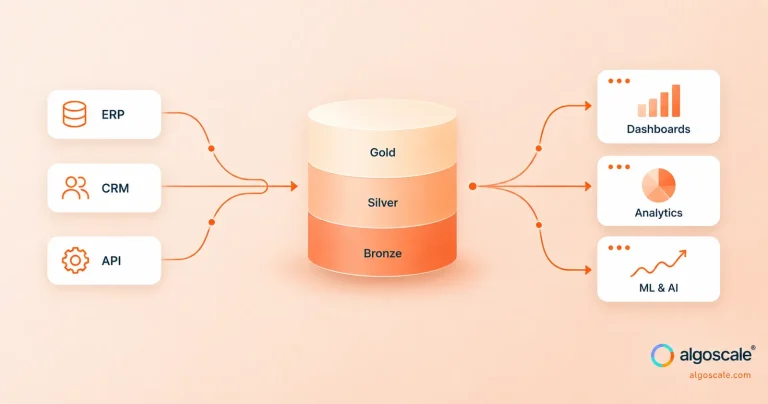
- Data Pipeline: We ingest data from multiple sources (customer profiles, transactions, documents) and process it through a secure, compliant pipeline.
- Embedding & Vector DB: Using embedding models, data is transformed into vector formats and indexed for fast, semantic search.
- LLM & Ops Layer: We connect to LLMs with an operational layer to manage prompts, model performance, and versioning.
- Arcastra Orchestration: Arcastra dynamically connects the LLMs, data systems, and finance applications, enabling real-time, secure GenAI operations.
- Application Delivery: Whether it’s a chatbot, smart dashboard, or compliance engine, we deploy GenAI solutions tailored to your use case.
- Feedback Loop: The system continuously learns from user interaction, improving responses and outcomes over time.
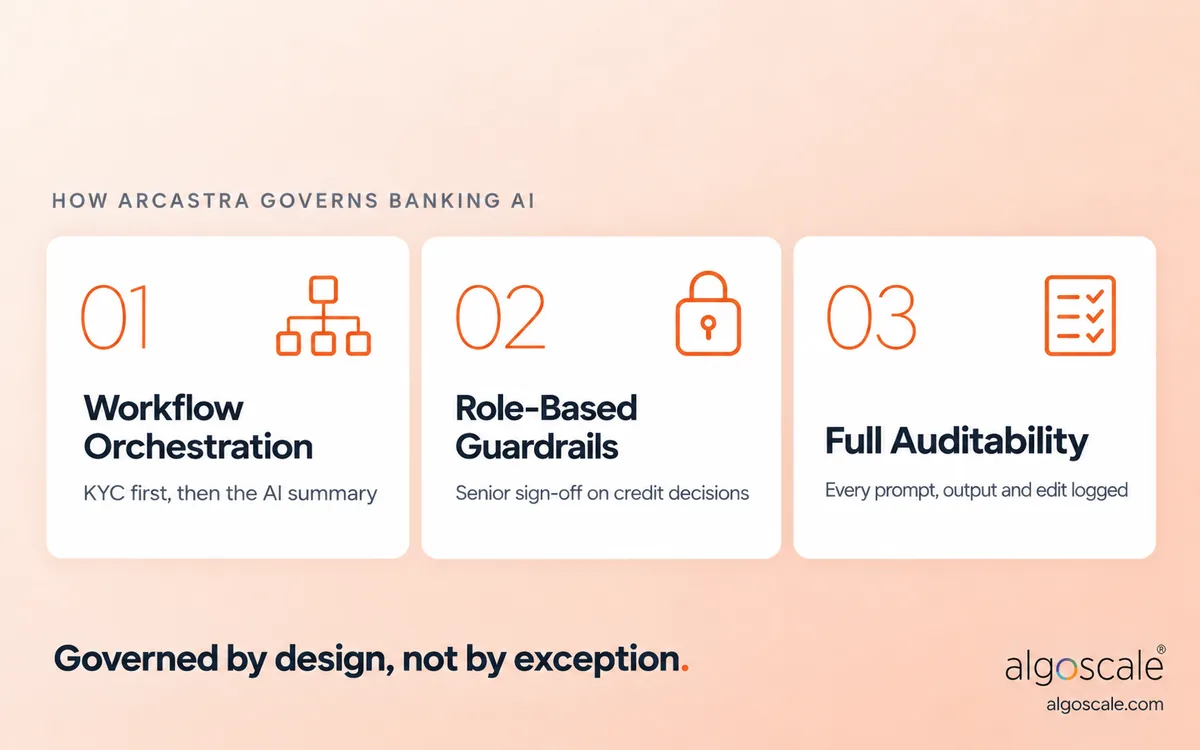
For banking deployments specifically, Arcastra adds three controls:
- Workflow Orchestration: Automates complex sequences. For example, it triggers an AI model to summarise a loan application only after the KYC verification confirms the user’s identity.
- Role-Based Guardrails: Ensures a junior analyst cannot approve an AI-generated credit decision without sign-off from a senior underwriter.
- Full Auditability: Every single prompt, AI output, and human edit is permanently logged. This provides compliance teams with a crystal-clear trail for regulatory audits.
With Algoscale, financial institutions don’t just deploy GenAI. They unlock it as a production-grade capability. As one of the top AI consulting companies, our expertise in generative AI consulting services lies in turning complex ideas into real-time, secure, and high-impact financial applications.
Conclusion
The integration of generative AI into the banking and financial services sector marks a turning point, not merely in operational efficiency but in how institutions think, create, and serve.
However, unlocking GenAI's full value in this highly regulated, data-intensive domain requires more than just deploying large language models. It demands orchestration of data infrastructure, intelligent agents, governance, compliance, and application pipelines.
Whether you're automating customer conversations, reimagining credit risk or embedding advisory capabilities at scale, Algoscale ensures your AI journey is not only future-ready, but also finance-first. The future of banking is not just digital. It's generative. And with the right partner, it's actionable.
Ready to Transform Your Banking Operations with Generative AI?
Whether you're in the early stages of experimentation or planning full-scale deployment, our team of AI and data engineering experts can help you:
- Identify high-impact GenAI use cases.
- Build finance-ready data and model pipelines.
- Orchestrate LLMs, agents, and workflows using Arcastra.
- Ensure end-to-end security, auditability, and governance.
Frequently Asked Questions
What is generative AI in banking?
Generative AI in banking refers to the use of large language models and advanced neural networks to create new text, code, or data based on financial inputs. It is used to automate complex tasks like drafting loan summaries, generating compliance reports, and writing personalised wealth management emails.
How does generative AI differ from traditional banking AI?
Traditional banking AI focuses on classification and prediction, such as detecting fraudulent card transactions or assigning a numerical credit score. Generative AI focuses on creation, such as writing a narrative report explaining exactly why a specific transaction was flagged for fraud.
Is it safe to use generative AI with sensitive financial data?
Yes, but only if deployed within a secure enterprise environment. Banks must use private, ring-fenced infrastructure, strict data masking techniques, and role-based access controls to prevent sensitive customer data from leaking into public AI models.
Can generative AI approve loans automatically?
No, generative AI should not approve loans autonomously due to regulatory and bias risks. Instead, it is used in the underwriting process to read unstructured documents (like tax returns) and generate a draft risk assessment, which a human underwriter then reviews and approves.
How do banks prevent AI hallucinations in financial advice?
Banks reduce hallucinations by using Retrieval-Augmented Generation (RAG). This technique restricts the AI to approved sources, forcing the model to generate responses based on the bank’s own vetted, proprietary research documents. It reduces hallucinations rather than eliminating them, so high-stakes outputs still need human review.
Which banks are leading in generative AI?
Morgan Stanley, JPMorgan Chase and Wells Fargo are among the most visible. Morgan Stanley reports that 98% of its advisor teams have adopted its AI assistant, while Wells Fargo’s Fargo assistant handled more than 245 million customer interactions in 2024.
What is agentic AI in banking?
Agentic AI goes beyond generating content. AI agents take actions, such as requesting documents, updating case records or triggering compliance checks, within limits the bank defines. Every action must be permitted, logged and reviewable.