

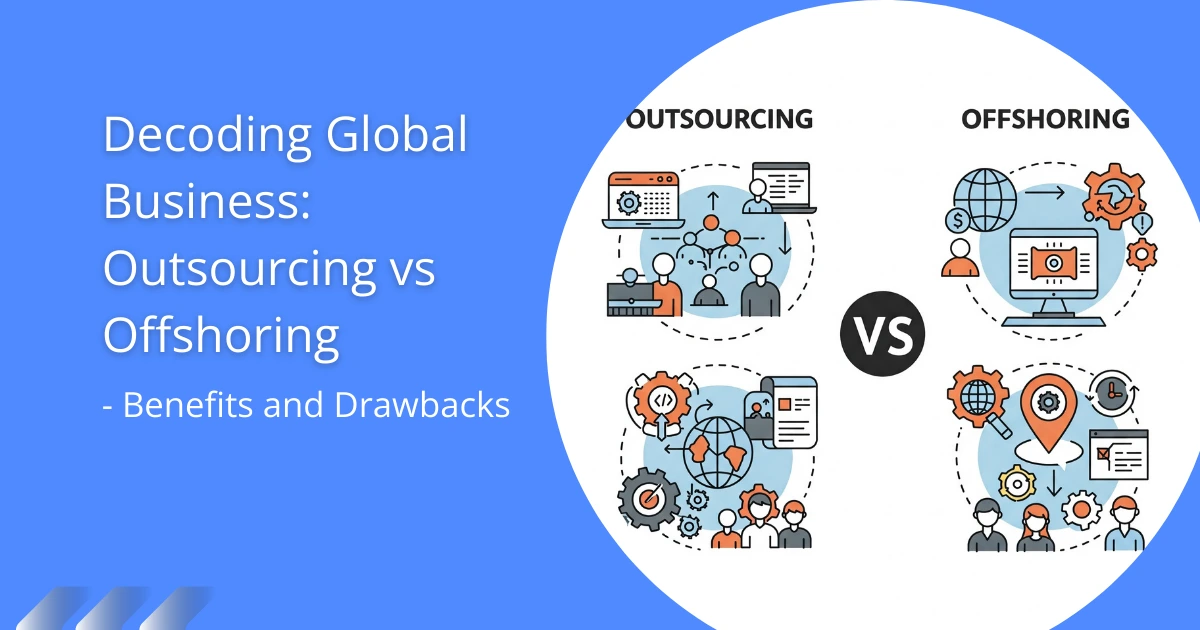

In today’s competitive business landscape, companies are increasingly turning to global strategies to optimize resources and drive growth. One common comparison that often arises is Outsourcing vs Offshoring. Although both approaches involve working with external teams, they differ significantly in execution, location, and management. In this guide, we’ll break down the key differences between Offshoring vs Outsourcing, explore their advantages and challenges, and help you decide which model is the best fit for your business needs, especially in industries like software development.
This blog breaks down the nuances of offshoring and outsourcing, offering a comprehensive comparison to help organizations determine which model best aligns with their operational goals. Whether you’re a growing startup or a global enterprise, decoding these concepts will empower you to build agile, scalable, and future-ready business functions.
What is Software Outsourcing? Characteristics and Use Cases
Outsourcing is a strategic business practice in which a company delegates specific tasks, processes, or functions to external service providers rather than handling them in-house. This approach allows organizations to focus on their core competencies while leveraging the expertise, scalability, and cost-efficiency of third-party vendors. Commonly outsourced services include IT support, customer service, accounting, and HR assistants.
By tapping into specialized external resources, businesses can improve operational agility, reduce overhead, and enhance service quality without the need for significant internal investment. For technical teams and enterprise leaders, the model serves as a powerful tool to accelerate project delivery and optimize resource allocation in an increasingly competitive market.
Key Characteristics of Outsourcing Software Development Team
Access to Global Talent
It connects businesses with skilled professionals worldwide, offering specialized expertise in emerging technologies. This global reach enhances innovation and ensures access to niche capabilities that may not be available in-house.
Faster Time-to-Market
With dedicated teams focused solely on development, the model accelerates the product development lifecycle. This speed is crucial in staying competitive and meeting tight deadlines.
Focus on Core Business Functions
Delegating development tasks allows internal teams to concentrate on strategic initiatives and core competencies. This separation of concerns improves productivity and organizational efficiency.
Defined Contracts and SLAs
It typically involves clear contractual agreements with specific service-level expectations. These agreements help mitigate risks, define project scope, and ensure accountability from the external vendor.
Top Use Cases for Outsourcing Software Development
Some of the prominent use cases concerning this model of business have been mentioned below.
MVP Development
Startups often outsource software development teams to rapidly build a Minimum Viable Product (MVP) without hiring an in-house team. This approach allows them to validate ideas quickly and cost-effectively before scaling.
Learn about Top-Rated MVP Development Companies in 2025
Modernising Legacy Systems
Enterprises with outdated systems leverage outsourced teams to modernize their software infrastructure. Thus, the model brings in specialized skills for legacy-to-modern tech migrations without disrupting internal operations.
Scaling Product Development
Businesses experiencing rapid growth outsource to scale their development efforts without delay. This enables continuous delivery of new features while maintaining high quality and performance standards.
What is Offshoring? Characteristics and Use Cases
It refers to strategically relocating business operations or services to a different country, typically to leverage cost advantages, access specialized talent, or optimize resource utilization. In the context of software development, the process involves partnering with teams or establishing development centres in regions with a strong technical workforce and favourable economic conditions.
This model enables companies to maintain control over project workflows while significantly reducing operational expenses. The process is particularly beneficial for organizations seeking to extend their development capabilities, accelerate delivery cycles, and ensure around-the-clock productivity through globally distributed teams. Partnering with a reliable BPO company can also enhance operational efficiency by managing non-core functions through offshoring strategies.
Key Characteristics of an Offshoring Software Development Team
Cost Efficiency
By shifting development operations to countries with lower labour costs, companies can significantly reduce overall expenses while maintaining quality output.
Time Zone Advantage
With teams distributed across time zones, it supports continuous development cycles, enabling faster turnaround and quicker product releases.
Infrastructure Savings
By choosing to hire offshore developers and leveraging their existing infrastructure and technology ecosystems, businesses can minimize investment in physical and digital resources.
Operational Control
Despite the geographical distance, this model allows companies to retain control over project management, development standards, and timelines through structured communication and collaboration tools. Project management integration helps streamline workflows, track progress, and maintain visibility across all stages of development.
Scalability
It also offers flexible team scaling options, allowing organizations to quickly ramp up or down based on project needs without long-term commitments.
Also read A Complete Guide – What to Look for in a Software Development Partner in 2025!
Top Use Cases for Offshoring Software Development
Some of the prominent use cases of this business process have been mentioned below.
Expanding Product Lines
Mature tech firms partner with an offshore software development company to scale up engineering capacity when launching new features or products. This approach ensures faster go-to-market timelines without overburdening their core in-house teams.
Specialized Skill Augmentation
Businesses offshore tasks that require niche technical expertise, such as AI, blockchain, or cloud migration, where in-house talent is unavailable or limited.
Cost-Effective Support
Managing offshore software development cost becomes significantly easier with dedicated offshore teams handling ongoing maintenance, bug fixes, and updates at a lower cost, freeing up internal resources for innovation and strategic initiatives.
Outsourcing vs Offshoring for Software Development: A Detailed Comparison Guide
Having explored the definitions, core attributes, and practical applications of both processes, it is now essential to delve into the fundamental distinctions between them. Let us understand these through the means of a table.
| Aspect | Outsourcing | Offshoring |
| Cost Optimisation | Reduced costs through vendor efficiency. | Cost savings from wage and tax benefits. |
| Control and Oversight | Less control with external management. | More control via a captive team. |
| Location | Domestic or international vendor options. | Typically involves foreign, lower-cost labour. |
| Risk Factors | Risks include vendor dependency, quality. | Risks include instability and time zone issues. |
| Talent Access | Access to external expertise and skills. | Access to scalable global expertise. |

Top Benefits of Outsourcing Software Development
-
Access to Specialised Skills and Expertise
One of the most significant advantages of software development is the immediate access it provides to highly specialized talent. Instead of investing time and resources into hiring and training in-house staff, businesses can partner with external development teams that already possess deep domain expertise, advanced technical skills, and experience in cutting-edge technologies. This enables faster project execution, improved code quality, and access to niche skills that may not be readily available within the local job market.
-
Potential Cost Savings
One of the primary benefits is the opportunity to significantly reduce operational and development costs. By collaborating with offshore or nearshore teams, businesses can leverage lower labour rates without compromising on quality. Additionally, it eliminates expenses related to recruitment, infrastructure, training, and employee benefits. This cost efficiency allows companies to allocate more resources to core business areas, innovation, or scaling efforts, ultimately enhancing their competitive edge in the market.
-
Scalability and Flexibility
It allows organizations to quickly scale teams up or down based on project requirements. Whether expanding resources to meet tight deadlines or downsizing after project completion, this model offers unmatched flexibility without the long-term commitment of in-house hiring. This adaptability is particularly valuable in dynamic markets where business needs evolve rapidly, enabling companies to respond efficiently without disrupting operational flow.
-
Focus on Core Competencies
By outsourcing software development, organizations can redirect their internal resources toward strategic functions that drive growth and innovation. Instead of allocating time and effort to manage complex development tasks, businesses can concentrate on their core competencies, such as product innovation, customer engagement, or market expansion. This approach, facilitated by flexible IT Staff Augmentation models, not only enhances overall productivity but also ensures that critical business areas receive the attention they deserve, ultimately contributing to long-term success.
Common Challenges and Risks of Outsourcing
Loss of Control Over Process and Quality
One of the key challenges is the potential reduction in direct oversight of project workflows and deliverable quality. When teams are managed externally, it can be harder to enforce internal standards, monitor day-to-day progress, or ensure that the output aligns perfectly with business objectives. This loss of control may lead to misaligned expectations, communication gaps, or inconsistencies in the final product, especially if governance practices are not clearly defined from the outset.
Communication Barriers and Time Zone Differences
A significant drawback can be the presence of communication challenges due to language differences, cultural nuances, or misaligned time zones. These factors can lead to delays in responses, misinterpretation of requirements, and reduced real-time collaboration. Time zone gaps, in particular, may slow down project cycles if not managed properly through overlapping work hours or asynchronous communication strategies, potentially impacting efficiency and overall productivity.
Data Security and Confidentiality Risks
One of the primary concerns is safeguarding sensitive business information. Transferring proprietary data, intellectual property, or customer details to external teams can increase the risk of data breaches or unauthorised access, especially if the vendor lacks robust security protocols. While many service providers adhere to global compliance standards, companies must conduct thorough due diligence, implement strong NDAs, and ensure the outsourcing partner maintains strict data protection measures to mitigate these confidentiality risks.
Dependency on the Vendor’s Performance
Outsourcing software development often creates a reliance on the third-party vendor’s capabilities and timelines. If the vendor underdelivers, faces internal challenges, or shifts priorities, it can directly impact your project’s progress, quality, and deadlines. This dependency limits your ability to intervene in day-to-day operations and can lead to delays or misalignment with your strategic goals.
Top Benefits of Offshoring Software Development
Significant Cost Reduction
One of the primary advantages is the substantial reduction in operational costs. By shifting development tasks to countries with lower labor expenses, companies can achieve high-quality results at a fraction of the cost compared to hiring in-house teams in high-cost regions.
It eliminates expenses related to infrastructure, recruitment, and employee benefits, allowing businesses to allocate budgets more strategically. This cost efficiency makes the model particularly attractive for startups and enterprises aiming to maximize ROI without compromising on deliverables.
Access to a Larger and a Specialised Talent Pool
The process opens the door to a vast global talent pool, providing access to highly skilled professionals with specialized expertise. Many offshoring destinations are known for their strong STEM education systems and experienced tech workforce, enabling companies to find developers with niche skills that may be scarce or cost-prohibitive locally. This extended reach not only accelerates project timelines but also enhances innovation by bringing in diverse perspectives and advanced technical capabilities in today’s fast-paced digital landscape.
Algoscale leverages a rich pool of highly skilled and dedicated software professionals to deliver cutting-edge development solutions tailored to your business needs. Teams at Algoscale are composed of top-tier talent with deep expertise across various technologies and industries, ensuring that you gain access to niche capabilities without compromising on quality or speed.
Full Control Over Operations
One of the key advantages is the ability to retain full control over your operations. Unlike traditional outsourcing, where the external partner may manage the majority of workflows, the model typically involves setting up a dedicated team or even a subsidiary in another country.
This setup allows companies to implement their processes, maintain quality standards, and align the offshore team closely with their business objectives and culture. As a result, businesses can ensure consistency, transparency, and long-term strategic alignment across both domestic and offshore teams.
Common Challenges and Risks of Offshoring
Cultural Challenges
Cultural differences can pose significant hurdles, especially when teams are spread across countries with varying business etiquette, work ethics, and communication styles. Misunderstandings may arise from differences in time perception, hierarchy, or even how feedback is given and received. These gaps can impact team cohesion, collaboration, and overall productivity if not managed proactively.
Time Zone Differences
One of the notable drawbacks is managing teams across different time zones, which can complicate real-time communication and project coordination. Delays in response times and limited overlapping working hours may lead to slower decision-making and extended development cycles. This time gap can also impact issue resolution, especially in fast-paced development environments where agility is key.
Geopolitical and Economic Risks
The model exposes businesses to potential geopolitical and economic instabilities in the offshore location. Political unrest, changes in government policies, fluctuations in currency, or economic downturns can disrupt business continuity, affect service delivery, or result in unexpected costs. These uncertainties can hinder long-term planning and create vulnerabilities in the supply chain.
Managing Remote Teams and Maintaining Quality
One of the key challenges is effectively managing remote teams while ensuring consistent quality. Physical distance, cultural differences, and varying work standards can lead to misaligned expectations, delays, and compromised deliverables if not carefully managed. Without strong project management practices and regular communication, it becomes difficult to monitor progress, enforce quality standards, and maintain accountability.
How to Choose Between Outsourcing and Offshoring for Your Business
When deciding between outsourcing and offshoring for software development, businesses must evaluate their goals, project scope, budget constraints, and operational preferences. The former is ideal for companies looking to delegate specific tasks or short-term projects to external vendors with specialized skills, enabling faster delivery and cost efficiency without long-term commitments.
On the other hand, the latter is more suitable for organisations aiming to build dedicated software development teams overseas, ensuring tighter integration with in-house operations and greater control over long-term projects. Key considerations such as time zone alignment, communication protocols, regulatory compliance, and data security must also guide the decision-making process.
By thoroughly assessing these factors, businesses can select the model that aligns best with their strategic objectives and ensures scalable, high-quality software delivery. Algoscale offers end-to-end software development services, including tailored outsourcing and offshoring solutions. From MVPs to enterprise-grade platforms, we help you innovate faster, scale smarter, and deliver with confidence.
Key Factors to Evaluate Before Choosing Outsourcing or Offshoring
Here are some of the key factors software development firms should consider when choosing between the two models.
- Project Duration and Complexity – For short-term or clearly defined projects, outsourcing may offer faster turnaround with less overhead. Offshoring is better suited for long-term, complex development efforts requiring sustained collaboration.
- Level of Control and Integration – Offshoring enables tighter control and alignment with internal processes due to dedicated teams. Outsourcing typically involves more autonomy for the vendor, limiting granular control.
- Access to Talent and Expertise – Outsourcing allows access to highly specialized skill sets on demand. Offshoring opens up a broader talent pool and enables long-term capacity building with skilled developers.
- Operational and Communication Considerations – Time zone differences, language proficiency, and communication tools should be evaluated. Outsourcing teams may require less integration, whereas offshoring demands strong collaboration practices to ensure productivity.
When to Opt for Outsourcing Software Development
Here are five key scenarios when outsourcing software development is the right choice.
- Limited In-House Expertise – When your internal team lacks the necessary technical skills or experience, it allows quick access to domain experts without long-term hiring commitments.
- Short-Term or One-Off Projects – For short-term projects such as building Minimum Viable Products (MVPs), implementing feature enhancements, or addressing urgent bug fixes, the model provides the agility and cost-effectiveness needed to move quickly without the burden of long-term staffing commitments. This approach enables companies to meet tight deadlines and adapt to evolving requirements efficiently. Algoscale offers rapid, scalable, and expert-driven MVP solutions tailored to your business needs, ensuring faster time-to-market with minimal risk.
- Faster Time-to-Market – It enables parallel development by leveraging external teams, accelerating project timelines, and helping you stay ahead of market competition.
- Tight Budget Constraints – When cost control is crucial, the model offers predictable pricing models and eliminates expenses related to hiring, onboarding, and infrastructure.
- Focus on Core Business Operations – Delegating development tasks to external partners lets your internal teams concentrate on strategic activities such as product management, client relations, or sales.
When to Opt for Offshore Software Development
Here are five key scenarios when offshoring software development is the ideal choice:
- Need for Long-Term, Scalable Development Teams – The model is optimal when your business requires dedicated, full-time teams that can grow with your project over time, ensuring consistency and continuity.
- Access to a Broader Global Talent Pool – It allows you to tap into highly skilled professionals in specialized technologies that may be scarce or expensive in your local market.
- Cost Optimization Without Sacrificing Quality – Offshoring to countries with lower labor costs can significantly reduce overall development expenses while maintaining a high standard of output.
- Establishing Global Presence – If you’re aiming to expand internationally, offshoring enables you to build teams closer to your target markets and operate across multiple time zones.
- Full Operational Control with Resource Ownership – The process is ideal for businesses that want to retain control over workflows, project management tools, and team oversight while benefiting from overseas execution.
Conclusion
As global markets evolve, choosing between outsourcing and offshoring has become a pivotal strategic decision for software development firms. Both models offer distinct advantages as the former brings agility, access to specialized skills, and reduced overhead for short-term or project-based needs, while the latter provides long-term scalability, deeper operational control, and access to a broader, global talent pool.
However, each approach also presents its own set of challenges, from managing time zones and cultural differences to ensuring quality and data security.
Ultimately, the right choice depends on your business objectives, resource capacity, and the complexity of your development roadmap. A well-informed, goal-oriented strategy will help ensure that your chosen model drives both innovation and efficiency.
Algoscale provides adaptable outsourcing and offshoring solutions designed to align with your specific business objectives. Whether you need support for MVP development or are looking to establish a dedicated offshore team, our services are built to be scalable, secure, and cost-efficient. Partner with Algoscale a Data Consulting and AI Services Company to accelerate innovation and deliver high-impact software solutions—faster, smarter, and with precision. Get in touch now!