


Most enterprises are not struggling to collect data. They are struggling to trust it. Reports disagree with each other. Different teams have different definitions of the same metric. Data sits in silos no one fully understands. And when leadership asks for a simple answer, it takes days to produce one everyone can agree on.
This is not a technology problem. It is a data governance problem.
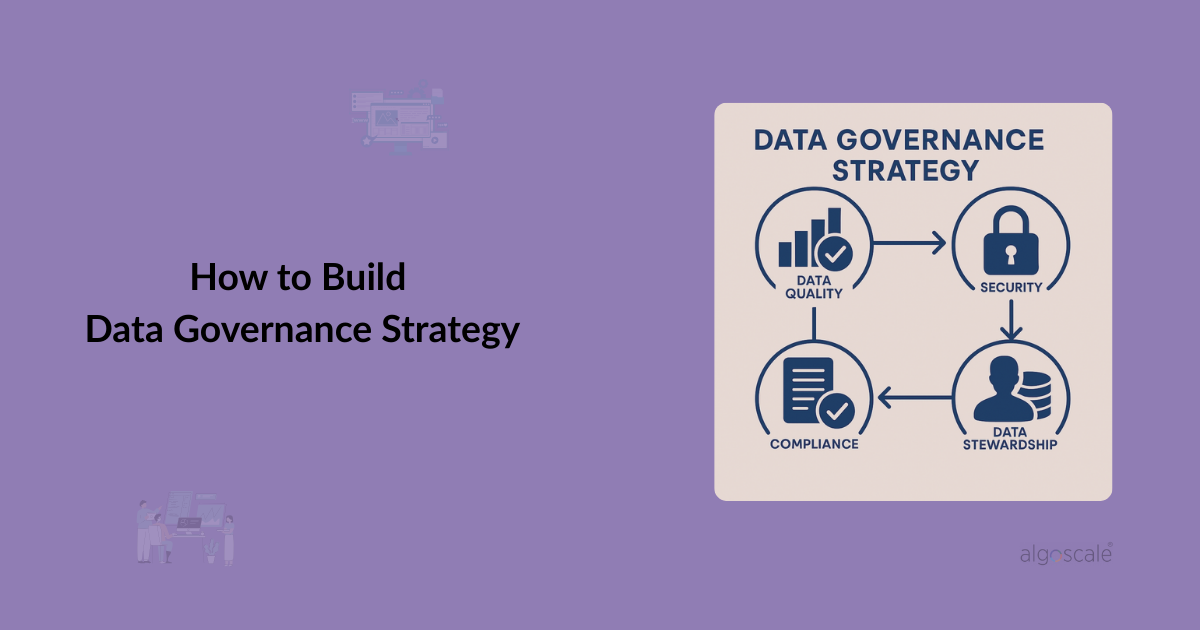
A data governance strategy gives your organization the policies, roles, and standards to manage data consistently, confidently, and in compliance with regulations. A data governance roadmap turns that strategy into a practical, phased plan that your teams can actually execute — without trying to fix everything at once.
In 2025, the stakes are higher than ever. As enterprises adopt AI and machine learning, ungoverned data is not just messy — it is dangerous. A model trained on inaccurate, incomplete, or biased data produces unreliable outputs. Regulations like GDPR, HIPAA, and CCPA require documented data lineage, access controls, and retention policies. And as more teams access data through self-service analytics platforms, governance is the only thing standing between data democratization and data chaos. That is exactly why forward-thinking enterprises are turning to data governance consulting services to build the right framework before problems become costly.
| $12.9M Average annual cost of bad data per org (Gartner) | 73% Orgs say poor data quality costs them revenue | 44% Of orgs lack a formal data governance lead | 5x ROI improvement with mature data governance programs |
This guide covers everything you need to build a data governance strategy and roadmap from scratch — or significantly improve the one you already have. We cover the core framework, operating models, a step-by-step 4-phase roadmap, the right tools, how to measure success, and the most common mistakes that derail governance programs before they gain momentum.
What Is a Data Governance Strategy?
A data governance strategy is the high-level plan that defines how your organization manages, protects, and uses its data assets to achieve specific business goals. Think of it as the constitution for your data — it sets the laws and principles, while your day-to-day governance activities enforce those laws.
A governance strategy answers the big questions: What data do we have? Who is responsible for it? How should it be managed and protected? What standards must everyone follow? And what outcomes do we expect governance to deliver for the business?
What Does a Strategy of Data Governance Include?
A complete data governance strategy covers six things:
- Business goals alignment — governance must be tied to measurable outcomes like reducing reporting errors, accelerating compliance audits, or enabling AI model deployment
- Data policies and standards — documented rules for how data is created, named, stored, accessed, shared, and eventually retired
- Roles and accountability — clear assignments of who owns which data and who is responsible for enforcing policies
- Operating model — the governance structure that defines how decisions are made and by whom
- Technology enablement — the tools that make governance scalable across large, complex data environments
- Metrics and KPIs — how success is measured, reported, and used to justify continued investment
7 steps to Build Data Governance Strategy
1. Define Business Goals, Strategy, and Measurable Objectives
A data governance strategy must start with clear business goals. Without a defined purpose, governance becomes a set of rules with no real impact. Goals typically include improving data quality, ensuring regulatory compliance, enabling analytics, or strengthening data security. These objectives should directly support business priorities like revenue growth, operational efficiency, or risk reduction.
How to implement:
Work with business leaders to identify key challenges related to data. Translate those into measurable goals (e.g., reduce data errors by 30%). Document success metrics and align governance initiatives with business KPIs to ensure relevance and executive support.
2. Establish Clear Roles, Responsibilities, and Data Ownership
Data governance succeeds only when accountability is clearly defined. This means assigning roles such as data owners (responsible for data outcomes), data stewards (handling quality and processes), and IT teams (managing infrastructure). Without ownership, data issues remain unresolved and governance fails.
How to implement:
Create a governance structure with clearly defined roles and responsibilities. Use a RACI matrix to map who is responsible, accountable, consulted, and informed. Establish a governance council to oversee policies and resolve conflicts. Ensure all stakeholders understand their roles through training and documentation.
3. Gain Complete Visibility into Your Data Landscape
Before governing data, you need a complete understanding of what data exists, where it resides, and how it flows across systems. This includes identifying critical datasets, sensitive information, and data dependencies. A proper data inventory helps reduce redundancy and improve visibility.
How to implement:
Conduct a data audit by scanning databases, warehouses, and applications. Use data catalog tools to document metadata, ownership, and usage. Classify data into categories such as sensitive, business-critical, or operational. Map data lineage to understand how data moves and transforms across systems.
4. Define and Standardize Data Governance Policies and Rules
Policies define how data should be handled across the organization. This includes rules for data quality, access control, privacy, and lifecycle management. Strong standards ensure consistency and reduce confusion across teams.
How to implement:
Start by defining key policies such as data access rules, validation standards, and retention guidelines. Keep policies simple, practical, and aligned with business needs. Document them in a centralized repository and ensure they are easily accessible. Regularly review and update policies as business and regulatory requirements evolve.
5. Select and Implement the Right Data Governance Tools
Technology plays a critical role in scaling data governance. Manual governance is not sustainable as data grows. Tools help automate processes like data discovery, quality monitoring, and access control.
How to implement:
Evaluate tools based on your needs—data cataloging, lineage tracking, data quality, or master data management. Choose scalable platforms that integrate with your existing systems. Start with essential tools first, then expand gradually. Ensure teams are trained to use these tools effectively to maximize adoption and ROI.
6. Ensure Data Security, Privacy, and Regulatory Compliance
Data governance must protect sensitive data and ensure compliance with regulations like GDPR, HIPAA, or CCPA. This step focuses on safeguarding data from unauthorized access and misuse while maintaining transparency.
How to implement:
Implement role-based access control (RBAC) to restrict data access based on user roles. Use encryption for data at rest and in transit. Maintain audit logs to track data usage. Work closely with legal and compliance teams to ensure policies meet regulatory standards. Regularly conduct audits and risk assessments.
7. Build a Phased Data Governance Roadmap for Scaling
A data governance strategy should not be implemented all at once. A phased roadmap ensures manageable execution and better adoption. It helps prioritize high-impact areas and scale gradually.
How to implement:
Create a roadmap with clear phases—assessment, pilot, implementation, and scaling. Start with a small use case or department to test governance processes. Measure results, refine your approach, and expand across the organization. Continuously monitor performance and update the strategy as business needs evolve.
Data Governance Operating Models — Which One Is Right for Your Organization?
Before you build your roadmap, you need to decide how governance decisions will be made and by whom. This is your operating model, and it is one of the most consequential choices in your governance program.
| Model | How it works | Best for | Watch out for |
| Centralized | Single corporate body makes all decisions | Regulated industries (banking, healthcare) | Can create bottlenecks |
| Decentralized | Each business unit governs independently | Agile, domain-driven organizations | Creates silos and inconsistency |
| Federated (Hybrid) | Central standards + domain enforcement | Large, multi-BU enterprises | Recommended for most orgs in 2025 |
1. Centralized model
In a centralized model, a single corporate governance body — usually led by the Chief Data Officer — makes all governance decisions for the entire organization. Every policy, standard, and exception goes through this central function. This model works well in highly regulated industries where strict data consistency and audit trails are non-negotiable. The downside is that it can be slow and creates bottlenecks for business units that need to move quickly.
2. Decentralized model
In a decentralized model, each business unit governs its own data autonomously. Domain teams make their own data quality, access, and metadata decisions. This model works well for organizations with strong domain ownership and a culture of autonomy. The risk is that different domains develop incompatible standards over time, making cross-domain reporting and AI model development significantly more difficult.
3. Federated model — recommended for most enterprises in 2025
The federated model — sometimes called the hybrid model — combines central governance standards with decentralized execution. A central data governance council sets the enterprise-wide standards, definitions, and policies. Individual data domains have their own data stewards who implement and enforce those standards locally.
Top Data Governance Tools to Support Your Strategy
Tools do not create governance — strategy and people do. But the right tools make governance scalable, automatable, and measurable. Here are the key tool categories and the leading platforms in each.
1. Data catalogue tools
A data catalogue is the foundation of your governance technology stack. It gives your organization a searchable inventory of all data assets, including metadata, ownership, quality scores, and lineage.
- Collibra — enterprise-grade governance platform with workflow automation, business glossary, policy management, and compliance reporting. Strong choice for regulated industries.
- Alation — known for its ease of use and strong search capability. Particularly effective for enabling self-service analytics because business users can find and understand data without IT assistance.
- Informatica Axon — part of Informatica’s broader data management suite. Strong for organizations that also use Informatica for data integration and data quality management.
- Microsoft Purview — native integration with the Azure ecosystem. If your data platform is primarily Azure-based, Purview provides the most seamless governance experience with minimal additional infrastructure.
- Apache Atlas — open-source option for organizations running Hadoop or other Apache ecosystem tools. Lower cost but requires more technical expertise to deploy and maintain.
2. Data quality tools
- Great Expectations — popular open-source framework for defining, testing, and validating data quality rules directly in your data pipelines. Strong adoption in the data engineering community.
- Ataccama ONE — enterprise platform for automated data profiling, cleansing, matching, and monitoring. Good for organizations that need to manage data quality across many systems simultaneously.
- Talend Data Quality — part of the Talend data integration suite. Provides data matching, standardization, address verification, and enrichment capabilities.
- Monte Carlo — data observability platform that monitors pipelines and datasets for quality issues, freshness problems, and schema changes in real time.
3. Data lineage tools
- OpenLineage — open standard for collecting lineage data from data pipelines. Integrates with Apache Airflow, dbt, Spark, and other popular pipeline tools. Recommended as the lineage collection standard for modern data stacks.
- Marquez — open-source metadata service that implements the OpenLineage standard. Good starting point for organizations building lineage tracking without a large budget.
- Apache Atlas — provides both metadata management and lineage tracking for Hadoop-based environments.
Frequently Asked Questions
Q: What is a data governance strategy?
A: A data governance strategy is the high-level plan that defines how an organization manages, protects, and uses its data assets to achieve specific business goals. It covers data policies, ownership roles, quality standards, compliance requirements, and the metrics used to measure governance success.
Q: What is the difference between a data governance strategy and a data governance roadmap?
A: The strategy defines the goals, principles, and operating model — the ‘what and why’ of governance. The roadmap is the phased execution plan — the specific steps, timelines, owners, and milestones that turn the strategy into action. You need both to run a successful governance program.
Q: How do you build a data governance roadmap?
A: Start with a current-state assessment to understand your existing data assets and governance gaps. Align governance goals to business priorities. Choose an operating model. Establish a governance council and assign data ownership roles. Run a pilot on one high-impact data domain. Then scale policies, tools, and stewardship across the enterprise in phases.
Q: What are the key components of a data governance framework?
A: The six core pillars are: data ownership and stewardship, data quality management, metadata management and cataloguing, data lineage and traceability, data security and access control, and compliance and regulatory alignment. Every effective governance framework addresses all six.
Q: How long does it take to implement a data governance program?
A: A focused pilot covering one data domain typically takes 3–6 months. A full enterprise-wide governance program — covering all critical data domains with automated quality monitoring, lineage tracking, and a trained stewardship network — typically takes 12–18 months depending on data complexity, organization size, and current maturity level.
Q: What is a data governance maturity model?
A: A data governance maturity model assesses how advanced an organization’s governance practices are, typically across five levels ranging from ‘Initial’ where no formal governance exists, to ‘Optimized’ where governance is AI-assisted, continuously improving, and embedded in all data workflows. Popular frameworks include DAMA-DMBOK, the IBM maturity model, and the PwC 5-layer framework.
Q: What tools are used for data governance?
A: Leading tools include Collibra and Alation for enterprise data cataloguing, Informatica Axon and Microsoft Purview for governance management, Great Expectations and Monte Carlo for data quality and observability, and OpenLineage with Apache Atlas for data lineage tracking. Tool selection should be guided by your maturity level and existing data stack.
Conclusion
Data governance is not a one-time project. It is an ongoing program that grows, adapts, and matures alongside your organization’s data environment. The organizations that treat governance as a strategic investment — not a compliance checkbox — are the ones that get more value from their data, move faster on analytics initiatives, and face fewer costly surprises when regulations change or AI initiatives scale.
The 4-phase roadmap in this guide — Foundation, Pilot, Scale, Optimize — gives any organization a realistic path forward regardless of where they are starting from. Begin with a current-state assessment, align governance to a real business priority, assign clear ownership, start small with a focused pilot, and build from there.
In 2025 and beyond, as AI adoption accelerates and regulatory scrutiny intensifies, the organizations with governed, trusted, well-documented data will outperform those without. Data governance is no longer just a risk management exercise. It is a competitive advantage.
If you are ready to build your data governance strategy and roadmap — or need expert help accelerating a program that has stalled — Algoscale’s data governance consulting services can help. Our team provides end-to-end support from assessment through execution, with deep expertise in the frameworks, tools, and change management practices that make governance programs succeed.