

Architecture discussions tend to stay abstract – layers, patterns, decision frameworks. It’s worth grounding what lakehouses actually look like once they’re deployed. Different industries and company types have converged on recognizably different common setups, shaped by their specific data characteristics, compliance requirements, and organizational structure.
This post is a practical survey of those common setups – not a recommendation for which one to copy, but a description of what’s actually out there and why each configuration tends to fit its context. For a use-case-driven look at whether a lakehouse fits your organization specifically, our companion post on who actually needs a data lakehouse covers that question directly.
If you want to talk through what a setup might look like for your specific situation, our Data Lake Services team at Algoscale has implemented lakehouse architectures across most of the industries described below.
Common Setups by Industry
Retail and E-Commerce
Retail lakehouses commonly combine streaming clickstream and transaction data with batch inventory and supply chain feeds, built on Databricks or Snowflake with Delta Lake or Iceberg as the table format. The defining characteristic is serving both real-time personalization (product recommendations, dynamic pricing) and traditional batch reporting from the same underlying platform. Data volume tends to be significant but not extreme compared to some other industries, and the primary architectural pressure is usually the real-time-plus-batch combination rather than raw scale alone.
Financial Services and Fintech
Financial services lakehouses are typically governance-first: heavy investment in access control, audit logging, and often Data Vault-style modeling specifically for the auditability and historical tracking regulatory requirements demand. Hybrid cloud or specific data residency configurations are more common here than in most other industries, driven by regulatory requirements about where financial data can physically reside. The architectural priority tends to be provable compliance and reliability over raw query performance, though both matter.
Healthcare
Healthcare lakehouse setups are similarly compliance-driven, with particularly heavy investment in classification and access control tooling – Microsoft Purview, AWS Lake Formation, or equivalent – to manage HIPAA and similar regulatory requirements around protected health information specifically. Data in healthcare settings is often more heterogeneous than in other industries, spanning structured claims data, clinical notes, and imaging metadata, which pushes toward genuinely flexible lakehouse storage rather than a rigid warehouse-only approach. Our post on data lakehouse architecture for healthcare covers this specific configuration in more depth.
SaaS and Technology Companies
SaaS and product-focused technology companies commonly build lakehouses centered on product usage and event data, often paired with tools like dbt for transformation and a strong internal self-service analytics culture. Databricks and Snowflake are both common platform choices, and these organizations frequently have the most mature internal data engineering capability of any industry represented here, since data infrastructure is often closely tied to the product itself. Feeding both internal BI and product-embedded analytics or ML features from the same lakehouse is a common pattern specific to this group.
Manufacturing and IoT
Manufacturing and industrial IoT lakehouses are shaped by high-frequency sensor data – often the dominant volume driver in these architectures – pushing toward streaming-first ingestion patterns and, in some cases, Kappa-style architecture rather than a traditional Lambda batch-plus-speed split. Edge-to-cloud data movement is a distinctive concern in this group that’s less prominent elsewhere, since sensor data frequently originates at physical locations with real network and connectivity constraints before it ever reaches cloud storage.
Early-Stage Companies and Startups
Early-stage companies typically run lean, single-cloud lakehouse setups with minimal tooling beyond the essentials – object storage, a table format, and a single query engine – deliberately avoiding the governance and multi-tool complexity that larger organizations accumulate. The architectural priority here is usually speed to a working system and low operational overhead, with the explicit expectation that structure gets added incrementally as the organization and its data needs actually grow, rather than architected preemptively for a scale that hasn’t materialized yet.
What’s Common Across All These Setups, Despite the Differences
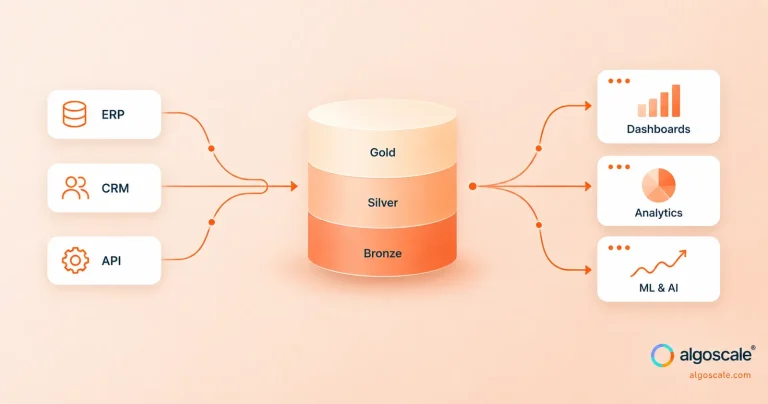
Underneath the real variation described above, a few things hold consistently across nearly every setup that works well. All of them separate storage from compute, using cloud object storage as a shared foundation regardless of which specific query engines sit on top. All of them eventually adopt some form of the medallion (raw-to-refined) staging pattern, even when it’s not explicitly labeled that way. And all of them treat governance as a first-class architectural concern rather than an afterthought, even when the specific tooling and rigor applied varies dramatically by regulatory context. For a broader look at the named architectural patterns underlying these industry-specific configurations, our post on lakehouse architecture patterns worth knowing before you build one covers this ground directly.
A Side-by-Side Illustration
Consider how differently two organizations of similar size approach the same underlying question: how quickly does new data need to be available for use? A retailer running real-time personalization needs product and browsing data available within seconds, justifying investment in streaming ingestion and low-latency serving layers. A financial services firm handling regulatory reporting, by contrast, often prioritizes provable accuracy and complete audit trails over speed – a report generated an hour later but demonstrably correct and fully auditable is worth far more than one available instantly but harder to defend during a compliance review.
Neither approach is more sophisticated than the other. They’re both well-suited responses to genuinely different requirements, and an architecture optimized for one company’s priorities would likely be a poor, over-engineered or under-governed fit for the other’s. This is the core reason industry-common setups exist in the first place – they’re not arbitrary conventions, but the accumulated result of many organizations independently arriving at similar answers to similar underlying constraints.
Common Mistakes When Copying Another Industry’s Setup
Adopting healthcare or financial services-level governance overhead without a comparable regulatory requirement. This creates real operational friction without a corresponding compliance benefit – governance rigor should match your actual regulatory context, not an unrelated industry’s.
Underinvesting in governance because “we’re just a startup.” Early-stage companies can reasonably start lean, but data quality and basic access control discipline are worth establishing early regardless of company size, since retrofitting them later is considerably more expensive than building them in from the start.
Assuming a streaming-first architecture is universally better because manufacturing and IoT use it. Streaming-first patterns fit specific data characteristics – high-frequency, continuous sensor data – and add real complexity that isn’t justified for organizations without that same underlying data shape.
Copying a specific vendor stack without evaluating fit. A tool combination that works well for a SaaS company’s product analytics needs doesn’t automatically transfer well to a retailer’s inventory and personalization needs, even if both are technically “lakehouses.”
Finding the Setup That Fits Your Situation
These common setups exist because they genuinely fit the data characteristics, compliance context, and organizational structure of the industries that converged on them – not because one architecture is objectively superior to the others. At Algoscale, our Data Lake Services team has implemented lakehouse architectures across most of these contexts, and starts by understanding your specific situation rather than defaulting to whichever setup is most common in a particular industry.
To see the broader range of data engineering and analytics work we do beyond industry-specific setups, take a look at what Algoscale builds across the data stack.
Why Algoscale
A few things shape how we actually deliver on data lake and data engineering work, beyond the architecture and practices covered above:
● Pre-built accelerators. We don’t start every engagement from a blank slate – proprietary accelerators built from prior implementations speed up common data source integration and analytics patterns.
● Faster time to value. For a focused initial scope covering core data sources and first analytics use cases, our accelerators typically compress development timelines to around four weeks, rather than the several months a from-scratch build often takes.
● Built on a scalable framework. Our implementation approach follows a repeatable, scale-ready framework, so the architecture built for your first use case extends cleanly as data volume and teams grow, rather than requiring a redo.
● Microsoft Solution Partner for Data & AI. Algoscale holds Microsoft Solution Partner status for Data & AI, including specific expertise implementing Microsoft Fabric as a modern data warehouse.
Frequently Asked Questions
1. Should we copy the common setup for our specific industry exactly?
It’s a reasonable starting reference point, but your organization’s specific data characteristics, compliance context, and team capabilities matter more than industry convention alone – treat these common setups as informative examples, not prescriptive templates to follow exactly.
2. Why do financial services and healthcare setups look so similar to each other?
Both industries face heavy regulatory requirements around data access, auditability, and historical tracking, which pushes both toward similar governance-first architectural priorities even though the underlying data itself is quite different.
3. Is streaming-first architecture only relevant for manufacturing and IoT companies?
No – it’s relevant for any organization with genuinely high-frequency, continuous data generation, which happens to be most common in manufacturing and IoT but isn’t exclusive to those industries.
4. Can a startup’s lean setup scale into an enterprise-grade architecture later without starting over?
Generally yes, particularly if open table formats and reasonable structural conventions are adopted from the start – the core storage and table format layers extend well, even as governance and organizational complexity get added on top later.
5. Do SaaS companies really need less governance than other industries?
Not necessarily less governance in absolute terms, but SaaS companies’ governance needs are often shaped more by internal data quality and access control than by external regulatory compliance, which changes what the governance investment actually prioritizes.
6. What’s the most common mistake companies make when researching lakehouse setups by industry?
Assuming their own situation matches their industry’s “typical” setup more closely than it actually does – company size, specific regulatory exposure, and existing technical capability often matter more than industry category alone in determining what setup actually fits.