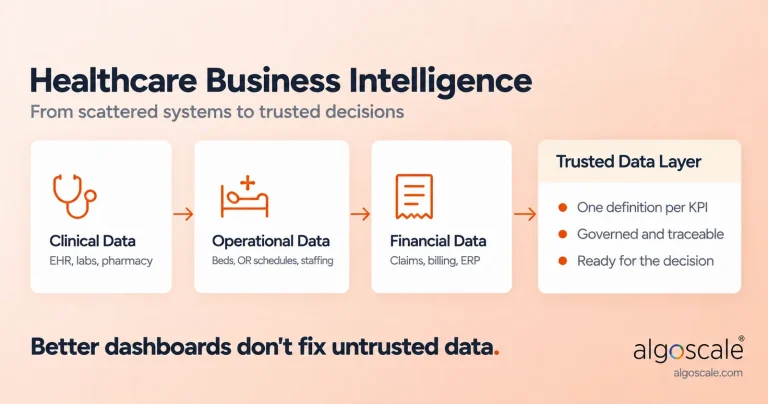



Healthcare organizations generate more data than almost any other industry, and very little of it lives in one place. Electronic health records, medical imaging systems, lab results, pharmacy platforms, wearable devices, and clinical trial systems all produce data constantly, but they rarely talk to each other. The result is a fragmented data landscape where clinicians cannot see a complete patient history, AI models train on incomplete information, and compliance teams struggle to prove where sensitive data has been and who has touched it.
A data lake house solves this by giving healthcare organizations a single, governed platform that holds every data type, structured records, unstructured imaging, streaming device data, while still meeting the strict security and compliance requirements the industry demands.
This guide explains how a data lake house is architected for healthcare, how it secures protected health information, what makes it compliant with HIPAA and other regulations, and how data lake house consulting services help healthcare organizations move from scattered systems to a single, trustworthy data foundation.
What Is a Data Lake House for Healthcare?
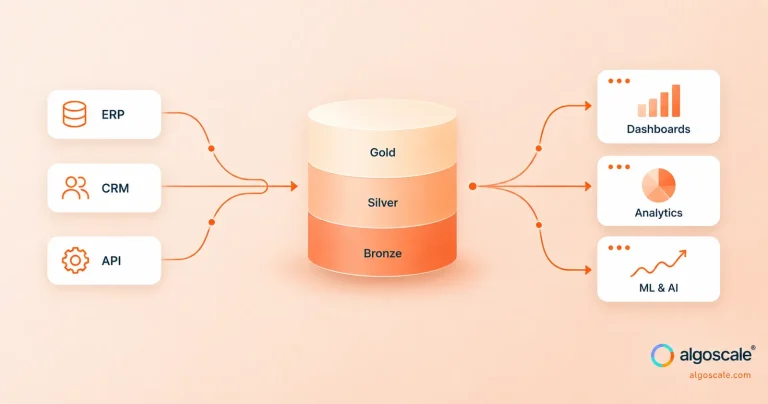
A data lake house, often shortened to lakehouse, is an architecture that layers warehouse style governance, structure, and transactional reliability directly on top of a data lake’s low cost, flexible storage. In a healthcare setting, this means an organization can store electronic health records, DICOM imaging files, lab results, claims data, and device telemetry side by side, in their native formats, while still enforcing strict access control and audit requirements on every byte.
Instead of routing structured billing data into a warehouse, imaging data into a separate archive, and device data into yet another system, a data lake house unifies all of it. Whether the platform runs as an AWS data lake house, an Azure data lake house, or a hybrid setup connecting both, the underlying goal stays the same: one governed source of truth that clinicians, researchers, and compliance teams can all trust.
How a Healthcare Data Lake House Is Architected
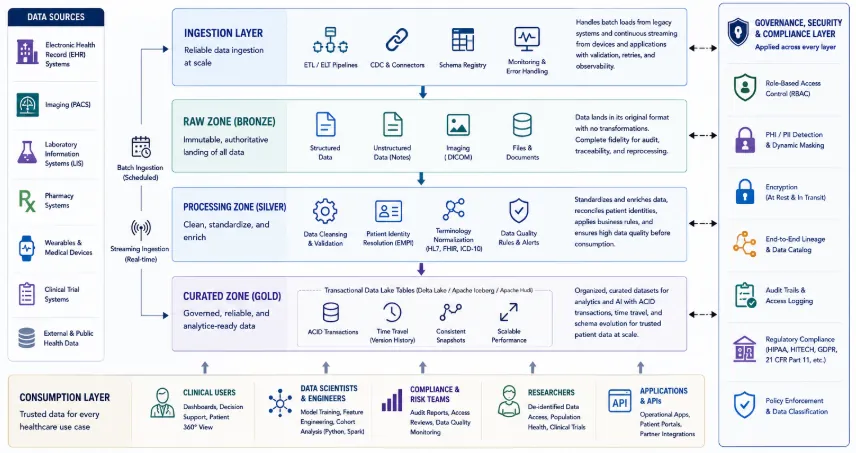
A healthcare data lake house is built in layered zones, with security and compliance controls running across every layer rather than being added at the end.
Ingestion Layer
Data enters from electronic health record systems, picture archiving and communication systems for imaging, laboratory information systems, pharmacy platforms, wearable devices, and clinical trial software. Ingestion pipelines handle both scheduled batch loads from legacy hospital systems and continuous streaming data from bedside monitors and wearables.
Raw Zone
All incoming data lands here in its original format, including unstructured clinical notes and large imaging files. No transformation happens at this stage, which preserves the complete original record, a requirement that matters heavily when audits or legal reviews need to trace data back to its source.
Processing Zone
Here, data is cleaned, standardized, and enriched. Patient identifiers are reconciled across systems, terminology is normalized against standards such as HL7 or FHIR, and automated quality checks flag incomplete or inconsistent records before they reach clinical or analytical use.
Curated Zone With Transactional Reliability
Processed data is organized into governed tables using open formats such as Delta Lake, Apache Iceberg, or Apache Hudi. These formats bring ACID transactions and time travel queries to patient data at scale, which means clinicians and researchers can query a consistent version of a patient’s record even while new data is being written in near real time.
Governance, Security, and Compliance Layer
This layer runs across every zone, not just the curated one. It manages role based access control, PHI and PII detection and masking, encryption at rest and in transit, end to end lineage tracking, and audit trail infrastructure that records every access event. In a healthcare data lake house, this layer is what separates a compliant platform from a liability.
Consumption Layer
At the top, clinicians access dashboards and decision support tools, data scientists train models using Python and Spark, compliance teams pull audit reports, and researchers query de-identified datasets for population health studies, all from the same governed platform.
How a Healthcare Data Lake House Compares to Traditional Architectures
| Dimension | Data Warehouse | Data Lake | Data Lake House |
| Data Types Supported | Structured only (billing, claims) | Structured, semi structured, unstructured (imaging, notes, device data) | All data types, unified |
| Schema Approach | Schema on write (predefined) | Schema on read (applied at query time) | Hybrid: flexible ingestion with enforced structure |
| PHI/PII Handling | Manual masking, limited scope | Inconsistent without active governance | Built in detection, masking, and audit trails |
| Real Time Capability | Limited, batch oriented | Possible with streaming ingestion | Streaming and batch on the same governed tables |
| Compliance Readiness | Strong within structured scope | Requires significant governance investment | Fine grained governance native to the architecture |
| Cost at Scale | High, compute and storage tightly coupled | Low storage cost, variable compute cost | Balanced, optimized storage and compute efficiency |
A data warehouse handles billing and claims reporting well but struggles with imaging files and unstructured clinical notes. A data lake handles volume and variety but needs significant manual effort to meet healthcare grade compliance. A data lake house is the only architecture built to hold every data type a hospital system generates while keeping security and compliance enforced consistently across all of it.
What Makes a Healthcare Data Lake House Database Different
The storage and query layer beneath a healthcare data lake house is what turns raw clinical data into something queryable, versioned, and auditable. Open table formats like Delta Lake, Apache Iceberg, and Apache Hudi sit on top of cloud object storage and add database grade capabilities that matter specifically in regulated environments.
These include ACID transaction support so concurrent updates to a patient record do not corrupt shared tables, time travel queries that let compliance teams reconstruct exactly what a dataset looked like at any past point, schema evolution so new clinical fields can be added without breaking existing pipelines, and fine grained access control down to the row and column level, which is essential when different roles, physicians, billing staff, and researchers, need different views of the same underlying data.
Security and Compliance in a Data Lake House
Security cannot be bolted onto a healthcare platform after the fact, it has to be part of the architecture from day one. A properly built data lake house addresses this through several layers working together.
Encryption is applied both at rest and in transit across every storage tier, whether the deployment sits on an AWS data lake house, an Azure data lake house, or a hybrid cloud data lake house spanning both. Role based and attribute based access controls ensure clinicians, researchers, and administrative staff only see the data relevant to their function. Automated PHI and PII detection scans incoming data and applies masking or tokenization before sensitive fields are exposed to broader analytics use. Lineage tracking records every transformation a dataset undergoes, which is critical when proving data provenance during an audit. Audit trail infrastructure logs every access event, satisfying the kind of detailed reporting that HIPAA, HITECH, and similar frameworks require. Data residency controls keep data within required geographic boundaries when regulations demand it.
Together, these controls allow a healthcare organization to give clinicians and data scientists faster access to data without compromising the protections patients and regulators expect.

Top Benefits of a Data Lake House for Healthcare Organizations
Complete, Trustworthy Patient Records
Clinicians no longer need to search across five different systems to understand a patient’s history. A data lake house consolidates records, imaging, labs, and device data into one queryable view, reducing the risk of decisions made on incomplete information.
Faster, More Accurate AI Models
Diagnostic and predictive models train on complete, governed datasets rather than fragmented exports. This improves accuracy for use cases like early disease detection, readmission risk scoring, and treatment recommendation engines, since the underlying training data better reflects real clinical complexity.
Real Time Patient Monitoring
Streaming ingestion from bedside monitors and wearable devices flows into the same platform as historical records, enabling alerts that surface deteriorating patient conditions before they escalate, rather than after the fact.
Stronger, Centralized Compliance
Instead of enforcing HIPAA and audit requirements separately across dozens of disconnected systems, a data lake house applies governance once, centrally, across all data sources, reducing both compliance risk and the manual effort required to prove it.
Lower Infrastructure Costs at Scale
A cloud data lake house decouples storage from computers, which matters for healthcare systems storing years of imaging and clinical history. Storage costs stay low while compute resources scale only when active analysis or model training is running.
Better Support for Research and Population Health
De-identified, curated datasets become available for population health studies and clinical research without requiring a separate extraction process, shortening the time between a research question and an answer grounded in real patient data.
Healthcare Use Cases for a Data Lake House
Clinical Decision Support
A data lake house unifies labs, vitals, medication history, and prior diagnoses so decision support tools can surface relevant alerts and recommendations to physicians at the point of care, rather than relying on a partial view pulled from a single system.
Medical Imaging and AI Diagnostics
Large imaging files, X-rays, MRIs, and pathology slides, are stored and processed alongside structured clinical data, allowing AI models for radiology and pathology to train on imaging paired with full patient context rather than imaging alone.
Claims and Revenue Cycle Analytics
Billing, claims, and reimbursement data flow into the same governed platform as clinical data, helping finance teams identify denial patterns, reduce billing errors, and accelerate revenue cycle reporting without separate reconciliation work.
Population Health and Clinical Research
Researchers query de-identified datasets spanning thousands of patient records to study disease patterns, treatment outcomes, and intervention effectiveness, supported by the same governance layer that protects identified data elsewhere in the platform.
Remote Patient Monitoring
Wearable and home monitoring device data streams continuously into the platform, supporting chronic disease management programs that depend on catching small changes in patient condition before they become emergencies.
Compliance Outcomes: Before vs After a Healthcare Data Lake House
| Area | Before Data Lake House Adoption | After Data Lake House Adoption |
| Patient Data Visibility | Fragmented across EHR, imaging, and lab systems | Unified, complete view across all sources |
| PHI Protection | Manual, inconsistent masking across systems | Automated detection and masking applied platform wide |
| Audit Readiness | Time consuming manual reconciliation for audits | Automated lineage and audit trails ready on demand |
| AI Model Training Data | Fragmented exports with gaps and inconsistencies | Complete, governed datasets with full clinical context |
| Real Time Monitoring | Limited to siloed device specific systems | Streaming data unified with historical records |
| Infrastructure Cost | High due to duplicate storage across systems | Reduced through decoupled, optimized storage and compute |
Our Data Lake Consulting Services
Algoscale’s enterprise data lake house consulting services are built on one principle: your healthcare data architecture should accelerate clinical and operational decisions, not delay them while still meeting every compliance requirement your organization is held to.
Data Lake Strategy and Architecture Design
We begin by assessing your existing systems, EHR platforms, imaging archives, lab systems, and device feeds, documenting every integration point and the bottlenecks slowing down clinical and research teams. From there, we design a zone based architecture tailored to healthcare workloads rather than imposing a generic template, connected through a unified metadata fabric that keeps the platform coherent as patient volume grows.
Enterprise Data Lake House Implementation
Our implementation work spans multi cloud and hybrid deployments across AWS, Azure, and GCP with a vendor neutral approach. Whether the target environment is an AWS data lake house or an Azure data lake house, we build medallion style architectures for progressive data refinement, configure schema on read flexibility with compliance guardrails, and support both streaming device data and batch clinical record ingestion.
Data Lake Migration and Modernization
Migrating patient data off a legacy platform carries real risk if mishandled. Our approach uses automated ETL to ELT conversion that preserves existing clinical business logic, full historical validation across large patient datasets, and parallel system operation until every record is verified before any legacy system is decommissioned.
Data Governance and Security Implementation
Governance is embedded into the foundation before a single record is ingested. We implement role based and attribute based access controls, automated PHI and PII detection and masking, end to end data lineage, audit trail infrastructure built for HIPAA and HITECH reporting, and data quality frameworks that catch inconsistent records before they reach clinicians or models.
ML and Analytics Enablement
We help healthcare organizations turn unified data into action by building model deployment pipelines for diagnostic and predictive tools, feature stores with versioning for reproducible research, and integration with the BI tools clinical and operational teams already rely on, while supporting real time use cases like patient monitoring alongside batch analytics.
Platform Optimization and Cost Engineering
Healthcare platforms accumulate inefficiency quickly given the size of imaging and device data. We optimize total cost of ownership through intelligent storage tiering for large imaging files, compute auto-scaling, and query tuning, converting data into efficient formats and redesigning partition strategies so queries are not scanning far more data than necessary.
Ongoing Support and Managed Services
As your long term data partner, Algoscale provides round the clock monitoring with proactive issue detection, performance tuning as patient volumes grow, schema evolution management as new data sources are added, and quarterly architecture reviews that keep the platform aligned with evolving clinical and regulatory needs.
Why Choose Algoscale for Healthcare Data Lake House Consulting
Most data lake house consulting services firms sell a platform and call it a strategy. Algoscale architects outcomes built specifically around the compliance pressure healthcare organizations carry every day. With 890 petabytes of production data under management, $47M in cloud cost savings delivered, and 4.8x faster data processing achieved for clients, our track record reflects real execution rather than theoretical frameworks.
Our consultants are platform agnostic. Whether the right fit is an Azure data lake house, an AWS data lake house, GCP Cloud Storage, or a hybrid cloud data lake house, we optimize for long term performance, governance, and patient data protection rather than vendor preference.
We have delivered zero failed audits across SOC2, HIPAA, and GDPR for clients operating in regulated healthcare environments, with architectures supporting platforms that manage millions of patient records under real world clinical load.
What This Means for Healthcare Data Leaders
Healthcare organizations do not need another isolated system, they need one platform that clinicians, researchers, and compliance teams can all trust at the same time. A data lake house gives healthcare leaders a way to unify patient data, accelerate AI and analytics initiatives, and meet strict regulatory requirements without forcing a tradeoff between speed and security.
Connect with Algoscale’s data lake house team to assess your current healthcare data architecture and build a platform that protects patient data while accelerating the decisions built on top of it.