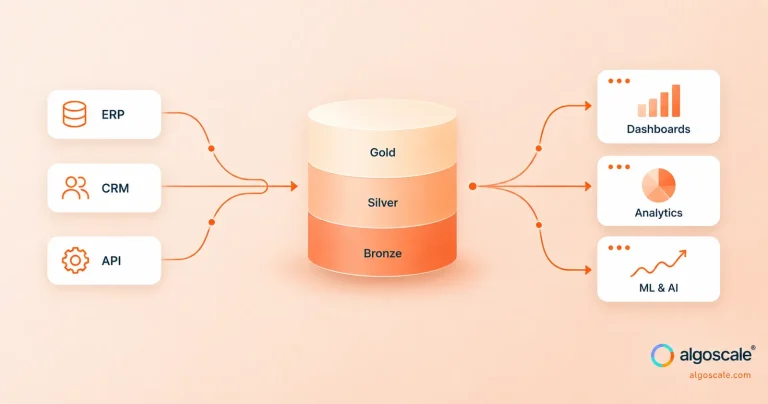


If you run a mid-size or enterprise organization in 2026, disconnected data is one of the most expensive problems you are probably not measuring. Sales numbers live in the CRM. Finance works out of spreadsheets. Operations pulls from a separate ERP. Every team operates on a different version of the truth, and leadership ends up deciding based on whichever report landed in their inbox last.
Data warehouse services solve this problem at the root. A properly architected warehouse consolidates data from across the organization into a single, governed, high-performance environment where every team queries the same source of truth. The payoff: faster decisions, reporting people actually trust, and an analytics foundation that scales as the business grows.
This guide covers what data warehouse services actually include, the core benefits enterprises realize from a structured implementation, and how to assess whether your organization is ready to move.
What Are Data Warehouse Services?
Data warehouse services are professional engagements focused on designing, building, governing, and optimizing centralized data repositories for enterprise analytics and reporting. Unlike ad hoc database setups or scattered departmental data stores, a warehouse is purpose-built for analytical workloads: fast querying across large volumes of historical data, integration from multiple source systems, and governed access for business users at every level.
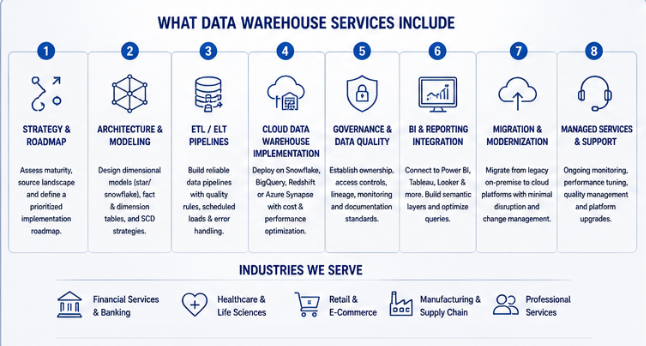
A mature data warehouse consulting services engagement typically spans three connected areas:
Strategic architecture. Assessing the existing data landscape, defining a warehouse schema aligned to reporting requirements, and building a roadmap for integration and long-term platform evolution.
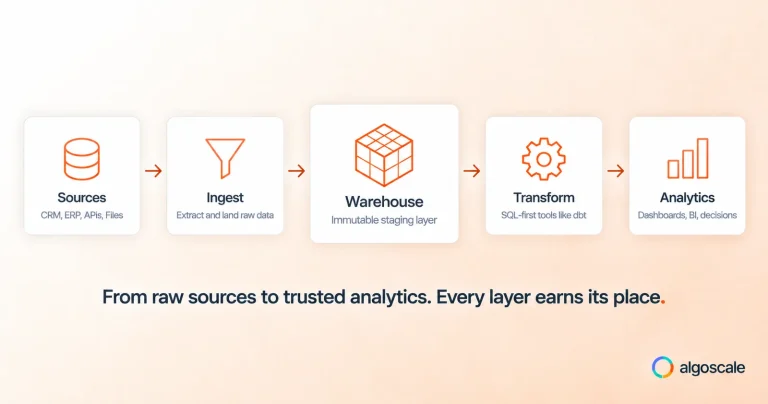
Technical implementation. Building ETL or ELT pipelines, designing dimensional models, configuring cloud infrastructure, and integrating sources ranging from ERPs and CRMs to flat files and third-party APIs.
Governance and operations. Establishing ownership policies, access controls, quality frameworks, refresh schedules, and documentation standards that keep the environment accurate and maintainable over time.
Organizations engage data warehouse solutions providers at different points. Some invest early to lock in a clean foundation before complexity grows. Others arrive after years of organic growth, carrying siloed databases, duplicated reports, and quality issues that have already eroded trust across the business. Both are valid starting points.
What Does a Data Warehouse Consultant Actually Do?
A data warehouse consultant combines technical depth with business context in a way internal teams often cannot replicate on their own. In practice, the role covers:
Current State Assessment. Before designing anything, a qualified consultant audits the existing environment: cataloging source systems, understanding data volumes and velocity, reviewing current ETL processes, and flagging the quality issues, redundancy, and gaps that will affect analytics output.
Schema and Data Model Design. A reliable warehouse rests on a well-designed schema. Consultants build dimensional models using star or snowflake schemas that balance query performance, flexibility, and maintainability. Poor modeling decisions at this stage create performance problems that compound as volumes grow.
ETL and Pipeline Development. Getting data into the warehouse reliably is a serious engineering challenge. Consultants build and tune extraction, transformation, and loading pipelines that survive schema changes, source updates, quality failures, and incremental loads without breaking downstream reporting.
Cloud Infrastructure Configuration. Modern data warehouse solutions run on platforms such as Snowflake, Google BigQuery, Amazon Redshift, or Azure Synapse. Consultants configure compute and storage, optimize for cost and performance, and design for scale from day one rather than bolting it on later.
Governance Framework Design. Data without governance becomes unreliable fast. Cloud data warehouse consulting services define ownership structures, access policies, cataloging practices, and quality monitoring frameworks that keep the warehouse accurate and auditable.
Training and Capability Transfer. Sustainable analytics needs internal capability. Engagements include structured knowledge transfer so your engineers, analysts, and business users can operate the environment confidently once the engagement ends.
Core Data Warehouse Services: What to Expect
Professional data warehouse consulting services cover a defined set of technical and strategic capabilities. A serious data warehouse solutions partner should offer all of the following:
1. Data Warehouse Strategy and Roadmap
Assessment of your current analytics maturity, source landscape, and reporting requirements, delivered as a prioritized implementation roadmap that balances quick wins against long-term architectural goals.
2. Data Architecture and Dimensional Modeling
Design of star or snowflake schemas optimized for analytical workloads, covering fact and dimension table design, relationship management, slowly changing dimension (SCD) strategies, and alignment with your existing or planned data catalog.
3. ETL and ELT Pipeline Development
Build and configuration of pipelines that extract from source systems, apply transformation logic, enforce quality rules, and load into the warehouse on defined schedules, with incremental load strategies and error handling built in.
4. Cloud Data Warehouse Implementation
End-to-end deployment on Snowflake, BigQuery, Redshift, or Azure Synapse, covering infrastructure provisioning, compute optimization, cost governance, and integration with your existing cloud environment.
5. Data Governance and Quality Framework
Establishment of ownership policies, access control structures, quality monitoring, lineage tracking, and documentation standards. This is what eliminates conflicting metrics and builds analytical trust across the organization.
6. BI and Reporting Layer Integration
Connection of the warehouse to downstream BI tools including Power BI, Tableau, Looker, or custom analytics platforms, with semantic layer design, certified dataset creation, and report query optimization.
7. Migration and Modernization
Migration from legacy on-premise warehouses (Oracle, Teradata, SQL Server) to modern cloud platforms, including schema translation, pipeline re-engineering, user training, and change management support.
8. Managed Services and Ongoing Support
Retainer-based support covering pipeline monitoring, performance tuning, quality management, capacity planning, and platform upgrades, suited to organizations that want professional management without a full internal data engineering team.

Top Benefits of Data Warehouse Services for Modern Enterprises
1. A Single Source of Truth Across the Organization
The most immediate benefit of a well-implemented warehouse is the end of data fragmentation and the conflicting reports it produces. When sales, finance, operations, and marketing all query the same governed model, KPI definitions hold, metrics align, and leadership can trust what their dashboards show.
Without this foundation, teams burn hours reconciling spreadsheets before every executive meeting. With it, that time shifts to analysis and decision-making.
2. Faster, More Reliable Business Intelligence
Data warehouse solutions are engineered for analytical query performance. Where transactional databases optimize for row-level reads and writes, a warehouse is built to aggregate, filter, and summarize millions of rows at speed. That translates directly into faster report loads, more responsive dashboards, and complex analyses that finish instead of timing out.
Organizations that move from ad hoc database queries to a structured warehouse consistently report dramatic BI performance gains at scale.
3. Scalability Without Proportional Cost Growth
Cloud data warehouse services run on elastic architectures that scale storage and processing independently. You pay only for the compute you use, scaling up for heavy analytical workloads and down during quiet periods. That is a world apart from on-premise warehouses, where scaling meant procuring hardware months in advance.
For growing enterprises, this means analytics infrastructure that keeps pace with the business without large capital investment cycles.
4. Improved Data Quality and Governance
Every structured warehouse engagement includes a governance layer that self-managed environments almost never have. Quality rules are enforced at the pipeline level before bad data reaches a report, access controls keep sensitive data with authorized users only, and lineage documentation makes every metric traceable to its source.
The result is an analytics environment that is auditable, compliant, and trustworthy, rather than one that needs manual validation before every board presentation.
5. Faster Time to Insight for Business Teams
With a properly structured warehouse, analysts spend far less time extracting, cleaning, and reconciling and far more time generating insight. Self-service analytics becomes genuinely useful instead of a source of inconsistent results, because users query certified, well-documented datasets rather than raw source tables stripped of business context.
6. Support for Advanced Analytics and Machine Learning
A centralized, clean, historical data store is the prerequisite for any serious machine learning or predictive analytics effort. Teams attempting to train models on fragmented, inconsistent sources struggle endlessly with model quality and deployment reliability.
A warehouse provides the governed, historical, properly labeled data that data science teams need to build models that actually perform in production. That makes data warehouse solutions a direct enabler of AI investment, not a separate infrastructure concern.
7. Regulatory Compliance and Audit Readiness
Industries operating under GDPR, HIPAA, SOX, or sector-specific regulations must demonstrate control over where data lives, who accesses it, and how it is used. A governed warehouse delivers the access logs, lineage documentation, sensitivity classification, and retention policies that compliance frameworks demand.
Without that structure, proving compliance at audit time is a manual, expensive exercise. With it, audit evidence is built into the platform from the start.
8. Reduced Operational Costs Over Time
The initial investment in data warehouse consulting services compounds into operational savings. Redundant ETL pipelines get consolidated, duplicated data stores are retired, manual reconciliation disappears, and the analytics team stops firefighting quality issues. Over a 12 to 24 month horizon, most enterprises find a properly structured warehouse costs less to run than the fragmented, self-managed environment it replaced.

Cloud Data Warehouse Services: Key Platform Comparison
Platform selection is one of the most consequential decisions in any warehouse engagement. Each major cloud platform carries distinct strengths, and the right choice depends on your existing cloud footprint, data volumes, and workload patterns.
| Capability | Snowflake | Google BigQuery | Amazon Redshift | Azure Synapse |
| Architecture | Separate compute and storage | Serverless columnar | Managed MPP cluster | Unified analytics platform |
| Pricing Model | Credits per compute second | Per-query or flat rate | Reserved or on-demand | Compute units |
| Best For | Multi-cloud, data sharing | Google ecosystem, ad hoc analytics | AWS-native workloads | Microsoft ecosystem |
| Scaling | Instant elastic scaling | Fully serverless | Manual or auto-scaling | Flexible compute pools |
| Data Sharing | Native secure data sharing | Analytics Hub | Data exchange | Limited native sharing |
| ML Integration | Snowpark, external functions | BigQuery ML built-in | Redshift ML via SageMaker | Azure ML integration |
| Real-Time Support | Snowpipe streaming | Streaming inserts | Kinesis integration | Azure Stream Analytics |
| Microsoft Ecosystem | Connector-based | Connector-based | Connector-based | Native integration |
Not every organization needs the newest or most feature-rich platform. A qualified data warehouse consulting services partner assesses your infrastructure, workload profile, and vendor relationships before recommending a path. The goal is fit, not novelty.
Signs Your Organization Needs Data Warehouse Services
Organizations usually recognize the need for structured data warehouse solutions when one or more of these situations turns chronic:
Different teams report different numbers. When sales and finance disagree on revenue and neither can explain why, the cause is almost always fragmented sources with transformation logic applied inconsistently at the report level instead of centrally.
Analytics queries are slow or unreliable. Reporting directly off transactional databases hurts everyone. Source systems slow down, analysts wait minutes for results, and dashboards time out under normal load.
Data preparation consumes most of the analytics team’s time. When engineers and analysts spend the majority of their hours extracting, cleaning, and reconciling before any analysis begins, the problem is a missing warehouse layer, not headcount.
Leadership does not trust the dashboards. If executives routinely cross-check reports against personal spreadsheets before deciding, analytical credibility is already gone. Rebuilding it requires a structural fix, not a prettier visualization tool.
Compliance reviews are painful and manual. Without centralized lineage and access documentation, every audit becomes a weeks-long manual exercise. This is a governance problem that warehouse infrastructure addresses directly.
You are scaling rapidly. Acquisitions, international expansion, and product line growth all demand data infrastructure that scales without creating fresh fragmentation. Building the warehouse foundation during a growth phase is far easier than retrofitting it afterward.
Data Warehouse Services Across Industries
Effective data warehouse consulting services are shaped by the data structures, compliance requirements, and reporting priorities of each sector:
Financial Services and Banking. Financial institutions run regulatory reporting, risk aggregation, customer profitability analysis, and fraud detection through the warehouse. Engagements focus on lineage, audit trail completeness, row-level security, and integration with core banking systems and market data feeds.
Healthcare and Life Sciences. Healthcare organizations deploy warehouses for patient outcome analytics, operational reporting, claims analysis, and clinical research. Cloud data warehouse consulting services here address HIPAA-compliant access controls, EMR integration, and longitudinal data models serving both operational and research needs.
Retail and E-Commerce. Retailers unify POS, e-commerce, inventory, CRM, and supply chain data into models that drive merchandising, demand forecasting, and customer analytics. The consulting challenge is source diversity plus the transaction volumes that must be processed reliably.
Manufacturing and Supply Chain. Manufacturers track production performance, quality control, supplier performance, and equipment maintenance forecasting through the warehouse. Engagements emphasize near-real-time integration from operational systems and models that plant managers can query without engineering support.
Professional Services. Consulting, legal, and advisory firms analyze project profitability, utilization, pipeline, and client engagement through the warehouse. The core implementation challenge is integrating PSA tools, CRM platforms, and financial systems into one consistent reporting layer.
How to Evaluate a Data Warehouse Consulting Partner
The market is broad and the quality gap between vendors is wide. These criteria separate serious practitioners from general-purpose implementers:
| Evaluation Criterion | What to Look For | Red Flags |
| Technical Depth | Demonstrated expertise in dimensional modeling, ETL engineering, and cloud platform configuration | Jumping to implementation with no assessment phase |
| Platform Certifications | Snowflake, dbt, AWS, Google Cloud, or Azure data certifications | Only generic cloud badges, no data-specific credentials |
| Governance Expertise | Experience building data catalogs, access control frameworks, and quality monitoring | Talking only about pipeline speed, never governance |
| Industry Experience | Case studies or references from your sector | Generic portfolio with no vertical context |
| BI Layer Integration | Connects the warehouse to your reporting tools with certified semantic layers | Treats BI integration as out of scope |
| Migration Track Record | Proven legacy-to-cloud warehouse migrations | Only greenfield references |
| Post-Delivery Support | Defined managed services or retainer model | No post-project support offering |
| AI and Advanced Analytics Readiness | Understands how warehouse architecture shapes downstream ML and analytics | No awareness of how data modeling affects model quality |
In-House vs. Outsourced Data Warehouse Consulting
The build-versus-engage question comes up in nearly every organization. The right answer depends on scale, urgency, and internal maturity, and the trade-offs are real:
| Factor | In-House Team | External Data Warehouse Consultant |
| Time to Productivity | 3 to 6 months minimum for hiring and onboarding | Deployable within days to weeks |
| Cost Profile | Fixed salary, benefits, and ongoing training | Variable cost aligned to project scope |
| Breadth of Expertise | Typically strong in one or two areas | Full stack: architecture, modeling, pipelines, governance, migration |
| Governance Knowledge | Built incrementally through internal experience | Established frameworks from multiple enterprise deployments |
| Platform Currency | Dependent on self-directed learning | Continuous exposure across diverse client environments |
| Scalability | Limited by headcount and hiring timelines | Scales up or down by project phase and demand |
| Knowledge Transfer | Knowledge stays in-house long-term | Requires structured handoff and documentation at close |
| Risk of Attrition | High if a key engineer or architect leaves | Low, team-based delivery with documented environments |
| Best Suited For | Sustained, high-volume data engineering work | Platform transitions, greenfield builds, capability gaps |
For most enterprises, the hybrid model works best: an external partner establishes the architecture, governance framework, and best practices, while internal staff are trained to handle day-to-day operations and incremental development going forward.
What Algoscale Delivers as a Data Warehouse Services Partner
Algoscale is a specialist data and analytics firm with data warehouse consulting engagements delivered across financial services, healthcare, retail, manufacturing, and professional services. Our approach to data warehouse solutions rests on four commitments:
Assessment Before Architecture. Every engagement opens with structured discovery: a review of your existing data infrastructure, source landscape, reporting requirements, and governance maturity. We do not design solutions before we understand problems.
Enterprise-Grade Data Modeling. Our consultants specialize in dimensional modeling, ETL and ELT pipeline engineering, and cloud platform configuration. We build models that perform at scale, support self-service analytics without opening governance risk, and remain maintainable by your team after handoff.
Governance That Holds Up in Practice. We design ownership structures, certification workflows, and access policies built for how your organization actually operates, frameworks teams follow because they work, not because documentation says so.
Cloud Data Warehouse Consulting Services Across Leading Platforms. With deep expertise across Snowflake, BigQuery, Redshift, and Azure Synapse, we help organizations select the right platform, plan low-disruption migrations, and architect environments that serve current reporting needs while supporting future advanced analytics initiatives.
Every engagement ships with full documentation, knowledge transfer sessions, and optional managed services support, so your team is never dependent on us indefinitely.
The Real Return on a Data Warehouse Investment
The benefits in this guide compound rather than stack. A single source of truth makes BI faster, faster BI makes self-service viable, governed self-service frees the analytics team, and a free analytics team finally has the bandwidth to support AI initiatives the business has been postponing for years. The warehouse is the one investment that unlocks all of the others.
What separates organizations that capture this return from those that do not is rarely the platform. It is the discipline of the implementation: assessment before architecture, governance from day one, and a partner who measures success by what your team can run independently after they leave.
If your organization is weighing a data warehouse investment, planning a platform migration, or trying to restore trust in its reporting, connect with the Algoscale team to discuss your data environment and the path that fits it.