

When founders invest in data warehouse services, they are not simply purchasing pipelines and schemas. They are buying something far more valuable: the ability to walk into a board meeting, an investor update, or a Monday leadership sync and trust that every number on the screen reflects a single, consistent version of reality.
That confidence is harder to come by than it sounds for a fast-moving startup. Most high-growth companies already have some data infrastructure in place: product analytics, a CRM full of customer data, a billing system processing revenue, and a handful of dashboards that someone built six months ago. What they often lack is the architectural foundation, governance structure, and strategic oversight that turns a collection of disconnected tools into a reliable, scalable analytics platform.
This is the gap that modern data warehouse services are designed to close not by adding more tools, but by ensuring the data a startup depends on for product decisions, board reporting, and fundraising is clean, unified, governed, and aligned to how the business actually operates.
What Founders Actually Get from Data Warehouse Services
When a startup invests in data warehouse consulting services, the visible output pipelines, schemas, dashboards is only part of the value. The more important deliverables are structural and strategic.
A Single Source of Truth Across a Fast-Moving Team
One of the most common and most costly data problems in early and growth-stage companies is conflicting numbers. The product team reports a different activation rate from the one in the investor deck. Sales pulls a different revenue figure from finance. Marketing calculates customer acquisition cost differently from the operations team.
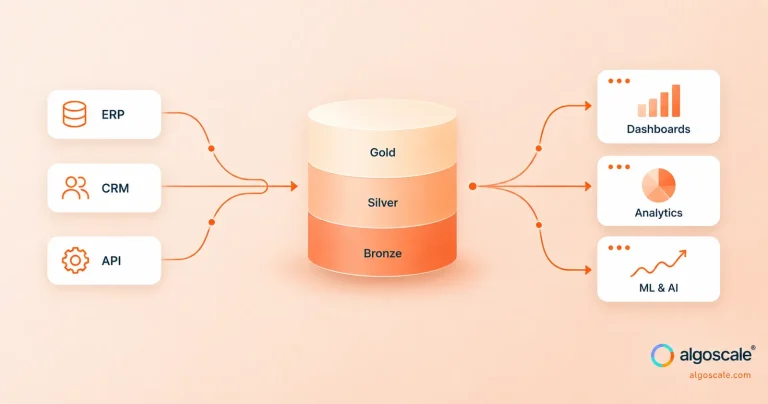
A properly executed data warehouse engagement resolves this by building a certified, centralised data layer, a single governed repository that every team’s reports draw from. When everyone is working from the same definitions, the debates about whose numbers are right stop happening, precisely when the company can least afford that distraction.
Analytics Infrastructure That Scales With the Business
Many startups reach a point where every new reporting request requires an engineer. Pipelines built quickly during the early days become too fragile to modify. Adding a new payment processor, a new market, or a new product line breaks something downstream.
A data warehouse consulting engagement redesigns the architecture so the platform scales as the business grows. New teams, new data sources, and new use cases can be absorbed without rebuilding from scratch every time the company reaches its next stage.
AI and ML Readiness Built Into the Foundation
Startups building AI-driven features or exploring machine learning in 2026 are discovering that model quality is a direct function of data quality. Inconsistent, siloed, or ungoverned data produces unreliable model outputs, regardless of how skilled the modelling team is.
A properly structured data warehouse service provides the clean, unified, well-documented data layer that every AI or ML initiative on the roadmap depends on. Investing in the warehouse early is, in effect, investing in the entire AI agenda at the same time.
The Four Phases of a Well-Run Data Warehouse Engagement
Not all data warehouse consulting engagements are structured the same way, but the most consistently successful ones follow a four-phase delivery model. Understanding these phases helps founders set expectations, ask the right questions when evaluating a partner, and recognise when a proposed engagement is missing critical steps.
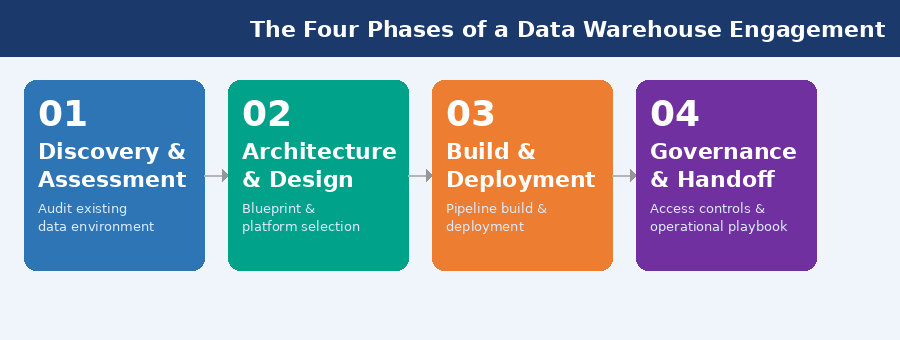
Phase 1 – Discovery and Assessment
Before any development begins, a qualified consultant conducts a structured audit of the existing data environment. This includes:
- Inventorying current data sources, pipelines, and reporting layers
- Reviewing data model quality and governance posture
- Assessing platform and licensing utilisation
- Speaking with founders and team leads to understand the metrics that actually drive decisions
The output is a written findings report not a sales deck with scored gaps and a scoped delivery plan.
Phase 2 – Architecture and Design
Based on discovery findings, the architecture phase produces the blueprint: platform selection (Snowflake, BigQuery, Redshift, Azure Synapse, or Microsoft Fabric), schema design, data modelling approach, pipeline architecture, and a lightweight governance framework appropriate for the company’s stage.
This phase defines the standards that all subsequent development follows. Skipping or compressing it is the leading cause of warehouse environments that need a costly redesign within 18 months, exactly the kind of rework a growing startup cannot afford.
Phase 3 – Build and Deployment
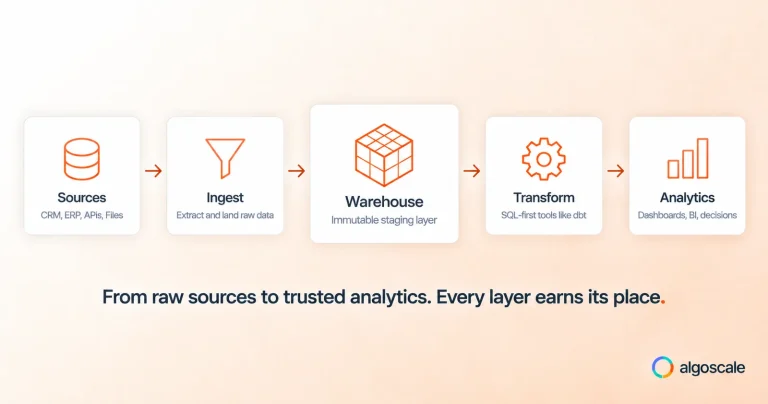
The build phase covers the actual development work: data ingestion pipeline construction, schema and data model implementation, transformation logic, access provisioning, and performance optimization. All development should follow the standards established in the architecture phase. Quality checkpoints at the end of each build sprint, not just at final delivery, are the hallmark of a disciplined cloud data warehouse services provider.
Phase 4 – Governance and Handoff
Governance is the most frequently deferred component of a data warehouse engagement. Startups that skip it end up with ungoverned environments, security gaps, and conflicting reports within months of delivery often right as they are preparing for a fundraise or an enterprise customer’s security review. A thorough handoff includes access control matrices, data lineage documentation, sensitivity labelling policies, and an operational playbook the internal team can run independently.
The Business Case: ROI Signals from Data Warehouse Services
Founders evaluating data warehouse services often ask the same question investors ask: how does this pay for itself? The answer depends on the company’s current data environment, but the following ROI signals are consistently seen after a well-executed engagement.

| ROI Signal | Typical Baseline Problem | Post-Engagement Outcome |
|---|---|---|
| Reduced time to insight | Analysts and founders spend most of their time preparing and reconciling data rather than analysing it | Unified semantic layer reduces data preparation time by 40–60% |
| Lower infrastructure cost | Overspend on unoptimised cloud compute or duplicated tools across teams | Architecture review typically identifies 20–35% cost reduction opportunities |
| Faster decision making | Leadership waits days for specific metric breakdowns ahead of board meetings | Self-service analytics model enables same-day access to most queries |
| Fewer data disputes | Meetings regularly derailed by conflicting numbers from different teams | Single certified data layer eliminates definition conflicts across the company |
| AI initiative success | ML and AI features fail or produce unreliable outputs due to fragmented data | Clean, governed, unified data foundation enables reliable model training and deployment |
| Reduced developer dependency | Every new report or data request requires an engineer | Governed self-service model enables founders and analysts to build independently |
| Investor and board readiness | No consistent source for the metrics that appear in fundraising decks | Governed warehouse provides consistent, auditable numbers across every deck and update |
Comparing the Leading Cloud Data Warehouse Platforms
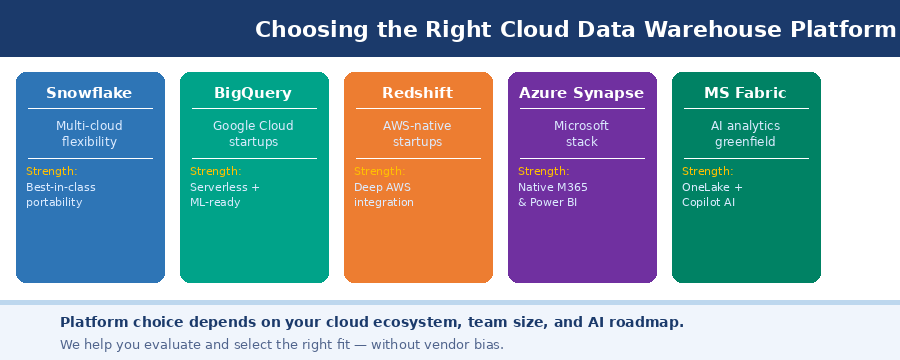
One of the most consequential decisions in a data warehouse engagement is platform selection. Each of the leading cloud data warehouse platforms has distinct strengths, pricing models, and ecosystem fit. Here is how the primary platforms compare for a growing startup.
| Platform | Best Fit | Strengths | Considerations | Pricing Model |
|---|---|---|---|---|
| Snowflake | Multi-cloud startups needing platform-agnostic flexibility | Best-in-class multi-cloud portability, strong data sharing ecosystem, mature governance | Higher per-query cost at scale; worth monitoring as usage grows | Credits-based consumption pricing |
| Google BigQuery | Startups already on Google Cloud needing serverless scale | Serverless architecture, strong ML integration via Vertex AI, no infrastructure management | Less native fit for Microsoft or AWS ecosystems | Pay-per-query or flat-rate slots |
| Amazon Redshift | AWS-native startups with growing data volumes | Deep AWS service integration, strong performance at scale, mature tooling | Tight AWS dependency; less optimal outside the AWS ecosystem | Reserved or on-demand node pricing |
| Azure Synapse Analytics | Startups built on the Microsoft stack (M365, Power BI) | Native Azure integration, unified analytics and warehousing, strong Power BI connectivity | Best value within the Microsoft ecosystem; less compelling outside it | Pay-per-query plus dedicated pool options |
| Microsoft Fabric | Greenfield builds or Microsoft-mature startups pursuing AI analytics | Unified OneLake architecture, Copilot AI integration, eliminates data duplication | Newer platform; migration planning matters if moving from an existing warehouse | Capacity-based F-SKUs, inclusive of Power BI Premium |
| Databricks Lakehouse | Startups blending heavy data engineering with ML and AI workloads | Best-in-class for data science pipelines, unified lakehouse architecture | Higher implementation complexity; benefits from strong internal engineering capability | DBU consumption pricing |
Comparing Data Warehouse Engagement Models
Founders evaluating cloud data warehouse services have several engagement model options. The right model depends on the company’s data maturity, the urgency of its needs, and its internal capacity to manage ongoing operations.
| Engagement Model | Best For | Structure | Risk Profile | Algoscale Approach |
|---|---|---|---|---|
| Fixed Scope Project | A defined deliverable new implementation, migration, or platform audit | Milestone-based delivery with fixed scope and defined outputs | Low, with clear deliverables and payment triggers | Discovery → Architecture → Build → Governance → Handoff, each phase with sign-off |
| Ongoing Development Retainer | Startups with evolving data needs and limited internal engineering capacity | Monthly consulting hours applied to a managed backlog of requests | Medium, requires active backlog management | Dedicated delivery team with sprint cycles, backlog review, and monthly reporting |
| Managed Services | Post-implementation environment management without building an internal data team | SLA-based monthly service with defined scope and response times | Low, with predictable cost and accountability | Tiered service levels covering environment health monitoring, incident response, and enhancement SLAs |
The Most Common Data Warehouse Mistakes Startups Make
Founders who have been through a poorly executed data warehouse engagement often describe the same set of mistakes. These are not technical failures they are structural and decision-making failures that produce entirely predictable outcomes.

| Selecting on price rather than capabilityThe cheapest vendor is rarely the least expensive option once you account for the cost of fixing what they build. Pipelines that need redesign, governance frameworks that were never implemented, and warehouse environments nobody can maintain all carry a remediation cost that typically exceeds the original savings. We would kindly encourage founders to evaluate capability first and use price as a tiebreaker between qualified candidates. |
| Skipping or rushing the discovery phaseStartups under time pressure often want to begin development immediately. This reliably produces scope creep, missed requirements, and architecture decisions made without full information. A proper discovery phase takes two to four weeks and saves multiples of that time in avoided rework later. |
| Treating governance as optionalGovernance is the most frequently deferred component of a data warehouse engagement. Startups that skip it end up with ungoverned environments, security gaps, and conflicting reports within months of delivery — often right as they are preparing for a fundraise or an enterprise customer’s security review. |
Industry-Specific Considerations for Founders
The core disciplines of data warehouse services apply across industries, but the specific priorities, compliance requirements, and data patterns vary by sector. We would encourage founders to ensure their consulting partner has relevant industry experience, not just generic data engineering capability.
| Industry | Primary Use Cases | Key Compliance / Data Requirements | What to Verify in a Consultant |
|---|---|---|---|
| Fintech & Financial Services | Risk reporting, transaction analytics, cost attribution, regulatory reporting | SOX and financial data lineage requirements, audit trails, role-based access | Experience with financial data models and integration with payment and banking systems |
| Healthtech | Patient outcome reporting, operational efficiency, clinical analytics | HIPAA-compliant access controls, PHI data handling, EMR integration | HIPAA implementation experience and familiarity with HL7/FHIR data patterns |
| E-Commerce & DTC | Sales performance, inventory management, customer behaviour analytics | PCI DSS for payment data, multi-region reporting, high data volumes | Experience integrating POS, ERP, CRM, and e-commerce platforms into unified models |
| SaaS & B2B Software | Product usage analytics, retention and churn analysis, pipeline and revenue reporting | Multi-tenant data modelling, usage-based billing data accuracy | Experience with product analytics tools, CRM integration, and SaaS metric frameworks |
| Marketplace & On-Demand | Supply and demand analytics, marketplace economics, operational efficiency | Multi-sided data modelling, near real-time operational reporting | Experience with two-sided marketplace data models and operational dashboards |
| Insurtech | Claims analytics, underwriting performance, policy reporting | Actuarial data precision, regulatory reporting, sensitive claims data | Insurance domain knowledge and experience with policy and claims data models |
On-Premises vs Cloud Data Warehouse: The Decision Every Founder Needs to Understand
One of the questions founders most frequently raise with data warehouse consulting providers in 2026 is whether they need on-premises infrastructure at all or whether they should move directly to cloud data warehouse services, and if so, which platform. For a high-growth startup, this deserves a clear, unbiased answer rather than a sales pitch.
| Scenario | Recommended Path | Why |
|---|---|---|
| You are running on a patchwork of spreadsheets and disconnected tools | Move directly to cloud data warehouse services as the foundation | Cloud-native architecture is better suited for greenfield builds than assembling on-premises infrastructure |
| You have some pipelines and a basic warehouse but it cannot keep up with growth | Architecture review and rebuild on a scalable cloud platform | A redesigned foundation now avoids a much larger rebuild after the next funding round |
| You are a Microsoft-ecosystem startup (M365, Azure, Power BI) | Azure Data Warehouse via Synapse Analytics or Microsoft Fabric | Native integration across the Microsoft stack reduces cost and governance complexity |
| You need multi-cloud portability and platform-agnostic flexibility | Snowflake | Best-in-class multi-cloud architecture with strong data sharing capabilities |
What Algoscale Delivers for High-Growth Startups
Algoscale is a specialist data and analytics firm. Data warehouse services are not a capability we added to a broader portfolio; they are a core discipline delivered by consultants who work exclusively in data architecture, warehouse engineering, and analytics governance.
Transparent scoping with no surprises
Every Algoscale engagement begins with a discovery phase that produces a written findings report and a milestone-based delivery plan. We do not propose solutions before we understand your environment. Founders receive a clear cost structure, defined outputs per phase, and a change control process before development begins.
Architecture built for the long term
Our data warehouse consulting team designs data models, pipeline architectures, and governance frameworks for where your company is heading, not just for where it is today. We build to the scale your organisation will reach over the next funding cycle, not only what is needed on delivery day.
Governance that actually gets implemented
Governance is not a final slide in our delivery deck. It is a structured phase with defined deliverables: access control matrices, data lineage documentation, sensitivity labelling policies, and an operational playbook your internal team can run independently.
Building the Right Foundation at the Right Time
For a high-growth startup, the choice is not whether to eventually build a solid data foundation, it is whether to build it now, while the company is still small enough to do it right, or later, after the cost of fragmentation has compounded.
The startups that invest in data infrastructure early arrive at their Series B or Series C with clean, auditable metrics, self-service analytics their teams actually trust, and an AI-ready data layer that accelerates every initiative on the product roadmap. Those that defer it spend precious engineering time firefighting data quality issues and reconciling reports at exactly the moments when clarity matters most.
Choosing a partner with the architecture depth, governance commitment, and knowledge transfer discipline to build it right the first time is what makes the difference. We would be genuinely glad to help your team take that step thoughtfully, transparently, and at a pace that works for your business.