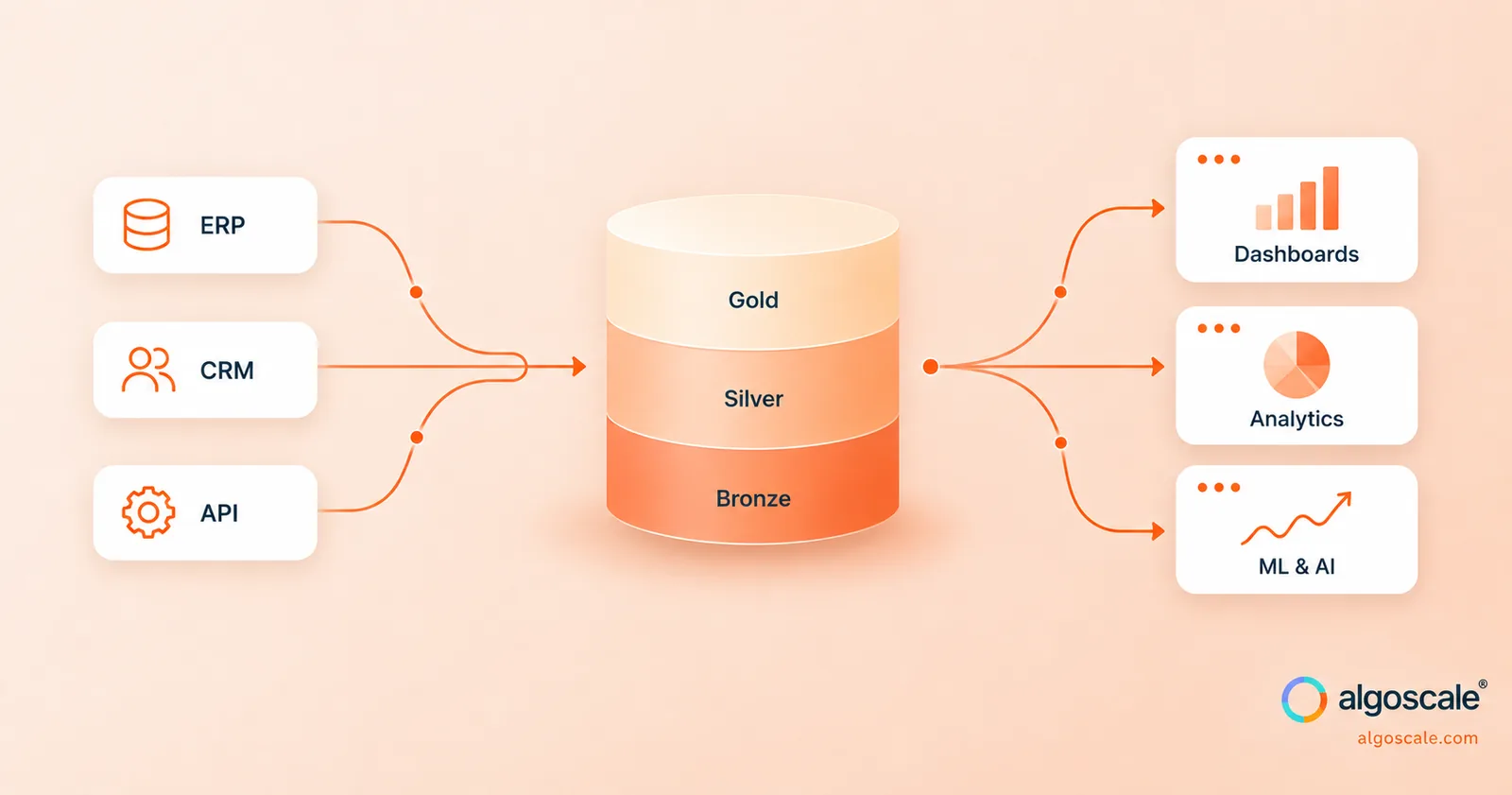


Data Science is the process of collecting, organizing, and analyzing data to understand what is happening and to make better decisions for the future.
In a more descriptive way, data science helps turn large amounts of raw data—like customer information, sales records, or website activity—into meaningful insights that businesses and organizations can actually use.
The Data Science Lifecycle
Data science follows a series of steps to transform data into insights that analysts can rely on. These combine processes, tools, and roles, as discussed below:
1. Data Ingestion
This involves data collection from raw structured and unstructured data formats from all relevant sources, including customer data, IoT data, files, audio, and pictures, using methods like web scraping, manual entry, and real-time streaming.
2. Data Storage and Processing
Different storage systems are required for data based on each company’s data format and structures. Analytics, deep learning, and ML workflows are facilitated by data storage standards implemented by data management experts. Data cleaning, deduplication, transformation also happens at this stage, before it is combined using ETL data pipelines. This lays the groundwork for storing the data in a central repository like a data lake, data warehouse, or data lakehouse.
3. Data Analysis
Data analysis helps data scientists understand the ranges, distribution of values, patterns, and biases within data and determine where this data would be most useful for modeling- machine learning, predictive analytics, or deep learning.
4. Feature Engineering
This is when raw data is transformed into meaningful inputs for models. The transformation process includes handling missing values, scaling features, and encoding categorical variables for improving model performance.
5. Model Building
At this stage of the data science lifecycle, the prepared data is used to train machine learning algorithms. Based on the business use case and problem, the models are tested for the best fit. Here, models learn from data to deliver accurate predictions.
6. Model Evaluation
This is when model performance is tested on unseen data. Performing well on familiar or training data does not guarantee real-world effectiveness. Useful metrics for assessing model performance here include accuracy, precision, recall, and F1-score.
7. Deployment
At this stage, the trained model is deployed into real-world applications. Users can now access it to make data-driven decisions.
8. Communication with Data Visualization
This is where the insights are presented to business users through data visualization techniques. This is when all team members access insights for decision making.
Benefits of Data Science
Discussed below are the benefits of data science:
- Improved Decision Making: Data science replaces guesswork with facts and data for decision-making. It helps businesses identify meaningful patterns from historical data and make accurate predictions to guide their decisions for operations, customer service, inventory, and supply chain optimization.
- Hyper-Personal Experiences: Today’s customers want a version of a digital product most relevant for them. Data science makes this possible with machine learning algorithms that closely learn from customers’ viewing, listening, or shopping choices and deliver personalised experiences across Netflix, Spotify, and Amazon.
- Predictive Analytics: This is one of the biggest benefits of implementing data science. Businesses can proactively adapt to the needs of tomorrow and stay prepared with powerful predictive analytics enabling trends and demand forecasting.
- Industry Wide Application: From customer segmentation, recommendation systems, fraud detection, risk analysis, improved patient care and so on, data science has extensive use cases across all industries, including retail, streaming services, financial services, and healthcare.
- Automation: Enterprises can substantially rely on intelligent models extensively trained to make better decisions. Human intervention is only required for expertise-oriented tasks, while data science works behind the scenes to ensure all team members can focus on what truly matters.