

In today’s dynamic digital environment, businesses, especially startups and scaling enterprises, need strategic tech leadership without the overhead of hiring a full-time executive. That’s where the concept of a Fractional CTO (Chief Technology Officer) comes into play. A Fractional CTO offers high-level technical expertise on a part-time or contract basis, helping companies make informed technology decisions, drive innovation, and align IT efforts with overall business goals. This model has gained significant traction due to its flexibility, scalability, and cost-effectiveness.
As businesses increasingly prioritise agility and lean operations, the demand for such roles is projected to rise in 2025. In this blog, we’ll explore everything you need to know about Fractional CTOs, their benefits and pricing models to when and how to hire one for your business. Whether you’re building your first MVP or scaling your product roadmap, a Fractional CTO might just be the strategic edge your team needs.
What is Fractional CTO?

A Fractional CTO (Chief Technology Officer) is a senior technology executive who offers strategic leadership and technical oversight to a company on a part-time, contract, or interim basis. Unlike a full-time CTO, a fractional CTO works with multiple organisations simultaneously or is engaged for a defined period, making it a highly flexible and cost-effective model.
Their core responsibilities typically include defining the technology roadmap, ensuring alignment between IT and business goals, managing development teams, evaluating tech stack decisions, and overseeing innovation initiatives.
For startups and growing businesses that may not yet require or be able to afford a full-time CTO, a fractional CTO provides access to top-tier expertise without the long-term financial commitment. This model enables organisations to drive digital transformation, strengthen tech infrastructure, and stay competitive in an ever-evolving landscape while maintaining budget efficiency and operational agility.
Responsibilities of a Fractional CTO

As businesses scale and technology becomes increasingly central to operations, the role of a Fractional Chief Technology Officer (CTO) emerges as a strategic asset for SaaS and best machine learning companies. Acting as a part-time executive, a Fractional CTO bridges the gap between business goals and technical execution without the overhead of a full-time hire. Below are some of the prime responsibilities of a Fractional CTO.
1. Technology Strategy Development
A fractional CTO defines and implements a scalable technology roadmap that aligns with the organisation’s business goals. This includes evaluating current systems and identifying opportunities for digital transformation.
2. Team Leadership and Mentorship
They oversee internal development teams, foster best practices, and build a high-performing engineering culture. In the context of team extension for SaaS companies, they also ensure seamless collaboration between in-house and extended teams while mentoring junior tech leaders to maintain continuity and facilitate knowledge transfer.
3. Tech Stack Evaluation and Optimisation
The CTO assesses and selects appropriate technologies, tools, and frameworks to ensure scalability, maintainability, and performance. They also guide decisions around architecture and third-party integrations.
4. Security and Risk Management
A fractional CTO ensures the company’s tech infrastructure adheres to compliance standards and security best practices. They proactively identify vulnerabilities and implement risk mitigation strategies.
5. Budgeting and Vendor Management
They optimize technology spend by defining budgets, negotiating contracts, and managing relationships with vendors and technology partners. This helps maximise ROI on tech investments.
6. Innovation and Competitive Advantage
By staying up to date with emerging technologies, a fractional CTO introduces innovative solutions that give the business a competitive edge. They help position the company as a tech-forward player in its industry.
Why is a Fractional CTO Required for Your Business?

Modern businesses need expert tech leadership without overextending resources especially in the form of team extension. A fractional CTO offers the right balance of strategy, scalability, and cost-efficiency. Some of the major reasons that make a fractional CTO important for your business have been stated below:
1. Helps to Make Your Ideas a Reality
A fractional CTO plays a critical role in converting visionary concepts into viable technological solutions. By leveraging deep domain expertise and strategic insight, they translate abstract ideas into actionable development plans, ensuring your product or platform is both technically feasible and aligned with market demands. Their involvement minimises the risk of missteps and accelerates time-to-value for innovation-driven businesses.
2. Helps to Find and Solve Technical Issues
In today’s fast-paced development environment, even minor technical bottlenecks can derail entire project timelines. A fractional CTO proactively identifies architectural flaws, performance constraints, and integration issues through systematic reviews and hands-on collaboration. Their ability to swiftly troubleshoot and recommend scalable solutions ensures consistent project momentum and system reliability.
3. Helps to Plan a Project
Effective project planning is a cornerstone of successful technology execution. A fractional CTO provides detailed technical roadmaps, prioritises deliverables, and aligns cross-functional teams with business objectives. Their leadership ensures each phase, from discovery to deployment, is strategically structured to mitigate risk, control budget, and meet critical milestones.
4. Helps to Scale Your Project
As your business grows, so must your technology infrastructure. A fractional CTO helps architect scalable systems that can handle increasing user loads, data growth, and operational complexity without compromising performance. Whether it’s cloud migration, microservices implementation, or DevOps integration, they ensure your tech foundation grows in step with your business.
If you’re planning to scale but lack the in-house expertise to navigate technical complexities, Algoscale’s seasoned fractional CTOs offer more than just advice. They bring hands-on leadership, deep technical acumen, and a strategic mindset to drive your vision forward. From designing scalable architectures to leading cross-functional engineering teams, our professionals seamlessly integrate into your workflows to deliver measurable growth.
5. Helps Prepare a Project Pitch for Your Organisation
Communicating technical value to stakeholders is vital for securing internal buy-in and investment. A fractional CTO supports this by translating complex architectures and technical plans into compelling, executive-level presentations, often structured as a pitch deck. They articulate ROI, competitive advantage, and scalability in a language business leaders understand, making your pitch not just clear but convincing.
6. Audit your Tech Projects Regularly
Continuous assessment ensures long-term project health and alignment with evolving business goals. A fractional CTO conducts regular technical audits, reviewing code quality, system performance, security protocols, and compliance. These audits help identify inefficiencies early, reduce technical debt, and keep the project roadmap aligned with strategic objectives.
7. Helps to Solve Your Everyday Problems
From workflow optimisations to addressing team-level challenges, a fractional CTO becomes your go-to problem-solver. They bring a high-level perspective while remaining embedded in daily operations, enabling quick decisions that keep development on track.
Whether you’re navigating technical uncertainty or need a reliable partner to steer your IT direction, Algoscale provides seasoned fractional CTOs who are ready to tackle your everyday challenges with precision and expertise.
Difference Between a Fractional CTO and a Full-Time CTO
Below is a tabulated comparison highlighting the major differences between a fractional CTO and a full-time CTO.
| Aspect | Fractional CTO | Full-Time CTO |
| Engagement Model | Part-time or project-based engagement; brought in for specific strategic needs. | Fully employed by the organisation with long-term strategic and operational roles. |
| Cost Structure | Cost-efficient; businesses pay only for the time or services required. | Higher cost due to full-time salary, benefits, and other employment overheads. |
| Flexibility | Offers greater flexibility in scaling involvement up or down based on business needs. | Fixed schedule and responsibilities; less adaptable to short-term changes. |
| Expertise Access | Brings diverse experience across industries; ideal for startups or scaling phases. | Deeply involved in one organisation’s operations, often with limited external exposure. |
| Speed to Impact | Quickly contributes to high-level decisions with minimal ramp-up time. | May require more time to integrate and build internal strategies from the ground up. |
Benefits of Hiring a Fractional CTO
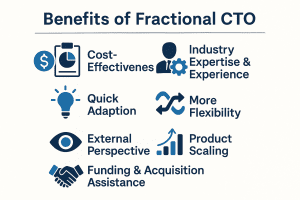
From cost-effectiveness to product scaling and more, a fractional CTO offers an umbrella of benefits for businesses of all sizes. Some of the benefits offered by a fractional CTO have been provided below:
1. Cost-Effectiveness
Hiring a fractional CTO allows organisations to gain high-level strategic and technical leadership without the financial commitment of a full-time executive. Especially for startups and mid-sized businesses, this model eliminates costs related to full-time salaries, benefits, and long-term overheads, offering an ideal solution for budget-conscious companies that still need expert guidance.
2. Industry Expertise & Experience
Fractional CTOs often come with a broad spectrum of experience, having worked across various sectors and projects. This diverse background enables them to apply proven frameworks and best practices to your business challenges. Their industry-specific insights can accelerate technology adoption, improve architecture decisions, and reduce the risks associated with untested strategies.
3. Quick Adaption
One of the standout advantages of a fractional CTO is their ability to quickly integrate into your existing teams and projects. With a results-driven mindset, they require minimal onboarding and can begin contributing strategic value from day one. Their agility enables rapid assessment of technology gaps, allowing businesses to implement improvements without losing momentum.
4. More Flexibility
Fractional CTOs provide flexibility in engagement, whether you need them for a few hours a week, during critical development cycles, or throughout a funding round. This flexible arrangement ensures you get expert input exactly when it’s needed, without the constraints of fixed employment structures, making it a highly scalable solution.
5. External Perspective
An external fractional CTO brings a fresh, unbiased viewpoint to your organisation’s tech landscape. Free from internal politics or legacy bias, they can objectively assess your technology stack, workflows, and team performance. This external lens is crucial for identifying bottlenecks and unlocking innovation that internal teams may overlook.
6. Product Scaling
As your product evolves, so must its architecture and infrastructure. A fractional CTO plays a key role in designing scalable solutions that support user growth, ensure performance, and maintain system stability. From cloud strategy to CI/CD pipelines, they build the technological foundation that allows your product to grow seamlessly with market demand.
7. Funding & Acquisition Assistance
Fractional CTOs are valuable during funding rounds or acquisition discussions, offering the technical credibility investors often seek. They assist in preparing technical due diligence, roadmap presentations, and scalability plans, ensuring stakeholders gain confidence in your technology vision. Their experience in navigating investor conversations can significantly boost your chances of successful funding or strategic exits.
When Should Businesses Hire a Fractional CTO?
Hiring a Fractional CTO becomes a strategic move when your organisation requires senior-level technology leadership but isn’t ready or doesn’t need to commit to a full-time executive. This model is particularly valuable for AI solution-providing startups and growing companies navigating early-stage product development, scaling challenges, or digital transformation initiatives.
A Fractional CTO brings in-depth technical expertise, strategic foresight, and operational efficiency to guide architecture decisions, manage development teams, and align technology with business goals, all on a flexible basis.
It’s also an ideal solution when your internal team lacks leadership for critical projects or when preparing for fundraising, acquisitions, or market expansion. By leveraging a seasoned CTO without the long-term financial commitment, businesses gain the advantage of informed decision-making, accelerated innovation, and technical resilience, precisely when it’s needed most.
Read Also – Want to Hire Software Development Team
Factors to Consider While Hiring a Fractional CTO
Some important factors businesses need to consider while hiring a fractional CTO have been provided below:
- Industry Experience & Technical Breadth – Ensure the Fractional CTO has proven expertise in your industry and a comprehensive understanding of relevant technologies to align IT strategy with business goals.
- Scalability and Growth Planning – Look for a leader who can design scalable systems and guide your tech stack to support long-term growth and evolving product requirements.
- Strategic Vision & Innovation – Evaluate their ability to drive innovation, prioritise digital transformation initiatives, and provide a forward-looking technology roadmap.
- Cultural Fit & Communication Skills – The CTO should mesh well with your leadership team and communicate complex technical concepts clearly to both technical and non-technical stakeholders.
- Security and Compliance Knowledge – A solid understanding of data security protocols, regulatory compliance (like GDPR or HIPAA), and risk mitigation is essential in today’s environment.
- Track Record of Delivery & Execution – Assess their history of delivering results under constrained resources, managing development teams, and launching successful products or platforms.
A Step-by-Step Process of Hiring Fractional CTO

Hiring a fractional CTO requires a strategic approach to ensure alignment with your business goals. Here’s a step-by-step process to help you make the right choice.
1. Define Your Business Needs
Start by identifying the technical challenges you face and the specific expertise you need. Clarify whether you require help with scaling, digital transformation, product development, or technical leadership.
2. Draft a Detailed Role Description
Create a clear and detailed job description outlining responsibilities, expected outcomes, required experience, technical skills, and engagement terms (hourly, project-based, or equity-based).
3. Search for Candidates
Look for fractional CTOs on platforms like LinkedIn, Upwork, Toptal, or through specialised tech recruiters. Networking in startup communities or tech events can also help find experienced candidates.
4. Review Profiles and Shortlist
Evaluate candidates based on their technical background, leadership experience, industry fit, and previous success with similar organisations. Shortlist 3–5 strong profiles for interviews.
5. Conduct Interviews
Interview shortlisted candidates to assess their technical knowledge, strategic thinking, communication skills, and cultural fit. Focus on how they align technology initiatives with business goals.
6. Check References and Past Work
Ask for references and review past projects or case studies. Speak with previous clients or employers to validate the candidate’s performance, leadership style, and reliability.
7. Define Scope and Terms
Clearly define the engagement model – expected working hours, deliverables, payment structure, communication frequency, and key milestones. Ensure both parties agree on the scope to avoid misunderstandings.
8. Sign a Contract
Draft and sign a formal contract outlining all agreed-upon terms, including confidentiality, intellectual property rights, payment schedules, and termination clauses.
9. Onboard the Fractional CTO
Introduce the CTO to your leadership team and technical staff. To ensure a smooth transition, provide access to relevant systems, background information, and immediate priorities.
10. Monitor Performance and Communicate Regularly
Set regular check-ins to review progress, address challenges, and adjust priorities if needed. Maintain open communication to ensure alignment with business objectives and long-term success.
Also Read – What is Virtual CIO (vCIO)
Potential Challenges Related to Hiring a Fractional CTO
While hiring a fractional CTO offers flexibility and expertise, it also comes with certain challenges. Understanding these challenges upfront can help you make informed decisions. Some of the potential challenges which businesses often face while hiring a fractional CTO have been provided below:
- Limited Availability – Fractional CTOs often manage multiple clients simultaneously, which can sometimes lead to delayed responses or reduced availability during critical phases.
- Alignment with Company Vision – Ensuring a part-time executive fully understands and aligns with the long-term vision and culture of the organisation can be more challenging compared to a full-time hire.
- Integration with Internal Teams – Internal teams may take time to adjust to an external leader, especially when there are existing workflows, technical frameworks, or cultural dynamics in place.
- Scope Management – Without clear and continuous communication, the defined scope of the fractional CTO’s role can expand unintentionally, leading to misaligned expectations and deliverables.
- Continuity and Long-Term Commitment – Since fractional CTOs may not always commit long-term, businesses might face challenges in maintaining continuity in technology strategy and leadership over extended periods.
Everything You Need to Know about Fractional CTO Rates, Salaries, and Costs
Hiring a fractional Chief Technology Officer (CTO) offers startups and small to medium-sized enterprises (SMEs) access to high-level technical leadership without the financial commitment of a full-time executive. Understanding the various compensation models—hourly rates, project-based fees, and equity compensation—is crucial for budgeting and aligning expectations.
1. Fractional CTO Hourly Rates
Hourly rates for fractional CTOs typically range from $150 to $500, influenced by factors such as experience, industry expertise, and geographical location. In tech hubs like Silicon Valley, rates can be higher due to increased demand and the cost of living. For instance, Algoscale Technologies offers incremental pricing with rates decreasing as more hours are added.
2. Project-Based Fees
For specific, well-defined projects, fractional CTOs may charge a flat fee. These fees can vary significantly based on the project’s complexity and duration. For example, Scopebird notes that project-based fees can range from $5,000 to $50,000 or more, depending on the project’s scope and duration. This model is ideal for companies that need focused expertise for a particular project without ongoing commitment.
3. Equity Compensation
Equity compensation is a common arrangement for fractional CTOs working with startups. A typical fractional CTO salary for startups may include a 50/50 split between cash and equity. This approach aligns the CTO’s incentives with the company’s growth, motivating them to drive success.
4. How Much Do Fractional CTOs Make?
The annual earnings of a fractional CTO can vary widely based on their engagement model and workload. On average, a fractional CTO salary can range from $50,000 to over $200,000 annually. This range accounts for various factors such as the number of engagements, hourly rates, and the specific terms of their contracts.
Conclusion
In conclusion, engaging a fractional CTO can be a strategic move for businesses looking to leverage high-level technical expertise without the financial burden of a full-time hire. Whether through hourly rates, project-based fees, or equity compensation, the fractional CTO model offers flexibility that aligns with a company’s specific needs and growth trajectory. By understanding these compensation structures, businesses can make informed decisions that drive innovation while optimising their financial resources.
For companies seeking experienced leadership in technology and innovation, Algoscale’s Fractional CTO services provide expert guidance tailored to your business’s unique requirements. As a trusted Data Consulting company, Algoscale not only offers fractional CTO services but also delivers comprehensive strategic insights that fuel long-term success. With a team of seasoned professionals, we help organizations navigate technology challenges with confidence. Ready to drive growth in today’s competitive market? Connect with Algoscale today and discover how our Fractional CTO services can empower your business.
Frequently Asked Questions
What does Fractional CTO mean?
A fractional CTO is a part-time or contract-based executive who provides strategic technological leadership to companies without being a full-time employee. They offer expertise in tech direction, digital transformation, and project oversight on a flexible basis
Where to find job opportunities for a Fractional CTO?
Job opportunities for fractional CTOs can be found on platforms like LinkedIn, Upwork, and AngelList, as well as through specialised recruitment firms. Networking within startup ecosystems and tech communities is also a key source of such opportunities.
What qualifications should a CTO have?
A CTO should have strong technical knowledge, typically in software development and systems architecture, combined with leadership and strategic planning skills. A degree in computer science or a related field, along with experience in driving tech innovations, is also essential.
What is the typical process of hiring a Fractional CTO?
Onboarding a fractional CTO starts with an initial consultation to define the scope and objectives, followed by integration into the team and development of a tech strategy. Regular communication and ongoing collaboration ensure the CTO aligns with company goals.
What are the common challenges businesses face when working with a Fractional CTO?
Common challenges include limited availability due to other engagements, integration difficulties with the existing team, and potential communication gaps. Additionally, unclear expectations and scope creep can also create challenges in maximizing the fractional CTO’s impact.