

A data lake serving one team and a handful of pipelines is a fundamentally different engineering problem than a data lake serving forty teams, hundreds of pipelines, multiple business units, and a compliance function that needs answers on demand. The architecture patterns that work fine at small scale – a shared bucket, a handful of naming conventions, tribal knowledge about which tables are current – break down predictably as an organization grows.
This guide is about that second problem: what actually changes when a data lake has to operate at enterprise scale, and the architectural decisions and practices that keep it governed, performant, and cost-efficient once hundreds of people depend on it. If you’re managing that scale of complexity right now, our Data Lake Services team at Algoscale has built and untangled enterprise-scale data lake architectures across retail, healthcare, and BFSI organizations.
What Actually Changes at Enterprise Scale
Small-scale data lake problems are usually technical: pick a storage format, write some pipelines, connect a BI tool. Enterprise-scale problems are mostly organizational, and the architecture has to account for that directly:
● Ownership becomes distributed. No single team can realistically own every dataset, so the architecture needs to support many teams managing their own data without stepping on each other.
● Cost becomes a governance problem, not just an engineering one. At a small scale, storage cost is a rounding error. At enterprise scale, uncontrolled storage and compute growth can become a significant line item that finance starts asking questions about.
● Compliance stops being optional. Multiple business units, multiple data types, and multiple regulatory jurisdictions mean access control and audit logging have to be built in from the start, not retrofitted.
● Discoverability becomes a real problem. With thousands of tables, “just ask someone” stops being a viable way to find the right dataset.
Core Architectural Principles for Enterprise Data Lakes
Domain-Based Organization
Rather than one flat, centrally-managed lake, most enterprise architectures organize data into domains aligned with business units or functional areas – finance, marketing, operations, product – each with clear ownership. This is closely related to the “data mesh” pattern: decentralized ownership of data, combined with centralized standards for how that data is governed and accessed.
Federated Governance
Centralizing every governance decision with one team doesn’t scale past a certain size – the team becomes a bottleneck. Enterprise architectures typically federate day-to-day data ownership out to domain teams, while keeping cross-cutting standards (security policies, naming conventions, access control models) centralized and consistently enforced through the catalog layer.
Tiered Storage and Lifecycle Management
At enterprise volume, storage cost management stops being optional. A tiering strategy – hot storage for actively-queried data, cool or archive tiers for infrequently accessed data – needs to be automated through lifecycle policies rather than managed manually, since manual cleanup simply doesn’t happen at scale.
Multi-Region and Multi-Cloud Considerations
Larger enterprises frequently operate across multiple cloud regions or even multiple cloud providers, whether from global operations, mergers and acquisitions, or deliberate multi-cloud strategy. Architecture decisions – table format choice, catalog design, replication strategy – need to account for this from the start, since retrofitting cross-region or cross-cloud support later is significantly more disruptive.
Key Components of an Enterprise Data Lake Architecture
Ingestion at scale. Hundreds of source systems require standardized, reusable ingestion patterns rather than one-off pipelines built independently by each team. A shared ingestion framework – even a lightweight one – prevents the same integration problems from being solved (and mis-solved) repeatedly across the organization.
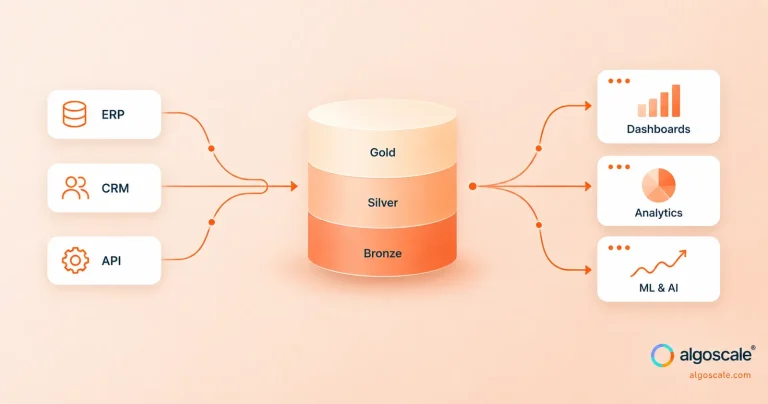
Storage with domain-based zoning. Rather than one bronze/silver/gold structure for the entire company, enterprise lakes often nest this pattern within each domain, giving teams autonomy over their own refinement pipeline while keeping the overall structure consistent and predictable.
Compute isolation by workload and team. Shared compute clusters at enterprise scale create resource contention and make cost attribution nearly impossible. Isolating compute by team or workload type – even within a shared platform – keeps performance predictable and costs traceable.
Centralized catalog and metadata management. This is the single most important piece of enterprise-scale architecture. Every dataset needs a documented owner, schema, lineage, and access policy, searchable from one place – otherwise, discoverability collapses as the number of tables grows into the thousands.
Self-service access with guardrails. Teams shouldn’t need to file a ticket and wait days to access data relevant to their domain. A well-governed enterprise lake provides self-service discovery and access requests, with automated approval workflows for anything within policy, and escalation only for genuinely sensitive data.
Best Practices for Running a Data Lake at Scale
● Standardize your ingestion and transformation patterns. Give teams a shared framework and shared conventions rather than letting each team independently reinvent pipeline architecture. This alone prevents a huge amount of the inconsistency that causes governance headaches later.
● Treat cost governance as a first-class discipline, not an afterthought. Set up cost attribution by team or domain from day one, and review it regularly – the earlier cost visibility exists, the less painful the eventual cleanup.
● Automate table maintenance and lifecycle policies. Compaction, old-version cleanup, and storage tiering all need to run automatically. At enterprise scale, anything that depends on a human remembering to do it will eventually not get done.
● Invest in the catalog before you need it. Waiting until data sprawl becomes unmanageable to invest in cataloging and governance tooling means solving the problem retroactively – always harder and more expensive than building it in from the start.
Standardize on a consistent pipeline architecture pattern. Deciding organization-wide whether teams build ELT or ETL-style pipelines – and sticking to it – reduces the cognitive overhead of onboarding engineers between teams. Our comparison of ETL vs. ELT: which architecture is better in 2026 is a useful reference point for making that call organization-wide.
● Build observability into the platform, not just individual pipelines. At enterprise scale, you need visibility into pipeline health, data quality, and cost across the entire lake – not just dashboards built by individual teams for their own pipelines.
Common Challenges at Enterprise Scale
Organizational silos re-forming inside the architecture. Even with a well-designed domain structure, teams can end up rebuilding walls between domains if governance and discovery tools aren’t genuinely shared and easy to use.
Tool proliferation. Different teams adopting different query engines, orchestration tools, or BI platforms independently creates long-term maintenance burden and makes organization-wide standards difficult to enforce.
Governance debt. Every dataset that goes live without being properly cataloged and governed becomes a small amount of debt that compounds – a few hundred ungoverned tables is a very different cleanup project than a few dozen.
Skills gaps across domain teams. Distributing data ownership to domain teams only works if those teams have the data engineering skills to maintain their piece of the architecture responsibly – this often requires a central platform team providing tooling, standards, and support.
Security and Compliance at Enterprise Scale
With multiple business units, data types, and often multiple regulatory regimes in play at once, security can’t be handled ad hoc. Enterprise architectures typically need role-based and attribute-based access control applied consistently through the catalog layer, encryption enforced by default rather than by exception, and centralized audit logging that can answer “who accessed this data and when” across every domain, not just the ones that thought to build logging themselves.
For organizations with especially strict regulatory requirements, this discipline matters even more – our post on data lakehouse architecture for healthcare covers how this plays out in a heavily regulated industry, and the same principles extend to financial services and other compliance-heavy sectors.
For a broader look at governance best practices generally, see data lakehouse security best practices for cloud-native organizations.
Why a Single Source of Truth Matters More at Scale
The bigger an organization gets, the more expensive it becomes when different business units report different numbers for the same metric – a small inconsistency in a 20-person company is an executive credibility problem in a 2,000-person one. A well-architected enterprise data lake, with federated ownership but centralized standards, is what makes a genuine single source of truth achievable without forcing every team through the same centralized bottleneck. We cover this pattern in more depth in creating a single source of truth using data lakehouse architecture.
Getting the Architecture Right at Your Scale
Enterprise data lake architecture isn’t just a bigger version of a small-team data lake – it requires genuinely different decisions around governance, cost management, and organizational structure from day one. At Algoscale, our Data Lake Services team has helped enterprise organizations design architectures that scale cleanly across dozens of teams without becoming an ungoverned mess or a centralized bottleneck.
To understand the business impact of getting this right, our post on top business benefits of implementing a data lake strategy walks through concrete outcomes.
To see the full scope of what we do beyond data lake architecture, explore how Algoscale approaches data engineering and analytics as a whole.
Why Algoscale
● Pre-built accelerators. We don’t start every engagement from a blank slate – proprietary accelerators built from prior implementations speed up common data source integration and analytics patterns.
● Faster time to value. For a focused initial scope covering core data sources and first analytics use cases, our accelerators typically compress development timelines to around four weeks, rather than the several months a from-scratch build often takes.
● Built on a scalable framework. Our implementation approach follows a repeatable, scale-ready framework, so the architecture built for your first use case extends cleanly as data volume and teams grow, rather than requiring a redo.
● Microsoft Solution Partner for Data & AI. Algoscale holds Microsoft Solution Partner status for Data & AI, including specific expertise implementing Microsoft Fabric as a modern data warehouse.
Frequently Asked Questions
1. At what point does a company actually need “enterprise” data lake architecture, rather than a simpler setup?
There’s no fixed headcount or data volume threshold – it’s more about complexity. Once multiple teams depend on shared data, compliance requirements exist across business units, or cost has become hard to track, the organizational patterns described here start becoming necessary, regardless of company size.
2. Is data mesh the same thing as an enterprise data lake?
Not exactly, though they’re closely related. Data mesh is an organizational and architectural philosophy emphasizing decentralized, domain-owned data with centralized standards. An enterprise data lake is the underlying infrastructure that can be architected to support that philosophy – many enterprise lakes adopt data mesh principles without using the term explicitly.
3. How do you prevent domain teams from creating their own silos within a domain-based architecture?
Shared tooling and shared governance standards are the key defense – if every domain uses the same catalog, the same access control model, and the same discovery tools, domain autonomy doesn’t have to mean domain isolation.
4. Who should own the central platform team in an enterprise data lake setup?
This varies by organization, but it’s typically a dedicated data platform or data engineering team that owns shared tooling, catalog infrastructure, and governance standards – while individual domain teams own their own datasets and pipelines within that framework.
5. How much does cost typically grow if enterprise data lake governance is neglected?
It varies significantly by organization, but the pattern is consistent: uncontrolled storage growth, duplicate datasets across teams, and un-decommissioned pipelines all compound quietly over time. Organizations that implement cost attribution and lifecycle automation early consistently avoid the steep, painful cleanup projects that ungoverned lakes eventually require.
6. How long does it take to re-architect an existing, ungoverned enterprise data lake?
This depends heavily on scale and how ungoverned the existing lake is, but a realistic phased approach – starting with the highest-priority domains and expanding from there – typically spans several months to a year for a large organization, rather than being a single disruptive migration event.