


Key insights
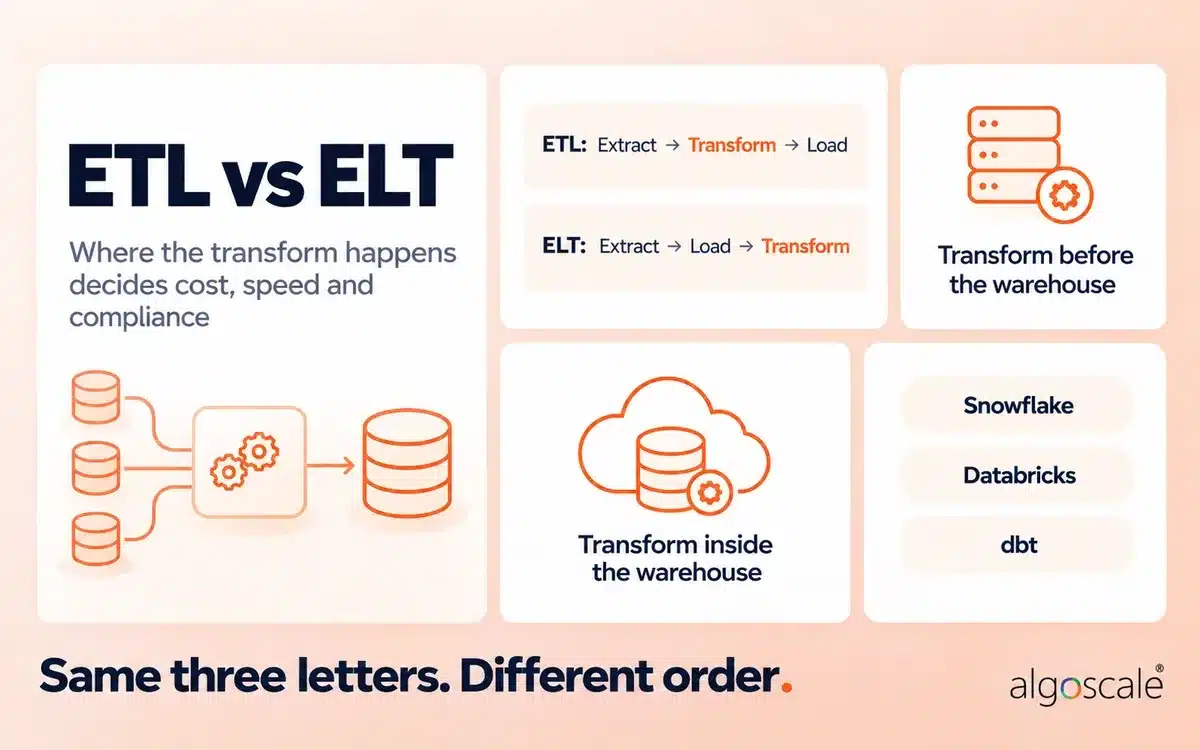
- The only real difference is where the transform runs. ETL cleans and reshapes data on a separate server before it reaches the warehouse. ELT loads raw data first and transforms it inside the warehouse.
- ELT is the default for cloud warehouses. Snowflake, Databricks, BigQuery and Redshift have the compute to transform at scale, so most new pipelines land raw data first and model it with SQL or dbt.
- ETL still wins when sensitive data can’t land raw. If PII, PHI or card data must be masked before it is stored, transform first, or use ETLT: light masking in flight, heavy modelling later.
- ELT is not automatically cheaper. You trade ETL server costs for warehouse compute. Badly designed ELT models that rebuild everything on every run can cost more than the ETL they replaced.
- Most teams run both. A typical 2026 stack uses ELT for analytics, ETL for regulated or legacy feeds, reverse ETL to push results back into business apps, and zero-ETL where the cloud vendor offers native replication.
- Tools don’t decide the pattern; the order does. AWS Glue, Azure Data Factory, Databricks and Spark can all run either ETL or ELT. dbt only handles the T.
- Proof from our work: we moved OH Partners’ paid media reporting from Redshift views to ELT on Snowflake and dbt, matched the old numbers 100% over 30 days, and recovered 1.2K+ missing conversions.
ETL and ELT are the two main ways to move data from source systems into a warehouse for reporting and AI. This guide explains how they differ, when to use each, which popular tools are ETL or ELT, and how to migrate safely, with a real project as proof. If you’re planning a new pipeline or modernizing an old one, our data engineering services and cloud data warehouse consulting teams build both patterns every week.
What is the difference between ETL and ELT?
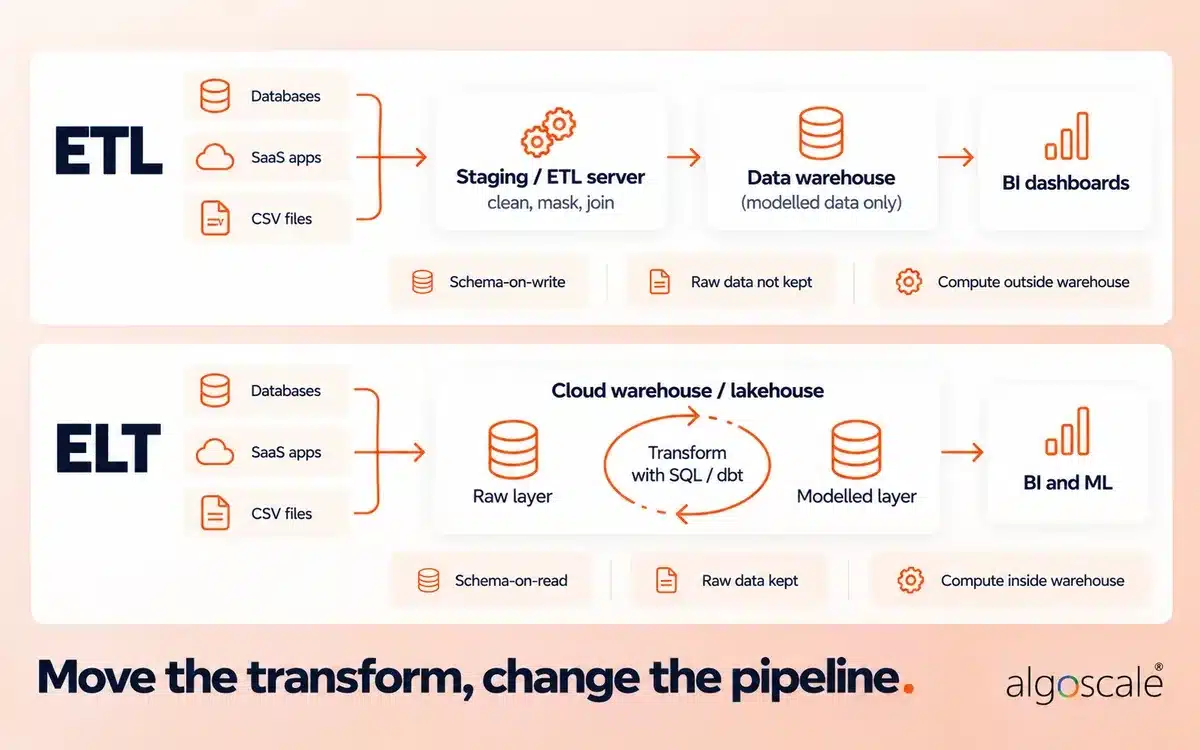
ETL (extract, transform, load) transforms data on a separate engine before loading it into the warehouse, so only clean, modelled data lands. ELT (extract, load, transform) loads raw data into the warehouse first and transforms it there with SQL or dbt. The order changes where compute runs, what data you keep, and how fast you can change your logic.
That single change in order has knock-on effects. In ETL, the schema is decided before data is written (schema-on-write), so a new question often means changing the pipeline and re-extracting. In ELT, raw data is already in the warehouse, so analysts can build a new model on top without touching the source. That’s why ELT pairs naturally with modern data warehouse design, where raw, staging and reporting layers live side by side.
IBM’s 7-minute explainer is a good visual summary of both patterns:
ETL vs ELT comparison table
| ETL | ELT | |
|---|---|---|
| Order | Extract → Transform → Load | Extract → Load → Transform |
| Where the transform runs | A separate ETL server or engine (SSIS, Informatica, Spark job) | Inside the warehouse or lakehouse (SQL, dbt, Spark on Databricks) |
| Schema | Schema-on-write: defined before loading | Schema-on-read: raw data loads first, models are built on top |
| Raw data kept? | Usually not; only transformed output is stored | Yes; raw data stays available for re-modelling |
| Data types | Best for structured data | Structured, semi-structured (JSON) and large volumes |
| Speed to load | Slower; data waits for transforms | Faster; data lands first |
| Speed to change logic | Slower; change the pipeline and often re-extract | Faster; edit a SQL model and re-run |
| Main cost driver | ETL servers, licences and engineering time | Warehouse compute and storage |
| Compliance | Sensitive fields can be masked before they are stored | Needs masking policies, access controls and a locked-down raw zone |
| Typical fit | On-premises warehouses, legacy systems, strict PII rules | Cloud warehouses and lakehouses, analytics, AI and ML |
What is ETL?
ETL (extract, transform, load) is a data integration process that pulls data from source systems, cleans and reshapes it on a separate engine, and then loads the finished result into a target such as a data warehouse. Only data that has passed the transformation step is stored.
The three steps:
- Extract: read data from databases, ERPs, CRMs, files and APIs.
- Transform: clean, deduplicate, join, mask and aggregate it on an ETL server or engine.
- Load: write the modelled data into the warehouse, ready for reporting.
ETL has been the standard since the 1990s, when warehouse storage and compute were expensive and limited. Loading only what you needed, in the shape you needed, kept costs down. It still makes sense today when the target can’t handle heavy transforms, when sources are messy legacy systems, or when rules say sensitive data must be masked before it is stored anywhere.
What is ELT?
ELT (extract, load, transform) is a data integration process that copies raw data from sources straight into a cloud warehouse or lakehouse, then transforms it there using the warehouse’s own compute, usually with SQL or dbt. Raw data is kept, and the reporting models are built on top of it.
The three steps:
- Extract: read data from sources, often with a managed connector like Fivetran, Airbyte or Azure Data Factory.
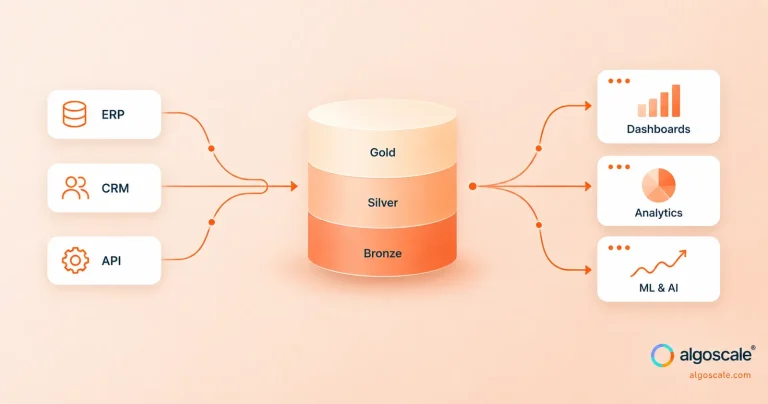
- Load: land it as-is in a raw layer (for example, the bronze layer of a medallion architecture).
- Transform: build staging, cleaned and reporting models with SQL, dbt or Spark, inside the warehouse.
ELT became the default once cloud warehouses separated storage from compute. Storing raw data got cheap, and compute could scale up for a big transform and back down afterwards. Keeping the raw data also means you can answer new questions later without re-extracting from the source, which matters for analytics teams, data lakes and AI projects that need full history.
When should you use ETL vs ELT?
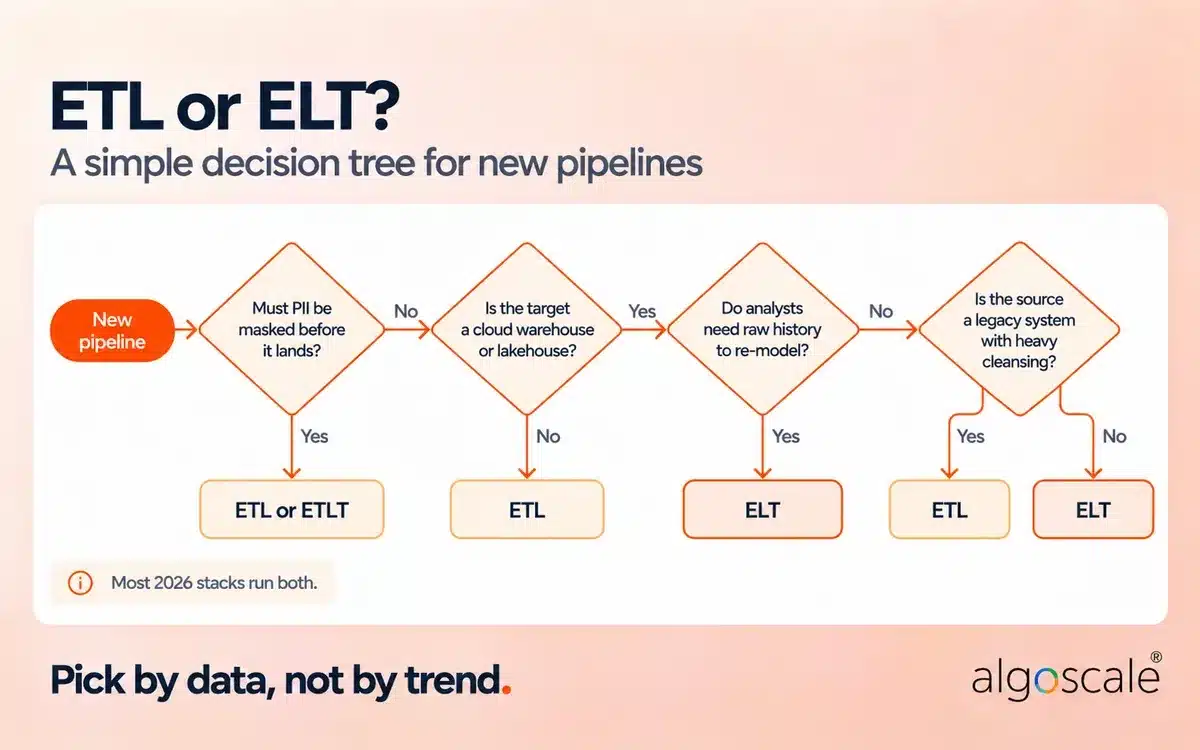
Use ELT when your target is a cloud warehouse or lakehouse and your team wants to keep raw data and change models quickly. Use ETL when sensitive data must be masked before it is stored, when the target has limited compute, or when legacy sources need heavy cleansing before anything else can use them.
Work through these six questions in order. The first “yes” usually settles it:
- Must PII, PHI or card data be masked before it lands anywhere? If yes, use ETL, or ETLT (mask in flight, model later).
- Is the target an on-premises or fixed-capacity database? If yes, ETL keeps heavy work off it.
- Is the target Snowflake, Databricks, BigQuery, Redshift or Microsoft Fabric? If yes, lean ELT.
- Will analysts need raw history to build new models later? If yes, ELT.
- Do business rules change often? If yes, ELT, because changing a SQL model is faster than changing a pipeline.
- Is the source a legacy system with years of messy data and a working ETL job? If it works and nobody needs more, keep the ETL job. Rewrite only where it hurts.
The question is rarely all or nothing. Most of the data architecture we design runs ELT for analytics and keeps ETL for one or two regulated or legacy feeds. Kahan Data Solutions covers how to choose when starting from scratch in under five minutes:
| Use ETL when… | Use ELT when… |
|---|---|
| Sensitive fields must be masked before storage | The target is a cloud warehouse or lakehouse |
| The target database has limited compute | You want to keep raw data for new questions and AI |
| Sources are legacy systems that need heavy cleansing | Business logic changes often |
| Output shape is fixed and well known | Data volumes are large or semi-structured (JSON, events) |
| A stable ETL job already works | Analysts and analytics engineers own the models in SQL |
For a real example of ELT in practice, see how we rebuilt OH Partners’ reporting further down this guide.
Is your tool ETL or ELT?
Most modern tools aren’t strictly ETL or ELT. What decides the pattern is where the transform runs. dbt only transforms; Fivetran and Airbyte only extract and load; AWS Glue, Azure Data Factory, Databricks and Spark can run either pattern, depending on how you build the pipeline.
This is the question people ask AI assistants most often about ETL and ELT, so here is the full list in one place:
| Tool | ETL, ELT or both? | What it does | Pick it when |
|---|---|---|---|
| SQL | Neither on its own; it’s a language | Writes the transforms in both patterns, and is the main language of ELT | Always; every pattern uses it |
| dbt | ELT (the T only) | Turns SQL select statements into tested tables and views inside the warehouse (dbt docs) | You run ELT and want version control, tests and documentation |
| AWS Glue | Both; ETL by design | Serverless Spark jobs that extract, transform and load (AWS Glue docs); can also land raw data in S3 for later transforms | You’re on AWS and need Spark-scale transforms or a data catalog |
| Azure Data Factory | Both | Copy activities and mapping data flows; Microsoft describes it as built for ETL and ELT (ADF docs) | You’re on Azure and need orchestration plus 90+ connectors |
| Databricks | Both; mostly ELT | Lakehouse that lands raw data in bronze and transforms to silver and gold with Spark SQL or Python | Large volumes, streaming, or ML on the same data |
| Snowflake | ELT target and engine | Loads data (Snowpipe, COPY) and transforms it with SQL, Snowpark and dynamic tables | You want a managed cloud warehouse that does the T |
| Amazon Redshift | ELT target; supports zero-ETL | Warehouse that transforms with SQL; native zero-ETL from Aurora, RDS and DynamoDB | You’re on AWS and want SQL-first analytics |
| Google BigQuery | ELT target and engine | Serverless warehouse; transforms with SQL or Dataform | You’re on Google Cloud |
| Fivetran | EL (the E and L of ELT) | Managed connectors that replicate sources into a warehouse | You want ingestion without maintaining connectors |
| Airbyte | EL | Open-source and cloud connectors for ELT | You want connector control or self-hosting |
| Matillion | ELT | Visual pipelines that push transforms down into the warehouse | Your team prefers low-code over dbt |
| Informatica | Both; classic ETL | PowerCenter is traditional ETL; its cloud platform adds ELT pushdown | Large enterprises with existing Informatica estates |
| SSIS | ETL | SQL Server Integration Services transforms on the SSIS server | Existing SQL Server shops; on-premises sources |
| Talend | Both; mostly ETL | Java-based ETL jobs with ELT components | Existing Talend estates |
| Apache Spark | Both | A processing engine; ETL if it runs before load, ELT if it runs on data already in the lake | Very large or streaming data |
| Python | Both | Custom scripts (pandas, PySpark) for either pattern | Small jobs or logic no tool supports |
If your team is weighing tools for a new build, our data integration consulting team can map your sources and targets to the right mix before you buy licences.
Which tools do you need for an ELT stack?
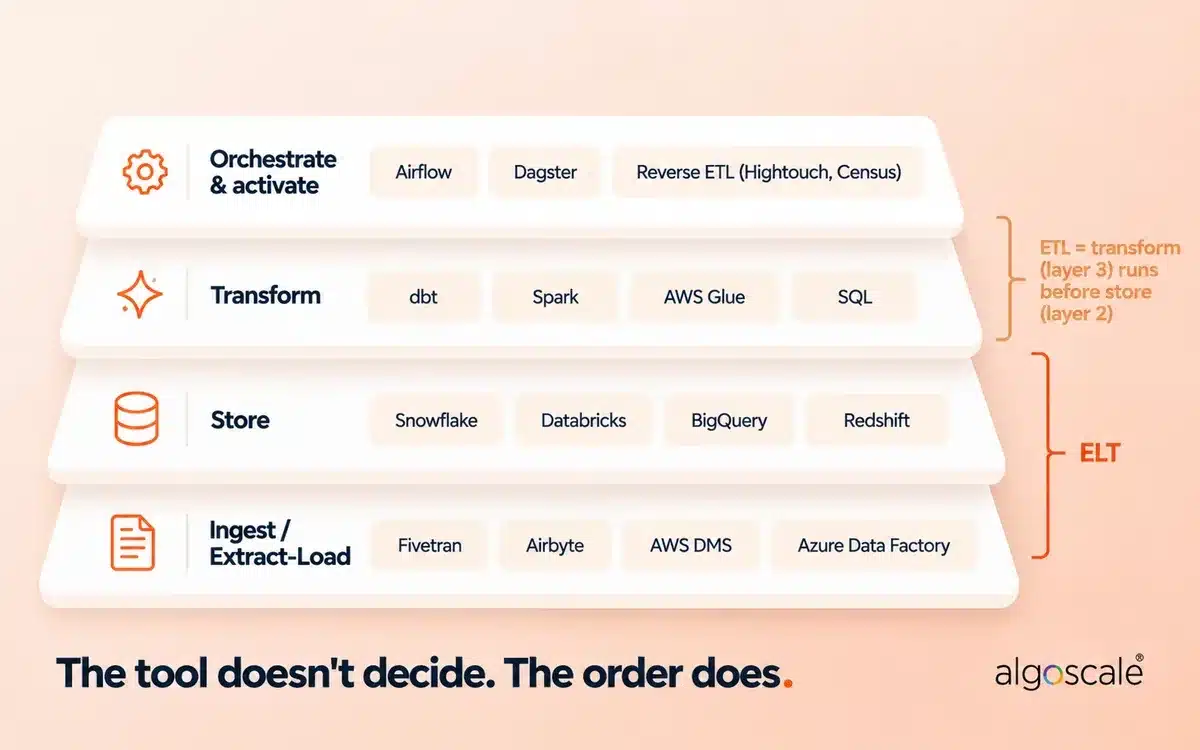
A working ELT stack has five layers: ingestion to extract and load, a warehouse or lakehouse to store, a transformation tool to model, an orchestrator to schedule and monitor, and optionally reverse ETL to send results back to business apps. You need one tool per layer, not one tool for everything.
| Layer | Job | Common choices |
|---|---|---|
| Ingest (E + L) | Copy data from sources into the raw layer, ideally with change data capture (CDC) | Fivetran, Airbyte, Azure Data Factory, AWS DMS |
| Store | Hold raw and modelled data; provide the compute for transforms | Snowflake, Databricks, BigQuery, Amazon Redshift, Microsoft Fabric |
| Transform (T) | Build staging, intermediate and reporting models, with tests | dbt, Dataform, Spark SQL, Snowflake dynamic tables |
| Orchestrate | Run jobs in order, retry failures, alert on problems | Apache Airflow, Dagster, Azure Data Factory, Databricks Workflows |
| Activate | Push modelled data back into CRM, marketing and support tools | Hightouch, Census (reverse ETL) |
Three design choices matter more than the tool names:
- Layer your models. Keep raw, staging, intermediate and reporting layers separate so a broken source never breaks a dashboard directly. Pick a modelling approach early; our guide to star schema vs Data Vault compares the options.
- Make transforms incremental. Process only new or changed rows. Full rebuilds on every run are the most common reason ELT bills grow.
- Automate the boring parts. Testing, documentation and deployment should run in CI/CD, not by hand. Data warehouse automation covers how far you can take this.
If you run Databricks or Fabric, the same layers apply inside a lakehouse; see what changes when you add the lakehouse layer.
Is ELT cheaper than ETL?
Not automatically. ELT removes the cost of separate ETL servers and licences, but moves the work onto warehouse compute, which is billed by usage. Well-built ELT with incremental models is usually cheaper to run and much cheaper to change. Poorly built ELT that rebuilds every table on every run can cost more than the ETL it replaced.
Here is where the money goes, and how to control each line:
| Cost driver | ETL | ELT | How to control it |
|---|---|---|---|
| Ingestion | Custom extract code or ETL tool licences | Connector fees (often priced by rows or volume) | Sync only the tables and columns you use; use CDC instead of full reloads |
| Transform compute | ETL servers, sized for peak load | Warehouse credits or DBUs per run | Incremental models; right-size and auto-suspend warehouses |
| Storage | Only modelled data | Raw plus modelled data | Cheap object storage for raw; retention rules on old snapshots |
| Re-runs and backfills | Often need re-extraction from source | Re-run SQL on raw data already stored | Partition large tables so backfills touch only what changed |
| Engineering time | Pipeline changes need specialist ETL skills | SQL and dbt changes, with tests | Code review, CI/CD and shared model conventions |
The biggest saving in most ELT projects isn’t compute. It’s how quickly the team can change a metric without breaking something else.
Is ETL or ELT better for sensitive or regulated data?
ETL is the simpler fit when rules say sensitive data must never be stored unmasked, because masking happens before the data lands. ELT can meet the same rules, but only with controls inside the warehouse: a locked-down raw zone, column masking, row-level access and audit logs. Many regulated teams use ETLT: mask in flight, model later.
In healthcare, the HIPAA Security Rule requires safeguards for electronic patient data wherever it is stored, including a raw layer. Card data under PCI DSS and personal data under CCPA raise the same question: who can see the raw table?
If you choose ELT for regulated data, put these controls in place before the first load:
- Separate the raw zone. Only the pipeline service account and a few engineers can read it.
- Mask sensitive columns by policy, not by copy. In Snowflake, dynamic data masking shows masked values to everyone except approved roles.
- Filter rows by user. Row access policies limit which records each role can see; Databricks Unity Catalog and BigQuery offer equivalents.
- Tag and audit. Classify PII columns, and log who queried them.
These controls are part of a wider governance programme; our data governance consulting team sets them up alongside the pipeline.
ETL vs ELT vs ETLT vs reverse ETL vs zero-ETL
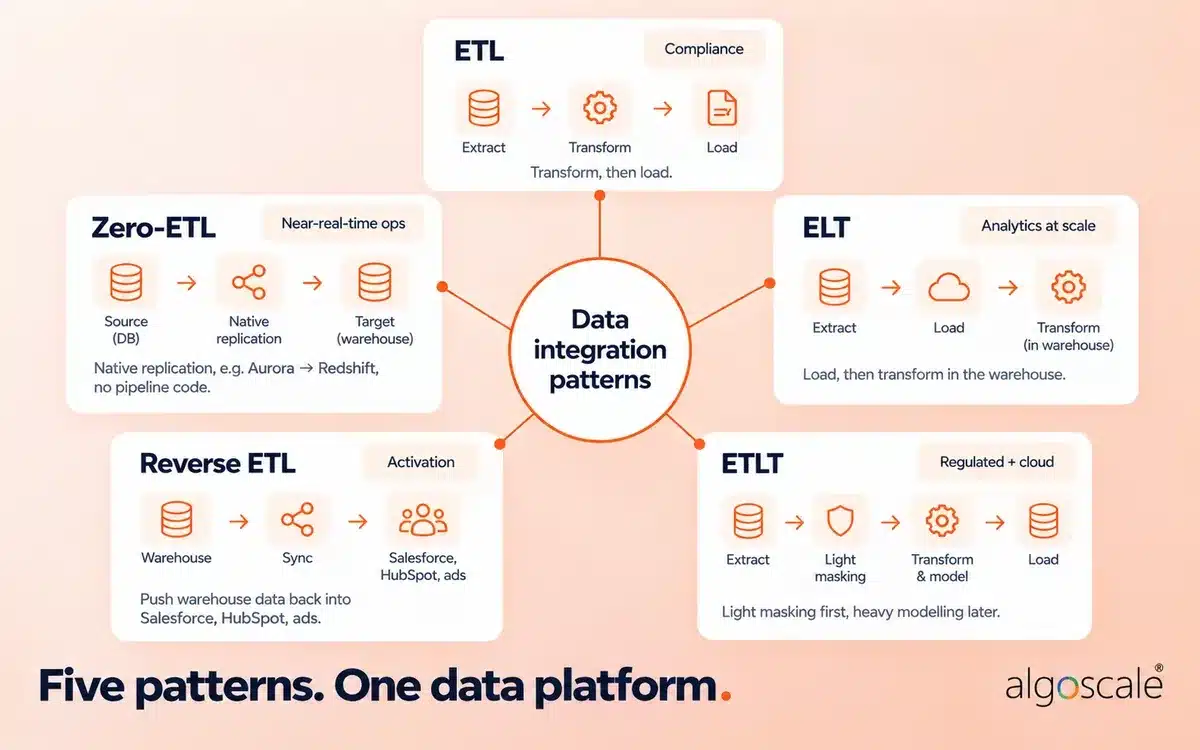
ETL and ELT move data into a warehouse. ETLT is a hybrid that does light masking before loading and heavy modelling after. Reverse ETL moves modelled data out of the warehouse into business apps. Zero-ETL is native replication between services from the same cloud vendor, with no pipeline code to maintain.
- ETLT (extract, transform, load, transform). A small transform in flight, such as hashing emails or dropping card numbers, then ELT-style modelling in the warehouse. It’s the usual answer for regulated teams that still want ELT’s flexibility.
- Reverse ETL. Syncs warehouse models (customer scores, product usage, churn risk) back into tools like Salesforce, HubSpot or ad platforms, so sales and marketing act on the same numbers as the dashboards.
- Zero-ETL. The cloud provider replicates data for you. For example, Amazon Redshift zero-ETL integrations copy data from Aurora, RDS and DynamoDB into Redshift without a pipeline. You still need to transform it, so zero-ETL replaces the E and L, not the T.
| Pattern | What moves where | Best for |
|---|---|---|
| ETL | Source → transform engine → warehouse | Compliance-first or legacy targets |
| ELT | Source → warehouse → transform in place | Analytics at scale on cloud platforms |
| ETLT | Source → light mask → warehouse → model | Regulated data on cloud platforms |
| Reverse ETL | Warehouse → CRM, marketing and support apps | Putting insights into daily workflows |
| Zero-ETL | Operational database → warehouse, natively | Near-real-time reporting within one cloud |
Is ETL dead in 2026?
No. ETL is no longer the default for new analytics pipelines on cloud warehouses, but it is still the right choice for sensitive data that must be masked first, for targets with limited compute, and for stable legacy jobs that work. What is fading is hand-coded, server-heavy ETL that nobody can change.
AI is changing the work, not the pattern. Assistants can now draft SQL models, write tests, document lineage and flag failing jobs. They don’t decide which numbers the business trusts or which data a regulator allows. Engineers still own the logic; they just spend less time typing it.
How do you migrate from ETL to ELT?
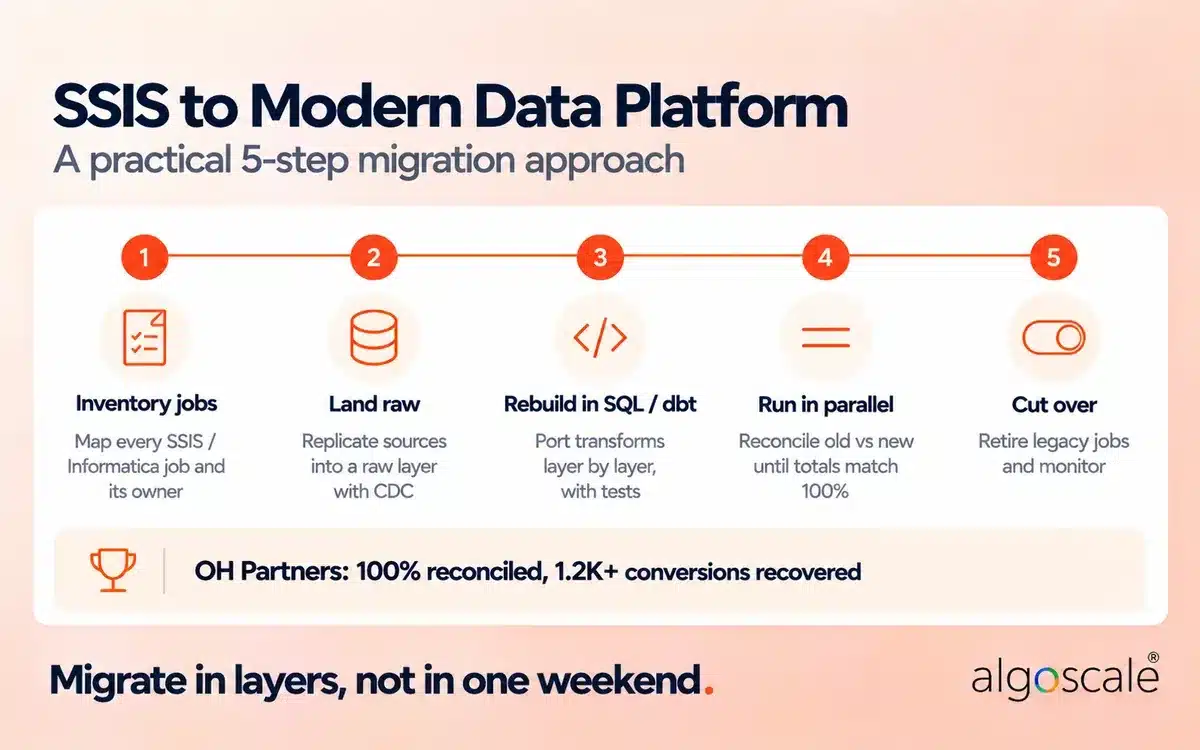
Migrate in layers, not in one weekend. Land raw data in the new warehouse first, rebuild the transformation logic as tested SQL models, run the old and new pipelines side by side until the numbers match, and only then switch reports over and retire the old jobs.
- Inventory every pipeline. List each ETL job, its sources, its outputs, who uses them and how often they fail. You’ll usually find jobs nobody needs.
- Rank by value and pain. Start with pipelines that break often or block important reports. Leave stable, low-value jobs for last, or keep them as ETL.
- Land raw data first. Replicate sources into a raw layer, ideally with change data capture, so the new models have the same inputs as the old jobs.
- Rebuild logic in dbt layers. Port each transform into staging, intermediate and reporting models, with tests for keys, nulls and accepted values.
- Run in parallel and reconcile. Compare old and new outputs at the lowest useful grain (date, account, product, channel) until totals match. This is the step teams skip, and the one that earns business trust.
- Cut over and retire. Point dashboards at the new models, monitor for a few cycles, then switch off the old jobs and servers.
For the wider plan, including sequencing, cost and downtime, see our guides to data warehouse migration and data warehouse implementation.
How Algoscale helped OH Partners move to ELT on Snowflake and dbt
We rebuilt OH Partners’ paid media reporting from legacy Amazon Redshift views into an ELT pipeline on Snowflake and dbt. The new numbers matched the old system 100% over a 30-day parallel run, and the rebuild recovered more than 1,200 conversions that the old logic had been missing.
The problem. OH Partners, a US creative advertising agency, reported paid media performance from several ad platforms through a set of Redshift “masterviews”. The logic was hard to trace and slow to change, and conversions were getting lost between the platforms and the reports.
What we built. An ELT pipeline: raw platform data lands in Snowflake first, then dbt transforms it through four layers, from raw (L1) to reporting-ready models (L4). Apache Airflow runs the pipeline, and GitHub Actions runs CI/CD so every model change is tested before it ships.
How we proved it. We ran the old and new pipelines side by side and reconciled them at date × platform × device × conversion grain, until every metric matched.
Results:
- 100% reconciliation with the legacy system over a 30-day window
- 1.2K+ missing conversions recovered
- About 40% less effort to debug and change reporting logic
- Version-controlled, tested models with Airflow and GitHub Actions CI/CD
Why ELT fit. The target was a cloud warehouse, data came from many ad platforms, and the reporting logic changed often. Landing raw data and modelling it in dbt made each change faster and every number traceable back to its source.
Read the full OH Partners case study, or see how our Snowflake consulting team runs projects like this.
ETL vs ELT example: one pipeline built both ways
Take one common job: combine Salesforce opportunities with order data from SQL Server into a revenue dashboard in Snowflake. Built as ETL, an integration server joins and masks the data, then loads one finished revenue table. Built as ELT, both sources land raw in Snowflake, and dbt builds the revenue model there.
| Step | ETL version | ELT version |
|---|---|---|
| Extract | SSIS or Informatica reads Salesforce and SQL Server | Fivetran or Airbyte replicates both sources |
| Where joins run | On the ETL server | In Snowflake, as a dbt model |
| Where PII is masked | Before loading; customer emails never reach Snowflake | In Snowflake, with a masking policy on the raw and staging tables |
| What’s stored | One finished revenue table | Raw Salesforce and order tables, plus staging and revenue models |
| Adding a new metric (e.g. win rate by region) | Change the ETL job, re-test, and often backfill from source | Add a dbt model on data already in Snowflake and run it |
| When a source field changes | The job fails until the mapping is fixed | The raw load keeps working; only the affected model needs a fix |
Both versions produce the same dashboard. The ELT version is quicker to change; the ETL version keeps customer emails out of the warehouse entirely. Which matters more to you is the whole decision.
Choosing your pattern
There’s no prize for picking a side. Use ELT where your platform and team can move fast on raw data, keep ETL or ETLT where data must be protected before it lands, and add reverse ETL or zero-ETL where they remove real work. Then prove every migration with reconciliation before you switch anything off.
If you want a second opinion on your pipelines, or help rebuilding them, talk to our data analytics consulting and data engineering team.
Frequently Asked Questions
Is SQL an ETL tool?
No. SQL is a query language, not a tool. But it does most of the transform work in both patterns, and in ELT it’s the main way transformations are written, usually through dbt or the warehouse’s own features. You still need separate tools to extract, load and schedule the work.
Is ETL outdated in 2026?
No, but it’s no longer the default. Most new analytics pipelines on cloud warehouses use ELT. ETL remains the better choice when sensitive data must be masked before storage, when the target has limited compute, or when a legacy ETL job is stable and nobody needs more from it.
Will AI replace ETL?
AI won’t replace ETL or ELT; it will change who writes them and how fast. AI assistants can already draft SQL models, generate tests, document lineage and spot failing jobs. People still decide what the data means, which numbers the business trusts and what rules apply to sensitive fields.
Is dbt an ETL or ELT tool?
dbt is an ELT tool, and it only does the T. It turns SQL select statements into tables and views inside your warehouse, with tests, documentation and version control. It doesn’t extract or load data, so it’s paired with ingestion tools like Fivetran, Airbyte or Azure Data Factory.
Is AWS Glue ETL or ELT?
AWS Glue is built as an ETL service: it runs serverless Spark jobs that extract, transform and load data. It can also support ELT, for example by landing raw data in Amazon S3 and transforming it later with Glue jobs or Amazon Redshift SQL. Its data catalog is used in both patterns.
Does AWS have an ETL tool?
Yes. AWS Glue is AWS’s main ETL service. AWS also offers AWS Database Migration Service (DMS) for replication and change data capture, Amazon Redshift zero-ETL integrations for native replication from Aurora, RDS and DynamoDB, and Amazon Managed Workflows for Apache Airflow (MWAA) for orchestration.
Is Azure Data Factory ETL or ELT?
Both. Azure Data Factory can transform data in flight with mapping data flows (ETL), or copy raw data into a warehouse or lakehouse and run the transforms there (ELT). Microsoft describes it as built for hybrid ETL, ELT and data integration projects.
Is Databricks ETL or ELT?
Databricks supports both, but most teams use it for ELT. Raw data lands in a bronze layer, and Spark SQL or Python transforms it into silver and gold tables inside the lakehouse. It’s also used for ETL-style jobs when data must be cleaned or masked before it reaches another system.
What is the difference between CDC and ETL?
Change data capture (CDC) is a way to extract data: it reads only the rows that were inserted, updated or deleted since the last run, often from database logs. ETL is the whole process of extracting, transforming and loading. CDC is often used as the extract step in both ETL and ELT pipelines.
What is reverse ETL?
Reverse ETL copies modelled data from your warehouse back into business tools such as Salesforce, HubSpot, Zendesk or ad platforms. It lets sales, marketing and support teams act on the same customer scores and segments the dashboards show, without exporting spreadsheets. Hightouch and Census are common tools.
What is zero-ETL, and does it replace pipelines?
Zero-ETL is native replication between services from the same cloud provider, such as Amazon Aurora to Amazon Redshift, with no pipeline code. It replaces the extract and load steps for supported sources only. You still need to transform the data, and sources outside that provider still need ETL or ELT.
Is ELT cheaper than ETL?
Often, but not always. ELT removes separate ETL servers and makes changes cheaper, but warehouse compute is billed by usage. Incremental models, right-sized warehouses and syncing only the data you need keep ELT costs down. Full rebuilds on every run can make ELT more expensive than ETL.