

Modern enterprises generate data across dozens of systems simultaneously. CRM platforms, ERP modules, marketing automation tools, IoT sensors, transactional databases, and third-party data feeds each produce their own version of business reality. When these systems operate in isolation, the result is a fragmented landscape where the finance team reports one revenue figure, sales reports another, and the analytics team produces a third. This is the data consistency crisis that plagues enterprise data strategy, and it is the direct consequence of operating without a single source of truth.
A data lake house addresses this problem at its architectural root. By unifying structured, semi-structured, and unstructured data on a single open-format storage platform with enterprise-grade governance, ACID transaction guarantees, and native support for analytics, machine learning, and streaming workloads, the data lake house becomes the authoritative platform from which every team in the organisation draws its data. There is one version of every metric, one lineage trail for every dataset, and one governance layer that controls who can see what and when.
This guide covers how lakehouse architecture creates a genuine single source of truth at enterprise scale, what it replaces, how leading platforms including the AWS data lake house, the Azure data lake house on Microsoft Fabric, and multi-engine cloud data lake deployments achieve it, and what organisations should expect when they partner with an experienced data lake house consulting service to lead the transformation.
Why Enterprises Struggle to Build a Single Source of Truth
The single source of truth problem is not new. Enterprises have been attempting to solve it through data warehouses, master data management programs, and centralized BI platforms for more than two decades. The results have been consistently partial. Data warehouses solved the consistency problem for structured transactional data but could not accommodate the volume, variety, and velocity of modern data. Master data management addressed entity resolution but not analytical consistency. BI platforms standardised reporting metrics but depended on fragmented upstream pipelines that each introduced their own transformation logic and quality risks.
The deeper problem is architectural. A single source of truth cannot be built on top of a fragmented data infrastructure. When raw data lands in seven different systems before reaching the analytical layer, there are seven points at which transformations can diverge, quality checks can differ, and definitions can conflict. No governance overlay applied at the consumption layer can compensate for the inconsistency introduced upstream. The fix must be architectural, not cosmetic.
The Multi-Platform Fragmentation Problem
Most enterprise data stacks that evolved organically over the last decade share the same structural pattern. A cloud data warehouse handles SQL analytics on structured data. A separate cloud data lake stores raw files for data science teams. A streaming platform processes real-time events independently. A BI layer sits on top, attempting to reconcile the outputs of these systems into coherent dashboards. Data engineering teams report that 60 to 70 percent of their capacity is consumed maintaining pipelines across these fragmented environments rather than building new capabilities.
The consequences compound over time. Every new data product requires coordinating schema changes across multiple systems. Access policies must be maintained independently in each platform with no guarantee of consistency. Lineage, when it exists at all, is manually documented and quickly becomes stale. Audit trails are platform-specific and cannot be aggregated into a unified compliance report without significant manual effort. The single source of truth remains permanently out of reach because the architecture was never designed to produce one.
What Is a Data Lake House and How Does It Solve This Problem
A data lake house is a data architecture that combines the low-cost open-format storage of a cloud data lake with the ACID transaction guarantees, schema enforcement, and query performance of a data warehouse, all on a single unified platform. The foundational innovation is the open table format: a metadata and transaction log layer that sits on top of standard Parquet files in cloud object storage, enabling database-grade reliability without requiring proprietary storage formats.
Delta Lake, originally developed by Databricks and now governed by the Linux Foundation, was the first production-grade open table format and remains the most widely deployed. Apache Iceberg, governed by the Apache Software Foundation, has become the dominant format in AWS-native and multi-engine deployments. Both maintain a complete transaction log alongside Parquet data files. Every write, update, and delete is recorded in the log before being applied to the data, giving the data lake house the ACID guarantees that raw lakes lack while keeping data in open formats compatible with any analytical engine.
The result is a platform that serves every data use case from the same storage substrate. Business intelligence, machine learning, streaming analytics, compliance reporting, and data science exploration all operate against the same governed tables with consistent metadata, unified lineage, and a single access control policy. This architectural unity is what makes a genuine single source of truth possible for the first time at enterprise scale.
How Data Lakehouse Architecture Creates a Single Source of Truth

1. The Medallion Architecture as a Unified Data Model
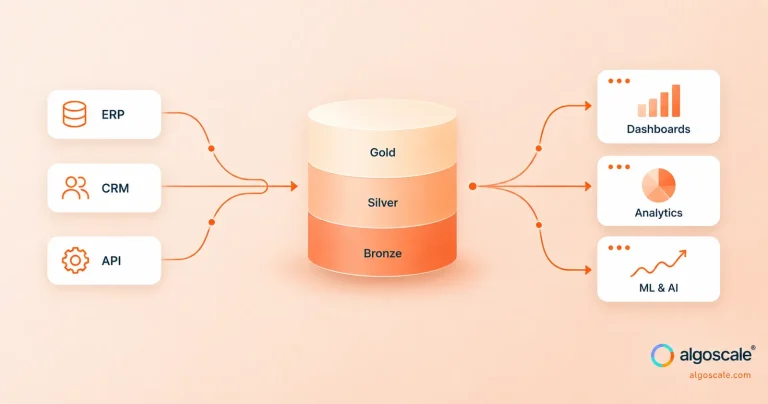
The medallion architecture is the standard design pattern for organising data within a data lake house. It structures data into three progressive layers: Bronze, Silver, and Gold. The Bronze layer captures raw data exactly as it arrives from source systems, with no transformations, preserving complete fidelity to the source. The Silver layer applies standardised cleansing, deduplication, schema validation, and business rule enforcement to produce a conformed, entity-resolved dataset. The Gold layer contains business-ready aggregates and domain-specific views built from the Silver layer for direct consumption by analytics and AI workloads.
The single source of truth emerges at the Silver layer. Every downstream consumer, whether it is a Power BI dashboard, a machine learning model, a regulatory report, or a data API, reads from the same Silver tables with the same transformation logic applied. There is no longer a scenario in which two teams arrive at different answers because they applied different business rules to the same raw data. The rules are encoded once at the Silver layer and inherited by every downstream workload automatically.
2. ACID Transactions That Guarantee Data Consistency
A single source of truth is only meaningful if the data it contains is reliable. ACID transaction support is the technical foundation of that reliability in a data lake house. Every write operation is atomic: it either completes fully or does not happen at all. Concurrent readers always see a consistent snapshot of the data, never a partially written state. Failed pipeline jobs leave tables in their last clean state rather than a corrupted intermediate condition.
For enterprises managing customer data, financial records, or risk positions, this is not a technical nicety. It is a compliance requirement. GDPR right-to-erasure mandates that a single deletion request be applied reliably across every table containing that individual’s data. BCBS 239 requires that risk data be aggregated with full auditability and point-in-time accuracy. These requirements cannot be satisfied on a raw cloud data lake without transactional guarantees. They are native capabilities of a well-designed data lake house.
3. Unified Governance as the Authority Layer
Governance is what transforms a technically consistent dataset into an organisationally trusted single source of truth. Without a unified governance layer, different teams can apply different access policies, use different data dictionaries, and publish different definitions of the same business metric. The result is a platform that may be technically consistent but is organisationally contested, which defeats the purpose of a single source of truth entirely.
Leading lakehouse platforms provide purpose-built governance layers that address this challenge directly. Databricks Unity Catalog delivers automated column-level lineage, dynamic PII masking, row-level security, and a centralized data catalog that serves as the authoritative business glossary for the entire platform. The Azure data lake house built on Microsoft Fabric integrates Microsoft Purview for unified data cataloging, lineage tracking, and sensitivity classification across all workloads in the platform. For AWS-native deployments, AWS Glue Data Catalog with Lake Formation provides centralised metadata management and fine-grained access control across the entire AWS data lake house.
When every data asset in the platform is registered in a single catalog with a documented owner, a defined business definition, a complete lineage trail, and a consistently enforced access policy, the governance layer itself becomes the organisational source of truth for data meaning, not just data content.
4. Time Travel for Historical Accuracy and Reproducibility
One of the most powerful and underappreciated capabilities of lakehouse architecture is time travel: the ability to query any table as it existed at any point in its history. Delta Lake and Apache Iceberg both maintain a complete transaction log that enables point-in-time queries without requiring separate historical snapshots or slowly changing dimension tables.
For a single source of truth to be genuinely authoritative, it must be authoritative across time, not just at the current moment. Regulatory reporting requires that an organisation produce the exact state of any dataset as of a specific historical date, often months or years after the fact. Machine learning reproducibility requires that a model can be retrained on the exact same historical snapshot used for its original training run. Incident forensics requires that a data engineering team can identify precisely when a data quality issue was introduced and what the clean state of the data looked like before the issue occurred.
All of these use cases are native capabilities of a well-designed data lake house. They require no additional infrastructure and no separate archival process. The transaction log is maintained automatically as part of every write operation, and querying it requires only a standard SQL clause specifying the target timestamp or version number.
5. Unified Batch and Streaming for Real-Time Consistency
A single source of truth that is accurate as of yesterday is only partially useful in an environment where business decisions are made in real time. Legacy architectures addressed streaming data by maintaining a separate real-time platform alongside the batch analytical system, with a reconciliation layer attempting to merge the two views into a consistent surface. This approach consistently produces divergence between real-time and batch metrics that erodes trust in both.
A data lake house unifies batch and streaming on the same storage layer. Spark Structured Streaming ingests real-time events into Delta or Iceberg tables with sub-second latency. The same tables that receive streaming writes serve concurrent SQL batch reads without duplication or reconciliation overhead. IoT telemetry, financial transaction feeds, clickstream events, and logistics data land directly into the governed medallion layers and are immediately available to any analytical workload. There is one version of the data, updated continuously, serving every consumer from the same storage substrate.
AWS Data Lake House vs Azure Data Lake House: Platform Paths to a Single Source of Truth

The strategic case for data lake house architecture is consistent regardless of platform. The implementation path depends on the organisation’s existing cloud investments, governance requirements, and workload composition.
Databricks Lakehouse Platform
Databricks invented the lakehouse concept and delivers the most complete implementation available across AWS, Azure, and GCP. Its Unity Catalog provides the most mature unified governance layer in the market, with automated column-level lineage, dynamic PII masking, row-level security, and the open Delta Sharing protocol for cross-platform data access. For AI-intensive workloads, capital markets, healthcare, and multi-cloud deployments, Databricks delivers the most capable path to a single source of truth that simultaneously serves analytics and machine learning at enterprise scale.
Azure Data Lake House on Microsoft Fabric
Microsoft Fabric is the recommended platform for enterprises with significant Azure, Power BI, and Microsoft 365 investments. OneLake, its unified storage layer, ensures that every workload in the platform reads and writes to the same Delta Parquet storage substrate. Power BI Direct Lake mode reads natively from OneLake without import or DirectQuery limitations, enabling sub-second dashboard performance directly against the single source of truth. The Azure data lake house built on Fabric integrates deeply with Microsoft Purview for unified governance and Azure Active Directory for identity-based access control, making it the natural choice for Azure-centric enterprises.
AWS Data Lake House with Apache Iceberg
For enterprises prioritising maximum portability and multi-engine flexibility, an AWS data lake house built on AWS Glue Data Catalog, Amazon Athena, and Apache Iceberg provides the widest engine compatibility available. Any Iceberg-compatible engine including Spark, Flink, Trino, and Amazon EMR can query the same underlying tables without format conversion. This architecture is the natural choice for organisations with deep AWS investments, multi-cloud strategies, or governance requirements that preclude dependency on a single analytical vendor. The cloud data lake layer on Amazon S3 serves as the shared storage substrate, with AWS Lake Formation enforcing fine-grained access control across every engine that touches the data.
Platform Comparison: AWS vs Azure vs Databricks Data Lake House
Choosing the right lakehouse platform is one of the most consequential decisions in any data lake house implementation. The table below compares the three leading platforms across the dimensions that matter most for building a reliable single source of truth at enterprise scale.
| Criteria | Databricks Lakehouse | Azure Data Lake House (Microsoft Fabric) | AWS Data Lake House (Apache Iceberg) |
| Table Format | Delta Lake (open) | Delta Lake via OneLake | Apache Iceberg (open) |
| Best For | AI/ML, multi-cloud, capital markets | Azure-native, Power BI-centric orgs | AWS-native, multi-engine portability |
| Governance Layer | Unity Catalog | Microsoft Purview | AWS Lake Formation + Glue Catalog |
| Streaming Support | Spark Structured Streaming + Flink | Eventstream + Azure Event Hubs | Kinesis + Amazon EMR + Flink |
| BI Integration | Databricks SQL + any BI tool | Power BI Direct Lake (native) | Amazon QuickSight + Athena |
| Storage Layer | S3 / ADLS / GCS | OneLake (ADLS Gen2 backed) | Amazon S3 |
| Multi-Cloud | Yes (AWS, Azure, GCP) | Primarily Azure | Primarily AWS |
| Vendor Lock-in Risk | Low (open Delta format) | Medium (Fabric ecosystem) | Low (open Iceberg format) |
| Ideal Data Volume | Petabyte scale | Enterprise to petabyte scale | Petabyte scale |
| Managed Service | Fully managed | Fully managed (SaaS) | Managed via AWS services |
| ACID Transactions | Full ACID via Delta Lake | Full ACID via Delta Lake | Full ACID via Apache Iceberg |
| Time Travel | Yes (Delta transaction log) | Yes (Delta transaction log) | Yes (Iceberg snapshot history) |
Industry Applications: Single Source of Truth in Practice
Financial Services and Risk Management
Global banks operating under BCBS 239 must aggregate risk data across trading desks, geographies, and asset classes with complete lineage and point-in-time accuracy. Legacy architectures that copy risk positions across multiple systems produce inconsistencies that regulators identify as material control weaknesses. A data lake house built on lakehouse architecture consolidates all risk data into a single governed platform where every position is sourced from one authoritative dataset, lineage is automated, and point-in-time reporting that previously required 48 to 72 hours of manual data preparation becomes a standard SQL query against the transaction log.
Healthcare and Life Sciences
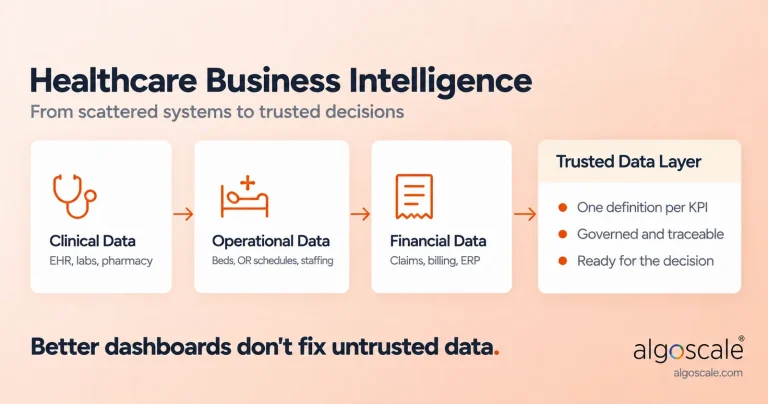
Healthcare organisations managing patient data across clinical, claims, and genomic systems face a version of the single source of truth problem with direct patient safety implications. When a clinician sees one medication history in the EHR and a different history in the analytics platform, the discrepancy is not an inconvenience. It is a risk. A data lake house with column-level access control enforces HIPAA compliance while ensuring that every team accessing patient data draws from the same governed, deduplicated, entity-resolved record. PHI exposure is controlled at the column level by the governance layer, not by pipeline design, which means compliance is guaranteed by architecture rather than by process.
Retail and E-Commerce
Retail enterprises operating omnichannel models generate customer interaction data across web, mobile, in-store point-of-sale, and third-party marketplace platforms simultaneously. Without a unified data lake house, customer lifetime value calculations differ between the loyalty team and the finance team because each draws from different source systems with different inclusion logic. A medallion architecture on a lakehouse platform resolves all customer entities into a single Silver-layer customer table from which every downstream calculation inherits the same identity graph, the same attribution model, and the same revenue recognition rules. The result is a single customer record that is authoritative across marketing, finance, and operations simultaneously.
What to Expect from a Data Lakehouse Implementation
A successful data lake house implementation that delivers a genuine single source of truth is a phased architectural transformation, not a lift-and-shift migration. Best-practice engagements begin with a structured assessment of the current data stack, a workload and data asset inventory, and a quantified ROI model that benchmarks current infrastructure costs against projected lakehouse economics. Architecture design follows, covering the medallion layer structure, governance model, streaming pipeline design, and the entity resolution strategy that will produce unified records at the Silver layer.
The most critical principle of a well-executed implementation is governance-first design. Unity Catalog, Microsoft Purview, or AWS Lake Formation must be configured before the first production table is created. Organisations that defer governance design consistently find that data is created without proper lineage, access policies are applied inconsistently, and business definitions diverge across teams before the platform is even fully operational. Untangling the resulting governance gaps requires an effort comparable to building the governance layer correctly at the outset.
Partnering with an experienced data lake house consulting service ensures that platform selection, medallion architecture design, governance configuration, entity resolution strategy, FinOps modelling, and migration sequencing are handled by engineers who have delivered comparable projects at enterprise scale. The right consulting partner brings referenceable case studies from your industry vertical, a documented implementation methodology, and defined post-migration managed services support. These are the non-negotiable criteria for evaluating any implementation partner for a transformation of this scope.
Delivered Outcomes: What a Unified Data Lake House Achieves
The business case for building a single source of truth on a data lake house platform is grounded in delivered outcomes that organisations consistently achieve after implementation:
• Storage costs at petabyte scale reduced from $230 to $480 per terabyte per month in proprietary warehouses to $20 to $40 per terabyte per month on cloud object storage.
• Risk data aggregation time for BCBS 239 compliance was reduced from 48 to 72 hours of manual preparation to 2 to 4 hours of automated query execution.
• Machine learning model development cycles compressed from 2 to 4 weeks to 2 to 5 days with governed, production-quality training data available directly from the lakehouse.
• Data engineering pipeline maintenance reduced from 60 to 70 percent of team capacity to 25 to 35 percent after consolidation onto a single data lake house platform.
• Self-service query latency reduced from hours in warehouse queue backlogs to seconds on an optimised lakehouse with Z-ordering and liquid clustering applied.
• Time to market for new data products reduced from 4 to 8 weeks to 1 to 2 weeks with a unified catalog and declarative pipeline framework.
• 3 to 7 separate vendor platform contracts consolidated to 1 to 2 contracts with 40 to 60 percent savings on total platform spend.
• Compliance reporting preparation reduced from 3 to 5 manual days per cycle to automated same-day delivery via lakehouse architecture time-travel queries.
• A single authoritative version of every business metric, customer record, and financial position replacing fragmented, contested figures across multiple systems.
Build Your Single Source of Truth with AlgoScale
The shift from fragmented data infrastructure to a unified data lake house is not simply a technology modernization initiative. It is a strategic investment in the organisational capacity to make decisions from a single, trusted, governed version of the truth. Enterprises that continue operating fragmented multi-platform stacks face rising infrastructure costs, inconsistent governance, duplicated pipeline maintenance, and an inability to answer the most basic questions about their business with confidence. The architectural foundation of a single source of truth is available today through production-ready lakehouse platforms, and the implementation methodology is proven at enterprise scale.
Whether your organisation is evaluating an AWS data lake house powered by Apache Iceberg, an Azure data lake house on Microsoft Fabric, a multi-cloud Databricks lakehouse, or a cloud data lake consolidation initiative, success depends on making the right architectural decisions, designing governance before data arrives, and executing the migration with a partner who has done it before.
At AlgoScale, we help enterprises design, implement, modernize, and optimize data lake house platforms that deliver a genuine single source of truth. Our specialists bring deep expertise across Databricks, Microsoft Fabric, Apache Iceberg, data governance, cloud modernization, analytics engineering, and AI-ready data platforms. From strategy and architecture assessment through migration execution and ongoing optimisation, we provide end-to-end support throughout the lakehouse journey.
If you are planning your next-generation data platform and want a clear roadmap for achieving a single source of truth at enterprise scale, connect with the AlgoScale team for a complimentary data lake house consulting service assessment. We will help you identify opportunities, evaluate platform options, and build a scalable lakehouse architecture aligned with your business goals, governance requirements, and future AI initiatives.