

Most businesses today are not short on data. They are short on the ability to use it. Customer behavior data sits in one system, transaction history lives in another, operational logs are buried in a third, and no one can pull a complete picture without waiting days for someone to manually stitch it together. That is the real cost of running without a data lake strategy.
A data lake is not just a storage decision. It is a business decision. When designed and governed correctly, it becomes the architectural backbone that connects every data source in your organization and makes that data usable, trusted, and available to every team that needs it. This guide breaks down the real, measurable business benefits of implementing a data lake, how it stacks up against other approaches, how leading data lake consulting services like Algoscale help organizations get there, and why the right strategy changes what your organization is capable of.
What a Data Lake Actually Does for Your Business
Before getting into the benefits, it helps to be clear on what a data lake is doing at the business level, not just the technical one.
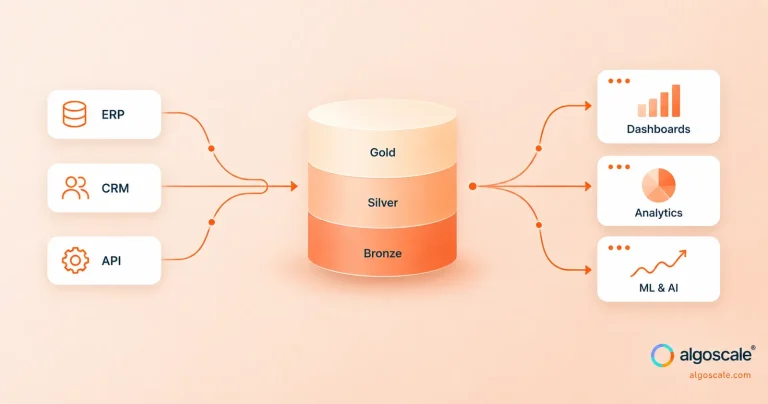
A data lake stores data from every source across your organization, structured tables, semi-structured logs, unstructured documents, streaming events, images, and more, in its native format without requiring a predefined schema. Data enters the lake as it is generated and gets organized into zones: raw, processed, and curated. Each zone serves a different type of consumer, from data engineers running pipelines to analysts pulling dashboards to machine learning engineers building models.
The business outcome of this architecture is a single, governed, always-available repository that removes the data bottlenecks that slow decisions, limit analytics, and prevent AI initiatives from getting off the ground.
Data Lake vs Traditional Storage Approaches: A Business-Level Comparison
One of the most common questions organizations ask before investing in a data lake strategy is how it changes what they can do compared to what they already have. This table answers that directly.
| Business Capability | On-Premises Data Warehouse | Siloed Departmental Systems | Cloud Based Data Lake |
| Data Types Supported | Structured only | Varies per system | Structured, semi-structured, unstructured |
| Time to New Insight | Weeks to months | Days to weeks | Hours to days |
| Cross-Department Analytics | Requires manual data merging | Not supported natively | Built-in unified access |
| Scalability Without Re-Architecture | Low, expensive upgrades required | None | Unlimited, scales on demand |
| Cost at Scale | High, compute and storage tightly coupled | Duplicated costs across systems | Low storage, pay-per-use compute |
| Support for Machine Learning | Limited, structured data only | None | Native, full raw data access |
| Governance and Compliance | Manual, system-by-system | Inconsistent | Centralized, automated |
| Real-Time Data Processing | No | Rarely | Yes, with streaming ingestion |
| Self-Service for Business Teams | Rare | No | Yes, with curated data layers |
| Time to Adapt to New Use Cases | Months of re-engineering | Not feasible | Days with schema-on-read |
The gap between a cloud based data lake and legacy storage is not incremental. It is architectural. Every row in this table represents a decision that compounds over time, either accelerating the business or constraining it.
The Top Business Benefits of a Data Lake Strategy
1. Decisions Get Faster Because Data Gets Closer
In most organizations, the gap between when something happens and when a decision-maker knows about it is measured in days, sometimes weeks. Data is generated in one system, extracted by an engineer, cleaned manually, loaded into a reporting tool, and eventually surfaced in a dashboard. Every step in that chain adds latency.
A data lake compresses that chain significantly. Real-time ingestion pipelines pull data from every source continuously. The processing layer applies transformations as data arrives. Curated datasets are always current and always available. The result is that business teams are working with data that reflects what is actually happening now, not what was happening last Tuesday.
For organizations where speed of insight translates directly into competitive advantage, this is not a marginal improvement. It is a fundamental change in how the business operates.
2. Operational Costs Drop Across the Data Stack
Legacy architectures carry significant hidden costs. Storage and compute are tightly coupled, meaning you pay for maximum capacity even when utilization is low. Multiple departmental systems duplicate the same data in different formats. Engineering time gets consumed by pipeline maintenance rather than building new capabilities.
A cloud based data lake decouples storage from compute, so each scales independently based on actual demand. Intelligent storage tiering moves less-accessed data to cheaper storage classes automatically, without manual intervention. A single governed platform replaces multiple redundant systems, eliminating the cost of maintaining data in five places when it only needs to live in one.
Organizations that migrate to a well-designed data lake consistently report significant reductions in total data infrastructure cost, often in the range of 40 to 60 percent, alongside material improvements in engineering productivity.
3. AI and Machine Learning Move from Pilot to Production
The most common reason AI initiatives stall is not the model. It is the data. Machine learning requires large, diverse, high-quality datasets for training. When that data is scattered across systems, incomplete, inconsistently formatted, or simply inaccessible, models either cannot be built or cannot be trusted in production.
A data lake solves the data supply problem for AI. By centralizing all historical and real-time data in a governed, accessible repository, it gives ML teams the complete, consistent training data they need to build models that actually perform. Feature stores built on top of the lake enable reproducible model training. Data lineage tracking ensures that every model can be audited back to its source data.
This is why organizations with mature data lake strategies deploy AI at scale, while those without them are still running isolated pilots. The lake is not a nice-to-have for AI. It is the prerequisite.
4. Regulatory Compliance Becomes Manageable Rather Than Painful
For organizations operating under HIPAA, GDPR, SOC 2, CCPA, or similar frameworks, compliance is not optional. But enforcing compliance across a fragmented data environment is genuinely difficult. Different systems have different access controls. Audit trails are incomplete. PII exists in places it should not. Data lineage is impossible to trace.
A data lake built with governance at its foundation changes this entirely. Role-based access controls enforce who can see what across the entire platform. Automated PII detection identifies sensitive fields the moment new data arrives. Data lineage tracks every transformation every dataset has undergone. Audit trails are generated automatically and stored in tamper-evident logs.
The result is that compliance becomes a property of the platform rather than an activity that consumes engineering and legal resources every time there is an audit or a breach.
5. Data Becomes an Organization-Wide Asset, Not an IT Resource
In organizations running without a data lake, data is effectively controlled by IT. Business teams submit requests. Engineers extract and transform data. Reports get delivered. The business consumes outputs but has no direct access to the underlying data. This creates a chronic backlog that frustrates both sides and slows every analytics initiative.
A mature data lake with a curated layer and a data catalog changes this relationship. Business users can discover, understand, and query data that has been validated and organized for self-service use. Analysts get direct access to what they need without submitting tickets. Leaders get dashboards that update continuously rather than on a scheduled delivery cadence.
This shift from IT-controlled data to organization-wide data access is one of the most significant cultural and operational changes a data lake enables, and one of the hardest to achieve without the right platform underneath it.
6. New Business Use Cases Can Be Activated Without Starting Over
In traditional architectures, every new analytical use case requires a new data extraction, a new pipeline, a new schema, and often a new system. That means every new initiative starts with weeks of engineering work before any analysis can begin. It also means that data collected for one purpose can never be repurposed for another without significant rework.
A data lake changes this because raw data is preserved in its original form. When a new use case emerges, data engineers query the existing lake rather than extracting from source systems again. New transformations are layered on top of what already exists. New models access the same historical data that powers existing reports. Time to value for new initiatives drops from months to days.
This agility compounds over time. Organizations with a data lake accumulate analytical capabilities continuously, while organizations without one spend that same time reinventing the data pipeline for every new project.

How a Datalake Database Powers These Business Benefits
Behind every business benefit described above is a technical foundation. The datalake database layer is what makes a data lake function like a database rather than a file system. This is where open table formats like Delta Lake, Apache Iceberg, and Apache Hudi come into play.
These formats add ACID transaction support to raw object storage, ensuring data consistency across large parallel writes. They enable time-travel queries that allow analysts to access historical snapshots of data without duplicating it. Schema evolution allows new data fields to be added without breaking existing pipelines or downstream consumers. Incremental processing means only changed data is reprocessed on each pipeline run, reducing compute costs and processing latency.
Without the datalake database layer, organizations end up with object storage full of files that cannot be queried reliably, cannot support concurrent writes safely, and cannot be audited for changes over time. With it, the lake behaves like a governed, versioned, queryable platform that supports both BI tools and ML frameworks simultaneously. This is the technical difference between a data lake that delivers business value and one that becomes a maintenance burden.
Azure Data Lake and Cloud Platform Options: Choosing the Right Foundation
Platform selection is a business decision as much as a technical one. The wrong platform choice creates vendor lock-in, unexpected cost structures, and integration friction that compounds for years. The right choice accelerates implementation and reduces long-term total cost of ownership.
Azure Data Lake Storage Gen2 is one of the most widely adopted enterprise platforms, particularly for organizations already running Microsoft infrastructure. It combines the scalability of Azure Blob Storage with a hierarchical namespace optimized for analytics workloads. Azure Data Lake integrates natively with Azure Synapse Analytics, Azure Databricks, and Microsoft Fabric, giving organizations a tightly integrated analytics ecosystem without requiring third-party connectors. For teams already working within the Microsoft stack, Azure Data Lake reduces integration complexity and accelerates time to production.
AWS offers Amazon S3 as the lake storage layer, paired with services like AWS Glue for data cataloging, Amazon Athena for serverless querying, and Amazon EMR for large-scale data processing. Organizations building AI and ML workflows often combine S3 with Amazon SageMaker for end-to-end model development on lake data.
Google Cloud Platform provides Cloud Storage as the foundation, with BigLake enabling unified access across lake and warehouse data and BigQuery serving as the primary analytics engine.
For organizations with hybrid requirements, multi-cloud architectures allow data to reside across environments with governance enforced through a unified metadata layer. The right platform is not the one with the best marketing materials. It is the one that aligns with your existing infrastructure, compliance requirements, team expertise, and long-term cost model.
Before and After: What a Data Lake Strategy Changes
This comparison shows the operational reality of the same organization before and after implementing a data lake strategy, across the dimensions that directly affect business performance.
| Operational Dimension | Before Data Lake Strategy | After Data Lake Strategy |
| Time to Answer a New Business Question | 2 to 4 weeks of engineering work | Hours using self-service analytics on curated data |
| Data Engineer Productivity | 60 to 80% of time on pipeline maintenance | Majority of time building new capabilities |
| Analytics Coverage | 20 to 30% of available data used | All data types ingested and available for use |
| AI Model Training Readiness | Months to assemble training datasets | Training data available on demand from centralized lake |
| Compliance Audit Preparation | Weeks of manual data gathering across systems | Automated audit trails available instantly |
| Response to New Regulatory Requirements | 3 to 6 months to implement data controls | Policy-based controls applied platform-wide in days |
| Cost of Adding a New Data Source | New pipeline, new system, new engineering sprint | Ingestion configuration, hours not weeks |
| Cross-Team Data Collaboration | Manual data sharing, version conflicts, duplication | Single source of truth accessible to all teams |
| Data Quality Visibility | Unknown until downstream errors surface | Automated quality checks at every pipeline stage |
| Business Team Access to Data | Ticket-based, engineering-dependent | Self-service access through governed data catalog |
Every row in this table represents a real operational friction point that a data lake strategy removes. Cumulatively, these improvements translate into faster decisions, lower operational costs, and a data team that spends its time creating value rather than managing infrastructure debt.
Our Data Lake Consulting Services
Algoscale’s data lake consulting services are built on the principle that data architecture should remove barriers to decisions, not create them. Every engagement starts with a thorough assessment of your current data environment and ends with a platform that performs in production, not just in a proof of concept.
Data Lake Strategy and Architecture Design
Every successful data lake starts with a strategy that is grounded in how your business actually uses data, not a generic template applied uniformly. Our consultants map your current data landscape, identify every source, every silo, and every bottleneck, and use that assessment to design a zone-based architecture where each layer serves a specific purpose. We select the right combination of platforms and tools based on your workloads, your compliance requirements, and your growth trajectory, never based on vendor preference.
Enterprise Data Lake Implementation
Our implementation practice delivers production-grade platforms across AWS, Azure, and GCP environments, including hybrid and multi-cloud configurations. We build medallion architectures that progressively refine data from raw ingestion through to business-ready curated datasets. Both batch and real-time streaming workloads are supported from day one, ensuring that latency-sensitive use cases are not treated as afterthoughts during implementation.
Data Lake Migration and Modernization
Moving off a legacy platform without disrupting ongoing operations requires a migration approach built around risk reduction. We run automated ETL-to-ELT conversion that preserves existing business logic while modernizing the processing layer. Parallel system operation continues until side-by-side validation confirms that every dataset has transferred accurately. Legacy platforms are decommissioned only after complete verification, with zero tolerance for historical data loss or integrity gaps.
Data Governance and Security Implementation
Governance is embedded into every layer of the platform, not applied as a post-implementation overlay. We configure policy-based access controls that protect sensitive data without creating friction for teams with legitimate access needs. Automated PII detection flags sensitive fields the moment new data is ingested. Data lineage is tracked end to end so every dataset can be traced back to its source. Audit trail infrastructure meets the requirements of SOC 2, HIPAA, GDPR, and CCPA from the first day of operation.
ML and Analytics Enablement
A data lake only delivers on its AI and analytics potential when the teams who need data can actually work with it. We build model deployment pipelines, feature stores with versioning and reproducibility controls, and seamless BI tool integrations that connect curated data to the dashboards and reports business teams already rely on. Self-service access frameworks give non-technical users the ability to explore and query governed data without submitting engineering requests for every new analysis.
Platform Optimization and Cost Engineering
Many organizations discover over time that their data lake is costing significantly more than it should. Poorly designed partition strategies cause unnecessary full table scans. Suboptimal storage formats inflate compute costs on every query. Compute resources run at full capacity even during low-demand periods. We audit existing platforms and restructure them for efficiency through intelligent storage tiering, compute auto-scaling, query tuning, and format optimization. Performance and cost improvements are measured and tracked as the platform evolves.
Ongoing Support and Managed Services
A data lake is not a project with an end date. It is a living platform that changes as your business grows. New data sources get added. Compliance requirements shift. User demand increases and usage patterns evolve. As your long-term partner, Algoscale provides continuous monitoring with proactive issue detection, schema evolution management, tool and version upgrades, and quarterly architecture reviews that ensure the platform continues to align with where your business is going, not just where it is today.
Why Enterprises Choose Algoscale for Data Lake Consulting
A successful data lake is not defined by the amount of data it stores but by how effectively that data can be governed, accessed, and transformed into business value. Organizations that invest in the right architecture, governance framework, and operational model create a foundation that supports analytics, AI, reporting, and innovation at scale.
This is where Algoscale helps enterprises accelerate their data transformation journey. With extensive experience managing large-scale cloud data platforms across healthcare, financial services, retail, insurance, and manufacturing, Algoscale enables organizations to design data lake architectures that are secure, scalable, cost-efficient, and ready for future growth.
Whether you are building a new data lake, modernizing legacy data infrastructure, or preparing your organization for advanced analytics and AI initiatives, Algoscale’s data lake consulting experts can help you create a platform that delivers measurable business impact.
Ready to unlock the full value of your enterprise data? Connect with Algoscale to evaluate your current data ecosystem and build a data lake strategy designed for long-term success.
The Organizations That Move First on Data Strategy Win
Data latency is a competitive disadvantage. Every week a decision gets made on incomplete information, every month an AI initiative sits blocked waiting for clean training data, and every quarter an analyst spends rebuilding a report that should have been automated is compounding cost that shows up in slower growth, missed opportunities, and increasing distance from the organizations that have already solved this problem.
A data lake strategy is how leading organizations have closed that gap. Not by storing more data, but by making the data they already have accessible, trusted, and actionable across every team and every use case. The businesses winning on data right now are not the ones with the most data. They are the ones with the infrastructure to use it.