

“Lakehouse” gets pitched fairly often as a universal upgrade – the thing every data-driven company should be moving toward. That’s an oversimplification. A lakehouse genuinely solves specific problems extremely well, and for organizations facing those specific problems, it’s a strong, often obvious choice. For organizations that aren’t facing them yet, it can be real complexity added ahead of actual need.
This post is about the concrete use cases – not abstract benefits, but specific situations – where a lakehouse architecture makes a clear, defensible case for itself. If more than one of these sound like your organization, that’s a real signal. If none of them do, that’s useful information too. If you want the broader industry trend context behind why this comes up so often now, our companion piece on why companies are moving from data lakes to lakehouses covers that ground.
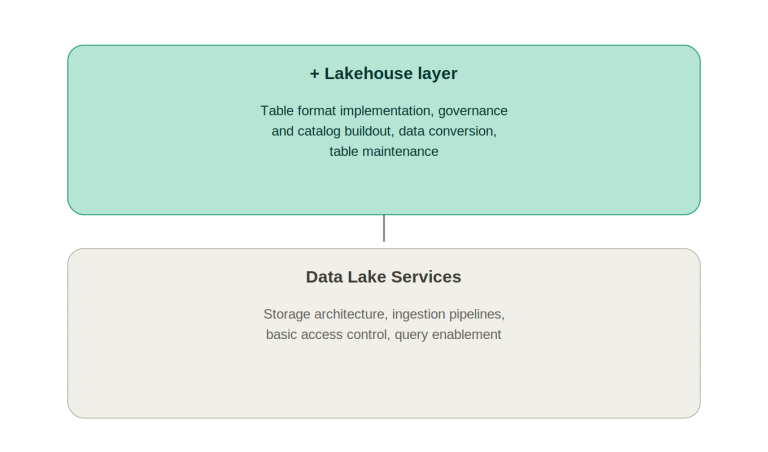
If you’re trying to figure out whether your own situation qualifies, our Data Lake Services team at Algoscale has these exact conversations regularly.
Use Cases Where a Lakehouse Makes the Case
Consolidating Fragmented BI and Reporting
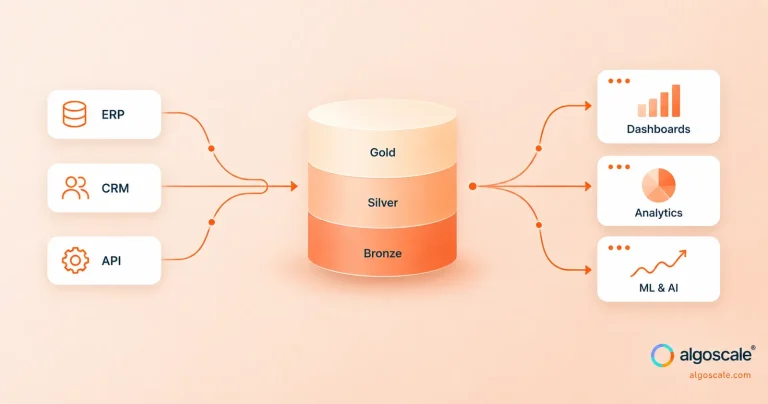
If your organization has multiple teams pulling from different systems and regularly landing on different numbers for what should be the same metric, this is one of the clearest, most common lakehouse use cases. The underlying cause is usually structural – different teams building their own “clean” versions of the same data because there’s no single, governed, trustworthy source. A lakehouse’s combination of reliability guarantees and centralized governance directly addresses this, giving every team a shared source of truth instead of independently maintained, slowly diverging copies.
Powering AI and Machine Learning Initiatives
Machine learning and AI projects need large volumes of data that’s both clean enough to trust and flexible enough to include structured, semi-structured, and unstructured sources together. Traditional data warehouses were built for structured business reporting, not this kind of workload, and companies trying to support serious AI initiatives on a warehouse-only architecture often hit real friction – either data isn’t accessible in the right form, or building a separate pipeline just for ML becomes its own maintenance burden. A lakehouse is built to serve both BI and ML from the same governed data, which is exactly the gap this use case needs closed. Our post on how generative AI benefits from a data lakehouse foundation goes deeper into this specific case.
Meeting Compliance and Audit Requirements in Regulated Industries
Healthcare, financial services, and other heavily regulated industries need to demonstrate not just current data accuracy but historical accountability – who accessed what, when data changed, and why. A plain data lake generally can’t answer these questions natively. A lakehouse’s transactional layer provides time travel and audit history as a built-in capability, and centralized governance tools make demonstrating compliance considerably less painful than reconstructing it after the fact. Our post on data lakehouse architecture for healthcare covers how this plays out in a specifically regulated context.
Real-Time Personalization at Scale
Retail and e-commerce companies running real-time personalization – product recommendations, dynamic pricing, targeted promotions – need to combine streaming behavioral data with historical purchase and inventory data, often at meaningful scale. This is a genuinely difficult combination for a traditional warehouse to serve well, since it requires both real-time ingestion and large-scale historical analysis from the same underlying data. A lakehouse’s support for both streaming and batch processing against the same governed tables fits this use case directly, without requiring a separate real-time architecture bolted on the side.
IoT and Sensor Data at Volume
Companies with significant IoT or sensor deployments – manufacturing, logistics, industrial equipment monitoring – generate large volumes of semi-structured, high-frequency data that doesn’t fit cleanly into a traditional relational warehouse model. A lakehouse’s flexible storage combined with reliability guarantees lets these organizations retain raw sensor data cheaply while still building trustworthy aggregated views for operational dashboards and predictive maintenance models from the same underlying platform.
Replacing Ungoverned Spreadsheet-Based Reporting
This use case is less technically dramatic but extremely common: an organization has genuinely outgrown maintaining critical business reporting through a sprawl of spreadsheets, manual exports, and ad hoc scripts, and needs a real, governed data platform instead. This doesn’t necessarily require the most advanced lakehouse capabilities from day one, but it’s often the actual trigger that starts an organization down this path – the pain of the current process becomes clearly worse than the effort of building something better.
Who Probably Doesn’t Need One Yet
It’s worth being honest about the other side of this. A small company with a single, well-functioning database or warehouse, one or two teams consuming the data, and no near-term AI initiatives likely doesn’t need lakehouse-specific capabilities yet – the added governance and table-format overhead wouldn’t be solving a problem that actually exists for them. Organizations still in an early, exploratory phase of understanding their own data may also be better served starting with a simpler data lake and adding structure once real patterns and pain points emerge, rather than architecting for complexity that hasn’t materialized.
Company size alone isn’t the deciding factor – a small company with a genuine AI product built on messy multi-source data can need a lakehouse more than a much larger company running one simple, well-behaved reporting pipeline.
An Illustrative Example
Picture two companies of similar size. The first runs a single product line, one primary database feeding a straightforward monthly reporting process, and no near-term plans involving machine learning. Nothing about their situation matches the use cases above – they’re a reasonable candidate to stay on simpler infrastructure until something genuinely changes.
The second company looks similar on paper – comparable revenue, comparable headcount – but sells across multiple channels, has marketing and finance teams pulling data from different systems and periodically disagreeing on basic numbers, and is trying to launch a personalization feature that needs both historical purchase data and real-time browsing behavior. This company is living several of the use cases above simultaneously, even though it’s not meaningfully larger than the first one. Size didn’t determine the need – the actual shape of their data problems did.
A Simple Self-Assessment
Ask honestly: Do more than one team regularly report different numbers for what should be the same metric? Is an AI or ML initiative stalled specifically because the data isn’t clean or accessible enough? Do you need to prove historical data accuracy for compliance, and currently can’t easily? Are you running both real-time and historical analysis needs against the same data, awkwardly, through separate systems? Is a spreadsheet-based reporting process genuinely breaking down under its own weight? If two or more of these are true, a lakehouse is very likely solving real problems for you, not just following a trend.
For a broader look at the measurable business impact once these use cases are addressed, our post on top benefits of a data lakehouse for enterprise data modernization is worth a read.
Matching the Use Case to the Investment
Recognizing which of these use cases actually applies to your organization matters because it shapes how you scope the work – a compliance-driven lakehouse for a regulated industry looks different in its early priorities than one built primarily to support an AI initiative. At Algoscale, our Data Lake Services team starts by understanding which of these real situations you’re actually facing, rather than proposing the same generic architecture regardless of the underlying need.
To see the broader range of data engineering and analytics work we do beyond lakehouse use case assessment specifically, take a look at what Algoscale builds across the data stack.
Why Algoscale
A few things shape how we actually deliver on data lake and data engineering work, beyond the architecture and practices covered above:
● Pre-built accelerators. We don’t start every engagement from a blank slate – proprietary accelerators built from prior implementations speed up common data source integration and analytics patterns.
● Faster time to value. For a focused initial scope covering core data sources and first analytics use cases, our accelerators typically compress development timelines to around four weeks, rather than the several months a from-scratch build often takes.
● Built on a scalable framework. Our implementation approach follows a repeatable, scale-ready framework, so the architecture built for your first use case extends cleanly as data volume and teams grow, rather than requiring a redo.
● Microsoft Solution Partner for Data & AI. Algoscale holds Microsoft Solution Partner status for Data & AI, including specific expertise implementing Microsoft Fabric as a modern data warehouse.
Frequently Asked Questions
1. Do we need to fit all six use cases to justify a lakehouse, or is one enough?
One genuine use case is often enough, particularly if it’s causing real, ongoing pain – like AI initiatives stalling or compliance audits being difficult. The use cases aren’t a checklist requiring multiple matches; they’re examples of the kinds of specific problems that make the investment worthwhile.
2. We’re a small company – can we still benefit from a lakehouse?
Yes, if you’re genuinely facing one of these use cases, such as building an AI product on messy data. Company size matters less than whether you’re experiencing the specific problems a lakehouse actually solves.
3. What if we’re not sure whether our situation qualifies?
The self-assessment questions in this post are a reasonable starting point, but an honest conversation with someone who’s implemented these architectures across different situations is often the fastest way to get a clear answer specific to your data and team.
4. Is “replacing spreadsheets” really a legitimate reason to build a lakehouse?
Yes, if the spreadsheet-based process has genuinely become unreliable or unsustainable at your current scale. The size of the underlying problem matters more than how technically sophisticated the trigger sounds.
5. Can our use case change after we’ve already built a lakehouse for a different reason?
Yes, and this is common. An organization that builds a lakehouse primarily to consolidate BI reporting often finds, months later, that the same governed data becomes the foundation for an AI initiative that wasn’t part of the original plan.
6. How do we avoid over-building for a use case we don’t actually have yet?
Scope your initial implementation to the specific use case that’s actually causing pain today, rather than architecting for every possible future scenario. A well-designed lakehouse foundation extends reasonably well to new use cases later without requiring you to have anticipated them all upfront.