

Enterprise data teams have spent the better part of a decade managing a frustrating architectural tradeoff. Cloud data warehouses delivered excellent SQL query performance and strong governance on structured data, but their proprietary storage formats and compute-coupled pricing made them prohibitively expensive at petabyte scale. Data lakes solved the cost problem by storing everything in cheap object storage, but without transactional guarantees, schema enforcement, or centralized governance, they quickly became what practitioners call data swamps: inconsistent, unreliable, and impossible to audit.
The data lakehouse resolves this tradeoff permanently. By layering open table formats such as Delta Lake and Apache Iceberg on top of low-cost object storage, the lakehouse delivers warehouse-grade reliability and analytical performance at data-lake-grade costs. In 2026, it is the production platform of choice for global banks, healthcare systems, manufacturing conglomerates, retail enterprises, and SaaS companies of every scale.
This guide covers every major benefit of data lakehouse architecture for enterprise data modernization: how it lowers infrastructure costs, eliminates operational fragility, accelerates AI and machine learning, unifies governance, and positions organisations to build the data products that will define competitive advantage over the next decade. Whether you are evaluating an AWS data lakehouse, an Azure data lakehouse on Microsoft Fabric, or a multi-engine Apache Iceberg deployment, the strategic case is the same.
Why Traditional Data Stacks Break at Enterprise Scale
Before examining the benefits of a modern data lakehouse, it helps to understand clearly what it replaces and why those legacy architectures consistently fail at scale.
The Data Warehouse Cost Trap
Cloud data warehouses such as Snowflake, Google BigQuery, and Amazon Redshift deliver excellent SQL performance on structured data. The problem is that they were designed for a world where analytical datasets were measured in gigabytes, not petabytes. Storing petabytes of raw event data in a proprietary warehouse format costs between $230 and $480 per terabyte per month. Compute and storage are tightly coupled, meaning you pay for both even when queries are not running. And because data lives in a proprietary format, extracting it for use by external tools is slow, expensive, and operationally disruptive.
Enterprises that have scaled into a cloud data warehouse find themselves negotiating renewals from a position of structural dependency. Switching is not technically impossible, it is economically irrational given the scale of the migration effort required. This lock-in dynamic is one of the most consistent pain points that organisations bring to a data lakehouse consulting service engagement.
The Data Lake Reliability Problem
The response to warehouse costs was the data lake: store everything in open-format Parquet files on Amazon S3, Azure Data Lake Storage, or Google Cloud Storage, and query it with Spark, Presto, or Hive. The concept was sound. The operational reality was consistently painful.
Raw data lakes have no transactional guarantees. A Spark job that fails mid-write leaves the target table in an unknown state. Concurrent readers may see partial data. There is no authoritative schema, so the same field may be represented as a string in one pipeline, an integer in another, and NULL in a third. Data lineage is manual at best, absent at worst. These are not edge cases, they are daily operational realities for engineering teams running unmanaged data lakes at scale. The data swamp is not a metaphor. It is the default outcome when object storage is used as a database without the metadata layer it requires.
The Fragmented Multi-Platform Problem
Many enterprises responded to the limitations of both warehouses and lakes by building both: a data warehouse for SQL analytics, a data lake for raw storage, a separate ML platform for data science, a streaming system for real-time events, and a BI layer on top of all of it. This architecture satisfied individual use case requirements but created a multi-platform operational nightmare. Data engineering teams report 60 to 70 percent of their capacity consumed by pipeline maintenance across these fragmented systems. Governance is retrofitted across seven platforms rather than designed into one. Every new data product requires coordinating schema changes, access policies, and lineage tracking across multiple systems that were never designed to work together.
What Is a Data Lakehouse and How Does It Work
A data lakehouse is a data architecture that provides ACID transaction guarantees, schema enforcement, and query performance comparable to a data warehouse, directly on top of low-cost open-format storage in a cloud object store. The architectural breakthrough is the open table format: a metadata and transaction log layer that sits on top of standard Parquet files in object storage.
Delta Lake, developed by Databricks and now governed by the Linux Foundation, was the first production-grade open table format. Apache Iceberg, governed by the Apache Software Foundation, followed and has become the dominant format in AWS-native and multi-engine architectures. Apache Hudl, optimised for high-frequency upsert workloads such as CDC pipelines, rounds out the three major open formats.
Each of these formats maintains a transaction log alongside the Parquet data files. Every write, update, and delete is recorded in the log before being applied to the data. This gives the lakehouse architecture the ACID guarantees that raw lakes lack, while keeping data in open Parquet files that any compatible engine can read. The result is a platform that combines the storage economics of a data lake with the reliability and query capabilities of a data warehouse, plus native support for ML, streaming, and unstructured data that neither predecessor could deliver.
Architecture Comparison: Data Warehouse vs Raw Data Lake vs Data Lakehouse
The table below compares the three major data architecture approaches across the dimensions that matter most for enterprise data modernization. Understanding these differences is essential before selecting the right platform for your organisation.
| Dimension | Cloud Data Warehouse | Raw Data Lake | Data Lakehouse |
| Storage Cost | $230–$480 / TB / month (proprietary format) | $20–$40 / TB / month (object storage) | $20–$40 / TB / month (open Parquet on object storage) |
| ACID Transactions | Full ACID support | None partial writes and corruption risk | Full ACID via Delta Lake or Apache Iceberg |
| Schema Enforcement | Strict schema-on-write | None schema-on-read, drift common | Enforced schema evolution with validation |
| Compute / Storage | Tightly coupled pay even when idle | Decoupled storage cheap, compute manual | Fully decoupled scale and shut down independently |
| Governance | Strong for structured data only | None no catalog, no lineage, no audit | Unified catalog, lineage, PII masking, row-level security |
| ML / AI Support | Limited structured data only | Manual extracts, no versioning | Native Feature Store, MLflow, model registry on same platform |
| Streaming | Batch-oriented, complex ETL required | Spark / Hive only, no unified view | Unified batch and streaming on same tables |
| Time Travel | Slowly changing dimensions required | No no transaction log | Yes full point-in-time queries via transaction log |
| Vendor Lock-in | High proprietary format, costly migration | Low open Parquet but no guarantees | Low open Delta / Iceberg readable by any engine |
| Multi-Engine Support | Limited to warehouse-native tools | Spark, Presto, Hive inconsistent | Spark, Flink, Trino, Athena, BigQuery, DuckDB and more |
Top Benefits of Data Lakehouse for Enterprise Data Modernization

1. Storage Cost Reduction of 30 to 60 Percent at Petabyte Scale
The most immediately quantifiable benefit of migrating to a data lakehouse is the reduction in storage costs. Object storage on AWS S3, Azure Data Lake Storage, or Google Cloud Storage costs between $20 and $40 per terabyte per month. Compare this to $230 to $480 per terabyte per month in a proprietary cloud data warehouse, and the economics are straightforward at any meaningful scale.
Beyond storage, the decoupling of compute and storage in a lakehouse architecture means that compute clusters can be shut down when not in use. An idle Databricks SQL warehouse costs nothing. An idle Snowflake virtual warehouse does not. For enterprises with variable query patterns, the ability to scale compute independently of storage delivers additional cost reductions that compound over time as data volumes grow.
Clients working with an experienced data lakehouse consulting service consistently achieve 30 to 60 percent total infrastructure cost reductions within 12 months of go-live, and that figure continues to improve as FinOps practices mature on the new platform.
2. ACID Transactions That Eliminate Operational Fragility
Full ACID transaction support is the single most important technical benefit of a modern data lakehouse architecture over a raw data lake. ACID guarantees mean that every write is atomic, meaning it either completes fully or does not happen at all. Concurrent readers always see a consistent snapshot of the data. Failed pipeline jobs leave tables in a clean prior state rather than a partially written corrupted one. Row-level updates and deletes, essential for GDPR right-to-erasure compliance and CDC-based data ingestion, work reliably without the workarounds that unmanaged lakes require.
In practice, this reliability translates directly to reduced pipeline failure rates, faster incident recovery, and a data engineering team that spends its time building new capabilities rather than diagnosing corrupted tables at 2 AM.
3. Enterprise-Grade Data Governance Across All Data Types
Data governance is the area where the distance between a data lake and a data lakehouse is most visible to non-engineering stakeholders. A raw data lake has no authoritative catalog, no automated lineage, no column-level access control, and no audit trail. Implementing these capabilities requires bolting on external tools that were never designed to work with open object storage natively.
A well-designed data lakehouse embeds governance into the architecture from the start. Databricks Unity Catalog provides automated column-level lineage, dynamic PII masking, row-level security, and cross-platform data sharing via the open Delta Sharing protocol. Microsoft Purview delivers equivalent capabilities across the Azure data lakehouse built on Microsoft Fabric, with deep integration into Azure Active Directory, Microsoft 365, and Azure Data Factory. Apache Polaris, now under Apache incubation, provides an open catalog server for multi-engine Iceberg architectures that require governance without vendor dependency.
For regulated industries, this is not a nice-to-have. BCBS 239 requires financial institutions to aggregate risk data with full lineage and auditability. HIPAA requires that PHI exposure be controlled and auditable at the column level. GDPR requires the ability to delete all records associated with a specific individual across every table in the platform. A lakehouse architecture with a purpose-built governance layer satisfies all of these requirements natively. Governance bolted across seven fragmented systems consistently produces gaps that regulators find.
4. Unified Platform for Analytics, Machine Learning, and AI
The most strategically important benefit of data lakehouse architecture in 2026 is its native support for the full AI and machine learning lifecycle on the same platform that serves business intelligence workloads. In legacy architectures, data scientists work on bespoke data extracts that go stale between refresh cycles. ML training runs on compute environments disconnected from the governed analytical platform, which means every model training run begins with a data procurement exercise rather than a query against production-quality data.
A lakehouse eliminates this friction entirely. The same Delta or Iceberg tables that power business dashboards serve as the training data for machine learning models. The Feature Store, built on the same object storage layer, makes pre-computed ML features available to any model without duplication. MLflow experiment tracking and the model registry are integrated into the same platform as the analytical workloads, so model governance and data governance are unified rather than siloed.
Organisations that have operationalised AI on a lakehouse consistently report model development cycles compressing from two to four weeks down to two to five days. The difference is not faster computation. It is the elimination of the data procurement, cleansing, and reconciliation work that consumed the majority of data scientists’ time in the legacy architecture.
For enterprises pursuing agentic AI strategies, the data lakehouse is the only architecture that provides the low-latency, governed, versioned data access that enterprise AI agents require at production scale.
5. Unified Batch and Streaming Analytics
Streaming analytics in legacy stacks requires a separate system. A Kafka cluster for event ingestion, a streaming database or processing engine for real-time computation, and a reconciliation layer to merge real-time and historical views into a consistent analytical surface. This is expensive to build, complex to operate, and consistently produces divergence between real-time and batch metrics that business stakeholders find confusing and engineers find embarrassing.
A data lakehouse architecture unifies batch and streaming into a single storage layer. Spark Structured Streaming ingests events into Delta or Iceberg tables with sub-second latency. The same table serves concurrent streaming writes and SQL batch reads with no duplication and no reconciliation pipeline. IoT telemetry from 50,000 sensors, clickstream data from a high-traffic e-commerce platform, financial transaction feeds, and logistics events are all first-class citizens on the same platform as the quarterly revenue reporting workloads.
For architectures requiring extremely low latency beyond what Spark’s micro-batch model can deliver, Apache Flink integrates natively with both Delta Lake and Apache Iceberg. On an AWS data lakehouse, Amazon Kinesis Data Analytics extends streaming support to high-throughput event processing at the scale that financial services and telecommunications workloads require.
6. Time Travel and Data Versioning for Compliance and Reproducibility
Delta Lake and Apache Iceberg both maintain a complete transaction log that enables point-in-time queries across any table. This capability, known as time travel, has practical applications across multiple enterprise use cases that go well beyond the technical curiosity it might appear to be at first glance.
For regulatory compliance, time travel means that a data lakehouse can produce the exact state of any risk position, customer account, or financial report as of any historical date, on demand, without maintaining separate historical snapshots or slowly changing dimension tables. BCBS 239 point-in-time risk reporting that previously required 48 to 72 hours of manual data preparation becomes a standard SQL query.
For machine learning, time travel enables fully reproducible model training. A data scientist can train a new model version on the exact historical snapshot used for a previous run, even months or years after the fact, and compare results with mathematical confidence that any difference in model performance is attributable to the model itself rather than changes in the training data.
For incident recovery, time travel means that a table corrupted by a bad pipeline run can be restored to its last clean state with a single command rather than a multi-hour reconstruction from backup files.
7. Elimination of Vendor Lock-in Through Open Standards
Data stored in a proprietary cloud warehouse format cannot be read by external tools without an export operation. At petabyte scale, that export is neither fast nor cheap. Enterprises that have scaled into a proprietary warehouse find that the cost of switching is so high that it effectively transfers pricing power to the vendor at renewal time. This is not a theoretical risk. It is a structural dynamic that plays out in contract negotiations across the enterprise data industry every year.
A data lakehouse built on Delta Lake or Apache Iceberg stores data in open Parquet files that any compatible engine can read. Spark, Flink, Presto, Trino, DuckDB, Amazon Athena, Google BigQuery, and dozens of other engines support both formats natively. Switching compute engines, migrating between cloud providers, or adopting a new analytical tool requires no data format conversion and no export pipeline. The data moves with the organisation rather than remaining hostage to a vendor contract.
This open standards foundation is what enables the hybrid architectures that sophisticated enterprises increasingly deploy: Databricks for ML and streaming workloads, Microsoft Fabric for Power BI-centric analytics, and an AWS data lakehouse or Azure data lakehouse as the shared storage substrate, all operating on the same underlying Parquet files with consistent transactional guarantees.
8. Self-Service Analytics and Accelerated Time to Insight
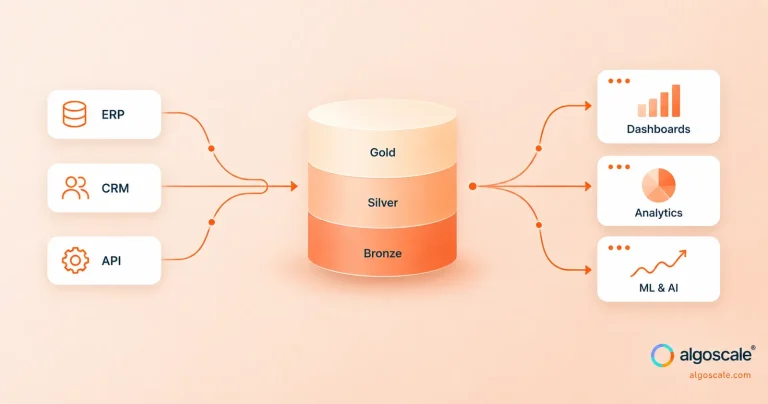
The Gold layer of a well-designed data lakehouse architecture is purpose-built for direct consumption by business analysts. Curated, business-ready aggregates covering revenue by product and geography, customer cohort retention, operational KPIs, and financial summaries are served through SQL interfaces including Databricks SQL, Microsoft Fabric SQL analytics endpoint, and Google BigLake to any compatible BI tool. Business analysts write standard SQL against these tables without requiring engineering involvement for every new query.
The practical impact of this self-service capability is significant. Self-service query latency drops from hours in a congested warehouse queue to seconds on a properly optimised lakehouse with Z-ordering and liquid clustering applied. Time-to-market for new data products compresses from four to eight weeks, the typical cycle when every new dataset requires an engineering sprint, to one to two weeks when analysts can explore and prototype directly against governed lakehouse data.
9. Dramatically Simplified Data Engineering Operations
Data engineering teams operating fragmented multi-platform stacks consistently report 60 to 70 percent of their capacity consumed by pipeline maintenance rather than building new capabilities. After consolidating on a unified data lakehouse platform, that figure drops to 25 to 35 percent. One platform to provision, monitor, and maintain replaces seven.
Declarative pipeline frameworks such as Delta Live Tables on Databricks reduce the engineering effort of building production data pipelines to schema definitions and quality expectation declarations. The framework handles dependency resolution, error recovery, incremental processing logic, and data quality monitoring automatically. Teams that previously required ten engineers to maintain a complex multi-platform pipeline estate find that they can operate a larger, more capable lakehouse platform with six engineers, freeing the remainder to build new data products rather than maintain existing plumbing.
AWS Data Lakehouse vs Azure Data Lakehouse: Platform Considerations

The platform decision is one of the most consequential choices in a data lakehouse migration engagement. Each major platform delivers the core benefits of lakehouse architecture with distinct strengths and cloud ecosystem alignments.
Databricks Lakehouse on AWS, Azure, or GCP
Databricks invented the lakehouse concept and remains the most complete implementation. Available across AWS, Azure, and GCP, it is the strongest choice for AI-intensive workloads, capital markets, healthcare, and multi-cloud deployments. Its Photon vectorised query engine delivers two to twelve times acceleration over standard Spark on analytical workloads. Unity Catalog provides the most mature unified governance layer currently available in the market, covering automated column-level lineage, dynamic PII masking, row-level security, and the open Delta Sharing protocol for cross-platform data access.
Azure Data Lakehouse on Microsoft Fabric
Microsoft Fabric is the recommended platform for enterprises with significant Azure, Power BI, and Microsoft 365 investments. OneLake, Fabric’s unified storage layer, makes every workload in the platform including data engineering, data science, real-time analytics, and Power BI read and write to the same Delta Parquet storage layer. Power BI Direct Lake mode reads natively from OneLake without import or DirectQuery limitations, delivering sub-second dashboard performance at scale. The Azure data lakehouse built on Fabric integrates deeply with Microsoft Purview for unified governance and Azure Active Directory for identity-based access control, making it the natural choice for Azure-native enterprises.
AWS Data Lakehouse with Apache Iceberg
For enterprises prioritising maximum portability and independence from any single vendor, an AWS data lakehouse built on AWS Glue Data Catalog, Amazon Athena, and Apache Iceberg provides the widest engine compatibility available. Any Iceberg-compatible engine, including Spark, Flink, Trino, and BigQuery Omni, can query the same underlying tables. This architecture is the natural choice for multi-cloud strategies, organisations with existing deep AWS investments, and those who wish to avoid dependency on Databricks or Snowflake licensing.
Platform Comparison: Databricks vs Azure Data Lakehouse vs AWS Data Lakehouse
The table below compares the three leading data lakehouse platforms across the dimensions that matter most for enterprise platform selection. Each platform delivers the core lakehouse benefits with distinct strengths aligned to different cloud ecosystems and workload profiles.
| Criteria | Databricks Lakehouse | Azure Data Lakehouse (Microsoft Fabric) | AWS Data Lakehouse (Apache Iceberg) |
| Table Format | Delta Lake (open, Linux Foundation) | Delta Lake via OneLake | Apache Iceberg (open, Apache Foundation) |
| Best For | AI / ML, multi-cloud, capital markets | Azure-native, Power BI-centric enterprises | AWS-native, multi-engine portability |
| Governance Layer | Unity Catalog | Microsoft Purview | AWS Lake Formation + Glue Data Catalog |
| Query Engine | Photon (2–12x Spark acceleration) | Fabric SQL Endpoint + Spark | Amazon Athena + EMR + Spark |
| BI Integration | Databricks SQL + any BI tool | Power BI Direct Lake (native, sub-second) | Amazon QuickSight + Athena |
| Streaming Support | Spark Structured Streaming + Apache Flink | Eventstream + Azure Event Hubs | Amazon Kinesis + EMR + Apache Flink |
| ML / AI Platform | Mosaic AI + MLflow + Feature Store | Azure ML + Azure OpenAI + Prompt Flow | Amazon SageMaker + Amazon Bedrock |
| Storage Layer | AWS S3 / ADLS Gen2 / GCS | OneLake (ADLS Gen2 backed) | Amazon S3 |
| Multi-Cloud | Yes AWS, Azure, GCP | Primarily Azure | Primarily AWS |
| Vendor Lock-in Risk | Low open Delta format | Medium Fabric ecosystem dependency | Low open Iceberg format |
| ACID Transactions | Full ACID via Delta Lake | Full ACID via Delta Lake | Full ACID via Apache Iceberg |
| Time Travel | Yes Delta transaction log | Yes Delta transaction log | Yes Iceberg snapshot history |
| Managed Service | Fully managed (SaaS) | Fully managed (SaaS) | Managed via AWS-native services |
| Ideal Data Volume | Petabyte scale | Enterprise to petabyte scale | Petabyte scale |
What to Expect from Enterprise Lakehouse Migration
A successful data lakehouse migration is a phased architectural transformation, not a lift-and-shift operation. Best-practice engagements begin with a structured assessment of the current data stack, a workload inventory, and a quantified ROI model that benchmarks current infrastructure spend against projected lakehouse costs. Architecture design follows, covering the medallion layer structure, governance model, streaming pipeline design, and FinOps cost controls.
The most critical principle of a well-executed lakehouse implementation is governance-first design. Unity Catalog, Microsoft Purview, or Apache Polaris must be configured before the first production table is created. Organisations that defer governance design and intend to retrofit it after go-live consistently find that data has been created without proper lineage, access policies have been applied inconsistently, and untangling the resulting governance gaps requires an effort comparable to building the governance layer correctly in the first place.
Partnering with an experienced data lakehouse consulting service provider ensures that platform selection, medallion architecture design, governance configuration, FinOps modelling, and migration sequencing are handled by engineers who have delivered comparable projects at enterprise scale. Referenceable case studies from your industry vertical, documented methodology, and defined post-migration managed services support are the non-negotiable criteria for evaluating implementation partners.
Delivered Outcomes: What Enterprise Lakehouse Adoption Achieves
The business case for migrating to a data lakehouse is grounded in delivered outcomes across infrastructure cost, analytical performance, and organisational agility.
• Storage costs at petabyte scale reduced from $230 to $480 per terabyte per month to $20 to $40 per terabyte per month on object storage
• Risk data aggregation time for BCBS 239 reduced from 48 to 72 hours to 2 to 4 hours on a Databricks lakehouse
• ML model training cycles compressed from 2 to 4 weeks to 2 to 5 days with governed lakehouse training data
• Data engineering pipeline maintenance reduced from 60 to 70 percent of team capacity to 25 to 35 percent after platform consolidation
• Self-service query latency reduced from hours in warehouse queue backlogs to seconds with Databricks SQL serverless
• Time-to-market for new data products reduced from 4 to 8 weeks to 1 to 2 weeks with Unity Catalog and Delta Live Tables
• 3 to 7 separate vendor platform contracts consolidated to 1 to 2 contracts with 40 to 60 percent savings on platform spend
• Compliance reporting preparation reduced from 3 to 5 manual days per cycle to automated same-day delivery
Build Your Enterprise Data Lakehouse with AlgoScale
The shift toward data lakehouse architecture is no longer just a technology modernization initiative; it is a strategic investment in scalability, governance, analytics, and AI readiness. Organizations that continue operating fragmented data ecosystems face rising infrastructure costs, inconsistent governance, duplicated data pipelines, and slower decision-making. In contrast, modern lakehouse platforms provide a unified foundation for data engineering, business intelligence, machine learning, and real-time analytics.
Whether your organization is evaluating an AWS-based lakehouse powered by Apache Iceberg, a Microsoft Fabric implementation on Azure, or a multi-cloud Databricks ecosystem, success depends on making the right architectural decisions, prioritizing workloads effectively, and executing the migration with minimal business disruption.
At AlgoScale, we help enterprises design, implement, modernize, and optimize lakehouse architectures that deliver measurable business outcomes. Our specialists bring deep expertise across Databricks, Microsoft Fabric, Apache Iceberg, data governance, cloud modernization, analytics engineering, and AI-ready data platforms. From strategy and architecture assessment to migration execution and ongoing optimization, we provide end-to-end support throughout the lakehouse journey.
If you’re planning your next-generation data platform and want a clear roadmap for adoption, connect with the AlgoScale team for a complimentary lakehouse readiness assessment. We’ll help you identify opportunities, evaluate platform options, and build a scalable architecture aligned with your business goals, governance requirements, and future AI initiatives.