


Every growing company eventually hits the same wall. Data starts pouring in from every direction. It can be from a customer transaction, a web event, an IoT device or third-party platforms, and more. That’s too much data in 30 seconds. And suddenly the systems that once worked just fine begin to crack under the weight of all.
Queries slow down. Reports take hours. The dashboard shows yesterday’s numbers.
The answer to this problem isn’t just more storage or faster server; it’s a smarter foundation. That’s exactly where big data architecture comes in.
Here’s something worth sitting with: The world is expected to generate around 221 zettabytes of data in 2026 alone. That’s a 22% jump over the previous year. And yet, despite massive investment, only 40% of companies worldwide reports that they are truly using their data analytics to the fullest.
The gap isn’t about having data. It’s about having the right infrastructure to handle it.
Here’s the twist…the global big data analytics market is projected to grow from $447.68 billion in 2026 to over $1.17 trillion by 2034. This reflects how urgent enterprises are looking for scalable data solutions. For startups scaling fast and enterprises managing complex data ecosystems, the pressure to build a reliable, future-proof data foundation has never been greater.
The harsh truth? Most organizations don’t revisit their data infrastructure until something actually breaks. A report becomes unusably slow, a critical design gets made on stale data, or the engineering team is spending more time firefighting pipelines than building anything meaningful, and suddenly, your technical debt is already piling up.
Rethinking your data architecture is about building a foundation that scales with your business. For companies navigating that shift, the right big data consulting services can mean the difference between a clean transition and a costly, drawn-out rebuild. This blog breaks down exactly how modern big data architecture makes that possible.
Let’s dive in.
What is Big Data Architecture?
Big Data Architecture is a structured framework that defines how large volumes of data are collected, stored, processed, and analyzed in an organization. In simple terms, it is the blueprint that shows how data moves from different sources to systems where it becomes useful for business decisions.
Today, companies generate massive amounts of data from websites, mobile apps, sensors, social media, transactions, and more. Traditional databases cannot handle this scale efficiently. That’s where Big Data Architecture comes in—it helps manage high-volume, high-speed, and high-variety data in a scalable way.
Signs Your Organization Has Outgrown Its Current Data Infrastructure
“Without big data analytics, companies are blind and deaf, wandering out onto the web like deer on a freeway.”- Geoffrey Moore
Most companies don’t realize their data infrastructure has become a liability, until the symptoms become impossible to ignore. And by the time they do, the cracks have usually been there for months.
If you’re a decision-maker wondering whether your current setup is holding your organization back, here are the signs that are hard to dismiss.
- Reports take hours to run – If pulling out a weekly performance report requires a coffee break or two, then something is off. Reports that once ran in minutes now tie up resources for hours, delaying the decisions that depend on them. This is almost always a sign that your systems weren’t designed to handle the volume of data you’re now generating.
- Teams rely on manual data extraction – When analysts spend their mornings downloading CSVs, copying data between spreadsheets, and manually stitching together reports from five different tools, that’s not a process problem; that’s an infrastructure problem. Manual data extraction is slow, error-prone, and a poor use of skilled people. This is a clear sign that your data pipelines aren’t doing the job they should be.
- Real-time insights are impossible- Your competitors are making decisions based on what’s happening right now. If your business is still running data that’s 24 hours or even a few hours old, you’re always reacting rather than leading. Real-time analytics isn’t a luxury reserved for tech giants anymore. It’s a baseline expectation for any organization to open at a scale.
- Data teams spend more time fixing pipelines than building – A high-performing data team should be building dashboards, models, and pipelines that drive business value. If instead they’re spending the majority of their time troubleshooting broken jobs, patching failing integrations, then that means the architecture under isn’t supporting them; it’s working against them.
- Infrastructure costs keep increasing – Spending more on storage, compute, and tooling every quarter is expected as you grow. But if the costs are rising faster than the value being generated from your data…that’s a red flag. Inefficient architectures tend to scale costs linearly, exponentially, while modern big data architecture is designed to scale efficiently, so you’re not paying for what you don’t use.
If two or more of this sounds familiar, your data infrastructure has likely already become a growth bottleneck.
Not sure where your data infrastructure stands? Algoscale offers a free architecture assessment to help you identify gaps before they become bottlenecks.
What Big Data Architecture Actually Solves for Enterprises
Before modern big data architecture vs. After.
Here’s what changes:
| Without It | With It |
| Pipelines break under load | Scalable pipelines that grow with your data |
| Decisions made on yesterday’s data | Real-time analytics, right when you need it |
| Data scattered across siloed systems | One centralized platform, one source of truth |
| Analysts wait days to access data | Self-serve access across teams, instantly |
That table isn’t hypothetical. It’s the difference organizations experience when they move from patched-together legacy systems to a modern big data architecture built for scale. Here’s what each of those shifts really means in practice.
1. Scalable data pipelines, That Don’t Break Under Pressure
Legacy pipelines are typically built for a predictable, manageable flow of data. The moment volume spikes, a product launch, a seasonal surge, a sudden increase of IoT data, they all get in. Modern architecture solves this by building pipelines that are elastic by design. These scale up when demand increases and scales down when it doesn’t, without manual intervention and without downtime.
2. Real-time analytics capabilities, From Nice to Have to Standard
There’s no reason real-time analytics has gone from a competitive advantage to a baseline expectation. Businesses will be able to act on data as it’s generated, not hours later. This helps in making faster and sharper decisions. Whether it’s detecting a fraud attempt the moment it happens or adjusting a pricing model, mid-campaign, real-time capability changes how quickly an organization can respond to what’s actually happening.
3. A Centralized data platform- One Version of the Truth
One of the most underrated problems in growing organizations is that different teams are working off different data. Sales have their numbers, marketing has theirs, and they rarely match. A centralized data platform eliminates confusion. Every team pulls from the same source, with the same definitions, the same logic, and the same freshness of data. Decision-making becomes faster and far less political.
4. Improved data accessibility across the business
Modern architecture isn’t just built for data engineers; it’s built for everyone who needs data to do their job. That means analysts, product managers, operations lead, and business stakeholders can access what they need, and yes, no ticket raising or waiting for three days. Self-serve data access isn’t just convenient; it multiplies the value of everything your data teams have built.
The Modern Big Data Architecture Stack Used by High-Growth Companies
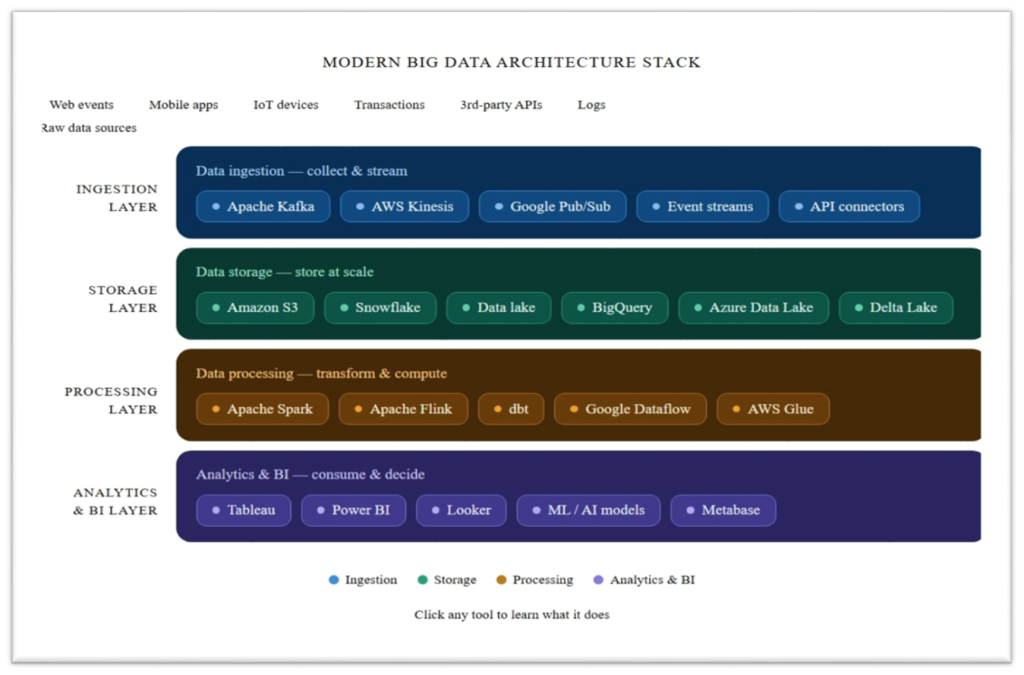
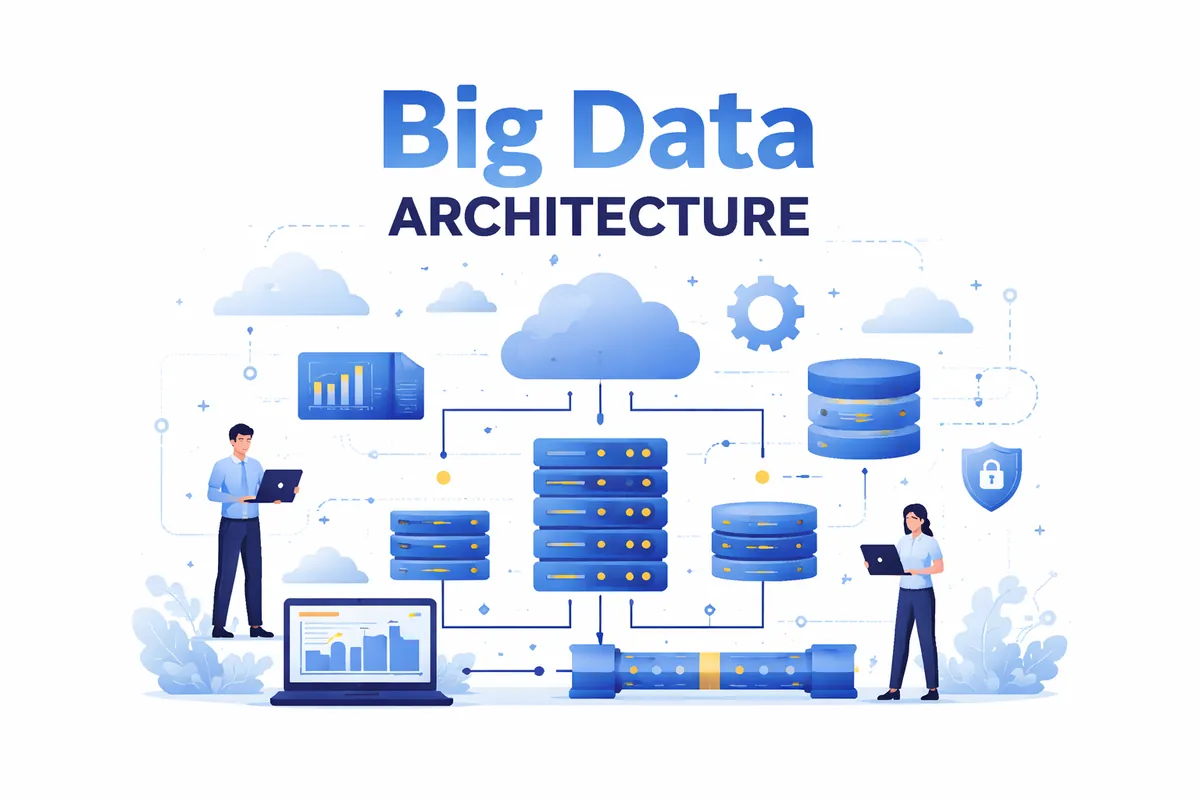
The diagram above tells the story at a glance. A modern big data architecture isn’t a single tool or platform. It’s a layered stack, where each layer has a specific job, and the whole system works only when those layers talk to each other seamlessly. Let us break down what happens at each level for a better understanding.
1. Data Ingestion
Bringing All Your Data into One Place
Before anything can be analyzed, data must be collected, and in enterprise environments, that data is coming from dozens of sources simultaneously. Apache Kafka handles this at scale; this tool acts as a real-time event streaming backbone that can invest millions of data points per second without dropping a beat! On the other hand, APIs pull in structured data from external platforms, while event streams capture user behavior and system activity as it happens. For big data consulting companies with physical operations, IoT sensors feed device and sensor data directly into the pipeline.
2. Data Storage
Holding It All Without Breaking
Once data is ingested, it needs a home to stay, one that can scale to petabytes without performance degradation. Data lakes store raw, unstructured data exactly as it arrives, preserving everything for future use. Amazon S3 is the most widely adopted cloud storage platform. The tools offer a virtually unlimited capacity with a cost-effective solution. Snowflake bridges the gap between raw storage and structured querying, making data accessible to data engineers and data analysts through a single platform.
3. Data Processing
Turning Raw Data into Something Useful
Stored data is only valuable when it’s processed. This is where Apache Spark comes in, a distributed processing engine capable of handling both batch workloads and real-time analytics at a massive scale. For businesses that need continuous, low-latency stream processing, Apache Flink is increasingly the go-to choice, especially in use cases like fraud detection and live recommendation engines.
The difference between batch and streaming processing matters here.
Batch processing handles large historical datasets on schedule, whereas stream processing handles data as it flows in milliseconds by milliseconds. Modern big data analytics architecture often runs both in parallel.
4. Analytics and Business Intelligence
Where Insights Actually Land
All of the above exists to serve this final layer, the point where data becomes a decision. Tableau and Power BI are the two dominant and easy-to-use BI tools used by enterprise teams to build dashboards, track KPIs, and visualize trends without writing a line of code. Increasingly, AI-driven analytics platforms are being layered on top, enabling natural language queries and automated anomaly detection that surface insights teams might otherwise miss entirely. This is the layer your business stakeholders interact with every day, which means getting the layers beneath it right isn’t optional.
Big Data Architecture Patterns Enterprises Use Today
Before you pick up a pattern, it helps to see them side by side. Here’s a quick orientation:
| Pattern | Best For | Complexity | Real-Time? |
| Lambda | Batch+ real-time hybrid needs | High | Yes (dual path) |
| Kappa | Streaming-first, simplified pipelines | Medium | Yes (Single path) |
| Data Lakehouse | Unified analytics + ML workloads | Medium | Partial |
| Medallion | Data quality and layered refinement | Low-medium | Partial |
Now let’s go deeper into each one, because choosing the right big data architecture pattern for your organization isn’t just a technical decision. It’s a strategic one.
Lambda Architecture- The Proven Workhorse
Lambda architecture was built to answer one question: How do you handle both massive historical datasets and real-time data without sacrificing accuracy or speed?
The architecture does this by running two parallel processing paths. The batch layer handles large volumes of historical data with high accuracy, reprocessing everything periodically to ensure everything is correct. The speed layer handles incoming data in real time, sacrificing some precision for low latency. Both outputs are merged at the serving layer, giving users a complete and current view of data. This has been the backbone of enterprise big data technical architecture for over a decade.
Over 72% of IT and engineering leaders now use data streaming for complex operations, and Lambda remains the dominant architecture for businesses that need both historical accuracy and live data running in parallel.
1. Kappa Architecture – Simpler, Streaming-First
Kapp was built as a direct response to Lambda’s complexity. You might be thinking, if the streaming technology is powerful enough, why maintain a batch layer at all?
We will make that clear for you! Kappa architecture has the same basic goals as Lambda, but all the data flows through a single path via a stream processing system. Here, the historical data is treated as stream replayed from long term storage when needed. One pipeline, one codebase, on processing engine can be Apache Kafka or Apache Flink.
Did you know? More than 90% of organizations are planning to use Apache Kafka in mission-critical use cases, the exact backbone that Kappa architecture is built on. That number alone tells you where enterprise streaming infrastructure is headed.
2. Data Lakehouse Architecture
The Modern Unified Platform
The Lakehouse pattern emerged to solve a specific frustration: organizations were maintaining a data lake for raw storage and a data warehouse for structured data. Two systems, double the cost, constant data duplication, and, of course, double the trouble.
The Data Lakehouse architecture combines the best features of data warehouses and data lakes, providing the flexibility and cost-effectiveness of data lakes with the structure and performance of data warehouses through technologies like Delta Lake, Apache Iceberg, and Apache Hudi.
According to McKinsey, numerous banks have achieved a 70% cost reduction simply by adopting data lake infrastructure, and the Lakehouse takes that further by removing the separate warehouse on top of it.
3. Medallion Architecture
The Data Quality Layer
This one doesn’t get enough credit in most architecture conversations, but it’s quietly become one of the most adopted patterns in modern data engineering.
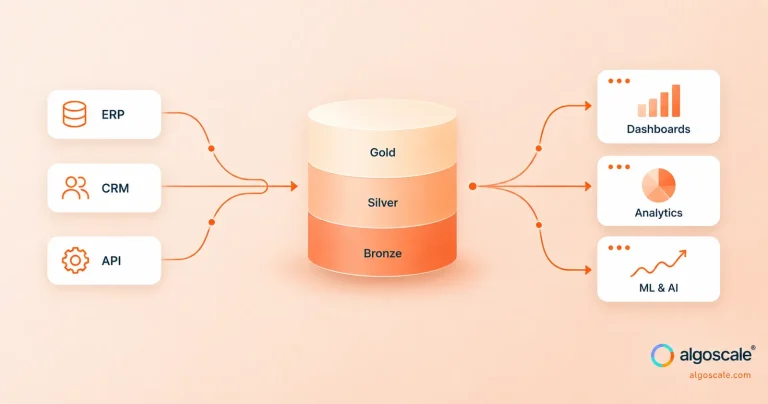
The medallion architecture, sometimes also called Bronze/Silver/Gold, is a layered data design pattern popularized by Lakehouse platforms like Databricks. Rather than focusing on batch vs stream, Medallion improves quality of the data with successive refinement stages.
The bronze layer holds raw and unaltered data ingested exactly as it arrived. The Silver layer is where cleaning, deduplication, and standardization happen. The Gold layer delivers analytics ready, business logic enriched data that analysts and dashboards can consume directly.
Enterprise governance studies show the cost of retrofitting data governance is 5-10 times higher than building it in from the start, which is exactly the problem Medallion architecture is designed to prevent.
4. Real Business Use Cases of Big Data Architecture
Talking about data pipelines and processing engines is one thing. But the real question that decision makers always ask us is simpler: What does this actually do for my business?
Here’s where modern big data solutions stop being infrastructure conversations and start becoming revenue, risk, and efficiency conversations. These are the use cases enterprises are actively running on production-grade big data analytics architecture right now.
5. Real-Time Fraud Detection- Catching What Humans Can’t
Imagine a customer making a purchase in Mumbai around 9 AM and another transaction attempting to go through in London at 9:04 AM. Without real-time data processing, that red flag surfaces in a report the next morning after the damage is done. With a modern big data architecture running Apache Kafka and Flink, that anomaly is caught in milliseconds, the transaction is flagged, and the customer gets an alert before they’ve even put their phone down. Businesses these days are deploying Kafka class streaming and event driven architectures to enable instant fraud detection.
6. Customer Behavior Analytics – Moving Beyond Guesswork
Most companies think they understand their customers. Then they look at the data and realize they’ve been making decisions based on monthly aggregates and gut instincts. Real customer behavior analytics are built on a proper data architecture. This tracks every click, scroll, session, cart abandonment, and support interaction in real time and stitches it all together into a single, coherent picture. This helps you understand your users and knowing about which customer segment is about to churn before they do.
7. Predictive Analytics
A manufacturing plant runs thousands of sensors across its equipment. Historically, maintenance was scheduled for machines to get serviced every 90 days, whether they needed it or not; they were repaired after breaking mid-shift. Predictive analytics changes that entirely. By processing sensor data continuously, the system learns what “normal” looks like for every machine and raises an alert the moment readings start drifting toward failure.
Gartner projected that through 2026, 60% of AI projects will be abandoned if they aren’t supplied with AI-ready data, which is exactly why getting predictive analytics foundation right matters so much before the models are even built.
8. IoT Data Processing
A single smart factory can generate millions of data points per minute across sensors, equipment, conveyor systems, and environmental monitors. A connected logistics fleet tracking hundreds of vehicles does the same. The volume isn’t the challenge it is processing all of it fast enough to be useful, while storing it cost-effectively for long term analysis. Big data architecture handles IoT data at both ends. By end of 2025, 75% of enterprise data was being created and processed at the edge, according to IDC, a number that makes IoT data processing one of the most urgent architectural challenges in enterprise infrastructure today.
Supply Chain Intelligence- Seeing Disruptions Before They Hit
This is the use case that went from “interesting pilot” to “board level priority” after global supply chains were hammered in recent years. The question enterprises are now asking isn’t just “where is my inventory?” It’s “what’s going to disrupt my supply chain in the next 30 days, and what should I do about it now?
Modern big data architecture makes that question answerable. By ingesting satellite imagery, port congestion feeds, supplier financial signals, weather data, and logistics telemetry into a unified pipeline, companies can model disruption risk weeks ahead of when it materializes a spreadsheet.
Challenges Companies Face While Implementing Big Data Architecture
85% of big data projects fail. Not because the technology doesn’t work, but because organizations underestimate the complexity of implementing it inside a real business with real constraints.
That number should give any decision-maker pause. And the reasons behind it are rarely mysterious. They show up the same way, in businesses. Here’s what they actually look like.
Common challenges include:
- Integration with legacy systems– Many businesses didn’t start with a clean data slate. They have a CRM from 2009, an ERP that predates the cloud, and a dozen homegrown databases held together by institutional knowledge and duct tape. Connecting any of this to modern architecture is a bit challenging and sensitive too. Nobody wants to be the team that “broke” the billing system during a migration.
- High infrastructure complexity– A modern big data stack involves ingestion tools, processing engines, storage platforms, orchestration layers, monitoring systems, and BI tools, all of which need to work together reliably at scale. Every tool added is another dependency, another failure point, and another skill set someone on the team needs to own.
- Data governance and compliance- You can build the most elegant pipeline in the world and still have it grind to a halt because nobody agreed on who owns the data, what “CLEAN” means or which team is responsible when something goes wrong.
- Managing large-scale data pipelines- Pipelines that work in staging behave very differently in production. At scale, a minor schema change upstream can result in a full pipeline failure downstream. A missed SLA on one job delays six others. And without proper observability, the data team is always the last to know.
- Real-time processing limitations– This can sound straightforward until you actually try to build it. Streaming data is harder to validate, harder to debug, and even harder to reprocess than batch data. Exactly once delivery guarantees, out-of-order event handling, and stateful computation all add layers of complexity that batch pipelines simply don’t have.
Closing the gap requires both the right architecture and the right team to operate it, which is something a lot of businesses discover only after they’ve already invested heavily in the wrong direction.
Best Practices for Designing Scalable Big Data Architecture
- Are your pipelines modular and independently deployable?
- Are storage and compute decoupled?
- Is data governance defined before data goes into production?
- Do you have real-time monitoring and alerting on every pipeline?
- Are you running cloud-native, or still lifting and shifting on-premises logic?
Have you ticked two or more? Then you should definitely keep reading.
- Design modular data pipelines– build each pipeline as an independent unit, so one failure doesn’t take everything downstream with it.
- Separate storage and compute layers– scale only what you need, when you need it. This is the core principle behind platforms like Snowflake and Databricks.
- Implement strong data governance from day one– define ownership, access controls, and data lineage before anything goes into production. Retrofitting costs your business more.
- Monitor pipelines continuously– treat data infrastructure with the same observability standards as production software. Catch failures before your business stakeholders do.
- Adopt cloud-native infrastructure– AWS, Google Cloud, and Microsoft Azure each bring distinct strengths. The right choice depends on your team, your tooling, and
When Companies Should Consider Big Data Architecture Consulting
Does this sound familiar?
“Your data team is talented, but they’re stretched. The backlog is growing faster than it’s being cleared. Every new initiative is delayed because the foundation under it isn’t solid enough to build on. And every quarter, the gap between what your business needs from data and what it’s getting widened a little more. This is the point where most organizations start asking whether they need outside expertise. Here’s how to know when the answer is yes.”
- Scaling from terabytes to petabytes– The jump from terabytes to petabytes isn’t a linear scaling problem; it’s an architectural one. Systems that perform beautifully on one scale routinely collapse at the next. Query patterns, partition strategies, indexing logic, and cost optimization all need to be rethought from first principles when data volume crosses certain thresholds. A big data consulting partner who has made this transition across multiple industries can compress what might be an 18-month internal learning curve into a fraction of that time.
- Migrating to cloud data platforms– Cloud migrations have a reputation for going over time and over budget, and it’s usually not because the cloud is hard. It’s because migration projects surface every piece of technical debt, and every assumption baked into the legacy system that nobody wrote down. Expert guidance on migration sequencing, data validation, rollback planning, and cutover strategy is the difference between a migration that lands cleanly.
- Building real-time analytics infrastructure– The tooling choices, streaming pipeline design, exact-once guarantees, monitoring strategy all of it requires experience that most data teams are still building. If real-time capability is a strategic priority rather than having specialists who have built and operated these systems in production, you will get there significantly faster than trial and error in a live environment.
- Modernizing legacy data warehouses- Legacy warehouses are like old houses, expensive to maintain and impossible to extend without disturbing the foundation. Modernization isn’t just a technical project; it’s a business continuity challenge. Consulting partners who specialize in warehouse modernization bring proven migration patterns, parallel-run big data frameworks, and validation of playbooks that protect business continuity throughout the transition.
Future of Big Data Architecture
The organizations leading their industries in five years are marking architecture decisions right now. Here are the four forces shaping where enterprise data platforms are header, and the signals worth paying attention to.
- Real-time data processing– This became the default. Batch processing isn’t disappearing, but it’s increasingly becoming the fallback rather than the default. As streaming infrastructure matures, organizations are setting real-time as the baseline expectation for new data products.
- AI-driven data platforms- AI isn’t just a consumer of data anymore; it’s becoming an active participant in how data is managed. AI-assisted pipeline monitoring predicts failures before they happen. Automated data quality remediation that fixes schema drift without human intervention. The next generation of data platforms won’t just store and process data; they’ll actively manage, curate, and surface it. AI is now automating data preparation and improving anomaly detection.
- Data Mesh Architecture- For years, data was treated like infrastructure, centrally owned, centrally managed, and perpetually backlogged. Data mesh flips that model. Rather than routing every data need through a central team, data mesh distributes ownership to the domain teams closest to the data. The central platform team shifts from being a bottleneck to being an enabler, providing the standards, and infrastructure
- Cloud-native data stacks- The future of enterprise data infrastructure is fully cloud native, not cloud hosted versions of on-premises architectures, but systems designed from the ground up for elasticity, managed services, and pay-as-you-go economics. Serverless processing, auto scaling storage, and native ML integration are rapidly becoming the standard expectation rather than the premium option.
Conclusion
Big data architecture isn’t a one-time project. It’s an ongoing investment in a business’s ability to make faster, smarter, decisions at whatever scale your business demands today and tomorrow. The companies getting this right aren’t the ones with the biggest budgets. They’re the ones who made deliberate architecture choices early, built with scalability in mind, and didn’t try to solve every problem at once.
If you’re reading this far, chances are you’re somewhere on this journey, maybe evaluating patterns, maybe dealing with a legacy system that’s starting to crack, maybe trying to make the case internally for why it’s time to modernize. Whatever stage you’re at, the next step doesn’t need to be a massive multi-year transformation. It starts with a clear-eyed assessment of where you are, where you’re going, and what the right path looks like for your specific context.
That’s exactly what Algoscale helps enterprises do. With deep expertise across the full big data architecture stack, from pipeline design and cloud migration to real time analytics and data governance, we work with businesses, startups, and data teams to build data infrastructure that performs in production, not just in decks.
Whether you’re scaling from terabytes to petabytes, modernizing a legacy warehouse, or building your real time analytics capability from the ground up, the right data architecture consulting company makes all the difference.