


A data model earns its keep when it becomes tables. Every one of the data modeling tools on this page draws an entity-relationship diagram. They differ on what happens after that: whether the model can generate DDL for the database you run, stay in step with that database as it changes, and be read by people who never open the modeler.
Price splits them just as sharply. erwin and ER/Studio print per-seat figures, Oracle’s modeler is free and dbdiagram.io’s paid plans start at $8 a month billed annually. SqlDBM and SAP PowerDesigner publish no number. PowerDesigner’s sap.com product page returned “page not found” when we checked on 12 November 2026, and SAP has not said in public when maintenance of the current version ends.
This page covers schema design: conceptual, logical and physical models, forward and reverse engineering. If you came looking for transformation models written in SQL, the explainer below sends you to the right comparison. Prices and limits were read on vendor pages on 11 and 12 November 2026.
7 Best Data Modeling Tools: Quick Comparison
| Tool | Best For | Public Reviews | The Catch | Starting Price | Cloud Warehouses It Names | Access |
|---|---|---|---|---|---|---|
| 1SqlDBM | Cloud warehouse teams on dbt | G2: modelers like working in parallel; one architect finds the APIs lacking | Quote-only price, and AI features cost extra | Not public (per seat, by quote) | Snowflake, Databricks, BigQuery, Redshift, Synapse, Fabric | Sales call for price and trial |
| 2erwin Data Modeler | Mixed relational and NoSQL estates | PeerSpot: strong on relational logical-physical work; large models open slowly | Shared model mart needs the dearer Workgroup edition | USD$3,588.38 per named user a year | Snowflake, Databricks, BigQuery, Redshift, Synapse | Buy online; trial needs registration |
| 3Algoscale | Retail and e-commerce build-outs | No G2 or PeerSpot listing: our own published case study only | You still license a modeler separately | Scoped per project | Snowflake, in the cited engagement | Talk to us |
| 4ER/Studio | Architects who need glossary links | PeerSpot: model compare praised; the report writer panned | Glossary and Purview/Collibra links are quote-only | $2,687 per user; billing term not stated | Snowflake, Databricks, BigQuery, Redshift, Fabric | Checkout for two tiers; trial needs registration |
| 5Oracle SQL Developer Data Modeler | Oracle shops with no budget | PeerSpot, on SQL Developer: modeling helps manage databases; mostly used by DBAs | No Data Modeler release listed after 24.3 | Free | None: DDL for Oracle, SQL Server and Db2 only | Free download from Oracle |
| 6SAP PowerDesigner | Existing PowerDesigner customers | PeerSpot: lineage analysis praised; upgrade support called tedious | No public SAP date for 16.7 maintenance | Not public | Snowflake and Redshift, updated in 16.7 SP02 | No public trial or buy page |
| 7dbdiagram.io | Developers keeping ERDs in Git | G2 and Hacker News: simple for ER diagrams; big schemas get crowded | Physical schemas only; exporting needs a login | Free; Personal Pro $8/mo billed annually | Reads Snowflake and BigQuery; writes no warehouse DDL | Draw without an account |
Not sure which of these fits your stack?
Tell us what you are running today and what you need it to do. We will tell you which of these we would pick, and why. We are not going to pitch you.
How We Researched These Data Modeling Tools
We started from the desktop and mobile search results for this term: twelve sources, Google’s AI Overview included. Two were Reddit threads we could not open, which we could not access. Eight of the rest list products, and three of those eight were written by vendors that list their own product: Sprinkle Data, SqlDBM and Redgate.
Nothing was trialled and no account was created. Five of the six vendors offer no instant trial: three ask for a registration or a sales conversation, Oracle’s download runs through its software download centre, and PowerDesigner has no public trial. Prices, editions and database lists come from each vendor’s own pages, read on 11 and 12 November 2026. We made one check by hand: on 12 November 2026, dbdiagram.io’s editor opened without an account, and Export asked for a login.
We read 46 reviews in full. On PeerSpot that was ten for ER/Studio, six for PowerDesigner, four on the Oracle SQL Developer listing and three for erwin. On G2 it was ten for SqlDBM. For dbdiagram.io it was thirteen across G2, Hacker News and Product Hunt. We dropped both Product Hunt reviews of dbdiagram.io: one reviewer makes a competing ERD tool and the other works at Holistics, which owns dbdiagram.io.
Lucidchart was on our first list, and five of the sources name it. SAP PowerDesigner took its place. Lucidchart is general-purpose diagramming, while PowerDesigner raises a question its users are asking right now: SAP still ships it but has not said in public how long 16.7 will be maintained. dbt is named by four of the twelve sources and is left out on purpose, for the reason the next section gives. The order below runs from the widest fit to the narrowest.
Five things decided the order, heaviest first:
- What it can generate DDL for – a model reaches production as a CREATE script for your warehouse, and the target lists here range from three databases to more than twenty
- Whether you can see the price – four of the six vendors print a figure and two print none, which decides whether a team can budget for data modeling software before a sales call
- Whether the model keeps up with the database – compare-to-live, ALTER scripts and version control are what stop a diagram drifting from production within a quarter
- Who else can read it – view-only seats, web portals and glossary links decide whether analysts and the business use the model or ask the modeler
- Whether the vendor is still investing – one vendor here has not dated its current version’s maintenance in public and another lists no modeler release since 2024, and a modeling standard is expensive to move off
Schema Design or Transformation: Which Kind of Data Modeling Tool Do You Need?
The phrase covers two different jobs, and search results mix them. This page ranks schema-design tools: dedicated ERD and enterprise modelers, and ERDs written as code.
A schema-design tool, which is what most database modeling tools and ER diagram tools are, starts from entities and relationships and generates the DDL that creates them. A transformation framework starts from SELECT statements that build tables inside a warehouse that already exists. Teams often need both. SqlDBM, at number one, is where the two meet, because it integrates with dbt. If dbt is what you meant, our dbt alternatives comparison covers that side.
| What you are trying to do | What you need | Where to look |
|---|---|---|
| Draw entities and relationships, then generate the CREATE scripts | A schema-design tool | This page |
| Write SELECT statements that build and test warehouse tables | A transformation framework such as dbt | dbt alternatives |
| Decide between a star schema, a snowflake schema and a data vault | A modeling method, chosen before any tool | Star schema vs snowflake schema vs data vault |
| Plan a warehouse end to end, layers and loads included | A design approach, then a tool | Data warehouse design |
| Sketch boxes with stakeholders, with no DDL at the end | A whiteboard or general diagramming tool | Any of them; none is ranked here |
1. SqlDBM: Best for Cloud Warehouse Teams Who Version the Model Beside dbt
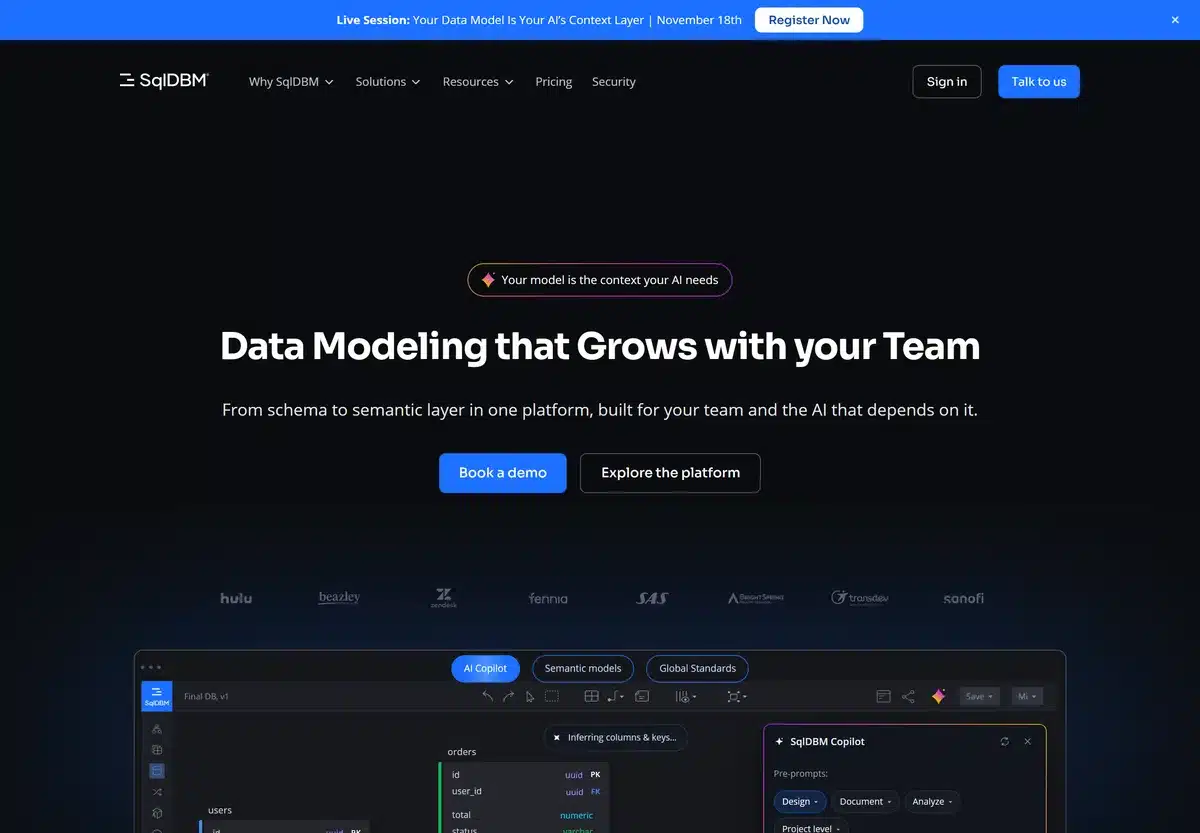
What it does: A browser-based modeler for conceptual, logical and physical models, with forward and reverse engineering, compare against a live environment, and dbt, Git and API integrations.
Who this is for: Analytics and data engineering teams on a cloud warehouse who already keep transformation code in Git. Pricing is per seat, with view-only users listed as included, which suits a few modelers serving a wider team of readers.
SqlDBM leads this list because it is the dedicated modeler built around the warehouses most teams now run. Its homepage names Snowflake, Databricks, BigQuery, Redshift, Synapse and Microsoft Fabric, and it is the most-cited tool on this search page: seven of twelve sources name it.
Its dbt and Git integrations are where schema design meets transformation code, a pairing our dbt alternatives post covers from the other side.

Key Features
- Conceptual, logical and physical modeling in the browser, with concurrent editing
- Forward and reverse engineering with ALTER script generation
- Compare a model against a live environment before pushing changes
- Native dbt, Git and API integrations, plus Jira and Confluence
Pros and Cons
Pros
- Snowflake, Databricks, BigQuery, Redshift and Fabric are all named, so cloud warehouse DDL is the core use case
- The model can sit in Git next to the dbt project
- Publishes a SOC 2 Type II badge, as dbdiagram.io does; we found no such badge on the desktop modelers’ pages
Cons
- No public price: per seat, quote only, with AI features billed separately
- Narrower than erwin on targets, with no MongoDB, Cassandra or Neo4j modeling named
- A small public review base, under twenty on G2, where reviewers name the APIs (Jake A., 12 February 2026) and CI/CD (Michal P., 26 January 2026) as weak spots
- One of the ranking pages that puts SqlDBM first is published by SqlDBM
What Users Say
I like that modelers in my company can work together on the same project in parallel.
Michal P., Technical Architect, mid-market company, on G2, 26 January 2026Rated 4 out of 5. The same review names CI/CD as the area most in need of improvement.

Automation and integration options are limited. For example, the APIs feel lacking.
Jake A., Data Architect, enterprise, on G2, 12 February 2026Rated 3.5 out of 5. The same review opens by calling SqlDBM easy to use.

Pricing
Not published. SqlDBM’s pricing page prints no figure. It says pricing is per user and that “Your price scales with seats, not with features” (read 11 November 2026). The number comes from a quote.
View-only consumer users are listed as included. The page does not say they cost nothing, so ask how the quote counts them. Copilot and AI credits are priced separately.
Bottom Line
The first call for a Snowflake, Databricks or BigQuery team that keeps dbt in Git.
Get the per-seat quote and the view-only terms in writing, and weigh the small review base, before you sign.
2. erwin Data Modeler: Best for Estates That Mix Relational and NoSQL Stores
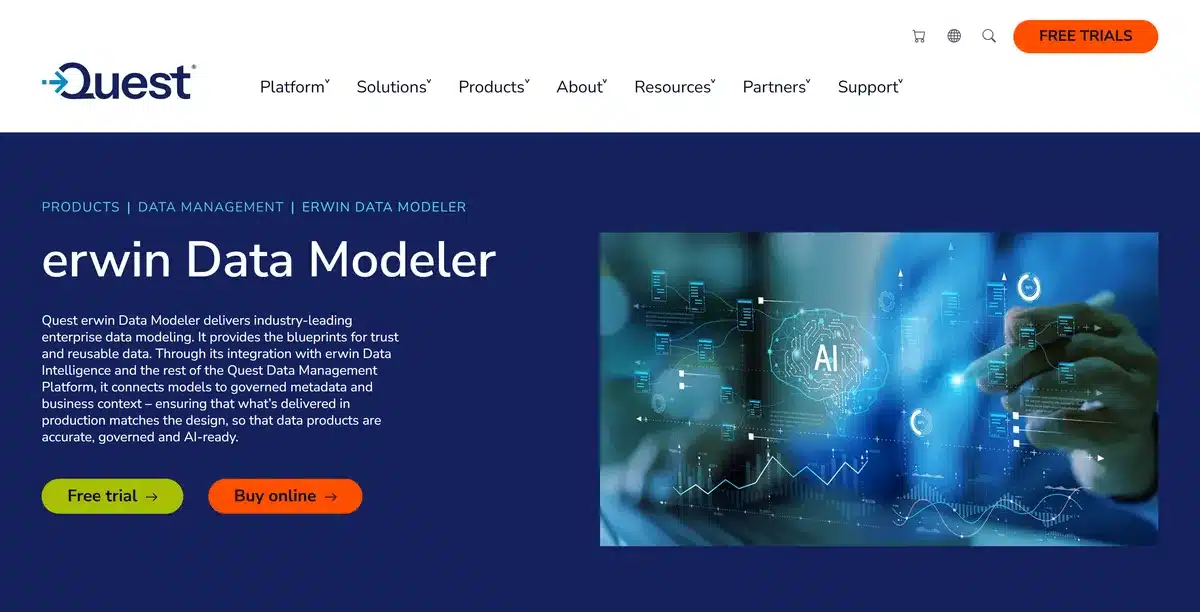
What it does: Quest’s desktop modeler for logical and physical models across relational, NoSQL and file targets, with Complete Compare and a Workgroup edition that keeps models in a central mart.
Who this is for: Large enterprises with a central data architecture function and a mixed estate. Of the PeerSpot reviewers who give a company size, 49 are large enterprises, 13 small businesses and 4 midsize, mostly in banking, insurance and consulting.
erwin’s case rests on breadth. Its database support page runs from Db2 for z/OS and Teradata through Snowflake, Databricks and BigQuery to MongoDB, Cassandra, DynamoDB, Neo4j, Avro and Parquet. No other tool here documents NoSQL and graph targets at that length.
It is also easy to price. Standard and Workgroup are sold through Quest’s online store at a printed price, with no sales call.

Key Features
- Logical and physical modeling with forward and reverse engineering
- Complete Compare between two models, a model and a database, a model and a script, or two databases
- Workgroup Edition keeps models in a central mart with versioning, conflict resolution and security
- A read-only Navigator Edition for people who only need to view models
Pros and Cons
Pros
- The longest documented target list on this shortlist, NoSQL and graph stores included
- A printed price: Standard and Workgroup can be bought online per named user
- A data modeler at JP Morgan Chase credits it with governance, because nobody can change table structures directly (Sushree Panigrahi, 23 January 2026)
Cons
- Not cheap, at USD$3,588.38 per named user a year for Standard, and PeerSpot reviewers call it expensive
- The central model mart, with conflict resolution and change auditing, is only in the dearer Workgroup Edition
What Users Say
It excels in relational OLTP and OLAP environments with logical-physical modeling
Sajal Chouhan, Senior Data Modeler, insurance company with 10,001+ employees, on PeerSpot, 8 October 2026

I see that large models sometimes cause it to be slow when opening.
Sushree Panigrahi, data modeler and AVP at JP Morgan Chase, on PeerSpot, 23 January 2026

Pricing
Standard Edition: USD$3,588.38 per named user a year, an annual subscription with 24×7 support. Workgroup Edition: USD$5,019.72, which adds the central repository, collaborative modeling with conflict resolution, and change auditing. Both prices are from Quest’s online store, read 12 November 2026.
Enterprise purchases go through Quest’s sales team. Standard has every modeling feature but no workgroup capability, so a team of modelers sharing one model is pricing Workgroup seats.
Bottom Line
Pick it when the estate is wider than relational and you want one modeling standard across all of it. Budget Workgroup seats for anyone who has to share a model.
Proven in large estates, and now priced in public.
3. Algoscale: Best for Getting the Model Built Against Your Real Sources
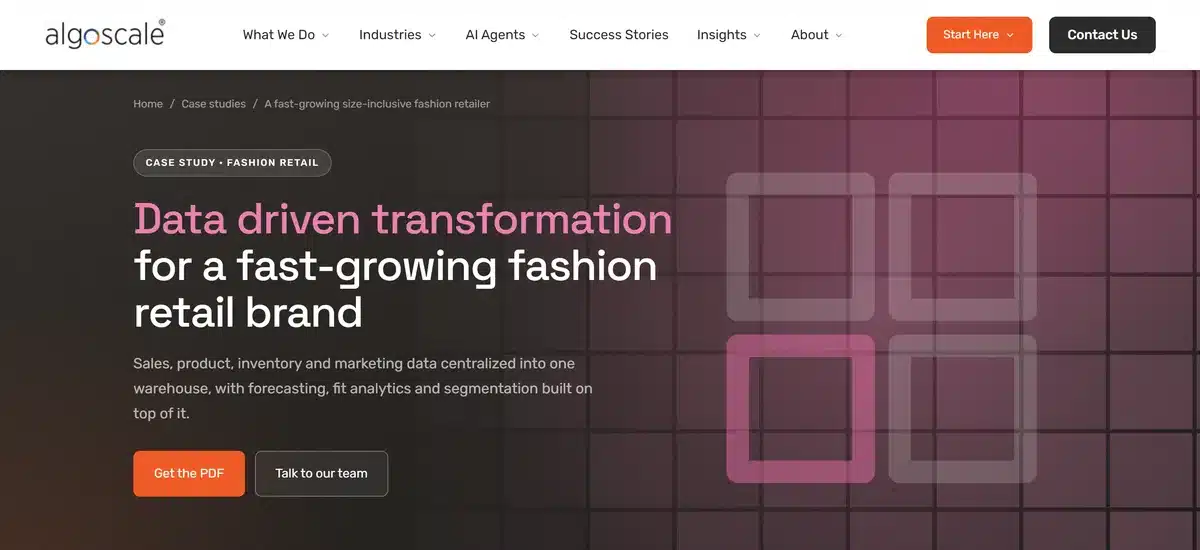
What it does: A data engineering team that builds what the model describes: star schemas and the warehouse underneath them, loaded by pipelines from the business’s own source systems.
Who this is for: Fast-growing retail and e-commerce businesses whose data sits across commerce, CRM, marketplace, ad and inventory systems and has to become one modeled warehouse.
Algoscale is a data engineering team, and this entry is about who builds the model once it is drawn. The question that follows “which tool?” is usually “who is going to build this?”, and in most shortlists nobody answers it.
For a fashion retailer selling through ecommerce, marketplaces and boutique stores, we built star schema models on a Snowflake warehouse, fed from Shopify, a CRM, marketplaces, ad platforms and inventory systems. Our case study lists the work.

Key Features
- Star schema models for customers, sales, returns, inventory and marketing
- A multi-layer data lake and a Snowflake warehouse with SQL pipelines
- Airflow pipelines from Shopify, CRM, marketplace, ad and inventory systems
- Power BI on top of the modeled warehouse
Pros and Cons
Pros
- Builds the model against real source systems: in the cited engagement, a storefront, a CRM, marketplaces, ad platforms and inventory systems
- Covers what a modeling tool leaves undone, from the pipelines to the warehouse itself
- Has built on Snowflake: the cited engagement runs on a Snowflake warehouse
- Sells none of the products ranked here
Cons
- You still license one of the tools on this list, or use none
- No public price; every engagement is scoped
- The published proof is one retail engagement
- No G2 or PeerSpot reviews; the evidence is our own case study
From Our Case Study
Implemented star schema models for customers, sales, returns, inventory and marketing
Algoscale case study, fast-growing fashion retailer (page read 12 November 2026)From our own published case study, not a third-party review.
Inventory turnover improved by 20% with centralized data & better forecasting
Algoscale case study, fast-growing fashion retailer (page read 12 November 2026)A reported result of the wider engagement. The case study credits it to centralized data and forecasting, not to the star schemas.
Pricing
Scoped per project. There is no rate card. The engagement covers source mapping, the warehouse, the pipelines and the reports on top; the modeling tool, if you use one, is licensed separately.
Bottom Line
Worth a call when the data is spread across a storefront, marketplaces and a CRM, and nobody on the team has built a warehouse from that mix before.
Choose the modeler first; call us when the model has to become a loaded warehouse.
4. ER/Studio: Best for Linking Glossary Terms to the Model, on the Enterprise Tier
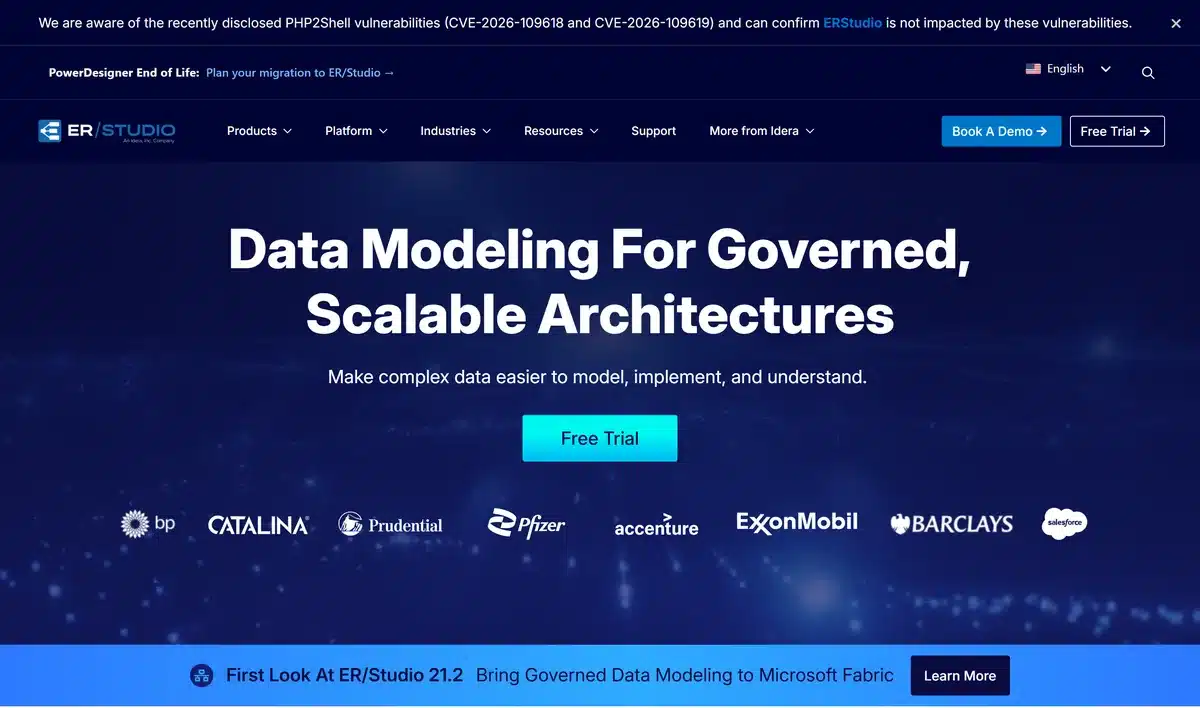
What it does: IDERA’s modeling suite: Data Architect for logical and physical models with compare and merge against live databases, plus an Enterprise-tier web portal that links glossary terms to model objects.
Who this is for: Data architecture teams that want glossary and governance links inside the modeler. Single modelers buy Data Architect and small teams buy Pro. PeerSpot reviewers range from 201-500 to 10,001+ employees.
On core modeling, ER/Studio and erwin are close substitutes. Both do logical and physical models, forward and reverse engineering, compare against a live database and a shared versioned repository. Where they differ is breadth, which favors erwin, and the business glossary, which favors ER/Studio.
That glossary is the reason to choose it. ER/Studio links business terms and glossary definitions to model objects.

Key Features
- Logical and physical modeling with forward and reverse engineering
- Compare and merge between models, and between a model and a live database
- Git-based version control through GitHub, GitLab, Bitbucket and Azure Repos (integrations page)
- Business glossary, web portal and Collibra and Microsoft Purview integrations on the Enterprise tier
Pros and Cons
Pros
- Prices for the two entry editions are printed, and both can be bought at checkout
- On Enterprise, glossary terms link to model objects inside the same product family, with no separate catalog to buy
- Its platform list covers Snowflake, BigQuery, Redshift, Databricks and Fabric
Cons
- The glossary and governance integrations are Enterprise-tier, and that tier is quote-only
- dbt appears nowhere in its published integrations
What Users Say
IDERA ER_Studio does a lot more and performs model comparison much better than Erwin.
reviewer2796111, Data Architect, financial services firm with 10,001+ employees, on PeerSpot, 20 January 2026

The solution’s reporting could be improved because the report writer is terrible.
Diane Blaum, Data Architect, performing arts organization, on PeerSpot, 18 May 2024

Pricing
Data Architect: $2,687.00 per user, aimed at individual modelers. Data Architect Pro: $3,693.00 per user, aimed at small teams, adding change management, real-time collaboration and modeling standards. Both from the ER/Studio pricing page, read 11 November 2026.
The page labels both “Total Subscription Price / User” but states no billing term, and notes that prices may not include VAT or taxes. Enterprise, with the glossary, the web portal and the Purview and Collibra integrations, is request-a-quote only.
Bottom Line
The two printed seats are solid modelers below erwin’s entry price, and the closest substitute for erwin on relational work.
erwin’s closest rival, set apart by a business glossary tied to the model.
5. Oracle SQL Developer Data Modeler: Best Free Modeler for Oracle, SQL Server and Db2
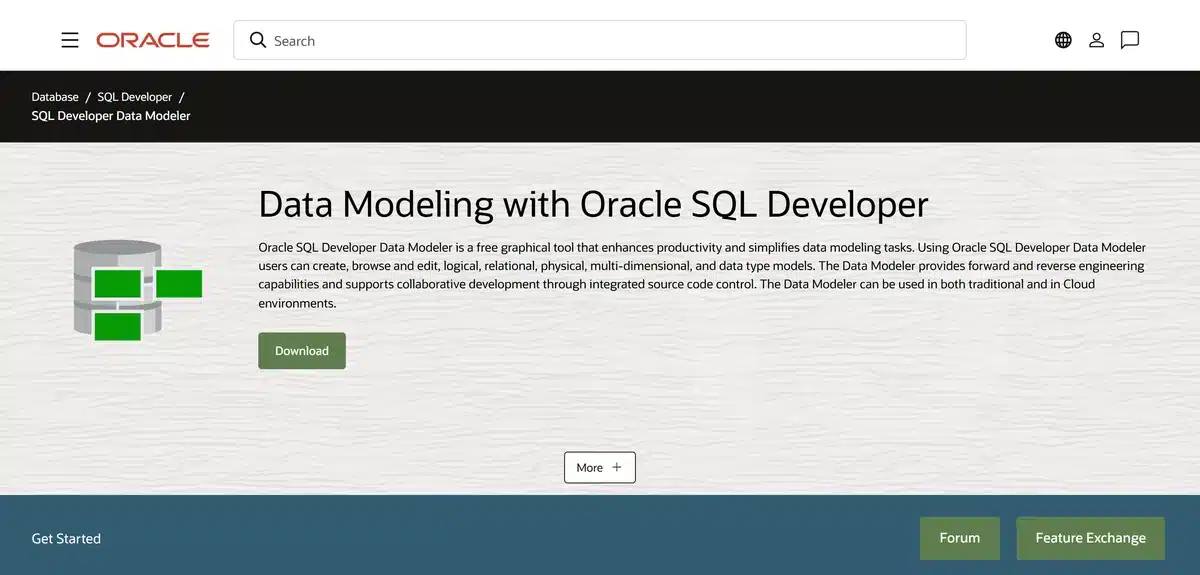
What it does: Oracle’s free desktop modeler for logical, relational, physical and multi-dimensional models, with forward and reverse engineering and DDL generation for Oracle, SQL Server and Db2.
Who this is for: Oracle-centric DBA and database development teams, and anyone already paying for Oracle Database support, who need DDL generation without buying a modeler.
Among free data modeling tools, this is the one with a full logical-to-physical workflow: DDL generation and ALTER scripts from a model compare. The limit is the target list. Its 24.3.1 release notes list export for Oracle, SQL Server and Db2 only, with no Snowflake, Databricks, BigQuery, PostgreSQL or MySQL.
Oracle’s support table also lists no standalone Data Modeler release after 24.3, whose support window ended in April 2026. Both reviews below were posted on PeerSpot’s Oracle SQL Developer listing; there is no separate page for Data Modeler.

Key Features
- Logical, relational, physical, multi-dimensional and data type models
- Forward and reverse engineering, including import from the data dictionary
- Compare/merge between models that produces ALTER statements (Oracle FAQ)
- Design files kept in a Subversion repository or a Git working copy
Pros and Cons
Pros
- Free, with no seat count and no trial clock
- A full logical-to-physical workflow with DDL and ALTER-script generation, which most free tools skip
- Design files can live in Git, so model changes are reviewed like code
- Supported through My Oracle Support for anyone with an Oracle Database support license
Cons
- DDL generation covers Oracle, SQL Server and Db2 only
- The product page is visibly out of date: its statement of direction still calls 20.3 the current release
What Users Say
The capabilities of Oracle SQL Developer’s data modeling have helped manage my database environments
MarcosBinelli, Solutions Architect at Deloitte Brazil, on PeerSpot, 25 September 2025

Data modeling capabilities exist in Oracle SQL Developer, but they are mainly used by DBA teams.
Sankhadeep Sengupta, Associate Consultant at a tech vendor with 10,001+ employees, on PeerSpot, 29 August 2025

Pricing
Free. Oracle calls it “a free graphical tool” and “a free, stand-alone product” on its product page, read 11 November 2026.
Support comes through My Oracle Support for customers with an Oracle Database support license. The download goes through Oracle’s software download centre.
Bottom Line
A sound pick when your targets are Oracle, SQL Server or Db2 and will stay that way, and there is no budget for a modeler.
Free and capable for Oracle, SQL Server and Db2.
6. SAP PowerDesigner: Best for Teams Already Running It

What it does: SAP’s enterprise modeling suite for conceptual, logical and physical data models, with lineage and impact analysis across those layers.
Who this is for: Organizations with an existing PowerDesigner install and a modeling team that depends on its lineage and impact analysis. PeerSpot’s reviewers span company sizes: Small 14, Midsize 6, Large 17.
This entry is for teams that already run PowerDesigner. SAP still ships it: the New Features Summary for 16.7 SP10 is dated 2 April 2026. SAP’s end-of-maintenance page dates versions 16.1, 16.5 and 16.6, but for the current version it points to the Product Availability Matrix, which needs an SAP login.
Vendors selling a replacement give dates of their own. SqlDBM’s own comparison page says 1 January 2027, while ER/Studio’s blog says December 2027 and cites no SAP source.

Key Features
- Conceptual, logical and physical data models in one suite
- Lineage and impact analysis across model layers
Pros and Cons
Pros
- Snowflake and Redshift are among the DBMS targets updated in 16.7 SP02
- Still being released: SAP published feature summaries for SP08, SP09 and SP10 between July 2024 and April 2026
- A large install base, with 40 reviews on PeerSpot, so its problems are well documented
Cons
- SAP has not dated 16.7’s end of maintenance in public, and the rival vendors’ dates disagree with each other
- No public price, and no SAP page to buy from
What Users Say
The lineage analysis helps my organization understand data dependencies at an enterprise level.
Kopparapu Venkatesh Prasad, Engineer at a tech vendor with 10,001+ employees, on PeerSpot, 29 August 2025

I found customer support to be tedious during the upgrade process to the latest version.
HemantKUMAR6, Principal Architect at Sopra Steria, on PeerSpot, 7 October 2025

Pricing
Not public. SAP’s PowerDesigner product address and its older technology-platform address both returned “page not found” on 12 November 2026, so there was no SAP price or buy page to read.
PeerSpot’s pricing section says only that “The pricing varies based on functionality and users” (read 12 November 2026).
Bottom Line
Keep using it while the lineage earns its place, and get the maintenance date from SAP itself before you plan past it.
Worth keeping where it already runs; start new estates elsewhere.
7. dbdiagram.io: Best for Developers Who Want the ERD as Code
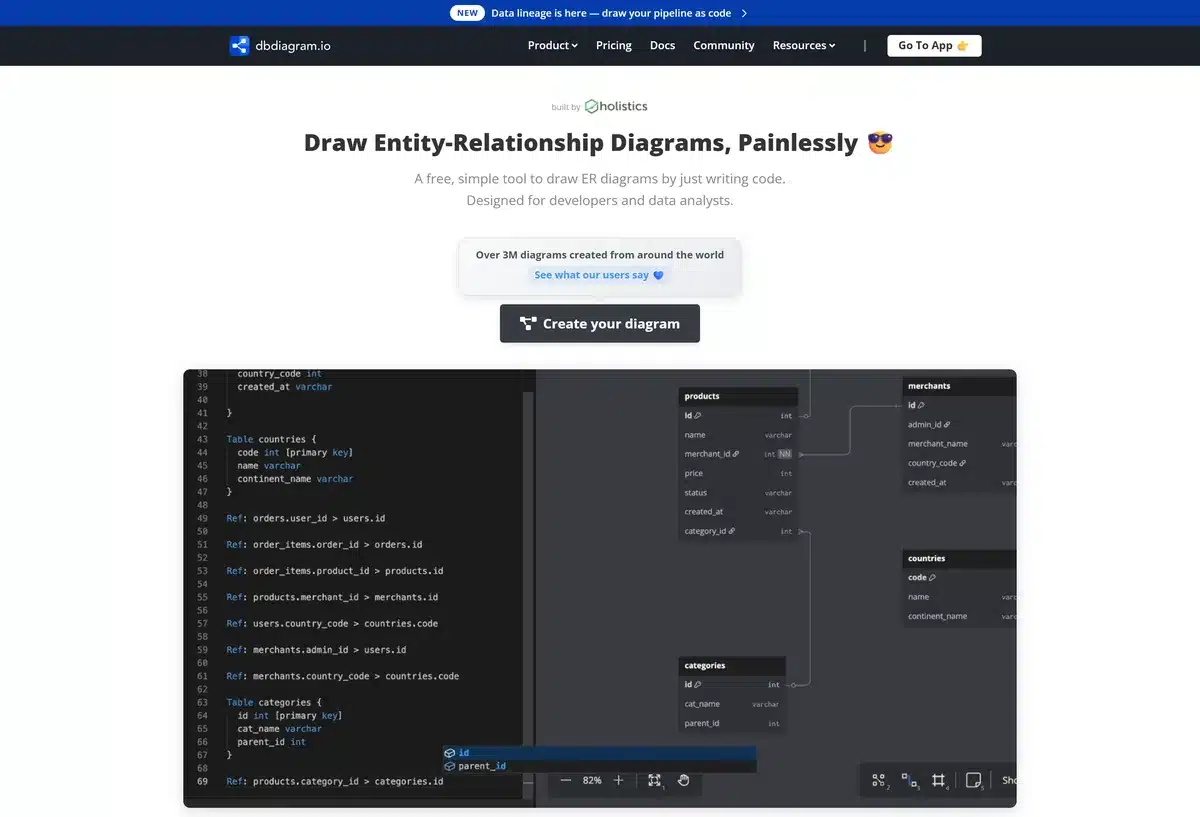
What it does: A browser ERD tool: you write the schema in DBML, an open-source markup language, and the diagram draws itself. It imports from databases and SQL dumps and exports SQL DDL.
Who this is for: Individual developers and small engineering teams documenting an application or warehouse schema who need no conceptual or logical layer. Free and Personal Pro are single-editor; Team starts at three editors.
dbdiagram.io is the code-first option. The schema is DBML text, Apache-2.0 licensed, so it can sit in the same repository as the application and be diffed in a pull request. Its CLI reads schemas from Snowflake and BigQuery but generates SQL for PostgreSQL, MySQL, SQL Server and Oracle only.

Key Features
- Schema written as DBML text; the diagram renders as you type
- Import from a live database or a SQL dump
- SQL DDL export for PostgreSQL, MySQL, SQL Server and Oracle
Pros and Cons
Pros
- The cheapest paid plan here, $8 a month billed annually, and a free plan for small projects
- DBML is open source, so the schema text is not locked to the vendor
- The CLI syncs .dbml files with version control and can run in CI/CD, even on Free
- Publishes a SOC 2 Type II statement on its pricing page
Cons
- No conceptual or logical modeling layer
- SQL output targets PostgreSQL, MySQL, SQL Server and Oracle only, with no cloud warehouse
What Users Say
I like how simple and easy dbdiagram.io is to use for creating ER diagrams and database schemas.
Ritik J., Software Engineer, mid-market company, on G2, 9 November 2026Rated 4 out of 5. The same review’s complaint is that large, complex schemas make diagrams crowded and difficult to follow.

dbdiagram.io requires login to export.
smusamashah on Hacker News, 27 April 2025A comment in the thread “Found a simple tool for database modeling: dbdiagram.io”.

Pricing
Free for up to 10 diagrams with a single editor and unlimited viewers. Personal Pro is $8 a month and Team is $75 a month, both billed annually; Team includes three editors, with extra editors at $5 a month. A Custom plan with 10 editors is priced on request. Figures from the pricing page, 12 November 2026.
The page shows prices in the visitor’s local currency, so the screenshot reads ₹299 and ₹2,599; the US figures are $8 and $75, billed annually.
Bottom Line
Teams that need logical models, or DDL for a cloud warehouse, should look higher up the list. For a developer documenting an application schema next to its code, it does the job.
Diagram-as-code at the lowest paid price on the list.
Which Data Modeling Tool Should You Choose?
Start from the database you deploy to, because that rules out more of this list than price does.
| Your situation | Start with | Why |
|---|---|---|
| Snowflake, Databricks or BigQuery, with transformations in dbt and Git | SqlDBM | It names those warehouses and lists dbt and Git integrations |
| Relational warehouses plus MongoDB, Cassandra or Neo4j | erwin Data Modeler | Its database support page covers NoSQL and graph targets |
| Glossary terms that must link to the tables they describe | ER/Studio Enterprise | The glossary and governance links sit on that tier |
| Oracle, SQL Server or Db2, with no budget | Oracle SQL Developer Data Modeler | Free, with DDL generation for exactly those three |
| Already on PowerDesigner, with lineage people depend on | Stay, and plan | SAP still ships service packs but has not dated 16.7 in public |
| An application schema documented in the same repo as the code | dbdiagram.io | The diagram is DBML text you can diff |
| A fast-growing retail or e-commerce business that needs the model loaded from real sources | Algoscale | The tool draws the model; somebody still has to build it |
Skip this category entirely if:
- Your models are SELECT statements in a dbt project. That is transformation work, covered in our dbt alternatives comparison.
- Nobody will own keeping the model in step with production. A diagram that has drifted from the database misleads more than having none.
- The only output you need is boxes on a slide for a workshop. A general diagramming tool does that for less.
What’s the Best Data Modeling Tool in 2026?
For a team on a cloud warehouse, SqlDBM is the best fit on paper: browser-based, built around Snowflake, Databricks and BigQuery, and wired to dbt and Git. Ask for the price early, since none is published, and weigh a G2 record of under twenty reviews.
For a large estate with a central architecture team, erwin or ER/Studio. Both now sell their entry seats at a printed price, and the choice between them comes down to NoSQL targets against glossary links, as the chooser above sets out.
On a zero budget, Oracle’s modeler or dbdiagram.io, depending on whether you deploy to Oracle-family databases or document an application schema in Git. Two lifecycle questions are worth settling before you standardize: Oracle’s Data Modeler release table stops at 24.3, and SAP has not dated PowerDesigner 16.7’s maintenance outside its customer portal.
When the model has to become a loaded warehouse, Algoscale. Our published case is a star-schema build on Snowflake for a fast-growing fashion retailer, from its real sources through to Power BI. You still pick the modeler.
How Algoscale Turns a Data Model Into a Loaded Warehouse
Every tool above stops at the model and the DDL. Then the work starts: mapping each source system onto the model, deciding how history is kept, building the pipelines that load it, and getting the reports on top to agree with the systems they came from.
That is the work our data architecture team does. For a fast-growing, size-inclusive fashion retailer selling through ecommerce, marketplaces and boutique stores, we centralized data from Shopify, a CRM, marketplaces, ad platforms and inventory systems. We implemented star schema models for customers, sales, returns, inventory and marketing on a Snowflake warehouse, with Airflow pipelines and Power BI on top.
The case study reports inventory turnover improved by 20%, and credits that to centralized data and better forecasting. The star schemas were one part of that build.
- Data centralized from the storefront, CRM, marketplace, ad and inventory systems
- Star schemas for the subject areas the business reports on
- A Snowflake warehouse, a multi-layer data lake and the pipelines that load them
- Power BI reporting on top of the Snowflake warehouse
Ready to put this into production?
Algoscale’s data engineers have built and migrated data platforms for retail, fintech and manufacturing teams. Book a free consultation and we will scope yours with you.
Frequently Asked Questions
Which tool is used for database design?
Database modeling tools, often called database design tools, differ most in the databases they deploy to, so no single one fits every case. For a cloud warehouse such as Snowflake, Databricks or BigQuery, SqlDBM is built for that work in the browser. For a large estate that mixes relational and NoSQL stores, erwin Data Modeler covers the widest documented list of targets. For Oracle, SQL Server or Db2 on no budget, Oracle SQL Developer Data Modeler is free and generates DDL for those three. For documenting an application schema in a code repository, dbdiagram.io lets you write the schema as DBML text and draws the diagram from it.
How much does erwin Data Modeler cost?
erwin Data Modeler Standard Edition costs USD$3,588.38 per named user a year, and Workgroup Edition costs USD$5,019.72, according to Quest’s online store on 12 November 2026. Both are annual subscriptions with 24×7 support. Workgroup adds the central model repository with conflict resolution, versioning and change auditing. Enterprise purchases go through Quest’s sales team. For comparison, ER/Studio prints $2,687 per user for Data Architect and $3,693 for Data Architect Pro, without stating a billing term.
Is SQL a data modeling tool?
No. SQL is the language a data model is turned into. The design happens in a modeler such as erwin, ER/Studio or Oracle SQL Developer Data Modeler, which holds the logical and physical model and forward-engineers it into SQL DDL, the CREATE statements that build the tables. Reverse engineering reads an existing database back into a model. People also say “SQL modeling” when they mean transformation models written as SELECT statements in dbt. That is a different category, compared in our dbt alternatives post.
Are there free data modeling tools?
Yes. Two tools on this list cost nothing to start. Oracle SQL Developer Data Modeler is free, with no seat count, and generates DDL for Oracle, SQL Server and Db2. dbdiagram.io has a free plan with up to 10 diagrams, one editor and unlimited viewers, and it includes SQL import and export. Its paid plans start at $8 a month billed annually. erwin, ER/Studio and SqlDBM are priced per user or per seat.