

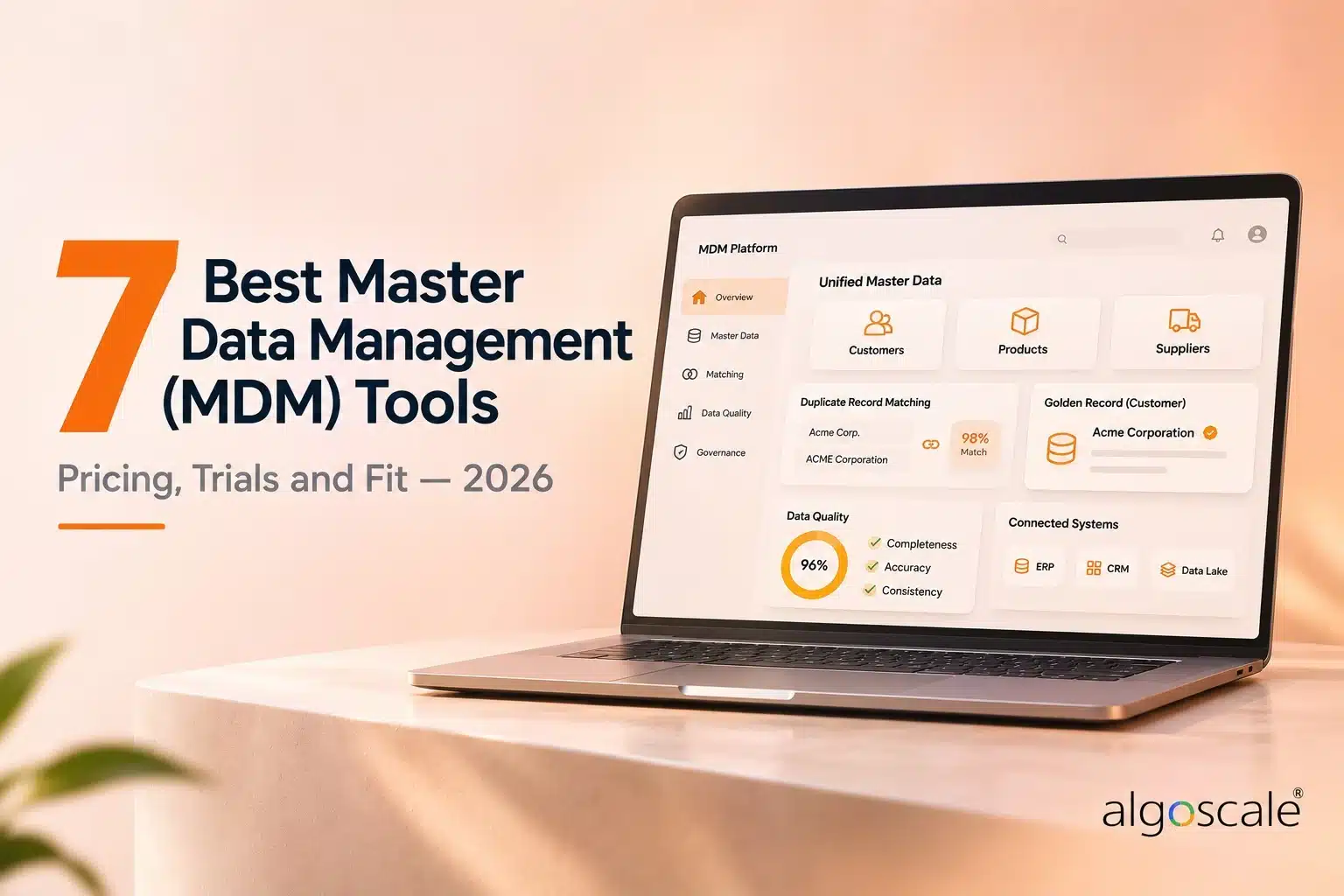

This page is about master data management: the customer, product, supplier and employee records that every other system copies. If you came here for mobile device management, the software that enrols and locks company phones and laptops, you are on the wrong page.
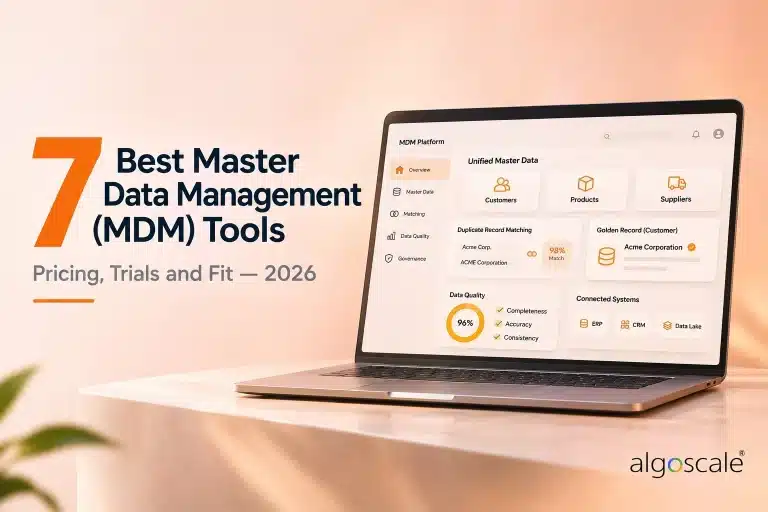
Master data management tools exist to settle one argument. The CRM, the ERP and the HR system each hold their own version of the same customer or employee, and somebody has to decide which value wins. The product of that decision is a golden record, plus the matching and survivorship rules that build it.
This comparison covers seven master data management solutions and judges them on what a buyer can check before a sales call: whether a price is published, whether there is a trial, and which data the product is built to master. None of the six vendors prints a price on its own website. Reltio comes closest, with a list price on its AWS Marketplace listing.
If you have not yet picked a hub style (registry, consolidation, coexistence or centralized), our data governance strategy guide covers that choice first.
7 Best Master Data Management Tools: Quick Comparison
| Tool | Best For | Public Reviews | The Catch | Starting Price | Access |
|---|---|---|---|---|---|
| 1Informatica MDM | Several domains on one platform | PeerSpot – match and merge praised; reviewers say there is no way to practise on MDM first | No MDM trial and no published price | Not published; quote only | Quote only; no MDM trial listed |
| 2Profisee | Microsoft-first estates, priced on volume | PeerSpot – a ‘no-brainer’ if your data is in Azure; security setup adds time | Weaker case outside a Microsoft estate | Not published; volume-based, by quote | Quote and demo |
| 3Semarchy xDM | A free trial first | PeerSpot – a quick proof of concept; local-language support is hard to find | No pricing page, so a quote anyway | Not published | Free trial, sign-up form |
| 4Algoscale | Choosing a platform before buying | No G2 or PeerSpot listing – one published case study only | Design and evaluation advice, not a build | Not published; scoped per engagement | Talk to us |
| 5Reltio | Live entity data for operational apps | AWS Marketplace – stewardship lifted customer and supplier data; AI matching called a black box | Price unit undefined; SaaS on AWS only | $15,600 per month per unit, 1-month AWS Marketplace contract (unit not defined) | Buy on AWS Marketplace |
| 6SAP Master Data Governance | Master data created inside SAP | PeerSpot – easy for end users; niche skills and cost | Niche skills, and little advantage outside SAP | No figure printed. Licensed through SAP Business Data Cloud, in blocks of 5,000 objects; contracts of 3 to 36 months | Demo request or Try now |
| 7Stibo Systems | Product and supplier data | PeerSpot – faster time to market; a complex tool that takes time to learn | Long learning curve, and no published price | Not published | Contact form for a quote |
Not sure which of these fits your stack?
Tell us what you are running today and what you need it to do. We will tell you which of these we would pick, and why. We are not going to pitch you.
How We Researched These Master Data Management Tools
Nothing was trialled and no account was created. Semarchy offers a free trial and SAP’s product page has a Try now link, but both need a sign-up, so you will not find a screenshot of a logged-in console below. Prices and licence terms come from the vendors’ own pages and Reltio’s AWS Marketplace listing, read on 12 November 2026; the one figure that comes from a reviewer is labelled as such.
Reviews come from PeerSpot and, for Reltio, from its AWS Marketplace listing. We read 32 in full: ten for SAP MDG, five each for Profisee, Reltio and Stibo, four for Informatica and three for Semarchy. These corpora are thin, and each entry says how thin. Informatica’s PeerSpot reviews sit under its whole cloud platform, and only four of the ones we read were about MDM.
G2, Reddit and Capterra were not used: G2 refuses plain automated requests and was not read in a browser for this post, Reddit and Capterra block automated reading, and we do not work around that.
Two names are missing on purpose. IBM’s MDM line is in transition: Bloor Research reports that IBM named Match 360 as its MDM direction in December 2024, and IBM’s own page now sells IBM Master Data Management without mentioning InfoSphere MDM, the name rival lists still use. Until it is settled which product a buyer would get, we cannot review it. Ataccama ONE is ranked in our data quality tools guide, where quality, governance and MDM are treated as one programme.
The entries run in editorial order, widest fit first: one platform for every domain at the top, then narrower fits, ending with the product-data specialist. Nothing is scored.
What we weighed, heaviest first:
- Can you see the price – it is the first thing a buyer needs, and none of the six vendors prints a figure on its own website
- Can you try it before you sign – MDM is judged on how it matches your records, and a demo on the vendor’s sample data cannot show you that
- Which domains it is built for – customer, product, supplier and employee records break in different ways, and most products are strongest on one of them
- Where your master data is created – a record born in SAP, in an Azure-hosted system or in an operational app points to a different product with the least rework
- What reviewers say it takes to run – skills, setup and learning curve come from reviews, which we cannot check ourselves, so they rank last
1. Informatica MDM: Best for Mastering Several Domains on One Platform

What it does: Multidomain master data management inside Informatica’s Intelligent Data Management Cloud: match and merge, stewardship and pre-built 360 applications for customer, product, supplier, finance and reference data.
Who this is for: Large enterprises with several master data domains and a budget one reviewer puts at “a quarter million to a couple of million a year”
Customer, product, supplier, finance and reference data each get a pre-built 360 application inside Informatica’s Intelligent Data Management Cloud. If you need several of them mastered under one contract, this is the widest fit on the list. The MDM page now describes Informatica as “from Salesforce”.
Getting near it is the hard part. Informatica’s trials page lists 30-day trials for integration, data quality and API products, and none for MDM. A principal consultant on PeerSpot says their team has no way to practise on it, so you will be judging the product from demos and a proof of concept the vendor runs.

Key Features
- Pre-built 360 applications for customer, product, supplier, finance and reference data
- AI-driven match and merge with rule recommendations
- Headless MDM: stewarding the golden record through APIs and MCP servers
Pros and Cons
Pros
- A consulting principal calls match and merge “invaluable for discovering golden master data records”
- The same reviewer values pulling data in and out without a separate integration tool
- The pricing page says MDM can also be bought on a per-domain records basis, not only in the platform’s consumption units
Cons
- No published price; one reviewer puts it at a quarter million to a couple of million a year
- No MDM trial: the trials page offers integration and data quality products, and a principal consultant says their team has “no way” to practise on MDM
- A reviewer says the cloud tools lack features people know from the on-premises MDM
- PeerSpot files reviews under the whole IDMC platform, so MDM-specific feedback is thin
What Users Say
The match and merge functionality is invaluable for discovering golden master data records.
Saikat Ghosh, Consulting Principal & Founder, on PeerSpot, 4 February 2025Posted under Informatica’s IDMC listing on PeerSpot, which covers the whole cloud platform rather than MDM alone.

For products Master Data Management or related to MDM or Data Governance, there is no way by which we can directly practice, and my team struggles at that point.
SaurabhGaonshindhe, Principal Consultant, on PeerSpot, 28 August 2025

Pricing
Not published. Informatica’s pricing page prices its cloud in Informatica Processing Units (IPUs) and prints no figure. The button is Get quote.
The only number we found is a reviewer’s. Saikat Ghosh writes that pricing is based on the number of master data entities managed, and that “It can range from a quarter million to a couple of million a year.” That is one buyer’s experience, not a list price.
The widest fit when customer, product and supplier data all need mastering on one enterprise contract. You cannot try the MDM yourself and the price is quote-only, so ask for a proof of concept on your own records.
2. Profisee: Best for Microsoft-First Estates That Want Volume Pricing

What it does: Master data management sold on record volume and built for Microsoft-first estates: a SaaS hosted in Azure or a containerised PaaS on any cloud, with an Application Edition aimed at moving off Microsoft Master Data Services.
Who this is for: Organisations on a Microsoft data stack (Azure, Purview, Fabric) or moving off Microsoft Master Data Services
Microsoft shops get the most out of this one. The SaaS edition is hosted in Azure, eligible Microsoft Marketplace purchases can count toward an Azure consumption commitment, and the Application Edition offers a one-click upgrade from Microsoft Master Data Services. Profisee describes itself as “built for Microsoft-first data strategies”.
The pricing model is the other difference. Profisee charges on total record volume, with unlimited domains and attributes, so adding a supplier domain to a customer one does not open a second line on the bill. The page still prints no figure.

Key Features
- Enterprise Edition for matching, survivorship and golden records
- Application Edition with a one-click upgrade from Microsoft MDS
- SaaS hosted in Azure, or containerised Kubernetes PaaS on Azure, AWS, GCP or any other cloud
Pros and Cons
Pros
- A bank’s BI architect says that if your data is centralised in Azure, Profisee “is a no-brainer”
- An MDM lead with three years on it calls support “very responsive” and points to the Profisee Academy for implementation
- The same lead found the initial setup straightforward
Cons
- No published figure, and the pricing page mentions no trial: quote and demo only
- A reviewer finds data lineage easier to get from Purview than from Profisee
- Security complexities can add time to setup, per an MDM lead
- Outside a Microsoft estate, the main reason to pick it over the others weakens
What Users Say
If they have centralized their data in Azure, Profisee is a no-brainer for data management.
reviewer2382861, Data and BI Architect Lead at a financial services firm with 10,001+ employees, on PeerSpot, 1 May 2024

Some security complexities might add time to the setup.
reviewer2584719, MDM Lead at a financial services firm with 5,001-10,000 employees, on PeerSpot, 30 October 2024

Pricing
Not published. The pricing page describes “Predictable volume-based pricing” (“Pay per B2C Customer, B2B Customer, Supplier, Vendor, etc.”) and offers a pricing quote and a demo in place of a figure.
Bought through Microsoft Marketplace, eligible purchases can count toward a MACC commitment, depending on the offer and purchasing path.
If your data already lives in Azure and you want MDM billed on record counts rather than domains, start here. Outside a Microsoft estate, compare it on price once you have a quote.
3. Semarchy xDM: Best for Teams That Want a Free Trial First

What it does: Multidomain MDM, now sold as part of the Semarchy Data Platform, that you can deploy as SaaS, on-premises, in your own cloud or inside Snowflake.
Who this is for: Data teams that want a free trial first, then a proof of concept, then procurement, on SaaS, on-premises or Snowflake
Start here if you want a golden record built from your own records before you see a quote. Semarchy’s trial page offers to “evaluate the full Semarchy Data Platform for free”, in the cloud or on-premises. Informatica’s trials page lists no MDM trial, and Profisee’s pricing page mentions none.
The name is changing. The site now sells the Semarchy Data Platform while PeerSpot and G2 still list Semarchy xDM, so search for both when you read reviews.

Key Features
- Deploy as SaaS, on-premises, in your own cloud or inside Snowflake
- Multidomain golden records across customer, product, supplier and reference data
- A Rapid Delivery Blueprint and professional services that Semarchy says launch an MDM programme in 12 weeks (its claim, not our measurement)
Pros and Cons
Pros
- A reviewer with three years on it names “quick turnover time” for a proof of concept as its selling point
- A second reviewer values that it can still run on-premises when “many solutions today are moving towards being cloud-only”
- The free trial covers the full platform, cloud or on-premises, so you can load your own records before a proof of value
Cons
- No pricing page at all; the old /pricing/ URL returns a 404
- Configuration means learning xDM’s own principles, and a reviewer notes that SQL Server backends lack regex
- A reviewer rates support as average because local-language support is hard to find
- The name on the trial and the name on review sites differ while the product is renamed
What Users Say
Semarchy xDM’s unique selling point is its quick turnover time, allowing for the rapid development of a proof of concept or minimum viable product.
Syed-Hasan, Director at Inspiring Software, on PeerSpot, 4 November 2024

There is room for improvement in terms of local support. Currently, there is a need to provide support in local languages, as it can be challenging to find such support in regions where the customer base is limited.
DavidPineda, Associate Partner at a tech services company with 10,001+ employees, on PeerSpot, 17 November 2024

Pricing
Not published. Semarchy has no pricing page. semarchy.com/pricing/ returns a 404 and the site links to none.
The trial sign-up form asks for a business email and a phone number.
Shortlist it if your team wants to load real records and see the matching before procurement. Expect to ask for a quote anyway, because the trial does not tell you the price.
4. Algoscale: Best for Choosing a Platform and Designing the Golden Record Before You Buy

What it does: A data engineering team that designs the master data foundation before a platform is bought: attribute ownership, matching and survivorship rules, and a scored platform evaluation.
Who this is for: Multi-entity organisations about to buy MDM. The published example is a telecom group with three legal entities and under ten thousand employees.
Every product above assumes you already know which system wins when two records disagree. Our published master data engagement, for the Indian telecommunications arm of a global conglomerate, was about settling that for employee records across three legal entities.
The work covered source profiling, matching and survivorship design, a golden record and reconciliation approach, lineage and audit architecture, a scored platform evaluation and a phased roadmap. The recommendation was the client’s existing HR software vendor’s own data management product, with two independent platforms named as alternatives. The case study does not name any of the three.
Key Features
- Scored MDM platform evaluation against explicit criteria
- Matching and survivorship design, with the conflict rules written down and agreed
- Attribute ownership and a governance operating model
- A phased implementation roadmap the buyer’s team can resource
Pros and Cons
Pros
- Vendor-neutral: in the published engagement the recommendation was the client’s existing HCM vendor’s product, not a new platform
- Conflict-resolution logic is documented, reviewed and agreed, so nobody has to reverse-engineer it from a model that has already run
- The case study marks every artefact as designed, not built
Cons
- The published MDM engagement was advisory: Algoscale designed the foundation and did not build it
- There is one published MDM evaluation, in the HR domain, and nothing public yet on customer or product MDM selection
- The case study does not name the platform it recommended, so you cannot check the pick against this list
- No published price; engagements are scoped
From Our Case Study
The recommendation was the enterprise HCM vendor’s own data management product as the primary path — lowest integration friction, existing commercial relationship, no new vendor onboarding or security review.
Algoscale case study: employee MDM and data governance design for an Indian telecom groupFrom our own published case study, not a third-party review. The engagement was design and evaluation: Algoscale designed the foundation and did not build it, and the page does not name the product it recommended.
Pricing
Not published. Engagements are scoped per programme and there is no rate card.
The case study page links an engagement estimator (“Real weeks. No sales call required”), which does not print a price.
Platform licences are separate. Whatever product you choose, you buy it from that vendor.
Worth a call before the purchase order, while the survivorship rules and the platform choice are both still open.
5. Reltio: Best for Customer Data That Operational Apps Read in Real Time

What it does: Cloud-native, SaaS-only multidomain MDM and entity resolution that keeps operational systems in sync in real time over APIs, sold in industry editions on contract.
Who this is for: Enterprises in the industries Reltio packages (B2B, B2C, life sciences, healthcare, financial services, insurance) whose operational apps need live entity data
A golden record that operational apps read live is the job here. Reltio’s listing promises “real-time bidirectional data exchange with operational systems at scale”, so CRM, ERP and service apps can all work from one customer or supplier record. It is SaaS only, runs on AWS, and comes in six industry editions.
The owner is changing. On 27 March 2026 SAP announced it had agreed to acquire Reltio, and reltio.com’s header now reads “An SAP company”. Our sources do not confirm that the deal has closed. SAP says Reltio will remain available as a standalone offering “for the foreseeable future”.

Key Features
- Real-time, bidirectional sync with operational systems over APIs
- LLM-based entity resolution (FERN) for rule-free matching
- Industry velocity packs with predefined models, match and survivorship rules
- SaaS only, on AWS
Pros and Cons
Pros
- A public list price: $15,600 per month per unit on the 1-month contract tab of its AWS Marketplace listing
- A consultant who ran a proof of concept of about four months for a client calls the effect of its data stewardship on data quality significant, particularly for customer and supplier data
- The listing offers 1-, 12-, 24- and 36-month contracts, so a first commitment can be short
Cons
- An AWS reviewer says the AI matching “operates like a black box”
- The listing does not define the price unit, so $15,600 is a floor you cannot extrapolate from
- SaaS only, with no on-premises option for teams that need one
- The same reviewer finds data model and match-rule configuration “overly complex for business users”
What Users Say
Specifically, the AI-based matching feature operates like a black box, making it difficult to understand why certain records are matched or not matched accurately.
reviewer2826747, verified AWS customer, on AWS Marketplace, 22 April 2026

I would describe the impact of Reltio Cloud’s data stewardship on data quality in my organization as significant, particularly for customer and supplier data.
RahulSoni, verified AWS customer, on AWS Marketplace, 7 April 2026RahulSoni is a senior data consultant, per his PeerSpot profile. His PeerSpot review of Reltio says the work was a proof of concept of about four months for a client, not a production rollout.

Pricing
$15,600 per month per unit on a 1-month contract on AWS Marketplace, for each of the six industry editions: B2B, B2C, Life Sciences, Healthcare, FinServe and Insurance.
The listing does not define what a unit measures. Treat the figure as a floor, and ask Reltio what a unit is before you compare it with anything.
The same listing offers 12-, 24- and 36-month contracts. reltio.com has no pricing page, and its /pricing/ URL returns a 404.
Pick it when CRM, ERP and service apps need to read and write one customer record in real time. Budget from $15,600 a unit a month, and before you sign, ask what a unit is and how the SAP deal affects your contract.
6. SAP Master Data Governance: Best for Master Data Created Inside SAP

What it does: SAP’s master data hub: governed change-request workflows, matching and consolidation built on SAP’s own ERP data model, now also sold as a cloud edition.
Who this is for: Organisations running SAP S/4HANA or ECC as the system where customer, supplier and material records are created, large enough that reviewers say the price is worth it
If customer, supplier and material records are created inside SAP, MDG is the hub that speaks SAP’s own data model. A governance advisor on PeerSpot says it “is built with the SAP data model and incorporates replication to S4 or ECC”.
The cost of that fit is people. An SAP manager says the skills it needs “are niche in the market”, and reviewers split on price by company size: worth it for large organisations, hard to afford for mid-sized ones.
Key Features
- Data models based on SAP’s ERP master data model
- Change-request workflows with multi-step approval
- Matching, consolidation and best-record creation
- Audit trail of master data changes
Pros and Cons
Pros
- Native to SAP’s data model, so records created in it replicate to S/4HANA or ECC, as a governance advisor describes
- The same advisor says the role-based forms are easier for business users than ERP transaction codes
- For larger organisations, the advisor says, it is worth the investment
Cons
- An SAP manager names both the cost and the people: the skills are niche, and “the challenge is in building something out of it”
- Custom fields and workflows often need ABAP, which reviewers say few people know
- A master data delivery lead writes that “mid-sized companies cannot afford SAP MDG”
- Outside SAP-centric estates its main advantage disappears
What Users Say
The interface in SAP Master Data Governance is easy to use for an end user.
reviewer2402049, data governance advisor at a consultancy with 1-10 employees, on PeerSpot, 11 February 2026

The challenge with SAP MDG is not only the cost but the resources. The skills required are niche in the market, and while you can purchase the product either one time or on a subscription basis, the challenge is in building something out of it.
Hariprasad-Sharma, SAP Manager, on PeerSpot, 26 November 2024

Pricing
No figure printed. SAP’s pricing page shows no dollar amount for MDG.
Licensed through SAP Business Data Cloud, in blocks of 5,000 objects, on contracts of 3 to 36 months, with usage-based billing and auto-renewal.
The product page offers Request a demo and Try now.
The right hub when SAP is where your master data is born and the skills to configure it are in-house or contracted. A mixed estate will find a platform not tied to SAP’s data model cheaper to bend.
7. Stibo Systems: Best for Product and Supplier Data

What it does: STEP, Stibo’s master data platform, strongest on product data (product information, onboarding and syndication), with data clouds for customer, business partner, supplier and location data alongside.
Who this is for: Retailers, distributors and manufacturers with large product catalogues and supplier onboarding
Product data sits at the centre of STEP, Stibo’s platform. Product information management, product onboarding and product data syndication run on the same platform as the master data hub, and the industries menu leads with retail, manufacturing, CPG and distribution. Supplier, customer, business partner and location data clouds sit alongside.
Stibo says Gartner named it a Leader in 2026 for both MDM and product information management; that is Stibo’s statement about Gartner’s reports. If your problem is product data but not MDM, our product data management software guide covers that ground.

Key Features
- Product information management, onboarding and syndication on the same platform as MDM
- Data clouds for supplier, customer, business partner and location data
- SAP material master and Salesforce connectors
- Workflow and business rules for approving changes to products
Pros and Cons
Pros
- An enterprise architect says it cut time to market because teams no longer hunt for the latest version of a record
- The same reviewer credits its data profiling and golden record for consistency in downstream applications
- A five-year user says the documentation “gives a good picture of the complete product and helps with training”
Cons
- A five-year user calls it “a complex tool” that takes time to learn
- The same user says error management “is not that good and needs to be improved”
- An enterprise architect wants more flexible views in the analytics module
- No published price anywhere on the site
What Users Say
They improved our ecosystem by reducing time to market because we don’t have to find out where the latest data is and where the latest or updated version of the record is.
Vinícius Strack, Enterprise Architect, on PeerSpot, 3 July 2024This review is about using STEP for customer master data, not product data.

It’s a complex tool, so it takes time to learn it.
reviewer1204092, PIM/QA Developer, on PeerSpot, 25 April 2022Posted in April 2022. We found no newer critical STEP review on PeerSpot that speaks to the learning curve.

Pricing
Not published. Neither the homepage nor the platform page shows a price or links to a pricing page.
Quotes go through a contact form on which every field is required.
A fit when products and suppliers are the records that hold up launches and orders, and you can staff a long learning curve. Ask for the quote early; none is published.
Which Master Data Management Tool Should You Choose?
First decide whether you need a commercial licence at all. A commercial MDM licence earns its price when you have multi-domain data to master at once, business users who need a stewardship UI to review and approve changes, or a regulated audit trail of who changed which record. Those are the things the vendors here document and their reviewers praise. If none of them applies to you, read the last list in this section first.
Choose Informatica MDM if:
- Customer, product, supplier and finance data all need mastering under one contract
- You already budget in Informatica Processing Units
- You can accept judging it from demos, because there is no MDM trial
Choose Profisee if:
- Your data platform is Azure, Purview or Fabric
- You are moving off Microsoft Master Data Services
- You would rather pay on record volume than per domain
Choose Semarchy xDM if:
- You want a free trial on your own records before procurement
- You need on-premises, your own cloud or Snowflake as the place it runs
Choose Algoscale if:
- Nobody has agreed which system wins when two records disagree
- You are not sure whether you need a new platform or a product you already license
- You want a scored evaluation before the purchase order, from a team that does not sell a platform
Choose Reltio if:
- CRM, ERP and service apps need to read and write one record in real time
- SaaS on AWS suits you, and you will find out what a unit is before signing
Choose SAP Master Data Governance if:
- Customer, supplier and material records are created inside SAP S/4HANA or ECC
- You have, or can contract, SAP and ABAP skills
Choose Stibo Systems if:
- Your hardest master data is a large product catalogue and the suppliers behind it
- You need product information and syndication on the same platform as MDM
Skip this category entirely if:
- You meant mobile device management. Nothing on this page enrols or locks a phone.
- You have one domain and one source of truth, and nobody needs to approve changes. A licence would buy stewardship and an audit trail you would not use.
- Nobody can say which source is trusted for which attribute. No platform here decides that for you.
What’s the Best Master Data Management Tool in 2026?
Informatica MDM for several domains on one platform, Profisee for Microsoft estates, Semarchy if you want a free trial first, Algoscale before the purchase order, when nobody has agreed which source wins and the platform choice is still open, Reltio when operational apps read the record live, SAP MDG when records are born in SAP, and Stibo Systems when products and suppliers are the hard part.
Before the Purchase Order: How Algoscale Scopes Master Data Work
A master data platform enforces rules that somebody has to write: which source is trusted for which attribute, how two near-identical records get matched, and who signs off a change. Those rules decide whether the golden record is right, whichever product on this page ends up holding it.
That is the work in our published employee master data case study for the Indian telecommunications arm of a global conglomerate. If you are at that stage, our master data management services team can scope it with you.
- Source system inventory and profiling, so you know which systems actually hold the record before matching starts
- Matching and survivorship design, with the conflict rules written down and agreed
- A golden record design and a reconciliation approach
- Data lineage and audit trail architecture
- A scored platform evaluation and a phased implementation roadmap
Still choosing a platform?
Tell us which systems hold the record today and which domains you need mastered. We will help you write the matching and survivorship rules and score the platforms against your criteria before you sign. We are not selling a platform.
Frequently Asked Questions
Which MDM software is the best?
Master data management software has no single best pick, because it depends on which data you need to master and where that data is created. Informatica MDM is the widest fit for several domains on one platform. Profisee suits Microsoft estates, SAP MDG suits records created inside SAP, Reltio suits operational apps that read the record live, and Stibo Systems suits product and supplier data. If you want a trial on your own records first, Semarchy offers a free trial of its full platform.
What is master data management used for?
Master data management keeps one trusted version of the records many systems share, such as customers, products, suppliers and employees. It matches duplicates across systems, applies survivorship rules to decide which value wins, and sends the resulting golden record back to the CRM, ERP and reporting tools. Products such as SAP MDG also keep an audit trail of master data changes, which matters in regulated industries.
What are the available SAP MDM tools?
SAP’s own master data product is SAP Master Data Governance, entry 6 above. SAP has also agreed to acquire Reltio, entry 5, in a deal announced on 27 March 2026. Our sources do not confirm that the deal has closed, and SAP says Reltio will remain available as a standalone offering for the foreseeable future.
Is SAP MDG part of S4 Hana?
SAP sells MDG as its own product, licensed through SAP Business Data Cloud, and it integrates with S/4HANA. A PeerSpot reviewer says it replicates to S/4HANA or ECC depending on which one the company runs, and SAP’s pricing page sells it in blocks of 5,000 objects on contracts of 3 to 36 months.