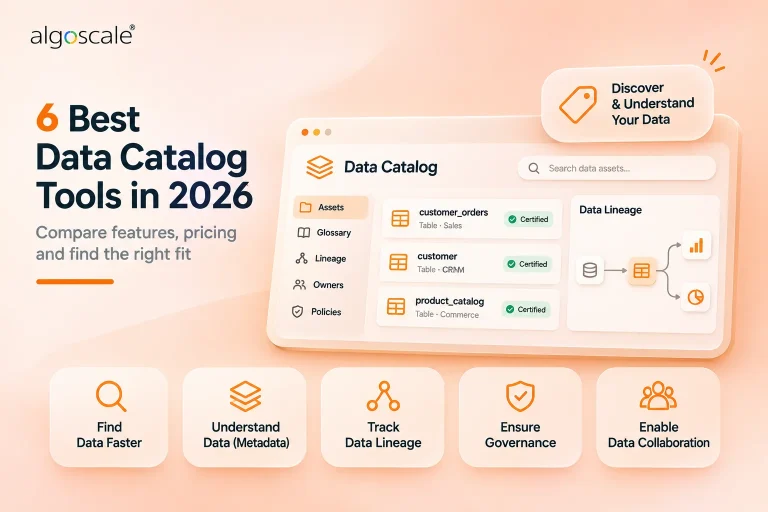



Data catalog tools keep a searchable record of the data a company holds: what exists, what it means, who owns it and whether it can be trusted. That is how Alation describes the job, and every tool on this page does a version of it. They differ in where they expect your data to live.
Alation and Atlan are built to sit across many platforms. OpenMetadata is open source and runs on any stack. Databricks Unity Catalog and Google Cloud Knowledge Catalog come built into their platforms, so a team on Databricks or BigQuery may already have one. Secoda is a managed tool that puts lineage and monitoring next to the catalog.
Two entries look different from older lists. Google renamed Dataplex Universal Catalog to Knowledge Catalog in April 2026, and Atlassian bought Secoda in December 2025. Every price, plan and limit below was read on the vendor’s own pages or marketplace listings on 14 November 2026. We did not trial any of the six.
6 Best Data Catalog Tools: Quick Comparison
| Tool | Best For | Public Reviews | The Catch | Starting Price | Where Your Data Lives | Access |
|---|---|---|---|---|---|---|
| 1Alation | Analysts searching many sources | PeerSpot: an eight-year user rates its discoverability highly; a financial services engineer says search mostly matches titles | Sales call first, no trial found | Not public; AWS Marketplace from $60,000 per 12 months | Across many platforms | Sales call |
| 2Databricks Unity Catalog | Databricks lakehouse estates | PeerSpot and Hacker News: credited as the platform’s main governance gain; one commenter hits a cross-cloud storage limit | Outside sources read-only, their lineage manual | No separate licence on Premium and Enterprise | Databricks | On by default in new workspaces |
| 3OpenMetadata | Teams that self-host | Hacker News: chosen by one enterprise for its Airflow and BI integrations; another commenter misses wiki, chat and JIRA connectors | Four services to run yourself | Free (Apache-2.0); Collate paid tiers not public | Any stack, self-hosted or managed | Self-host, or Collate Free Tier |
| 4Atlan | Finding existing assets and owners | PeerSpot: credited with cutting redundant ingestion; one consultant says templates and automations need support | Quote only, no trial found | Not public | Across many platforms | Sales form |
| 5Secoda | Catalog plus monitoring, managed | Hacker News (October 2021, before the acquisition): called a great product, though team adoption was the hard part | No price, and Atlassian’s plans unpublished | Not public | Across many platforms, managed | Free trial offered |
| 6Google Cloud Knowledge Catalog | BigQuery and Google Cloud estates | PeerSpot: one review; good classifiers for Google Cloud data, too few connections beyond it | Non-Google sources need connectors you build | $0.06 per DCU per unit time (Iowa); 100 DCU-hours a month free | Google Cloud | Google Cloud project |
Not sure which of these fits your stack?
Tell us what you are running today and what you need it to do. We will tell you which of these we would pick, and why. We are not going to pitch you.
How We Researched These Data Catalog Tools
We started from the search results for data catalog tools on 14 November 2026: 17 sources, counting Google’s AI Overview and three pages it cites. Three could not be read: a r/dataengineering thread, which Reddit blocks to automated fetching, Gartner’s Peer Insights page, which returned an error, and Quest’s product page, which returned only a redirect. Nine of the 14 we read name a set of tools, and four of those nine come from vendors that list their own product first: Acceldata, Secoda, DQLabs and Alation.
Nothing was trialled and no account was created. Alation and Atlan start with a sales conversation, Unity Catalog and Knowledge Catalog need a Databricks workspace or a Google Cloud project, and Secoda’s trial and OpenMetadata’s hosted sandbox both need an account. So there is no logged-in screenshot in this post. Prices, plans and features come from vendor pages, documentation and marketplace listings.
We read 39 reviews and comments in full: nine for Alation on PeerSpot and TrustRadius, six for Unity Catalog, eleven for OpenMetadata on Hacker News and GitHub, six for Secoda, five for Atlan on PeerSpot and two for Knowledge Catalog. G2 blocks automated reading and we do not work around it, so no G2 figure appears below. Reddit, Capterra and SourceForge were not read.
Snowflake Horizon Catalog was on our list and came off it: we found no Horizon-specific review on PeerSpot, TrustRadius or Hacker News, and G2 lists only the Snowflake platform. Collibra, Informatica and Microsoft Purview are ranked in our governance comparison and DataHub in our lineage comparison, so they are not ranked a second time here. The order runs from the widest fit to the narrowest.
What we weighed, heaviest first:
- Whether it reaches where your data lives – a catalog that sees half the estate leaves people asking colleagues about the other half
- Whether you can see the price – three of the six print no figure on their own site, while the two platform catalogs publish what they cost
- How quickly you can try it – on by default, a free tier, a Docker container and a sales call make for very different first weeks
- Search, glossary and ownership – these are what a catalog buyer pays for; policy enforcement and lineage depth have comparisons of their own
- What it takes to keep running – self-hosting moves the cost from licence to engineer time, and a SaaS catalog can change owners
Data Catalog, Governance Platform or Lineage Tool: Which Do You Need?
A data catalog is an inventory of metadata. It records the tables, dashboards and models a company has, what they mean and who is responsible for them, without copying the data itself. Secoda’s pricing FAQ says it pulls in metadata rather than data, and Google’s Knowledge Catalog docs describe crawling and indexing technical metadata where it sits.
Governance platforms and lineage tools overlap with catalogs, and several products here do some of each. The difference is the job a buyer needs done first. Enforcing access policy and proving it to an auditor is governance. Tracing how a number was produced across pipelines is lineage. Finding a table, learning what it means and knowing whom to ask is the catalog’s job, which is why catalogs also appear in searches for data discovery tools.
| What you need first | What to look at | Where to read about it |
|---|---|---|
| Find a table, see what it means and who owns it | A data catalog | This page |
| Enforce access policy and show an auditor who can see what | A data governance platform | Our data governance tools comparison, which ranks Collibra, Informatica and Microsoft Purview |
| Trace how a number was produced across pipelines and tools | A data lineage tool | Our data lineage tools comparison, which ranks DataHub and Apache Atlas |
| Decide which of several customer records is the true one | Master data management | Our master data management tools comparison |
| Check that a trusted table is still correct on every load | A data quality tool | Our data quality tools comparison |
1. Alation: Best for Analysts Who Need to Find the Trusted Table Across Many Sources

What it does: Alation is a cross-platform catalog. It connects to 120+ sources without moving data. Each entry records what an asset is, what it means, who owns it and whether it can be trusted, and people search it in the catalog or from the tools they already use.
Who this is for: Large enterprises with data spread across several warehouses, ERPs and BI tools, and a steward or governance function to curate the catalog.
Alation’s case is that no platform catalog covers a mixed estate. Its catalog FAQ (read 14 November 2026) puts it this way: “Unity Catalog knows Databricks. Horizon knows Snowflake. Neither governs both, plus SAP, Oracle, and tools that existed before either.” Pre-built connectors cover the major platforms, and an Open Connector Framework handles the long tail.
Search does not stay inside the catalog. The Alation Anywhere docs cover search from Slack, Microsoft Teams, Tableau and a Chrome extension. For Alation’s stewardship and policy features, see our data governance tools comparison, which judges it on that axis.

Key Features
- 120+ pre-built connectors, with an Open Connector Framework for other sources
- Business definitions, ownership, trust signals, quality scores and usage context on every entry
- MCP and API access, so AI agents read the same definitions and ownership people see
Pros and Cons
Pros
- Fix a definition once and it propagates to every consuming platform, according to Alation
- Runs as Alation Cloud Service or customer-managed, for estates that cannot send metadata to a SaaS service
- Certified for ISO 27001:2022, and states it has met all controls for SOC 2 Type 2, ISO 27017, 27018 and 27701
Cons
- No free tier or self-serve trial found: the first step is a 30-minute sales call
- Connectors are licensed separately, according to one eight-year user (PeerSpot, 13 November 2025)
- The same user wants lineage that can be queried outside the Alation UI, in a relational format
What Users Say
If you are looking for better data discoverability, Alation Data Catalog is basically your best choice. Consider which connectors that you want to purchase, since those are licensed separately.
reviewer2776527, Senior Data and Analytics Consultant at a manufacturing company with 10,001+ employees, on PeerSpot, 13 November 2025

The current search functionality in Alation Data Catalog is not necessarily great. It does not do natural language searching as we would prefer. It mostly searches titles, and we would prefer it to search the description and some of the source comments to find answers that we need.
reviewer2785566, Senior Data Engineer and Data Platform Engineer at a financial services firm with 1,001-5,000 employees, on PeerSpot, 9 December 2025The same review credits Alation’s lineage with easier impact analysis.

Pricing
Not published on alation.com. Its pricing page redirects to a form for booking a 30-minute call.
The one public figure is Alation’s own AWS Marketplace listing, which shows a 12-month subscription to Alation Data Catalog starting at $60,000 (checked 14 November 2026). How many units that buys is settled by contacting the vendor, and the listing says fees are non-cancellable and non-refundable.
Bottom Line
Put it on the list when analysts lose time asking colleagues which table to trust and the answer could sit in any of several platforms. Ask in the first call which connectors your sources need and how each is licensed.
The catalog to buy when your data spans several platforms and analysts need one place to search it, as long as you can commit to a quote before you have used it.
2. Databricks Unity Catalog: Best for Databricks Estates That Want the Catalog in the Platform They Already Pay For

What it does: The catalog and governance layer built into Databricks: one namespace for tables, volumes, models and functions, with search, a curated Discover page, comments, tags, column-level lineage for work run on Databricks, an audit log, and read-only federation of outside catalogs.
Who this is for: Organisations already on Databricks Premium or Enterprise, from a single data team to a multi-workspace platform group, whose tables and models mostly live in the lakehouse.
A Databricks workspace created after 8 November 2023 already has Unity Catalog switched on. Assets follow a catalog.schema.object namespace, and lineage is captured down to the column for queries run on Databricks. Search filters by owner and tag, and natural-language table search is in Public Preview.
Its reach stops at the platform’s edge. Lakehouse Federation brings Snowflake, AWS Glue, Hive metastores and other catalogs in as read-only foreign catalogs, and lineage for anything outside Databricks has to be added as external metadata objects.

Key Features
- A curated Discover page where curators group assets into business domains and mark them certified
- AI-generated comments on catalogs, schemas, tables, columns, models and volumes, reviewed by a person before saving
- An audit log system table recording data access and system activity
- An Apache 2.0 open-source Unity Catalog with an Iceberg REST Catalog API for outside engines
Pros and Cons
Pros
- No separate licence on Premium and Enterprise, so a Databricks shop gets a catalog without a new contract
- Column-level lineage arrives automatically for work on Databricks, where a separate catalog would have to harvest it
- One governance lead credits it with tracking where sensitive data sits, which their old data warehouse could not do (PeerSpot, 14 January 2026)
Cons
- Search hides tables a user cannot already read, and tables in the legacy hive_metastore stay out of search until they are upgraded
- Semantic search, Discover pages and account-scoped Discover are still in Preview or Beta
- Databricks warns that AI-generated comments are not always accurate, and that saving one runs an ALTER command that can disrupt pipelines and jobs
- There is no review listing for Unity Catalog alone: PeerSpot’s Databricks page shows 4.1 out of 5 from 96 reviews, for the whole platform
What Users Say
The Unity Catalog has been a big improvement, even though we haven’t gotten the rest right.
SimonRobinson, Governance And Engagement Lead, on PeerSpot, 14 January 2026

I find myself using Unity Catalog most frequently because it provides a unified governance solution for all data and AI needs on Databricks, offering centralized access control, auditing, lineage, and data discovery capabilities across the platform.
Satyam Wagh, consultant at Nice Software Solutions, on PeerSpot, 3 February 2026

it drives me insane that I can only mount external volumes with the same block storage as my workspace provider. So I can’t mount an external volume to an AWS bucket on an Azure UC.
viccis on Hacker News, 17 May 2025

Pricing
No separate licence on Premium and Enterprise. The product page says it is included with those tiers, and Databricks’ answers page calls it “free and included with Databricks at no additional cost” (both read 14 November 2026).
You pay for the compute and storage you use. Some optional features run compute of their own and bill through normal Databricks compute pricing: predictive optimization, for example, runs ANALYZE, OPTIMIZE and VACUUM on serverless jobs compute.
Bottom Line
If most tables and models already sit in Databricks, catalogue them here before pricing a separate product. Count how much of the estate lives elsewhere first, because that share decides whether you will need a second catalog later.
The default for a Databricks estate, at no extra licence cost, provided you accept that every outside source arrives read-only.
3. OpenMetadata: Best for Teams That Want to Self-Host the Catalog and Own the Metadata Store

What it does: An open-source (Apache-2.0) metadata platform. An ingestion framework harvests metadata from 130+ data services into one graph, which people search across tables, dashboards, pipelines, ML models, glossaries and tags. Collate sells it as a managed service.
Who this is for: Data engineering teams with platform skills, meaning someone who already runs Docker or Kubernetes services, a database and a search cluster, and would rather spend engineer time than licence budget.
OpenMetadata puts search, a glossary, owners, lineage and data quality tests on the same asset pages. Search is keyword and faceted, with discovery through frequently joined tables and lineage. The glossary is hierarchical, and new terms go through review and approval before they are applied to assets.
The licence is free, but production needs the server on Java 21, MySQL or Postgres, Elasticsearch or OpenSearch, and Airflow or another scheduler for ingestion, per the deployment docs. Our data lineage tools comparison covers its lineage in depth.

Key Features
- Connectors for 130+ data services feeding one metadata graph
- Search across tables, topics, dashboards, pipelines, ML models, containers, glossaries and tags
- Owners, classifications and data quality tests on each asset
- Self-host under Apache-2.0, or run the same core through Collate
Pros and Cons
Pros
- No licence fee, and Collate’s managed Free Tier needs no sales call
- Glossary, ownership, lineage and quality tests all come in the one open-source product
- An exit in both directions: Collate says core metadata can be migrated back to the open-source version
- Actively developed, with commits pushed to the GitHub repository on 13 November 2026
Cons
- Collate’s Free Tier refreshes metadata weekly, caps quality tests at 10 and has no SSO; hourly refresh and audit logs sit on the quote-only Enterprise tier
- Open-source support is community forums and GitHub issues; Collate’s paid plans add business-hours support, with 24×7 on Enterprise
- Conversational AI, AI Analytics and AI Studio are kept for Collate’s managed product
What Users Say
Recently, we deployed a catalog but we went with open-metadata https://open-metadata.org/ another amazing project. What we missed on marmot was existing integrations with Airflow and other plugins like Tableau, PowerBI etc as well as other features such as sso, mcp etc. We’re an enterprise and needed a more mature product.
pratio on Hacker News, 2 December 2025Posted under a Show HN for Marmot, a lighter catalog.

OpenMetadata may be what you need: https://open-metadata.org/ but I couldn’t spot wiki, chat, github nor JIRA connectors :shrug:
vladsanchez on Hacker News, 17 October 2025A suggestion to another commenter, not an account of his own deployment.

Pricing
Free to self-host under the Apache-2.0 licence.
Managed, through Collate: a Free Tier with 5 users and 500 data assets on multi-tenant SaaS. Premium (25 users, 5,000 assets) and Enterprise (50 users, 10,000 assets, with unlimited options) print no price and go through Book a Demo, per Collate’s pricing page (read 14 November 2026).
Bottom Line
Before sizing a production cluster, check the quickstart requirements: the Docker setup alone asks for 6 GiB of memory and 4 vCPUs. If nobody wants to own those services, Collate’s Free Tier runs the same core.
Pick it for a catalog that works on any stack with no licence fee, if you can staff the services it runs on.
4. Atlan: Best for Checking Whether an Asset Already Exists, and Who Stewards It, Before You Rebuild It

What it does: Atlan is delivered as SaaS. It crawls warehouses, BI tools and pipelines on a schedule, then lets people find assets by keyword, filters or conversational search, with owners, descriptions, certificates and glossary terms on each asset.
Who this is for: Large organisations with data across several warehouses and BI tools. Eight of the ten Atlan reviewers on PeerSpot work at large enterprises.
Atlan’s connectors are set up in three steps: authenticate, scope the crawl to a database, schema or table, then schedule it daily, weekly or on demand, with incremental updates handled automatically. Each crawled asset can carry an owner, a certificate, a README and aliases, and a duplicate-asset detector app looks for copies.
Owners, in Atlan’s docs, are the primary contact for questions about an asset’s status and quality. Structured search filters by source, certification, owner and tags. For Atlan’s tag-based policy features, see our data governance tools comparison.


Key Features
- Conversational search that answers questions about ownership, data quality and lineage
- Business glossary with nested categories, bulk CSV upload and an app that links terms to matching assets
- An MCP server, so AI tools such as Claude, Cursor and ChatGPT can query the catalog
Pros and Cons
Pros
- Native connectors span Snowflake, BigQuery, Redshift, Databricks, the major databases, Tableau, Power BI, Looker, Sigma and dbt
- Owners, certificates and glossary terms sit on the asset, so a search result carries its context
- SAML SSO with Okta, Entra ID, Google and other providers, plus SCIM provisioning
Cons
- No public price: the pricing page is a sales form, and the AWS Marketplace listing is quote-only
- No free tier or self-serve trial found
- An IT consultant calls diagram automation “not connected to the business glossary” (PeerSpot, 31 October 2025)
What Users Say
Atlan has positively impacted the organization since it helps in discovering already available assets, allowing for reduction of redundant ingestion of external data and reduction of time to market for any project.
reviewer2784381, an anonymous Lead at a tech vendor, on PeerSpot, 5 December 2025

Working with templates, Excel import, export, and running automations is not self-explanatory, and you always need help from Atlan support team.
Peter Neumann, IT consultant at Pathfinder, on PeerSpot, 31 October 2025He tested Atlan on behalf of a customer.

Pricing
Not published. atlan.com/pricing redirects to a Talk To Our Sales Team form, and Atlan’s own AWS Marketplace listing offers custom pricing through a private offer (both read 14 November 2026). It is delivered as SaaS.
Bottom Line
Worth the sales call when several teams on several platforms keep building datasets that already exist. Since nothing about pricing is public, ask early how the connectors you need are priced.
A fit for organisations that will keep owners and certificates filled in, since the inventory is only as useful as the stewards who maintain it.
5. Secoda: Best for Data Teams That Want Catalog, Lineage and Monitoring in One Managed Tool

What it does: Secoda is a managed service that harvests metadata from warehouses, BI and pipeline tools into one searchable workspace, with a glossary, owners, column- and table-level lineage, monitoring and an AI assistant. Atlassian acquired it in December 2025.
Who this is for: Data teams that want a managed catalog business users can read without each needing a paid seat, connected through no-code integrations. Self-hosting and unlimited connectors are reserved for the Enterprise plan.
Secoda’s search covers tables, columns, glossary terms, documents, metrics and questions. Results are ranked by popularity, taken from views in Secoda over the last 90 days plus views and queries extracted from the source.
Atlassian bought Secoda in December 2025. The announcement quotes Atlassian EVP Tiffany To saying Secoda will move to Atlassian’s cloud and strengthen Rovo. It tells current customers their experience will not change and promises to “publish clear technical plans and timelines well in advance” (post updated 4 December 2025). Those timelines are not yet published.

Key Features
- A glossary, plus owners on any resource, assignable to a group
- Automated column- and table-level lineage, with dbt Cloud and Core tests, tags and metrics
- Monitoring, a data quality score and PII scanning in the same workspace
Pros and Cons
Pros
- Unlimited viewers on every plan, so business readers cost no seats
- No-code connectors, with over a hundred integrations listed, dbt Cloud and Core among them
- Catalog, lineage and monitoring in one tool
Cons
- No price on any plan, and the pricing page contradicts itself on which plan includes the API
- Self-hosting and unlimited integrations are Enterprise-only, so the cheaper plans are SaaS with a capped connector set
- Both public comments shown below date from October 2021 and predate the Atlassian acquisition
What Users Say
Great product! Hard part is still getting the team to use it, but we’ve been making inroads.
coderintherye on Hacker News, 29 October 2021From Secoda’s October 2021 Launch HN thread.

We have exactly this problem (and have tried to solve it in various ways) and launched Secoda internally at PartnerStack a few days ago.
nchudleigh on Hacker News, 29 October 2021A PartnerStack customer in the same 2021 thread, four years before the acquisition.

Pricing
Not published. Secoda’s pricing page lists Core, Premium and Enterprise with feature lists and a Learn more button on each, and no figure on any plan.
Viewers are unlimited on all three plans. Single-tenant deployment starts at Premium and self-hosting at Enterprise. A Start free trial button appears on the integrations page; its length and whether it needs a card are not stated.
Bottom Line
Fits a data team that would rather run one managed tool than a catalog plus a monitoring product, and that wants business readers in it without buying them seats.
Worth a look for one managed tool covering catalog, lineage and monitoring, once Atlassian’s plans for Secoda and a price are in writing.
6. Google Cloud Knowledge Catalog (formerly Dataplex): Best for BigQuery Estates That Want Metadata Harvested Without Another Tool

What it does: Google Cloud’s managed metadata catalog, formerly Dataplex Universal Catalog. It harvests technical metadata from BigQuery, AlloyDB, Spanner and other Google Cloud sources automatically, and adds search, a business glossary, custom metadata, profiling, data quality and lineage.
Who this is for: Data teams whose warehouse and lake are on Google Cloud (BigQuery, Cloud Storage, AlloyDB, Spanner), where harvesting is automatic. Estates that are mostly elsewhere get far less from it.
Google renamed Dataplex Universal Catalog to Knowledge Catalog on 10 April 2026. The API, CLI and IAM names did not change, and the pricing SKUs are still called Dataplex. It is a different product from Google Cloud Data Catalog, which Google discontinued on 1 June 2026, so older guides to that product do not apply.
Inside Google Cloud it harvests on its own: schemas from BigQuery, AlloyDB and Spanner are crawled and indexed automatically, and search takes natural language or keywords. Outside it, you build a custom connector for sources such as Snowflake, Databricks or Oracle, package it as an Artifact Registry image and schedule it through Workflows.


Key Features
- Business glossary with categories, terms, synonyms and related terms
- Column-level profiling and data quality scans on BigQuery and Lakehouse-managed tables
- Automatic lineage from BigQuery and Dataflow, plus an API that accepts OpenLineage events from other systems
Pros and Cons
Pros
- Prices are published down to the DCU and the gibibyte-hour, with 100 free DCU-hours a month for discovery
- Catalog search and API calls are free, so the bill stays the same as more people search
- Google lists it in scope for ISO 27001, 27017 and 27018, SOC 1, 2 and 3, and PCI DSS, and on its HIPAA covered-products list
Cons
- Lineage is kept for 30 days by default and billed as metadata storage for as long as it is stored
- Scans and ingestion run jobs on BigQuery, Dataflow, Spark and Cloud Storage, and that cost appears under those services
- One Stack Overflow user, Sergey Shabalov (26 October 2025), saw column-level lineage in the console but got table-level links back from the lineage REST API, and asked: “Is it a bug in Google’s implementation, or am I doing something wrong?” It had no answer on 14 November 2026
- Only one rated public review was found, on PeerSpot
What Users Say
I assess the usefulness of Google Dataplex’s centralized management layer in simplifying data operations across environments as not there yet because the connections are lacking.
PraveenChatla, Head Of Information at Ericsson, on PeerSpot, 18 February 2026Under 10% of his three-to-four-petabyte estate is in Google Cloud, and the same review praises its classifiers for Google Cloud data.

Pricing
Pay as you go, with every rate published. In Iowa (us-central1), standard processing for metadata discovery is $0.06 per DCU per unit time, with 100 DCU-hours a month free on that SKU only. Premium processing for lineage, data quality and profiling is $0.089, with no free tier. One- and three-year BigQuery commitments lower both rates.
Metadata storage is $0.002739726 per gibibyte hour, which Google’s own example works out at $2 per GiB per month, with the first 1 MiB free. Rates are from the pricing page, read 14 November 2026.
Bottom Line
Turn it on before buying anything if BigQuery is where the data lives, then watch the BigQuery and Dataflow lines on the bill, since that is where scan costs show up.
Use it when your data lives in Google Cloud; each source outside it means building and hosting a connector of your own.
Which Data Catalog Software Should You Choose?
Three questions usually settle it: which cloud platform holds most of your data, whether you need governance or self-service discovery, and whether you want open source or commercial. The first one decides most of this list.
Snowflake shops already have Horizon Catalog in the account. Snowflake’s own catalog guidance is to use Horizon for governance inside Snowflake and to add a third-party catalog where you need visibility across the rest of the stack.
| Your situation | Start with | Why |
|---|---|---|
| Most of the data is in Databricks | Databricks Unity Catalog | Already in your workspace, with no new licence |
| Most of the data is in BigQuery and Google Cloud | Google Cloud Knowledge Catalog | Harvests Google Cloud metadata with no tool to deploy |
| Most of the data is in Snowflake | Horizon Catalog, then a cross-stack catalog if needed | Snowflake’s own advice, above |
| Several warehouses, ERPs and BI tools, and analysts who search | Alation | Designed to sit across platforms |
| Several platforms, and teams that rebuild what already exists | Atlan | Owners and certificates on every crawled asset |
| No licence budget, and engineers who run services | OpenMetadata | Apache-2.0, with Collate as a managed fallback |
| One managed tool for catalog, lineage and monitoring | Secoda | Unlimited viewers on every plan |
| Access policy has to be enforced and proved | A governance platform | Compared in our data governance tools post |
Skip this category entirely if:
- Your data sits in one small database whose users already know every table.
What’s the Best Data Catalog Tool in 2026?
For an estate spread across several platforms, Alation. It is cited by 8 of the 14 sources we read, level with Collibra for the most, and it is built on the assumption that no single platform holds everything. Atlan is the other cross-stack choice, and the better fit when the problem is teams duplicating each other’s datasets.
For data that lives in one platform, the catalog that comes with it. Unity Catalog on Databricks and Knowledge Catalog on Google Cloud both catalogue their own estate with nothing new to deploy. OpenMetadata suits teams that want no licence fee and can run it, and Secoda suits a team that wants monitoring in the same tool.
After the Catalog Is Chosen: Where Algoscale Comes In
Each tool above can harvest schemas. Owners, definitions, glossary terms and certifications still have to be agreed and entered by people, and the sources outside a tool’s reach still have to be connected.
That is the work our data governance team does. On Databricks, an example is this lakehouse build, governed with Unity Catalog.
- Connecting the sources your chosen catalog does not reach on its own
- Agreeing owners and stewards for the assets people actually use
- Writing glossary terms and definitions and linking them to tables
- Handing over a catalog the stewards can keep current without us
This post’s author, Neeraj Agarwal, has 16+ years in data engineering and analytics and has led enterprise data warehouse and lakehouse builds for retail, fintech and manufacturing clients including Walmart and Capital One.
Ready to put this into production?
Algoscale’s data engineers have built and migrated data platforms for retail, fintech and manufacturing teams. Book a free consultation and we will scope yours with you.
Frequently Asked Questions
Is there a free or open source data catalog tool?
Yes. OpenMetadata is open source under Apache-2.0 and free to self-host, and Collate’s managed Free Tier covers 5 users and 500 data assets. DataHub is the other Apache-2.0 option and is ranked in our data lineage tools comparison. Unity Catalog has an Apache 2.0 open-source version, though its site documents a CLI and REST APIs rather than a search interface, and the Databricks version costs nothing extra on Premium and Enterprise. Google Cloud Knowledge Catalog gives 100 DCU-hours of metadata discovery a month free, and its search API calls are free.
What are the key differences between Collate and OpenMetadata?
Collate is the managed service built on OpenMetadata. Collate runs it for you with a 99.9% uptime SLA and SOC 2 Type II, and keeps Conversational AI, AI Analytics and AI Studio for its own product. Running OpenMetadata yourself means owning the DevOps, upgrades and scaling, with support from community forums and GitHub issues. Collate has a Free Tier (5 users, 500 data assets) and quote-only Premium and Enterprise tiers, and says core metadata can be migrated back to OpenMetadata.
What is metadata management?
Metadata management tools collect and maintain the data about your data: names, schemas, descriptions, owners, lineage and usage. Gartner uses metadata management as the name of the market where these tools are reviewed. A data catalog is the part people see, the searchable layer they use to find assets.
What is the difference between a data catalog and a data dictionary?
A data dictionary defines the fields in a dataset. A data catalog is the searchable inventory across many datasets and sources, and it usually holds those definitions alongside owners, lineage, usage and trust signals. The catalogs on this page treat the dictionary as one part of the whole: Alation lists data dictionaries among its steward tools, and Secoda’s search covers dictionary terms next to tables, columns, documents and metrics.