

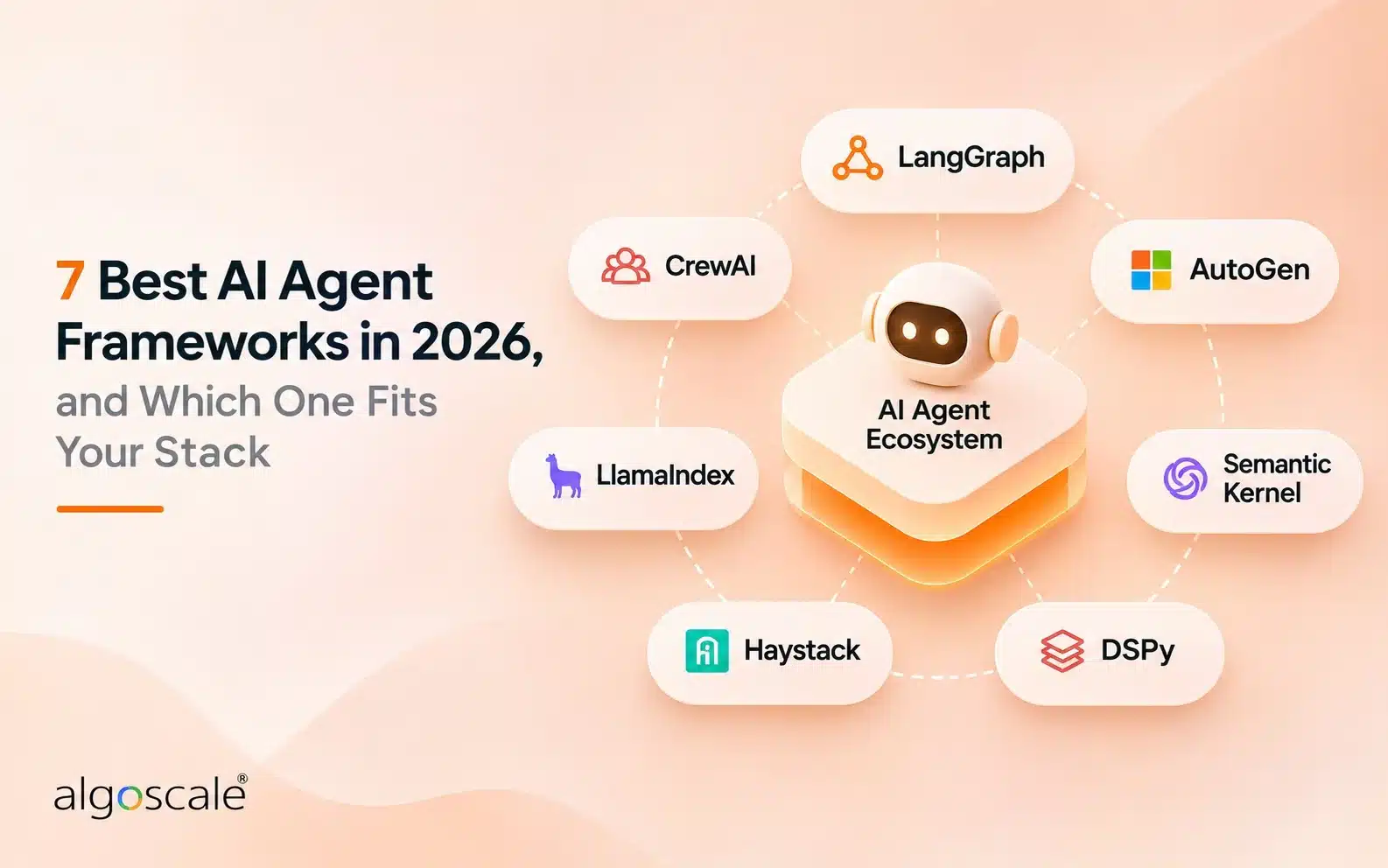

AI agent frameworks are the code around a model call: the loop that lets a model pick a tool, the state kept between steps, and what happens when a run stops halfway. This page compares six of them that a developer installs, plus Algoscale at number four, ranked as a services team and labelled as one.
Most lists of agentic AI frameworks stop at features. The two questions that actually decide the pick are which language your team writes, and whether the job is one agent or several working together. The comparison table answers the first, and the chooser at the end answers both in a single grid.
Nothing here was installed or run. Every price, licence and language claim comes from the vendor’s own docs, pricing page or GitHub repository, read on 11 and 12 November 2026, and every user quote links to a public comment.
If you are still working out what your agent should do, start with our guide to building AI agents. This page is about what you build it with.
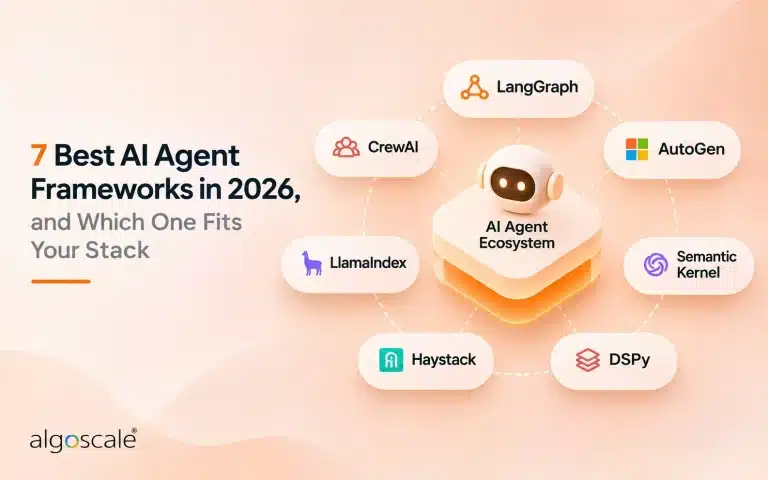
7 Best AI Agent Frameworks: Quick Comparison
| Tool | Best For | Public Reviews | The Catch | Starting Price | Languages | Access |
|---|---|---|---|---|---|---|
| 1LangGraph | Long-running agents that must survive a crash | Hacker News – the graph praised as a mental model; one production user lost state mid-run | Low-level: you design the graph yourself | Free (MIT); LangSmith Plus $39 a seat a month | Python, TypeScript | Open source; bring a model key |
| 2CrewAI | Role-based agent teams, fast | Hacker News – easy to mix and match roles; one builder hit its limits in 2025 | Hosted plan jumps from free to Enterprise | Free (MIT); hosted Basic free, Enterprise custom | Python | Open source; bring a model key |
| 3OpenAI Agents SDK | The thinnest agent loop | Hacker News – happy with the abstractions; infra and observability were the bigger pain | An SDK, not a runtime: hosting is yours | Free (MIT); model tokens at API rates | Python, TypeScript | Open source; bring a model key |
| 4Algoscale | Having a document agent built and wired in for you | No public reviews – our own case study: $7M in missed escalations captured | A services engagement; one published agent | Scoped per project | Python (published case) | Talk to us |
| 5Microsoft Agent Framework | .NET, Azure and AutoGen migrations | Hacker News and GitHub – a pre-1.0 user found it not worth the hassle; a production MCP bug report | Hosted compute rate not on the rate card | Free (MIT); Foundry hosting compute rate not published | .NET, Python, Go (preview) | Open source; bring a model key |
| 6Pydantic AI | Typed, validated output in Python | Hacker News – “Highly recommend” for the agent loop; one user missed built-in observability | Python only; serving layer is yours | Free (MIT); Logfire Team $49 a month | Python | Open source; bring a model key |
| 7LlamaIndex | Agents that read your documents | Hacker News – “great for RAG” from a team building on it; chunking criticised | A history of API churn; TypeScript port archived | Free (MIT); LlamaParse Pro $500 a month | Python (TypeScript port archived) | Open source; bring a model key |
Not sure which framework fits your stack?
Tell us which language your team writes, what the agent has to do and which systems it has to touch. We will tell you which of these we would pick, and why. We are not going to pitch you.
How We Researched These AI Agent Frameworks
Nothing was installed, run or trialled, and no account was created. All six are open source AI agent frameworks and could run on a laptop, but each one needs a model API key from a paid provider account, and we do not open accounts for a comparison. So there is no hands-on test anywhere in this post. Every claim comes from public docs, pricing pages and official GitHub repositories.
The shortlist came from ten sources that rank or are cited for this term: nine pages we read, plus the names in a Reddit result’s snippet, since Reddit blocks automated reading. We counted how often each framework appeared. The order is editorial, widest fit first, so the general-purpose frameworks lead and the narrower fits follow.
Two familiar names are missing on purpose. AutoGen’s own README says Microsoft no longer provides bug fixes, security fixes or support for it, and tells new users to start with Microsoft Agent Framework. Semantic Kernel’s README opens by saying it is now Microsoft Agent Framework. Their slot went to the maintained successor at entry 5.
User evidence is public Hacker News comments plus one GitHub issue. We read 105 on-topic comments across the six frameworks and quote two per framework in full, from different people, with a few more short quotes in the pros and cons. When a commenter has a stake, such as a tool to sell or a product built on the framework, or wrote before a 1.0 release, the note under the quote says so.
G2, Reddit and Capterra were not used. Reddit and Capterra block automated reading, and we do not work around that. G2 refuses it too, and we found G2 listings for only three of these six, so using it would have judged half the list on different evidence. Nothing here was measured, so there are no scores.
Five things decided the order:
- Which language it supports – it rules frameworks out before anything else does: three of the six are Python only, and only one is built for .NET
- What happens when a run fails halfway – checkpoints, resumable state and a human approval step are what separate a demo from an agent you can leave running
- What you pay for beyond the free library – every framework here is MIT-licensed, so the real bill is model tokens plus whichever tracing, hosting or parsing product sits next to it
- One agent or a team of them – all six work as a multi-agent framework as well as for a single agent, though each makes a different shape easy
- Whether it will still be maintained – seven of the ten sources we could see still list AutoGen, which now gets no security fixes
Agentic AI Frameworks, SDKs or Platforms: Which Do You Need?
Three different things get sold as an AI agent framework, and each is paid for differently. It helps to know which one you are shopping for, and whether you need an agent at all.
| What you have | What you need | What you pay for |
|---|---|---|
| A task you could write as a plain function | No agent at all | Nothing. Microsoft’s own Agent Framework docs say: “If you can write a function to handle the task, do that instead of using an AI agent.” |
| One model, a few tools, a short loop | A provider SDK, such as the OpenAI Agents SDK at entry 3 | The SDK is free under MIT; the bill is model tokens and tool calls at the provider’s published API rates |
| Long-running, stateful or multi-agent work in your own code | A code framework: LangGraph, CrewAI, Microsoft Agent Framework, Pydantic AI or LlamaIndex | The library is free under MIT; the paid parts are add-ons such as LangSmith, Logfire, CrewAI’s hosted platform, LlamaParse or Foundry hosting |
| A business team that wants to drag boxes rather than write code | A hosted or no-code builder such as n8n, Flowise, Copilot Studio or Vertex AI Agent Builder | Not ranked here. These are products rather than libraries you install, and they belong in a different comparison |
| Agents already written on AutoGen or Semantic Kernel | A migration | Both READMEs now point to Microsoft Agent Framework at entry 5 |
1. LangGraph: Best for Long-Running Agents That Need Checkpoints and Human Approval

What it does: A low-level orchestration framework and runtime for long-running, stateful agents. You draw the agent as a graph, and it checkpoints state so a run can pause for a person and resume after a failure.
Who this is for: Engineering teams putting long-running or approval-gated agents into production, who will design the control flow themselves and can pay for LangSmith tracing once it is live
LangGraph is first because it answers the question that decides whether an agent survives production: what happens when a run stops halfway. It checkpoints state, so a run resumes after a failure or a pause, and a person can inspect or edit that state before it continues. Its docs describe it as low-level.
In exchange, you draw the graph yourself: nodes, edges, state and every branch. For a single prompt-and-tool loop that is overhead. The tracing that makes a failed run debuggable lives in LangSmith, a separate paid product, not in the MIT-licensed library.


Key Features
- Agents defined as a graph of nodes and edges, so branching and loops are explicit
- Checkpointed state, so a run resumes after a failure or a pause
- Human-in-the-loop: pause execution, inspect or edit state, then continue
- Short-term thread state plus longer-term memory across sessions
- Streaming of tokens, state updates and other events while the graph runs
Pros and Cons
Pros
- The graph makes control flow explicit; one Hacker News user calls it “a very useful mental model for thinking about an agentic flow”
- MIT-licensed and free; you pay only if you want LangSmith tracing or managed deployment
- Python and TypeScript implementations
Cons
- Low-level by its own description: the graph, the state and the control flow are yours to design
- Debugging a failed run without tracing is painful; one production user says the state was gone by the time they opened the logs
- Managed deployment is metered in LSUs, so the hosted bill follows compute consumed rather than a flat plan price
- The observability and deployment that make it production-friendly live in a separate paid product
What Users Say
I’ve found that the graph abstraction that LangGraph uses is a very useful mental model for thinking about an agentic flow
four_fifths on Hacker NewsThe same comment calls LangChain itself “a meaningless abstraction”; the praise is for LangGraph’s graph.

Last year I was running a LangGraph agent in production. It failed on step 4 of 6 nd by the time I opened the logs, the state was gone.
redhanuman on Hacker NewsDisclosure: this opens the author’s own Show HN for a debugging tool, so they have something to sell. The failure they describe is first-hand.

Pricing
LangGraph costs nothing under its MIT licence. The pricing page prices LangSmith, the tracing and deployment layer that sits around it.
Developer: $0 per seat per month, with up to 5k base traces a month. Plus: $39 per seat per month, with up to 10k base traces a month and one free small serverless deployment. Enterprise is custom.
Deployment beyond that is charged on resources consumed, metered in LSUs at $1.00 per LSU. Runtime compute, for example, is 0.0675 LSU per vCPU-hour. The page calls this LangSmith Deployment and does not use the name LangGraph Platform.
Pick it when the agent runs for minutes or days, must survive a crash and needs a person to approve a step; skip it for a single prompt-and-tool loop, where its graph is overhead.
2. CrewAI: Best for Role-Based Agent Teams You Want Running Fast

What it does: A standalone Python framework for teams of role-based agents, called crews, and for Flows that own state and execution order. The company also sells a hosted platform with a visual editor.
Who this is for: Teams whose workflow maps onto roles such as researcher, writer and reviewer, and who want to try a hosted visual editor, free up to 50 workflow executions a month, before an Enterprise contract
CrewAI starts from roles rather than graphs. You describe agents the way you would describe a team (a researcher, a writer, a reviewer), group them into a crew, and have the crew work its tasks sequentially, hierarchically or as a hybrid. It is a standalone framework with its own primitives, and no LangChain dependency underneath.
For production, the docs now point you to Flows, which own state and execution order while the crew does the work inside each step. That adds a second concept to learn. The hosted platform goes straight from a free tier of 50 workflow executions a month to Enterprise pricing.


Key Features
- Agents with roles, grouped into crews that work a list of tasks
- Sequential, hierarchical or hybrid processes
- Flows that own state and execution order, recommended for production apps
- A kickoff() method that runs one agent directly, without a task or crew
- A hosted platform with a visual editor and AI copilot, free up to 50 workflow executions a month
Pros and Cons
Pros
- Role-based crews map onto how people already describe the work; one user says “it’s easy to mix and match” agents
- A developer who spent a week comparing frameworks in December 2024 found CrewAI “the simplest to get started with”
- A standalone framework with its own primitives, so there is no LangChain dependency to inherit
Cons
- One builder “re-built with CrewAI but was limited” and moved the project to another framework in 2025
- The hosted platform jumps from a free tier capped at 50 workflow executions a month straight to custom Enterprise pricing
- Production structure now means Flows as well as crews, a second concept on top of roles and tasks
- Single-agent use exists through kickoff(), but the docs, pricing and quickstart all centre on crews and Flows
What Users Say
Ive used CrewAI to compose agents, it’s easy to mix and match and it does seem to change context based on roles
jrvarela56 on Hacker News

I re-built with CrewAI but was limited so now doing the same again but using AutoGen.
nickwatson on Hacker NewsWritten in May 2025. Microsoft has since archived AutoGen and no longer ships security fixes for it; entry 5 is its successor.

Pricing
The open-source framework is free, under an MIT licence.
The pricing page prices the hosted platform in two plans. Basic is free and includes the visual editor, an AI copilot, GitHub integration and 50 workflow executions a month. Enterprise is custom.
There is no paid self-serve tier between the two, so the first step past 50 executions a month is a sales conversation.
Buy into it when the job naturally splits into roles and you want a crew running quickly; expect to add Flows for production state, and to feel limited if you need fine-grained control.
3. OpenAI Agents SDK: Best for the Thinnest Agent Loop With Tracing Built In

What it does: A lightweight framework with very few abstractions (agents, handoffs or agents-as-tools, and guardrails) plus sessions and built-in tracing. It uses OpenAI’s Responses API by default, and its README says it supports 100+ other LLMs.
Who this is for: Product teams that want the smallest agent loop with tracing built in, in Python or TypeScript, usually on OpenAI models, though the README calls it provider-agnostic
The OpenAI Agents SDK is the smallest thing on this list that still counts as a framework. It has three primitives (agents, handoffs or agents-as-tools, and guardrails) plus sessions and built-in tracing. The README calls it provider-agnostic, supporting 100+ other LLMs, though it uses OpenAI’s Responses API by default.
It does not give you a runtime. The docs overview makes no durable-execution claim, so hosting, scaling and recovering a failed run are yours to build. One user who is largely happy with the abstractions says exactly that below.


Key Features
- Three primitives: agents, handoffs or agents-as-tools, and guardrails
- Sessions as a persistent memory layer inside the agent loop
- Built-in tracing for visualizing, debugging and monitoring workflows
- OpenAI’s Responses API by default, with Chat Completions and other providers supported
Pros and Cons
Pros
- Very few abstractions; a user who has used it “for a while” is “largely happy with the abstractions”
- MIT-licensed; the only bill is model and tool usage, priced per token and per call on a public page
- Python and TypeScript SDKs
Cons
- An SDK, not a runtime: the same user found building the infra and observability, and having it scale reliably, the bigger pain
- OpenAI’s Responses API is the default; other providers work, but they are the non-default path
- The bill moves with the model you pick: standard short-context input runs from $0.05 (GPT-5 nano, now deprecated) to $30.00 per 1M tokens
- No durable-execution claim on the docs overview, unlike LangGraph’s checkpointing
What Users Say
I’ve had great success with the OpenAI agents SDK
baalimago on Hacker NewsThe same comment says it let them keep integrations independent and “be very strict with what I expose to OpenAI”.

Building the infra and observability, and having it scale reliably, was a bigger pain for me.
suncemoje on Hacker NewsThe same comment opens: “I’ve been using the OpenAI Agents SDK for a while now and am largely happy with the abstractions”.

Pricing
The SDK has no licence fee (MIT). You pay for model usage at the rates on OpenAI’s API pricing page.
Standard short-context input runs from $0.05 to $30.00 per 1M tokens. The $0.05 floor is GPT-5 nano, which its own model page labels Deprecated. The top is GPT-5.5 Pro, whose output is $180.00 per 1M.
Hosted tools cost extra: web search is $10.00 per 1k calls plus search content tokens, file search $2.50 per 1k calls plus storage, and Code Interpreter or Hosted Shell containers $0.03 to $1.92 per 20-minute session.
Use it when you are on OpenAI models and want the smallest set of primitives with tracing included; budget for building your own hosting, scaling and durable state around it.
4. Algoscale: Best for a Document Agent Built Into Your Own Systems, With Human Review

What it does: A services team that builds document and data agents into a client’s own systems, with a human review step.
Who this is for: Companies with a large document estate, contracts in the published case, where an agent’s extracted terms have to be checked by a person before they reach the system of record
Algoscale is not a framework. We are a services team that builds document and data agents into a client’s own systems, with a person reviewing the output before it reaches the system of record. We are on this list because the question after “which framework?” is usually “who builds it and wires it in?”
Our published proof is one contract agent. For a client with thousands of agreements in six languages, DocumentIQ, our document-processing agent, ran OCR, extracted structured metadata and scored its confidence, and a human-in-the-loop layer checked the output. The case study names no framework, and it is one agent, not a multi-agent system.

Key Features
- A document-processing agent (DocumentIQ) doing OCR, structured metadata extraction and confidence scoring
- A human-in-the-loop validation layer between the agent and the system of record
- Multilingual extraction, with agreements in six languages in the published case
Pros and Cons
Pros
- A named, published outcome from a built agent: $7M in missed price escalations captured
- Human review is part of the build, which matters where the agent’s output feeds money decisions
- Works on the client’s own data and systems rather than in a hosted product
Cons
- A services engagement, not a product: no free tier, no trial and no rate card
- The published proof is one document-processing agent, not a multi-agent system
- The case study names no framework, and our service page names only LangChain and LlamaIndex; there is no published Algoscale work on LangGraph, CrewAI, the OpenAI Agents SDK, Microsoft Agent Framework or Pydantic AI
From Our Case Study
Identified and captured $7M in missed price escalations, applied proactively during renewals.
Algoscale case study: AI-powered contract intelligenceFrom our own published case study for this engagement, not a third-party review.
Developed a human-in-the-loop validation layer to minimize hallucinations and maintain high data accuracy.
Algoscale case study: AI-powered contract intelligenceFrom the same case study. We quote it because the review step is the part of the build a framework does not give you.
Pricing
Scoped per project. We publish no rate card, and there is no free tier or trial.
The published outcome of that work, in the case study’s own words: manual contract review effort reduced by over 80% through AI-driven extraction and validation.
Bring us in when the job is a document agent built into your own systems with a person reviewing its output; our published proof is a contract agent that captured $7M in missed escalations.
5. Microsoft Agent Framework: Best for .NET Teams and AutoGen or Semantic Kernel Migrations

What it does: Microsoft’s agent framework for .NET, Python and, in public preview, Go: individual agents plus workflows for multi-agent orchestration. Microsoft calls it the direct successor to both AutoGen and Semantic Kernel.
Who this is for: Enterprise .NET and Azure teams, and any team with AutoGen or Semantic Kernel agents that now needs a maintained target
If your team writes C#, this is the entry. Microsoft Agent Framework covers .NET and Python, with Go in public preview, and Microsoft calls it the direct successor to both AutoGen and Semantic Kernel, built by the same teams. Both of those projects’ READMEs now send new users here.
Its docs are unusually frank about when not to use an agent. Agents cover the case where one LLM call, possibly with tools, is enough; workflows cover several agents that must coordinate. Version 1.0 shipped for Python and .NET on 2 April 2026, so check the date on any opinion you read, including one of the two below.


Key Features
- Agents that work with Microsoft Foundry, Anthropic, Azure OpenAI, OpenAI, Ollama and more
- Workflows for explicit multi-agent execution, when several agents or functions must coordinate
- Session-based state management, type safety, filters and telemetry carried over from Semantic Kernel
- SDKs for .NET and Python, with Go in public preview (Go 1.26 or later)
Pros and Cons
Pros
- The maintained home for AutoGen and Semantic Kernel code, since both READMEs now point here
- Docs that are direct about when not to use an agent at all
- No additional charge for running Foundry-native agents on Azure; you pay for models and tools
Cons
- The rate card shows hosted-agent vCPU and memory as N/A, so the compute cost of hosting on Foundry cannot be worked out from the public page
- Go support is still a public preview
- One early user found it “wasn’t even worth the hassle” against plain REST calls on a job extracting VBA code from an Access database, writing before 1.0
- A post-1.0 production user reports an MCP tool that never recovered after a brief connection loss, failing “for about five days, until we restarted it”
What Users Say
It wasn’t even worth the hassle of using the MS Agent Framework, I would have been better off with plain HTTPS REST API calls.
jiggawatts on Hacker NewsWritten on 25 November 2025 about early experiments, before the 1.0 release on 2 April 2026. The job was extracting and cross-referencing VBA code from an Access database.

We hit this in production with a long-lived backend process that shares one tool instance across requests. After one short connection loss, all of that process’s MCP tool calls failed for about five days, until we restarted it.
markuspalme on GitHubFrom a bug report filed by an outside user after 1.0. It is a first-hand production report, but bug reports lean negative by nature.

Pricing
Microsoft charges nothing for the framework, which is MIT-licensed.
Hosting on Foundry Agent Service: the pricing page says “There is no additional charge for creating or running Foundry-native agents using prompts and workflows”. Model tokens are billed separately.
On the rate card (Central US, USD), hosted-agent vCPU per hour and memory per GiB-hour both read N/A, so the compute rate for hosting is not published there.
Built-in tools are priced: File Search storage at $0.11 per GB of vector storage a day, with 1 GB free; Code Interpreter at $0.033 a session; Web Search and Custom Search at $14 per 1,000 transactions.
Choose it if your team writes C# or runs on Azure, or you have AutoGen or Semantic Kernel code to move; elsewhere, its main advantage is Microsoft’s ecosystem, which you would not use.
6. Pydantic AI: Best for Python Teams That Need Typed, Validated Output

What it does: A typed Python agent framework from the Pydantic team. Every run returns validated, typed output, models swap by string across most providers, and observability comes through Pydantic Logfire or any OpenTelemetry backend.
Who this is for: Python engineering teams wiring agents into existing systems where outputs must match a schema, and who want to switch model providers without rewriting code
Pydantic AI is for the case where a wrong-shaped answer is a bug. Every run comes back validated and typed, models swap by string across OpenAI, Anthropic, Google, Bedrock, Mistral, Ollama and dozens more, and dependencies are injected into tools in a type-safe way. It also offers durable execution on nine engines.
Multi-agent work is a ladder of five documented levels, from one agent calling another inside a tool up to graph control flow and Deep Agents. Choosing the rung is your design decision. Tracing runs on standard OpenTelemetry, with Logfire as the paid first-party backend.


Key Features
- Validated, typed output on every run
- Type-safe dependency injection into tools and instructions
- Durable execution on nine engines
- Pydantic Graph for typed control flow when one agent loop is not enough
Pros and Cons
Pros
- A broad provider list, so the model is a configuration choice
- A team using it says “the entire Agent loop is taken care of by the framework” and recommends it
- Standard OpenTelemetry, so tracing is not tied to Logfire
Cons
- Serving the agent to users is on you: a team running it in production says they “kept rewriting the same infrastructure to actually show them to users”, writing in the launch post for their own library built on it
- Python only, with no TypeScript or .NET SDK
- Five documented multi-agent levels give you flexibility, but picking the right one is left to you
- Observability out of the box is thin unless you adopt Logfire or wire up your own OpenTelemetry backend
What Users Say
We’re using pydantic AI where the entire Agent loop is taken care of by the framework. Highly recommend.
pietz on Hacker News

Ended up using pydantic_ai package, literally just want tools w/ pydantic validation–but out of the box it doesn’t have good observability, you would have to use their proprietary SaaS
munro on Hacker NewsThe “proprietary SaaS” point is the commenter’s view. Pydantic’s docs say instrumentation is standard OpenTelemetry, so other backends work as well as Logfire.

Pricing
Pydantic AI is open source (MIT) and costs nothing. The pricing page prices Logfire, the observability add-on, and does not price Pydantic AI at all.
Logfire: Personal is free with 10M records a month and one seat. Team is $49 a month, Growth $249 a month, and Enterprise is custom.
Because instrumentation is standard OpenTelemetry, you can send traces to a backend you already run instead of paying for Logfire.
Pick it when a wrong-shaped answer is a bug (extraction, classification, anything feeding another system) and your team writes Python; it will not build your serving layer for you.
7. LlamaIndex: Best for Agents Whose Main Job Is Reading Your Documents

What it does: A Python toolkit for building LLM agents over your own data: data connectors, indexes and query engines for retrieval, plus event-driven Workflows that combine agents and tools. The company also sells LlamaParse for hard documents.
Who this is for: Python teams building agents over internal documents such as contracts, reports and scanned PDFs, who may pay for LlamaParse when plain text extraction fails
LlamaIndex is the pick when the agent’s real job is reading. Data connectors, indexes and query engines are the core of the library, and Workflows add branching, retries and human review, which fits a document job where a person signs off at the end.
Its own docs say the built-in readers are fine for clean text, but scanned PDFs need better parsing before indexing, which is what the paid LlamaParse is for. The TypeScript port is archived, so for new work this is a Python-only choice.


Key Features
- Data connectors, indexes and vector stores for retrieval over your own data
- Query and chat engines an agent can call as tools
- Event-driven Workflows with branching and retries
- LlamaParse for scanned PDFs and complex layouts, priced in credits
- A multi-agent guide with a built-in AgentWorkflow class
Pros and Cons
Pros
- Workflows include human review, which suits document jobs where a person signs off
- LlamaParse handles documents plain readers cannot; one user in July 2024 said it “works great with the kinds of images and table graphics I feed it”
- The framework is MIT-licensed and separate from the paid parser
Cons
- API churn is a long-running complaint: one user wrote in March 2025 that it and LangChain “keep breaking their APIs from one version to the next”
- The TypeScript port is archived, so it is Python-only for new work
- Out-of-the-box chunking can disappoint: a user who tried it in December 2025 found “some words or sentences were split in the middle”
- Paid parsing is credit-metered, and Pro’s 800k headline is a one-time bonus, not the monthly allowance
What Users Say
I recently tried llamaindex and some other opensource solutions. the result was poor, some words or sentences were split in the middle.
billconan on Hacker NewsWritten about chunking documents for retrieval.

we actually use LlamaIndex as one of our components. It’s great for RAG, and we didn’t want to reinvent what they’ve already done.
rachelradulo on Hacker NewsDisclosure: the commenter works on LlamaFarm, a product built on top of LlamaIndex, and wrote this in her own launch thread. The use is first-hand; the motive is not neutral.

Pricing
You pay nothing for LlamaIndex itself. The pricing page prices LlamaParse, the hosted platform formerly called LlamaCloud, which its own FAQ says is a commercial platform and not open source.
Pay-as-you-go: $0 a month with 10K included credits, then $1.5 per 1K credits. Pro: $500 a month with 400K included credits, per the plan comparison table on the pricing page, at $1.25 per 1K after that. Enterprise is custom.
The 800k figure on the Pro card in the screenshot is a separate limited-time, one-time bonus for business email domains only, and unused bonus credits expire if you downgrade. Plan on the 400K.
Basic parsing costs as little as 1 credit a page; layout-aware agentic parsing with LLMs or vision models costs more.
Choose it when the agent’s real work is reading and retrieving from your documents; pin your version, because the API has a history of moving under you.
Which AI Agent Framework Should You Choose?
Start with two questions: which language your team writes, and whether the job is one agent or a team of them. The grid below answers both. It includes three frameworks we did not rank, Google’s Agent Development Kit, Mastra and the Claude Agent SDK, because for some languages they are the answer. Every cell rests on that framework’s own docs or repository.
LangGraph vs CrewAI? LangGraph if you need to control, pause and recover every step. CrewAI if the work reads as roles and you want a crew running first.
| Your language | One agent | A team of agents |
|---|---|---|
| Python | OpenAI Agents SDK for the thinnest loop; Pydantic AI when the output must be typed; LlamaIndex when the agent reads documents. CrewAI runs a single agent through kickoff(). | LangGraph for control and checkpoints; CrewAI for role-based crews; Microsoft Agent Framework workflows; Pydantic AI’s delegation and hand-off levels; LlamaIndex’s AgentWorkflow |
| TypeScript | OpenAI Agents SDK (openai-agents-js), Mastra, the Claude Agent SDK, LangGraph’s TypeScript port, Google ADK | LangGraph’s TypeScript port, OpenAI Agents SDK handoffs, Claude Agent SDK subagents, Google ADK. |
| .NET (C#) | Microsoft Agent Framework agents | Microsoft Agent Framework workflows (the only ranked framework with a .NET SDK) |
| Go | Google ADK; Microsoft Agent Framework for Go, in public preview | Google ADK; Microsoft Agent Framework for Go, in public preview |
| Java or Kotlin | Google ADK | Google ADK, the only framework here with Java and Kotlin SDKs |
Choose LangGraph if:
- The agent runs for minutes or days and has to survive a crash
Choose CrewAI if:
- The work splits naturally into roles such as researcher, writer and reviewer
Choose OpenAI Agents SDK if:
- You want three primitives and tracing, and nothing more
Choose Algoscale if:
- The agent has to read documents and write into a system you already run
Choose Microsoft Agent Framework if:
- Your team writes C# or runs on Azure
Choose Pydantic AI if:
- Every output feeds another system and has to match a schema
Choose LlamaIndex if:
- The agent’s main job is retrieving from your own documents
Skip this category entirely if:
- Nobody will own the agent once it is live. Every framework here gives you the loop, and none of them watches it for you.
- You want a no-code builder for a business team. These are code libraries; hosted builders belong in a different comparison.
What’s the Best AI Agent Framework in 2026?
LangGraph, if the agent has to survive a failure. Checkpointed state and a human approval step are what production agents need most, and LangGraph builds its runtime around them. CrewAI if the work reads as roles and you want a crew running quickly. The OpenAI Agents SDK if you want the smallest loop with tracing included, and will build the hosting around it.
The narrower fits come next: Microsoft Agent Framework if your team writes C# or has AutoGen or Semantic Kernel code to move, Pydantic AI when a wrong-shaped answer is a bug, and LlamaIndex when the agent’s real job is reading your documents. And if the job is a document agent wired into your own systems with a person checking its output, that is the work Algoscale has published (entry 4).
How Algoscale Builds an Agent Into Your Own Systems
The frameworks above run the loop. Getting an agent into production is the work around it: connecting it to the documents and systems it has to read, deciding where a person checks its output, and writing the result somewhere the business already looks.
For our published engagement, a contract agent with a human review step, the case study reports $7M in missed price escalations captured and manual contract review effort cut by over 80%.
On frameworks, we will only say what is published. Our AI agent development page lists LangChain and LlamaIndex among the technologies we work with, alongside OpenAI, Claude, Gemini, Mistral AI and Elasticsearch. The case study does not name the framework that agent ran on; its stack is Python, AWS and Azure.
- Agents that read the documents you already hold, including scans and agreements in more than one language
- A human-in-the-loop validation layer between the agent and the system of record
- Output written into a system the business already runs (a CLM, in the published case)
Need the agent built into your own systems?
Tell us what the agent has to read and where its output has to land, and we will scope it with you. Book a free consultation, or see how we work first.
Frequently Asked Questions
What are agent frameworks?
An agent framework is a code library that runs the loop around a language model: it gives the model instructions and tools, carries out the tool calls the model asks for, keeps state between steps and, in the fuller ones, coordinates several agents. OpenAI’s SDK describes an agent as an LLM “equipped with instructions and tools”. LangGraph calls itself an orchestration framework and runtime for long-running, stateful agents. All six frameworks ranked here are free and MIT-licensed; you pay for the model and any hosting or tracing around them.
What is the most used agent framework?
No public source measures how many teams use each framework, so the closest proxy is GitHub stars, which measure attention rather than production use. Read on 11 November 2026: CrewAI 60,777, LlamaIndex 52,874, LangGraph 44,805, the OpenAI Agents SDK (Python) 30,617, Pydantic AI 21,143 and Microsoft Agent Framework 14,633. LlamaIndex’s count covers its whole retrieval toolkit, not only its agent features, and Microsoft Agent Framework only reached 1.0 in April 2026.
What are some popular agent frameworks?
Across the ten sources we could see for this term (nine pages read, plus the names in a Reddit result’s snippet), CrewAI appeared in 10, LangGraph in 9, AutoGen, the OpenAI Agents SDK and Pydantic AI in 7 each, LlamaIndex in 6, and Google’s Agent Development Kit and Semantic Kernel in 5 each. Two of those are no longer the place to start: both of their READMEs now point to Microsoft Agent Framework. For TypeScript teams, Mastra is the TypeScript-first pick Google’s AI Overview for this search names.
What are software agents in AI?
A software agent in AI is a program that uses a language model to decide its next step, calls tools to take that step, and repeats until the task is done. The OpenAI Agents SDK defines its agents as “LLMs equipped with instructions and tools”. Microsoft’s Agent Framework docs draw the useful line: use an agent when a single LLM call, possibly with tools, is enough; use a workflow when several agents or functions must coordinate; and if you can write a function to handle the task, do that instead.