

Key Insights for Data Strategy Leaders
- Different Jobs, Different Rules: A data lake stores structured, semi-structured and unstructured data and applies structure when it’s read (schema-on-read). A data warehouse models data before it’s loaded (schema-on-write) so business users get consistent, governed numbers.
- Storage Price Isn’t Total Cost: Cloud object storage makes lakes cheap per GB, but ingestion, processing, governance, monitoring and data movement all add to the bill. A warehouse can still be the cheaper choice for workloads running millions of repeated analytical queries.
- Governance Decides Success: A lake without owners, a catalog, quality rules and retention policies turns into a data swamp. In a warehouse, governance sits close to where business users consume the data.
- The Lakehouse Blurs the Line: Table formats like Delta Lake and Apache Iceberg add reliable tables and governance on top of lake storage. It’s worth evaluating for new platforms, but it isn’t an automatic replacement for a mature, stable warehouse.
- Most Enterprises Need Both: The lake handles broad ingestion, raw history and ML, while the warehouse serves governed BI. In one Algoscale AWS project, 14+ ERP systems were unified into an S3 data lake feeding 20+ live dashboards, cutting reporting prep time by 70%.
A data lake and a data warehouse solve different problems.
A data lake gives an enterprise a flexible place to ingest and retain large volumes of data in different formats. A data warehouse organizes data for governed, repeatable analytics and reporting.
The distinction used to be fairly clear.
The scale of enterprise data is one reason this decision matters. IDC estimates that the world generated 6.9 petabytes of data every second in 2025, with that figure projected to reach 17.1 petabytes per second by 2029.
It isn’t anymore.
Modern cloud platforms can support capabilities traditionally associated with both architectures. Lakehouse architectures have blurred the boundary further by combining lake storage with warehouse-style management and analytics. Microsoft, AWS and Databricks now document architectures where lakes, warehouses and lakehouses work together rather than existing as isolated alternatives.
So the useful question isn’t simply:
Which is better, a data lake or a data warehouse?
It’s: Which architecture fits the data, workloads, governance requirements and operating model of your business?
Data Lake vs Data Warehouse: At a Glance
| Area | Data Lake | Data Warehouse |
|---|---|---|
| Primary role | Flexible data storage and processing | Governed analytical serving |
| Data | Structured, semi-structured and unstructured | Primarily structured, with modern platforms supporting additional formats |
| Data modeling | Often deferred until processing or consumption | Usually modeled before analytical consumption |
| Storage | Commonly cloud object storage | Managed analytical storage |
| Main users | Data engineers, data scientists, analysts | Analysts, BI teams, business users |
| Best suited to | Diverse data, exploration, ML, large-scale processing | BI, reporting, governed analytics |
| Governance | Must be designed and enforced | Typically more tightly integrated with the analytical layer |
| Query experience | Depends heavily on processing and table architecture | Generally optimized for repeatable analytical queries |
The table gives you the distinction. The architecture decisions come next.
What Is a Data Lake?
A data lake is a centralized repository for storing large volumes of data in its original or minimally transformed form.
That could include relational tables, JSON, XML, application logs, documents, images, audio or other machine-generated data.
Microsoft describes data lakes as repositories that can store structured, semi-structured and unstructured data at large scale, with transformation often applied when the data is needed.
That flexibility is the main attraction.
Imagine an enterprise acquiring data from 30 different systems. Some sources are well structured. Others aren’t. The business also doesn’t know yet which datasets will eventually support an AI model, operational report or new product.
A lake lets the organization retain the data before every future use case has been defined.
But flexibility creates responsibility.
A lake still needs data ownership, cataloging and metadata, access controls, quality rules, lineage, retention policies, monitoring and lifecycle management.
Without those controls, finding trustworthy data becomes harder as the platform grows. Algoscale’s guide to data lake architecture breaks down how to design these layers.
What Is a Data Warehouse?
A data warehouse is designed around analytical consumption.
Data from operational systems is ingested, transformed and modeled into structures that support reporting, analytics and business intelligence.
That usually means business entities such as:
Customers → Orders → Products → Revenue → Regions
The advantage is consistency.
A finance team should get the same revenue number whether it’s looking at a monthly report or an executive dashboard. Business users shouldn’t have to understand raw source-system structures to answer routine questions.
This is where the warehouse remains particularly strong. If you’re designing one, Algoscale’s breakdown of data warehouse architecture walks through the layers.
Data Lake vs Data Warehouse: The Real Differences
1. Data structure and flexibility
The traditional distinction is simple: lake means store first, structure later; warehouse means structure and model data for analytical use.
That’s still useful, but don’t turn it into an absolute rule.
Modern warehouses increasingly support semi-structured data, while lake architectures can provide schema enforcement, transactional guarantees and governed analytical tables.
The more useful distinction is how much structure the workload requires and where that structure is enforced.
2. Data modeling
A warehouse usually starts with known analytical requirements. You define the business logic, create models and expose datasets for consumption.
A lake can delay some of those decisions.
That works well when data scientists or engineering teams need access to raw information for experimentation, feature engineering or new analytical use cases.
But delaying decisions doesn’t mean avoiding them. Eventually, valuable data still needs definitions, ownership and business context.
3. Performance
Warehouses have traditionally had the advantage for predictable analytical queries because data is already modeled for the questions users are likely to ask.
A raw lake is different. Querying files directly can require additional processing, optimization and metadata management.
Modern lakehouse architectures have narrowed this gap considerably. Databricks, for example, documents warehouse workloads running directly on lake storage, with relational modeling and SQL-based analytics on top.
So don’t compare a raw data lake with a fully optimized warehouse and assume the result represents every modern lake architecture.
Architecture matters.
4. Governance and data quality
This is one of the most important differences in practice.
A warehouse generally puts governed, modeled data close to the point where business users consume it.
A lake gives you much more freedom, but that freedom has to be controlled.
You need to know: What is this dataset? Who owns it? Where did it come from? Can I trust it? Who can access it? What changed between versions?
Modern lakehouse patterns address these issues with cataloging, schema enforcement, quality checks, lineage and transactional table formats.
Governance isn’t an add-on. It is part of the architecture.
5. Cost
This is where generic comparison articles often oversimplify things.
A data lake can be economical for retaining large volumes of data because cloud object storage separates storage from compute and can scale independently.
But storage price isn’t total cost.
You also need to account for data ingestion, processing, query compute, data transformation, governance, cataloging, monitoring, engineering effort, data movement and duplicate storage.
A warehouse may cost more per unit of storage but still be the better economic choice for a workload involving millions of repeated analytical queries.
The right comparison is total cost of ownership for the workload, not storage price per GB.
Data Lake vs EDW
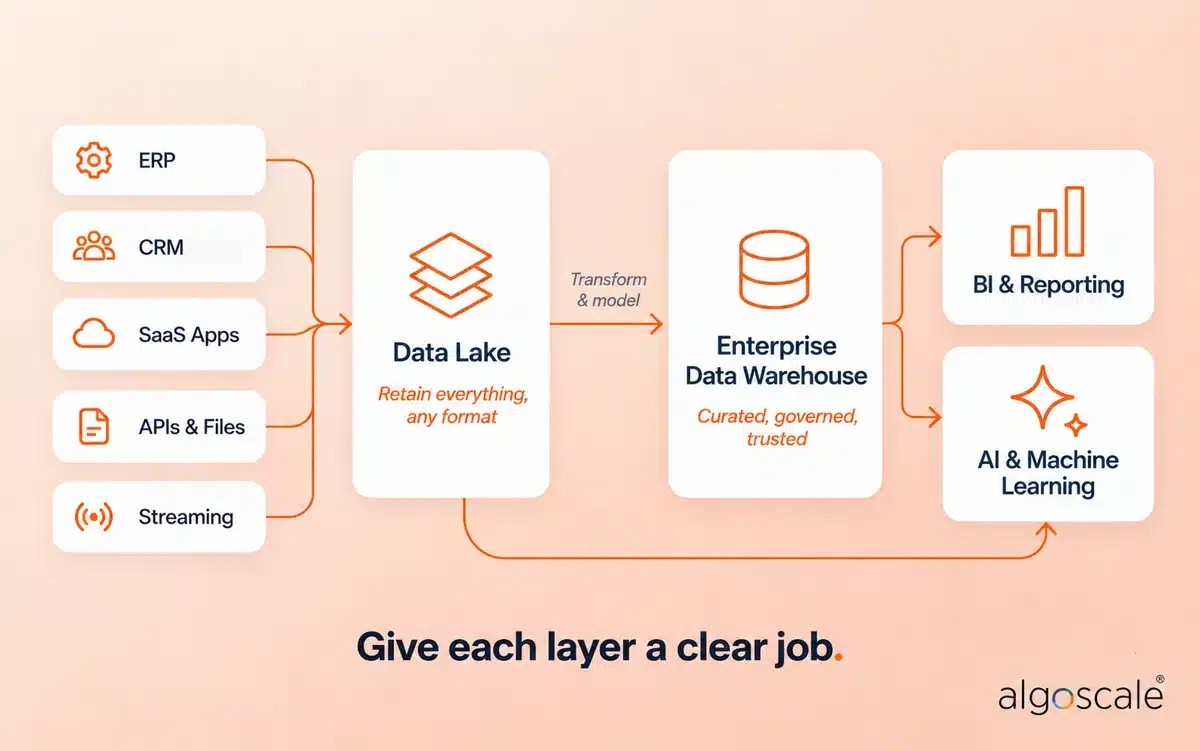
An EDW, or Enterprise Data Warehouse, is designed to provide a trusted analytical foundation across an organization.
A data lake serves a broader storage and processing role.
Operational systems → Data Lake → Transformation → Enterprise Data Warehouse → BI
The lake can retain source data and support engineering or advanced analytics. The EDW can expose curated, governed datasets for finance, operations, sales and executive reporting.
This architecture is particularly useful when an organization already has significant warehouse investment but also needs to handle new data types and AI or machine learning workloads.
You don’t always need to replace one with the other. Sometimes the better answer is to give each layer a clear job.
Data Lake vs Data Warehouse vs Lakehouse

The lakehouse changes the decision.
A lakehouse aims to combine flexible lake storage with capabilities traditionally associated with warehouses, including reliable tables, governance and analytical performance.
That doesn’t mean every company should migrate to a lakehouse.
An enterprise with a mature warehouse, stable BI workloads and well-understood data models may have little reason to replace it.
A company building a new platform around analytics, data engineering and AI may evaluate a lakehouse much more seriously. If that’s the situation, Algoscale’s practitioner comparison of Microsoft Fabric vs Databricks and its walkthrough of Databricks lakehouse architecture are good next reads.
The decision depends on the starting point.
When Should You Choose a Data Lake?
A data lake makes sense when you need to retain and process large amounts of varied data and expect multiple future workloads.
Common examples include machine learning datasets, IoT and sensor data, application and event logs, large-scale raw ingestion, data science experimentation, historical data retention and multi-source data consolidation.
The important qualifier is that a lake needs an operating model around it. Storage alone isn’t a data strategy.
When Should You Choose a Data Warehouse?
A warehouse is a strong fit when the business needs reliable, governed analytics around established metrics and processes.
Think financial reporting, executive dashboards, sales analytics, supply chain reporting, customer analytics, regulatory reporting and self-service BI.
If business users need to answer the same important questions repeatedly and trust the numbers behind those answers, a well-designed warehouse can be difficult to beat.
When Should You Use Both?
This is often the most practical enterprise pattern.
Algoscale’s own implementation work illustrates why.
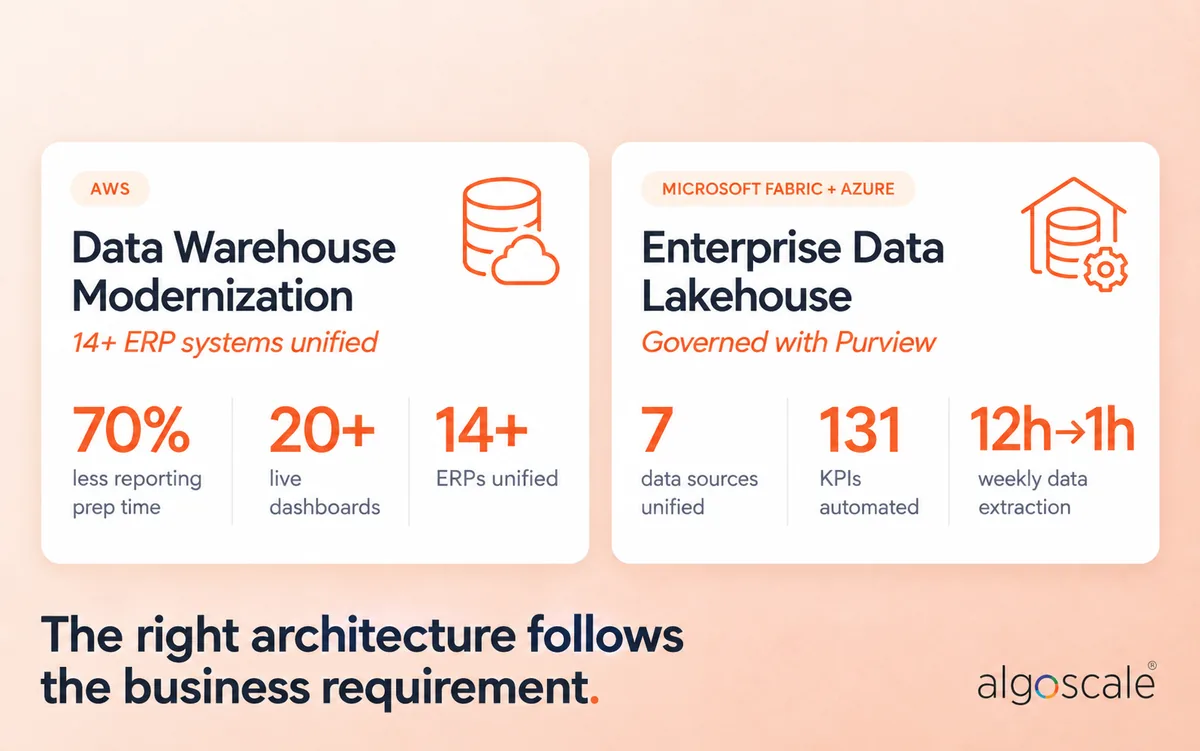
In one AWS data warehouse modernization project, the team unified 14+ ERP systems, automated the data pipelines and delivered 20+ live dashboards, reducing reporting time by 70%.
In another engagement, Algoscale built an Azure data lakehouse on Microsoft Fabric for a healthcare regulator, with Purview governance, column-level lineage and role-based access. It unified 7 data sources, automated 131 KPIs and cut weekly data extraction from 12 hours to 1.
These are two different architecture problems.
And that’s the point.
The right architecture follows the business requirement.
Find Your Starting Point: Data Architecture Fit Assessment
Every section above ends in the same place: it depends on your data, your workloads and where you’re starting from.
That’s why Algoscale built a short assessment that does the mapping for you.
Answer eight questions about your data types, who uses the data, how repeatable your reporting is, your AI and machine learning plans, your existing warehouse, your governance requirements, how much raw history you keep and the size of your engineering team.
You get one of four starting points.
Warehouse-led: governed BI is the priority, and a lake can wait.
Lake-led: varied data and ML workloads come first, with a curated serving layer on top.
Lake + warehouse: each layer gets a clear job.
Start small: begin with a focused warehouse and grow from there.
If you have no existing warehouse and score high on both sides, the assessment also flags a lakehouse as worth evaluating.
Every answer shows how it moved your result, so you can see exactly why you landed where you did.
Take the Data Architecture Fit Assessment →
How Algoscale Approaches the Decision
Algoscale doesn’t position the data lake, warehouse or lakehouse as a universal answer.
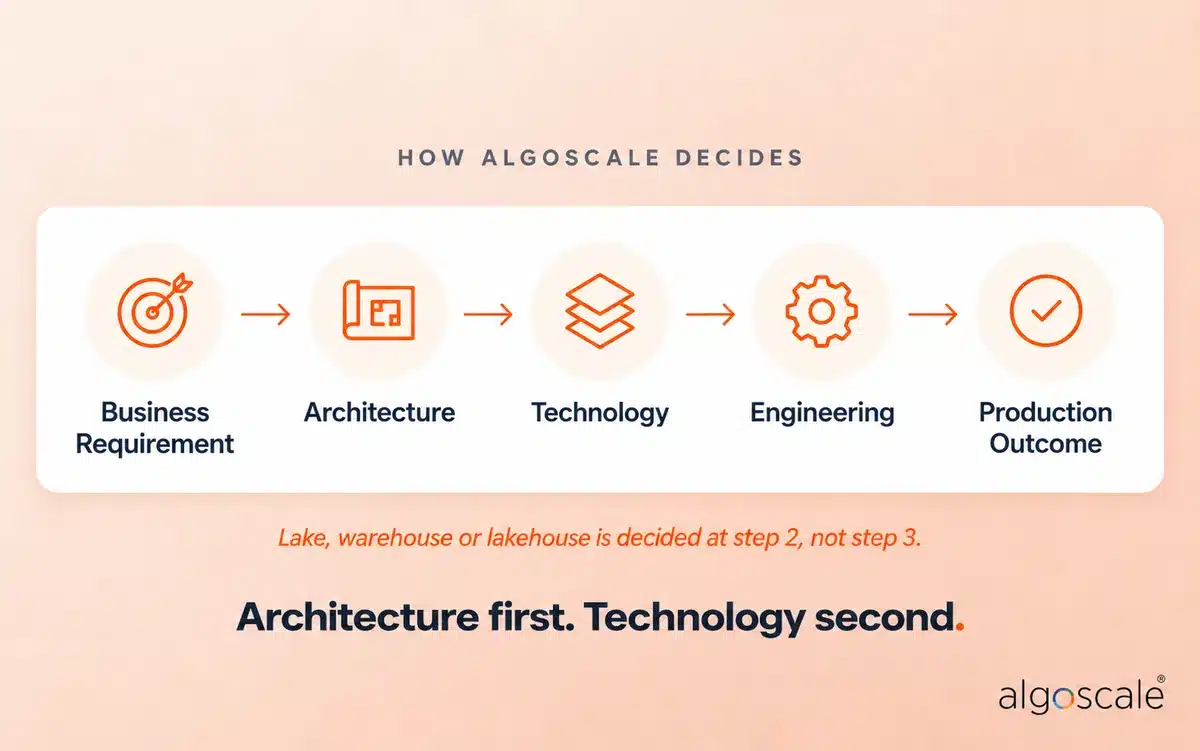
Its approach starts with the existing environment, business requirements, data sources, reporting needs, governance requirements and future workloads. The delivery path is business requirement, architecture, technology, engineering and production outcome.
That also means the technology choice comes after the architecture decision.
Algoscale works across AWS, Azure, Google Cloud, Databricks, Snowflake and Microsoft Fabric, with reusable architecture patterns and production-ready data engineering capabilities.
Its S.C.A.L.E. platform accelerator adds reusable infrastructure, ingestion, governance, data layering and orchestration patterns. It isn’t a replacement for Databricks, Snowflake or Microsoft Fabric. It’s designed to provide a production-ready foundation that can work with them.
That’s the more useful way to think about data architecture.
Not: Lake or warehouse?
But: What does the business need the data platform to do?
Final Thought
The data lake vs data warehouse debate has moved beyond raw data versus structured data.
Modern enterprise architectures are about workload separation, governance, data quality, performance, cost and how different systems work together.
A warehouse may be the right answer.
A lake may be the right answer.
For many enterprises, the answer is both, with a lakehouse also worth evaluating.
Start with the business problem. Then design the architecture. Only after that should you choose the technology. If you’re weighing that decision now, Algoscale’s data warehouse consulting and data lake consulting teams can help map it out.
Frequently Asked Questions
What is the difference between a data lake and a data warehouse?
A data lake provides flexible storage for structured, semi-structured and unstructured data, applying structure as different workloads require it. A data warehouse is designed around structured, modeled and governed data for analytics, reporting and business consumption. Modern platforms can support capabilities associated with both, so the workload and architecture matter as much as the storage model.
What is the difference between a database, a data warehouse and a data lake?
A database runs the application, storing the current state for transactions. A data warehouse is built for analysis, holding cleaned, modeled history from many systems. A data lake stores raw data of any format before anyone has decided how it will be used. One runs the business, one reports on it and one keeps everything in case you need it later.
Is a data lake better than a data warehouse?
Neither is universally better. A data lake is generally a stronger fit for diverse data, data engineering, machine learning and exploratory analytics. A data warehouse is often better for governed BI, repeatable reporting and established analytical workloads. The right choice depends on what the business needs its data platform to do.
If a data lake has no schema up front, where does the schema live?
A data lake uses schema-on-read: structure is applied when the data is queried, not when it’s stored. A data warehouse uses schema-on-write, where data is modeled before it’s loaded. In practice, a lake’s schema lives in a catalog or metastore, such as AWS Glue Data Catalog or Unity Catalog, or in the metadata of table formats like Delta Lake and Apache Iceberg.
If a company already has a data warehouse, does it need a data lake?
Not always. A lake starts to earn its place when new data types arrive that the warehouse handles poorly, such as logs, events, documents or images, when data science teams need raw history, or when keeping everything in warehouse storage gets expensive. The warehouse keeps doing what it does best: governed BI.
Can a data lake replace a data warehouse?
A data lake can replace some warehouse workloads in modern architectures, particularly when a lakehouse provides warehouse-style capabilities on top of lake storage. But replacing an existing warehouse isn’t automatically the right decision, and the same goes for converting a mature warehouse into a lakehouse. Enterprises should consider BI workloads, governance, data models, performance, migration effort and total cost before making the switch.
Is a data lake cheaper than a data warehouse?
Not necessarily. A data lake can provide economical large-scale storage, particularly with cloud object storage, but storage isn’t the full cost. Processing, transformation, governance, monitoring, engineering, data movement and query compute all contribute to total cost. The better comparison is total cost of ownership for the specific workload.
How do you stop a data lake from becoming a data swamp?
Treat it as a product, not a dumping ground. Every dataset needs an owner, a catalog entry, a clear zone (raw, cleaned or curated), quality checks and a retention policy. Most data swamps aren’t caused by bad technology. They’re caused by data landing with nobody accountable for it.
What is the difference between a data lake and a lakehouse?
A data lake primarily provides flexible storage and processing for different types of data. A lakehouse adds capabilities on top of that storage layer, such as reliable tables, governance and analytical workloads traditionally associated with data warehouses.
Is Snowflake a data lake or a data warehouse?
Snowflake is primarily a cloud data warehouse. It can also store semi-structured data, handle unstructured files and work with open table formats like Apache Iceberg, so it can take on some lake-style workloads. Most enterprises still use it as the governed analytical layer rather than the place where every raw file lands.
Is Amazon S3 a data lake?
Not on its own. Amazon S3 is object storage. It becomes a data lake when you add a catalog, access controls, governance and query engines on top, such as AWS Glue Data Catalog, Lake Formation and Athena. Storage alone isn’t a data lake, just as it isn’t a data strategy.
Is Databricks a data lake or a lakehouse?
Databricks is a lakehouse platform. Your data still sits in cloud object storage, which is the lake. Databricks adds Delta Lake for ACID transactions and schema enforcement, plus Unity Catalog for governance. Together, they give you warehouse-style reliability on lake storage.
Where does a data mart fit?
A data mart is a smaller slice of the data warehouse built for one team or domain, such as finance or sales. It isn’t a separate architecture choice. It’s a way of serving curated warehouse data to a specific audience.
How do you choose between a data lake, data warehouse and lakehouse?
Start with the business requirement, not the technology label. Evaluate data types and volumes, BI requirements, AI and machine learning workloads, governance, performance, existing platforms, engineering capabilities and total cost. If you want a structured starting point, the Data Architecture Fit Assessment maps your answers to a recommended architecture.