


Think about the last time an outdated system slowed down your mid-day work or made a simple task difficult. Now imagine the same happening with the entire company ten times with each employee every day. Sounds frustrating, right? But, that is where it is for companies that still have legacy systems in 2026. Modernization of legacy systems is not just an overhauling of IT anymore. Legacy system modernization is now a business imperative process for all organizations out there to be competitive, secure, and future-proof.
The legacy systems modernization might have been serving faithfully for decades, but unfortunately they are costly to maintain, of limited integration capabilities, and mounting security risks and vulnerabilities. Legacy system modernization is not merely a matter of replacing outdated technology, but new opportunities also, streamlining the operation, and making way for innovation that keeps pace with adaptability with the markets.
Let us break it down for you. In this blog, we’ll walk you through what legacy system modernization is, why it matters, and how businesses are addressing it today. We’ll also cover legacy system modernization strategies, legacy system modernization services, real-world applications, and legacy system modernization approaches, so you’ll be well aware of how to modernize legacy systems without getting lost in the jargon.
What Is Legacy System Modernization?

So, then, what is legacy system modernization, exactly? Very simple, it’s a process of re-engineering or revamping your old software and IT infrastructure so they’re able to meet today’s business needs. Partnering with professional Managed IT Newcastle services can ensure your systems are modern, secure, and fully functional for today’s business requirements.
Your Legacy systems are most often the workhorse of the company, but sometimes if they are old, they are also a bottleneck. They can be on outdated hardware, unsupported software, or simply too rigid to integrate with newer technologies. Legacy modernization services are all about upgrading the systems to make them usable, more agile, and able to interface with newer tools like cloud platforms and Artificial intelligence.
It doesn’t mean that legacy system modernization is all about eliminating everything which is outdated. It’s all about being smart, recognizing what to keep and what to improve, and what to replace so your systems can continue to support growth and innovation. Legacy system modernization enables organizations to reduce costs, improve performance, and bring new opportunities they could not pursue before.
Why Modernize Legacy Systems?

Now we have learned what legacy system modernization, now let us get a bit deeper into why legacy system modernization has become so huge in 2026. If you ever tried to load new software on old machines, you probably know what kind of technical issues like slow performance, constant updates, and that constant fear of a system-wide catastrophic crash. That is where top legacy application modernization companies step in to rectify all that, and so much more.
1. Reduce Operation Costs
One of the biggest reasons why organizations invest in legacy system modernization services is reducing expensive maintenance and support for legacy systems. Older software often requires specialized knowledge and constant patches, wasting time and money. Legacy system modernization streamline operations and remove such hidden costs.
2. Improve Security and Compliance
Legacy systems are a severe security risk because they could potentially be incompatible with the latest security patches or compliance guidelines. Following a NIS2 compliance checklist during modernization helps close security gaps before they become regulatory risks. Cyber attacks are not holding up for legacy systems to come up to date. By re-engineering legacy systems and implementing legacy modernization initiatives, organizations can secure confidential information, remain compliant with regulations, and can save themselves the trauma of a costly breach.
3. Boost Flexibility and Integration
Ever tried to connect an old system with a cloud infrastructure or an AI Tool? Not fun, not even easy though. Legacy system modernization simplifies the integration process, makes it smoother, gives access to more powerful tools, and keeps business running along merrily without technical hassles.
4. Boost Efficiency and Performance
Slow log ins, slow processes, and system crashes definitely drains productivity, in this evolving digital world. Modernization of legacy systems speeds up, removes bottlenecks, and allows businesses to expand as they do without worrying about their technical capabilities if they can or cannot do it.
5. Enable Innovation and Growth
This is where the excitement begins. Once systems are updated, businesses can play around with AI, predictive analytics, and automation with ease. It’s no longer about fixing yesterday’s issues, it is perpetually concerned with building tomorrow.
6. Improve User Experience and Deployment Speed
Legacy modernization services also introduce new interfaces and user-friendly interfaces, allowing employees as well as customers to easily access technology. Additionally, embracing contemporary software development methods such as DevOps enables quicker deployment of new features and updates, keeping your systems in sync with business requirements.
Unlock Growth with Expert Legacy Modernization Services
Modernization isn’t just about replacing old systems—it’s about enabling innovation. Our experts transform legacy platforms into agile, scalable, and secure solutions that integrate seamlessly with cloud and modern technologies.
Start Your Modernization Journey
Legacy System Modernization Services

So, let’s see what all is needed for legacy modernization services? It is definitely not a once-in-a-while solution. Different companies need different legacy application migration solutions and depending on how aged their systems are, how much data these systems can hold, and what all they have planned for the future. The idea is to create a roadmap that helps in modernizing technology while keeping day-to-day operations going in an easy-going manner without any technical issues
1. Application Re-engineering
Now and then, the best course of action is to re-write existing programs. This service is intended to increase performance, add new features, and get old software to act like it was written to run on today’s technology instead of a decade ago. It also helps any software development company in long-term extension of critical business applications without disrupting vital processes.
2. Cloud Migration
Among the most sought-after legacy system modernization services is cloud migration of data and applications. The method speeds up the system, makes it efficient, scalable and easier to maintain and less dependent on costly on-premises hardware. This legacy application migration allows companies to leverage cloud-native capabilities in analytics, automation, and security.
3. API Integration and Enablement
New systems need to communicate and talk with each other. By introducing APIs into the new legacy applications, businesses are able to interface with new platforms, expose new capabilities, and enrich workflows without having to rebuild everything from scratch. In this manner, it is made certain that there is better interoperability with third-party services and developing technologies.
4. UI/UX Modernization
Even the most powerful system can grow outdated if the interface appears to have been developed in the early 2000s. UI/UX modernization gives new life to the look and feel, reducing navigation and usage complexity for both employees and customers. A refreshed interface has the most user adoption and will reduce the training time for the new systems.
5. Data Modernization
Legacy systems have a tendency to trap data in silos. Modernizing them means scrubbing, migrating, and formatting that data to prepare it for analytics, AI, and real-time decision-making and converting information into an effective business asset. Effective data modernization also makes accuracy, governance, and accessibility improvements across all business units.
6. Security Upgrades
Old legacy security techniques won’t cut it anymore. Modernization onto modern platforms assists in safeguarding sensitive information, achieving compliance, and avoiding threats and cyberattacks. Ongoing monitoring, threat identification, and automated patching also enhance the security stance of modernized applications.
7. Application Modernization Consulting
Other times, the beginning point is deciding where to begin. Legacy modernization consulting services allow the examination of existing systems, the identification of risk, and a clear roadmap for modernization. The services also provide ROI estimates and help prioritize what to modernize first to yield the best business value.
8. Legacy SaaS Modernization
Old SaaS apps can be re-architected as cloud-native, modular apps with enhanced scalability and quicker feature delivery. Legacy SaaS modernization services ensure smooth performance along with managing an increasing number of users in different regions.
9. AI Enablement for Legacy Applications
Addition of features with AI-enabled features like predictive analytics, intelligent automation, and natural language processing can breathe new life into legacy applications. It elevates them from mere working tools to smart, knowledge-based platforms.
Legacy System Modernization Strategies

As discussed, legacy system modernization is not a one-size-fits-all proposition. Depending on your current IT landscape, your budget, and future business aspirations, different strategies can be used to achieve a seamless upgrade. These legacy system modernization strategies enable organizations to move away from rigid legacy management systems to agile, scalable, efficient and future-proofed platforms without compromising business logic essential to it. Many top legacy application modernization companies now provide tailored solutions to help enterprise adopt the right strategy.
1. Rehosting
Rehosting is also described as “lift and shift”, this legacy modernization technique relocates legacy applications from on-premises servers to cloud infrastructures without altering core architectures. This legacy modernization strategy is one of the fastest that improves scalability, productivity and reduces infrastructure cost while minimizing downtime.
2. Replatforming
Replat forming is the incremental making of improvements to applications before replatforming them into the cloud. It may include updating the middleware or moving to managed databases for better performance. Replatforming strategy is the best balance of speed versus depth of modernization for businesses and organizations that need to maximize efficiency without completely reimagining and redevelopment. Partnering with an offshore software development company can simplify this process.
3. Refactoring
Refactoring is everything about restructuring and simplifying the application code so that it is more maintainable and compatible with modern frameworks. Refactoring legacy system modernization service helps to get rid of the technical debt and makes it easy to carry out future upgrades like API integrations or AI powered features.
4. Rearchitecting
Rearchitecting entails restructuring the system’s total architecture to support modern frameworks, cloud-native environments, and microservices. It is one of the most comprehensive modernization methods, preparing systems to support long-term scalability, automation, and advanced analytics.
5. Replacing
At times, the optimal solution is to begin anew. Replacing a legacy system entails retiring old software and designing a completely new solution using modern tools. Although it requires more expenditure, this replacement offers a future-proof platform designed for today’s performance and security needs, often delivered by digital transformation services specialists.
6. Retiring
Not every component of a legacy system is worth bringing up to date. Retirement eliminates outdated elements or modules that no longer provide business value, reducing complexity and maintenance costs.
7. Maintaining
Sometimes, there are parts of the system that are still useful and can be kept as it is. Holding on involves keeping some applications with minimal updates for compliance, security, and minimal tweaking of performance saving costs where a complete overhaul is unnecessary.
8. Encapsulation
This legacy modernization technique allows organizations to encapsulate legacy applications in APIs, which facilitates integration with new systems. It’s a cost-effective legacy system modernization technique that facilitates teams to add functionality while setting up a phased migration to newer systems.
9. Rebuilding
Rebuilding involves rewriting significant parts of a legacy application but preserving its core logic. It is performed when specific modules of the application are ancient, thus providing a middle ground between rearchitecting and refactoring.
Unlock Growth with Expert Legacy Modernization Services
Modernization isn’t just about replacing old systems—it’s about enabling innovation. Our experts transform legacy platforms into agile, scalable, and secure solutions that integrate seamlessly with cloud and modern technologies.
Talk to Our Experts
Legacy System Modernization Approaches

Legacy system modernization is done by companies using a variety of methods based on complexity, expense, and intended impacts. Each approach determines how thoroughly the legacy system is enhanced and how quickly it can deliver value. Legacy system modernization approach selection ensures that upgrade is consistent with business goals, technical potential, and long-term vision.
1. Incremental Modernization
Instead of changing everything at once, incremental modernization seeks to enhance systems in small, manageable increments. This approach mitigates risks, preserves business continuity, and allows teams to pilot improvements step by step while still benefiting from modern capabilities.
2. Big Bang Modernization
This approach involves replacing or completely rebuilding the system all at once. While it requires a lot of planning and money, it can rapidly bring a completely modernized infrastructure to the ground with minimal dependence on legacy elements.
3. Hybrid Modernization
Hybrid modernization combines incremental and big bang strategies. It allows for incremental modernization of some parts and redevelopment or replacement in toto of others. This is versatile and makes it the most pragmatic legacy system modernization approach for big organizations.
4. API-Led Modernization
By enabling legacy systems to communicate with new platforms through APIs, organizations can modernize without rewriting all systems. This is particularly useful for businesses that need to make rapid integrations with cloud services, mobile applications, or third-party tools.
5. Cloud-Native Modernization
Cloud-native migration allows legacy systems to leverage microservices, containers, and serverless computing. Not only does this enhance performance and scalability, but it also makes applications easier to maintain and adapt in the future.
6. Replacement with COTS (Commercial Off-the-Shelf)
In some cases, organizations choose to replace legacy systems with off-the-shelf commercial software solutions. This allows for low development time and cost, even though customization may be necessary to meet specific business needs.
7. Low-Code/No-Code Modernization
For others requiring extensive architecture reworks, low-code and no code solutions will provide a quick and inexpensive solution to introduce modernity to the applications. This legacy modernization approach is especially effective for developing new interfaces, workflows, and automation features quickly.
Modernizing Legacy Government System
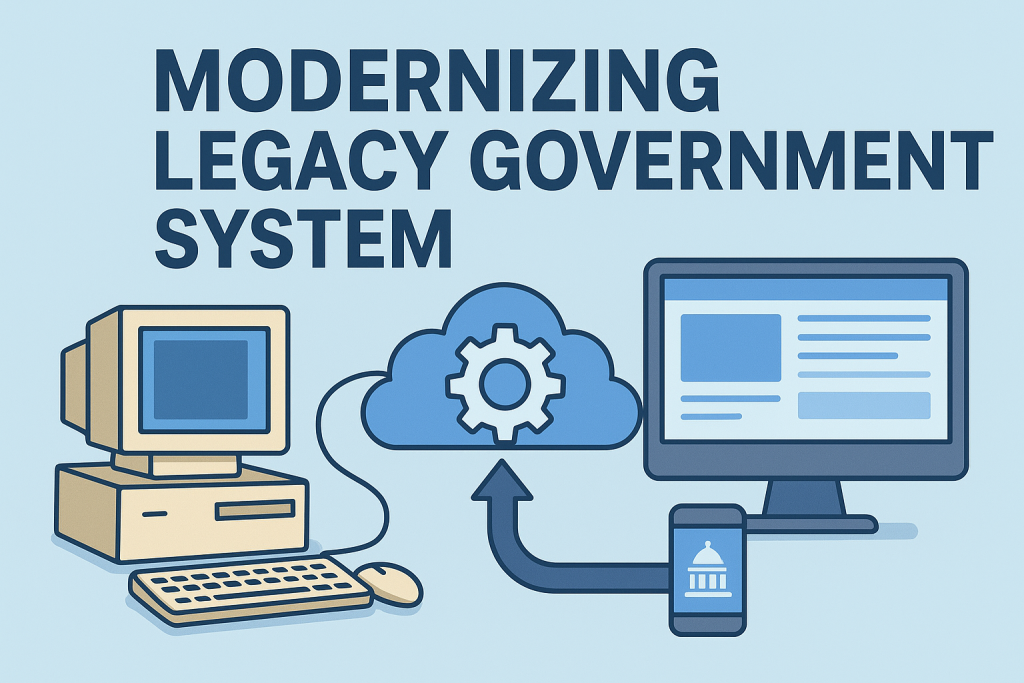
Government agencies generally face unique challenges in upgrading legacy systems. Such systems were coded decades ago, in old programming languages, with sensitive citizen information. Yet they remain mission-critical to work like tax filing, healthcare, defense, and public records.
It’s not just about making these systems faster, it’s about keeping them secure, compliant, and accessible in a world of increasing digital demands.
Legacy government system modernization has to strike the right balance between innovation and risk management. Private enterprise systems are not juxtaposed with government agencies with inflexible compliance models, high security requirements, and low tolerance for downtime.
With the use of legacy system modernization services such as cloud migration, API enablement, and data modernization, enterprises can become more efficient and still maintain continuity of operations. Additionally, enterprise application modernization can inject automation, predictive analysis, and citizen-driven services into processes otherwise slow in nature.
Tools & Technologies for Legacy Modernization
Legacy system modernization requires more than strategy; it requires appropriate tools and technologies to enable performance, scalability, and long-term success. Whether you’re migrating applications, cloud migration, or rewriting code, the right stack and choosing the best software development company ensures the process is faster, more consistent, and future-proof. Here in this section, we are going to learn about important technologies enabling successful legacy system modernization.
1. Cloud Platforms(AWS, Azure, Google Cloud)
Cloud platforms provide scalable infrastructure, serverless computing, and managed services to transform applications into modernized form in a more efficient and cost-effective way. Cloud platforms provide the ability to migrate legacy applications to secure, high-performance environments.
2. Containerization & Orchestration (Docker, Kubernetes)
Containerization provides bundling of applications and their dependencies as portable units, ensuring uniform deployments across different environments. Kubernetes provides orchestration to ensure scalability, fault tolerance, and smooth updates while modernizing applications, and a Kubernetes observability platform helps teams monitor cluster performance, detect issues early, and maintain reliability at scale.
3. DevOps & CI/CD Tools (Jenkins, GitLab, Azure DevOps)
Automation tools automate code integration, testing, and deployment so that updated systems can readily support new features without sacrificing availability.
4. API Gateways & Integration Platforms (MuleSoft, Kong, Apigee)
API enablement tools expose legacy system functionality to new applications, cloud services, and third-party tools without recasting entire architectures.
5. Database Modernization Tools (Flyway, Liquibase, AWS DMS)
These solutions assist in migrating legacy databases into modern, cloud-native, and analytics-enabled platforms with utmost care to preserve schema optimization and data integrity.
6. Low-Code & No-Code Platforms (OutSystems, Mendix)
For front-end modernization or workflow automation, low-code and no-code platforms support rapid modernization without unnecessary custom coding.
Best Practices for Successful Modernization

So, we hope we convinced you to modernize those old systems and get them up to speed with existing technology. Smart decision. But the truth is that legacy system modernization is more than a technical refresh. It’s getting technology in sync with business needs and making the process seamless, secure, and future-proof. Let’s examine some tried and tested practices that turn legacy system modernization into a success story rather than a struggle.
1. Start with a Concrete Evaluation
Modernization works best when you have a good sense of what you’re working with. Take some time, discuss with your tech team or hire offshore developers to evaluate your system performance, dependencies, security risks, and user problems. This first step helps you develop a plan that’s realistic and aligned with your business goals and user requirements.
All legacy systems cannot be replaced immediately. Your organization needs to focus on the ones which have a direct impact on operational processes, customer satisfaction, or profit. This particular strategy makes the legacy modernization effective as well as a cost-effective measure.
2. Choose the Right Strategy for Your System
Against which we had discussed earlier methods like replatforming, rehosting, refactoring etc, each method has its own advantages and disadvantages. The art lies in matching the right approach with the system complexity, risk acceptance and future scalability goals.
3. Leverage Cloud & AI to Deliver Meaningful Value
Legacy system modernization is not fixing what already doesn’t work. Software is old after a while. Choose the best AI development company which provides Cloud-native features and AI-powered capabilities that can make systems more intelligent, quicker, and more efficient, enabling new opportunities for automation and insights.
4. Modernize in Phases, Not All at Once
It is risky to go straight to a full replacement. A replacement in phases enables you to improve incrementally, experiment with enhancements, and make seamless upgrades without impacting critical operations.
5. Integrate Security into Every Step
Legacy systems are generally more vulnerable to cyber attacks and there can be the risk of loss of confidential data. Hardening security measures, assuming new compliance models, and ensuring protection of the data should be from the inception of legacy system modernization.
6. Keep Teams Aligned Throughout
Technology alone will never ensure successful modernization. You must involve IT, business executives, and operations or engage a top offshore software development company early in the process to ensure that all decisions align with business objectives and goals.
Unlock Growth with Expert Legacy Modernization Services
Modernization isn’t just about replacing old systems—it’s about enabling innovation. Our experts transform legacy platforms into agile, scalable, and secure solutions that integrate seamlessly with cloud and modern technologies.
Talk to Our Experts
Common Challenges in Legacy System Modernization

Legacy system modernization is interesting and sounds hip, but it has its own negatives and pitfalls. From the buried dependencies to migration pangs, these roadblocks can derail progress or even slow down a project considerably. Knowledge of these roadblocks upfront can be money- and time-savers and an excellent frustration-reducer. Let’s cut to the heart of the greatest challenges that companies undergo in legacy systems modernization.
1. Complex System Dependencies
The older and legacy systems usually comprise numerous layers of code, integrations, and workflows that have been built over the years. Disentangling these dependencies without breaking down the core functionalities can prove to be one of the most time-consuming tasks of modernization.
2. Data Migration Risks
Data hidden in legacy databases is not only hard to move, it often needs to be cleansed, sorted, re-built, and secured. A single misstep in the data migration process can lead to the potential loss of the data, corruption, or compliance violation.
3. Downtime & Business Disruption
Shutting down core systems, even for a short period, impacts operations, revenue, and customer satisfaction. Minimizing downtime while modernizing is a delicate balancing act.
4. High Modernization Costs
Legacy system modernization is expensive, especially for high-volume industries. The migration costs increase when there is a need to re-architect systems or when the cost of licensing and hardware upgrade plus expenses add up during the process.
5. Security Loopholes in Transition
Even though modernization improves security in the long run, the transition phase exposes the systems to vulnerability. Without adequate protection, applications and data are exposed to cyber attacks.
6. Resistance to Change
IT and staff departments do not want to change from systems they have spent years working on. Change management and training are necessary in order to facilitate the change and reduce resistance.
7. Integration with New Tools
New systems should seamlessly integrate with third-party applications, APIs, and cloud services. Incising old and new technology without disrupting existing workflows is a big challenge.
Real-World Examples of Successful Modernization
Let’s look at some examples of legacy systems that successfully made the transition showing why digital transformation services alone are never a sufficient solution for legacy modernization.
1. Capital One – from data centers to cloud-only banking
Capital One’s move to AWS is an ideal legacy system modernization done right. The bank retained eight on-premises data centers and bet the entire company on the cloud, which eliminated infrastructure drag and sped new feature development without sacrificing core banking resiliency. To those wondering why legacy system modernization matters, this migration unlocked scalability, improved security controls, and accelerated customer experiences powered by managed services and serverless.
2. Nasdaq – reshaping market structures for speed and scale
Exchanges aren’t exactly known for easy change, yet Nasdaq has been modernizing legacy systems by moving key workloads and even matching engines into AWS. The results are concrete; ingesting tens of billions of records daily and loading market data hours faster, with a roadmap that balances cloud agility and data-sovereignty needs. If you’re comparing legacy system modernization strategies, this blends replatforming with targeted rearchitecture for mission-critical latency.
3. DBS Bank APIs, Microservices, and culture transformation
DBS converted a legacy bank to a digital champion by integrating legacy system modernization services with API enablement, microservices, and cloud adoption with an engineering culture built for speed. The bank’s API approach enables teams to break loose legacy logic, scale faster, and ship updates reliably, which is what modernizing legacy systems needs to do when business growth is on the line.
4. HMRC (UK)- Phased replacement of tax legacy systems
The phased replacement of legacy platforms by the United Kingdom’s tax authority “Making Tax Digital” shows that it is possible to phase out legacy platforms without breaking service continuity. HMRC delivered digital VAT reports on time, then spent extra time moving taxpayer records off old systems because of real-world data issues, a reminder that plans for modernizing legacy systems often call for staged delivery and ruthless focus on data quality.
5. Estonia-
X-Road as backbone for interoperable public services Estonia modernized legacy government systems through standardizing secure information exchange using X-Road and leveraging digital identity. Instead of rewriting all systems at the same time, they created a platform to let agencies integrate, build, and roll out citizen-facing services more rapidly, a model many governments emulate as a standard when implementing legacy system modernization across national levels.
6. USCIS (USA) – modernizing immigration case processing
USCIS moved critical immigration workloads off legacy systems and into cloud-based, API-driven environments, cutting verification processing time and improving service reliability. The effort combined DevSecOps, incremental refactoring, and cloud migration, the combination of legacy system modernization strategies you resort to when uptime and compliance can’t be allowed to lapse.
Future Trends in Legacy System Modernization

Legacy systems are no longer being viewed as simply outmoded technology, they’re now becoming the foundation for change when modernized with the right methodology. Organizations in the future will rely on automation, AI-driven intelligence, and composable architecture to revolutionize how they modernize older systems. Let’s talk about the most significant feature trends in legacy system modernization that are shaping 2026 and beyond.
1. AI-Powered Modernization
Artificial intelligence is making the transition from a catchphrase to an essential driver of modernization. An experienced AI development company can leverage advanced AI models to audit vulnerable codebases, find redundant modules, and even recommend refactoring, replatforming, or retiring certain components. Machine learning enables forecasting the impact of change, reducing errors, and shortening modernization cycles by leaps and bounds.
2. Low-Code and No-Code Migration Tools
The arrival of low-code and no-code platforms is simplifying modernization for organizations without large development teams. These platforms allow IT experts to re-implement legacy processes, build modern interfaces, and integrate APIs with much less coding. This makes deployment faster and less dependent on large technical expertise.
3. Cloud-Native By Default
Whereas cloud adoption has been trendy for years now, modernization is increasingly going cloud-native by default. Businesses are moving past simple rehosting and are embracing microservices, containers, and serverless architectures to gain performance scalability as well as cost-effectiveness. The move also facilitates continuous delivery and resiliency for mission-critical applications.
4. Continuous Modernization Pipelines
The days of big-bang upgrades are behind us. Organizations are installing pipelines that scan, test, and upgrade systems incrementally. The approach is less time-consuming. Spreads costs over time, and keeps systems future-proof with incremental increments rather than great redesigns every couple of years.
5. Cybersecurity-First Approaches
While cyberattacks become more technology-savvy, modernization efforts now include security from the outset. Zero-trust architecture, AI-driven threat detection automation, and compliance automation are no longer niceties but imperatives to protect modernized systems from evolving threats.
Conclusion
Legacy system modernization is not a nicety upgrade anymore, it is a business-critical move to stay competitive in this fast-evolving digital landscape. From defining tangible legacy system modernization plans to leveraging cutting-edge tools and best practices, organizations are discovering smarter ways of overhauling outdated platforms without affecting mission-critical processes.
If you’re exploring or looking for legacy system modernization services or looking to implement advanced legacy systems modernization approaches, or even aiming to modernize legacy government systems, a well-planned strategy can make all the difference.
As a leading AI services and data consulting company, Algoscale helps organizations transform outdated applications, platforms, and data environments into agile, future-provable solutions. Our professionals deliver tailored modernization roadmaps, cloud migrations, API enablement, and security enhancements to cut costs, improve performance, and create new opportunities.
Getting started? Let’s build a modernization plan that keeps your systems smarter, faster, and stronger for years to come.
Reduce Costs and Boost Efficiency with Legacy Application Modernization
Outdated systems drain resources. Algoscale helps you cut maintenance costs, enhance flexibility, and deliver better customer experiences with tailored modernization strategies.
Get a Free Consultation
FAQs
1. What does legacy system modernization really mean?
Legacy system modernization is all about taking older software and IT systems , the ones running on outdated systems and upgrading them to meet the current performance, security, and scalability needs.
2. Why should businesses bother modernizing legacy systems now?
Because the cost of waiting is high. Older systems become slower, harder to maintain, and vulnerable to security threats. Modernizing helps your company save money, and integrate with latest technologies and tools like AI and cloud computing services.
3. What types of legacy system modernization services are available?
There are many wide range of services available like cloud migration, application re-engineering, UI/UX upgrades, API integration, data modernization, and advanced security enhancements.
4. What challenges should I expect during modernization?
Legacy modernization is not easy or smooth. Businesses often face hurdles like migrating huge volumes of data, dealing with undocumented code, or managing downtime risks. But with the right strategies this process may minimize the hurdles.
5. How do I know which modernization approach fits my business model best?
As a legacy modernization company we suggest you start with an assessment of your existing systems, their age, complexity and performance gaps. This helps you to weigh options like rehosting, replatforming, refactoring, or replacing. A good technology partner like Algoscale will help map out a clear roadmap tailored to your needs.