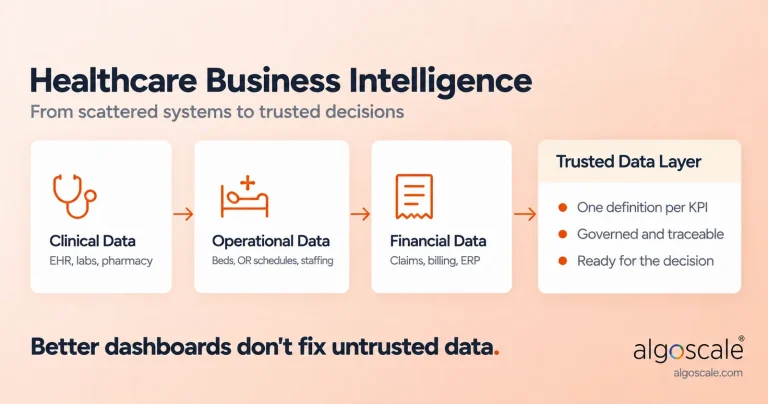


Every hospital, clinic, and diagnostic network generates data continuously — patient records, lab reports, prescriptions, imaging files, billing data, insurance claims, staffing logs, and device-generated vitals. The volume is not the problem. The problem is that most of this data sits in separate systems that were never designed to communicate with each other.
Electronic Health Records live in one system. Laboratory data sits in another. Imaging is stored separately. Pharmacy and prescription platforms operate in isolation. Financial and billing systems are completely disconnected from clinical workflows. Each system works reasonably well on its own. Together, they create fragmentation that slows down every decision that depends on a complete picture of what is happening.
In healthcare, that fragmentation has real consequences. Doctors cannot see a complete patient history at the point of care. Administrators receive delayed reporting based on data that was current two days ago. Clinical and financial teams analyze the same patients using different datasets and arrive at different conclusions. Tracking a patient’s end-to-end journey — from admission through treatment to discharge and follow-up — requires manual effort across multiple systems.
This is the environment Algoscale works in when healthcare organizations come looking for data modernization support. The goal is not adding another analytics tool on top of existing fragmentation. It is building a connected data foundation where clinical, operational, and financial information flows together without friction.
Why Traditional Healthcare Analytics Architecture Is No Longer Sufficient
Healthcare operations have changed significantly over the last several years. Patient volumes are rising. Chronic disease management requires continuous monitoring rather than periodic check-ins. Operational costs are tightening while regulatory compliance requirements become more demanding. Care delivery timelines are shortening.
Traditional data architectures were built for a different operating environment — one where batch reporting was acceptable, where data moved slowly between systems, and where analytics was primarily a back-office function rather than a clinical one.
That model no longer fits. Healthcare organizations increasingly need real-time operational visibility, not weekly reports. They need analytics systems that support decisions as they are being made — not systems that explain what happened after the fact.
The shift toward platforms like Microsoft Fabric reflects this change. Rather than adding another integration layer between existing disconnected systems, Fabric consolidates data engineering, storage, analytics, and governance into a single environment. For healthcare organizations managing data across dozens of source systems, that consolidation has practical value that goes well beyond technical convenience. Algoscale’s Microsoft Fabric consulting practice helps healthcare organizations assess readiness for this transition and design migration strategies that account for the complexity of healthcare data environments.
What Microsoft Fabric Brings to Healthcare Data Environments
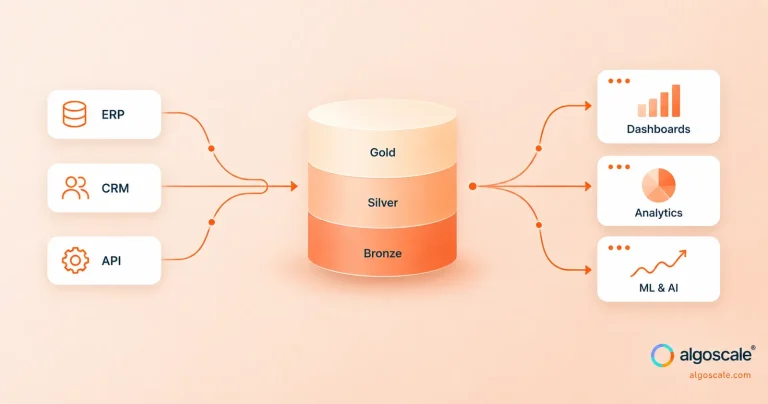
Microsoft Fabric is not a reporting tool or a dashboard platform. It is a unified analytics infrastructure that combines data integration, data engineering, data storage, and analytics into a single connected environment with shared governance.
For healthcare organizations, the most significant architectural change Fabric introduces is OneLake — a unified storage layer where data from different source systems can be accessed without being duplicated across platforms. Clinical data, operational data, and financial data all live in the same environment. Teams accessing that data for different purposes — clinical analysis, operational reporting, financial planning — work from the same source rather than from separate exports of the same underlying records.
This matters in healthcare because data duplication is one of the primary sources of inconsistency. When clinical and financial teams pull separate exports from the same EHR system at different times, they get different numbers. When operational dashboards are built on stale batch exports, they do not reflect current bed availability or staffing levels. OneLake reduces these inconsistencies by giving different workloads access to the same data without requiring it to be moved or replicated.
Algoscale’s implementation of Microsoft Fabric in healthcare environments focuses on connecting these source systems cleanly — establishing reliable ingestion pipelines from EHR platforms, laboratory systems, billing platforms, and operational tools into a unified data layer that serves both real-time and analytical workloads.
Traditional Healthcare Data Architecture vs Microsoft Fabric
| Area | Traditional Healthcare Systems | With Microsoft Fabric |
| Data Structure | Isolated systems per department | Unified data environment via OneLake |
| Access to Insights | Slow and batch-based | Near real-time across workloads |
| Data Duplication | High across departments | Reduced significantly |
| Clinical and Financial View | Analyzed separately | Connected in the same environment |
| Maintenance Effort | High IT dependency | Lower operational overhead |
| Governance | Per-system, inconsistent | Centralized across all data workloads |
| Decision Making | Reactive based on historical data | Proactive with current operational data |
| AI and ML Readiness | Limited by fragmented pipelines | Supported natively within the platform |
How Microsoft Fabric Changes Healthcare Analytics in Practice
1. A Complete View of the Patient Journey
When clinical data is fragmented across systems, the patient record that a clinician sees is rarely complete. Lab results may not have been pulled through from the laboratory system. Imaging reports may sit in a separate viewer. Medication history may require a separate lookup.
With properly connected data pipelines, clinicians can access a continuous patient story — diagnoses, lab results, medications, imaging reports, and follow-up history in one view. Algoscale builds these healthcare data pipelines as part of broader data engineering engagements, connecting source systems to a unified layer that supports both clinical decision making and downstream analytics.
The practical impact is earlier risk detection, fewer duplicate tests ordered because prior results were not visible, and better continuity of care across care teams.
2. Real-Time Visibility in Critical Care Environments
In ICU and emergency settings, data latency has clinical consequences. A vital sign alert that arrives two minutes late, or a lab result that takes an hour to appear in the clinical view, affects the timing of decisions that matter.
Unified data architecture reduces this latency by eliminating the handoffs between systems that slow down data movement. Patient vitals become accessible faster across care teams. Alerts can be triggered based on live data rather than periodic batch updates. Clinical decisions are supported by information that reflects the current state of the patient rather than the state from the last system refresh.
3. Hospital Operations Become Easier to Manage
Operational inefficiencies in hospitals often go undetected because the data needed to identify them is spread across too many systems for anyone to monitor in aggregate.
With unified operational data, hospital administrators can track bed occupancy, staff allocation and workload, equipment usage, and admission and discharge cycles in a single operational view. Bottlenecks become visible before they create patient flow problems rather than after. Algoscale’s healthcare IT consulting engagements consistently identify operational blind spots that were not visible in siloed reporting environments — and that become addressable once data is consolidated.
4. Clinical and Financial Data Working Together
One of the most persistent gaps in healthcare analytics is the separation between clinical and financial datasets. Treatment decisions and cost implications are analyzed by different teams using different systems, which makes it difficult to understand the relationship between care protocols and financial outcomes.
When clinical and financial data exist in the same analytics environment, treatment cost per patient becomes visible alongside clinical outcomes. Insurance claim patterns can be analyzed in the context of care protocols. High-cost procedures can be evaluated against outcome data. This brings a level of transparency to healthcare decision-making that is very difficult to achieve when the two datasets live in separate systems.
5. Less Time Spent on Data Preparation
A large portion of healthcare analytics effort in traditional environments goes into cleaning data, moving it between systems, fixing inconsistencies, and rebuilding pipelines that break when source systems are updated. In some organizations, the majority of the data team’s time goes toward infrastructure maintenance rather than actual analysis.
Consolidating onto a unified platform reduces this overhead. Pipelines are built once and maintained in one place. Data quality rules are enforced at the ingestion layer rather than applied repeatedly by each team that consumes the data. Teams that previously spent significant time on data preparation can redirect that effort toward the analysis that actually supports clinical and operational decisions.
Governance, Security, and Compliance in Healthcare Data Environments
Healthcare data is among the most sensitive data any organization manages. Analytics systems built on this data must treat governance and security as foundational requirements, not features to be added later.
Microsoft Fabric’s governance model applies centrally across all workloads — data engineering, warehousing, and reporting operate under the same access controls and audit framework. Role-based access controls ensure that clinical staff, operational teams, and financial analysts see only the data relevant to their function. Audit-ready tracking supports HIPAA compliance requirements. Centralized policy enforcement means governance rules are consistent across departments rather than implemented differently in each system.
Algoscale’s healthcare IT consulting practice builds these governance frameworks as part of Fabric implementation — not as an afterthought, but as part of the initial architecture design. For healthcare organizations operating across multiple facilities, consistent governance is often just as operationally important as the analytics capabilities themselves.
Common Healthcare Analytics Challenges Microsoft Fabric Addresses
| Challenge | Impact on Healthcare Organizations |
| Disconnected EHR, lab, and billing systems | Incomplete patient records and reporting inconsistencies |
| Batch-based reporting workflows | Delayed operational decisions |
| Data duplication across departments | Conflicting metrics and higher storage costs |
| Separate clinical and financial analysis | Limited visibility into cost and outcome relationships |
| Manual data extraction and preparation | High IT overhead, slow analytics delivery |
| Inconsistent governance across systems | Compliance risk and audit complexity |
| Limited AI and predictive analytics readiness | Difficulty scaling forecasting and risk models |
How Algoscale Implements Microsoft Fabric in Healthcare Environments
Algoscale approaches healthcare data modernization as an end-to-end engagement — covering architecture design, source system integration, pipeline development, governance implementation, and ongoing optimization.
Their healthcare analytics work includes:
- Unified data architecture design connecting EHR, laboratory, billing, and operational systems
- Microsoft Fabric implementation and migration from legacy analytics environments
- Real-time data pipeline development for clinical and operational workloads
- Clinical and financial data integration for connected analytics
- HIPAA-aligned governance frameworks and role-based access design
- Data warehouse modernization as part of broader healthcare platform transitions
- AI and predictive analytics infrastructure preparation
- Business intelligence reporting layer design for clinical, operational, and executive teams
One consistent pattern Algoscale encounters across healthcare clients is the gap between what leadership expects analytics to deliver and what fragmented legacy infrastructure can actually provide. Closing that gap requires more than deploying a new platform — it requires redesigning how data moves through the organization, how it is governed, and how different teams access it. That is the work that makes the analytics layer above it actually reliable.
The Shift From Reactive to Proactive Healthcare Analytics
The most significant change that unified healthcare analytics enables is not technical — it is operational. Healthcare teams shift from asking what happened last week to understanding what is happening right now and where risks are building.
Bed occupancy reports that are hours old do not support real-time patient flow decisions. Staffing analytics based on yesterday’s data do not help with today’s scheduling gaps. Financial reports that take days to compile do not support timely operational adjustments.
When clinical, operational, and financial data flows together in near real time, healthcare organizations can move from analytics that explains the past to analytics that informs the present. That transition is what Microsoft Fabric makes architecturally possible — and what Algoscale’s data engineering and implementation expertise makes operationally real in healthcare environments.