


The modern data landscape demands more than what any single platform was originally designed to deliver. Data warehouses excelled at structured analytics but struggled with unstructured data and machine learning. Data lakes handled raw storage at scale but lacked the transactional guarantees and governance that enterprise teams require. The Databricks Lakehouse architecture was built to resolve this fundamental tension and it has changed how leading engineering teams think about their entire data stack.
This guide unpacks the architecture that powers the Databricks Lakehouse: the core components, the medallion data flow pattern, the engineering benefits, and the real-world applications that make it the platform of choice for organizations serious about becoming data-driven at scale.
What Is a Lakehouse? The Architecture That Changed Everything
A Lakehouse is a data architecture that combines the best qualities of data warehouses and data lakes on a single, open platform. It provides the low-cost storage and flexibility of a data lake with the ACID transactions, schema enforcement, and query performance of a data warehouse all while natively supporting machine learning, streaming, and business intelligence workloads.
Databricks, the company founded by the original creators of Apache Spark, pioneered the Lakehouse concept and built their platform from the ground up to realize it. The result is an architecture where data engineers, data scientists, and business analysts all work from the same underlying data layer eliminating the data silos, duplication, and consistency issues that plague multi-platform architectures.
Data Warehouse vs. Data Lake vs. Lakehouse: A Direct Comparison
The table below summarises how each architecture handles the requirements modern data teams face:
| Feature | Data Warehouse | Lakehouse |
| Storage Format | Proprietary columnar | Open formats (Parquet/Delta) |
| ACID Transactions | ✅ Yes | ✅ Yes |
| Schema Enforcement | ✅ Strict | ✅ Flexible + Enforced |
| BI & Reporting | ✅ Excellent | ✅ Excellent |
| ML / Data Science | ⚠️ Limited | ✅ Excellent |
| Streaming Support | ⚠️ Batch-only | ✅ Unified |
| Governance | ✅ Strong | ✅ Unity Catalog |
| Cost at Scale | ❌ Expensive | ✅ Low + Optimised |
| Open Standards | ❌ Vendor lock-in | ✅ Open |
Core Components of the Databricks Lakehouse Architecture
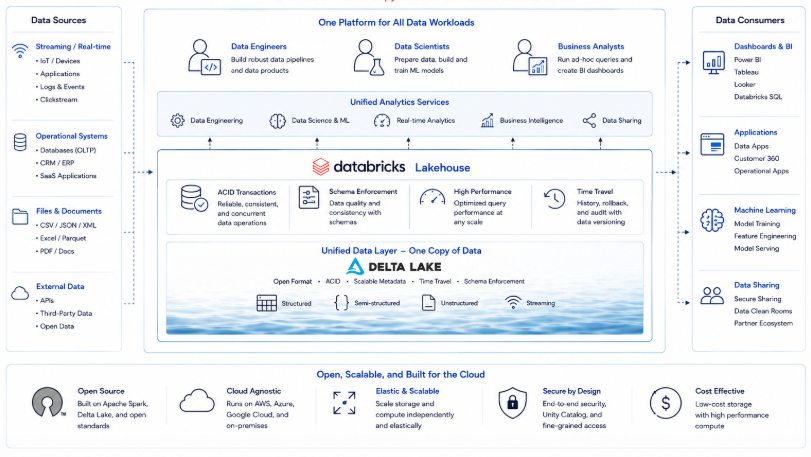
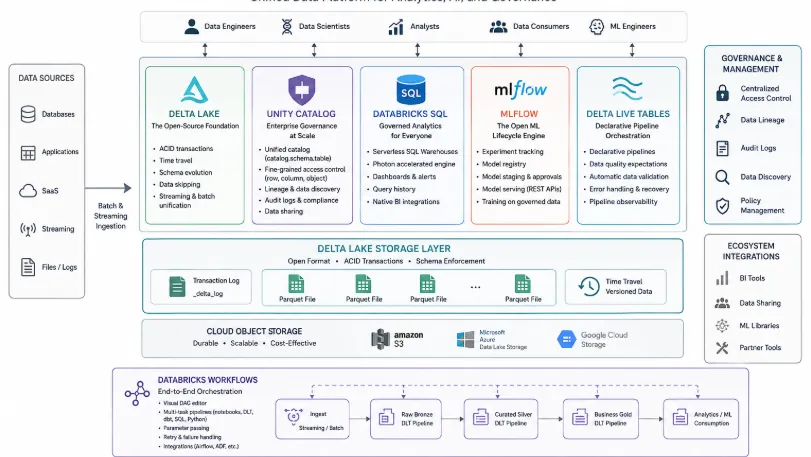
The Databricks Lakehouse is not a single product, it is an integrated set of purpose-built components that work together to deliver a unified data platform. Understanding each component is essential to understanding why the architecture performs the way it does.
Delta Lake The Open-Source Foundation
Delta Lake is the open-source storage layer that gives the Lakehouse its warehouse-like reliability. Built on top of Parquet files stored in cloud object storage (S3, ADLS, GCS), Delta Lake adds a transaction log that tracks every change to every table. This transaction log is what makes ACID guarantees possible on a distributed system, a capability that was previously only available in proprietary databases.
• ACID transactions: concurrent reads and writes without corruption
• Time travel: query any historical version of a table with VERSION AS OF or TIMESTAMP AS OF
• Schema evolution: add, rename, or restructure columns without rewriting data
• Data skipping: Z-ordering and file-level statistics accelerate query performance by skipping irrelevant files
• Streaming and batch unification: a single Delta table serves both streaming ingestion and batch queries
Unity Catalog Enterprise Governance at Scale
Unity Catalog is Databricks‘ unified governance solution, providing a single control plane for data access, lineage, auditing, and sharing across all workspaces and compute types. It introduces a three-level namespace catalog.schema.table that enables organisations to structure data assets by domain, team, or environment with fine-grained access controls at every level.
Column-level security allows masking of PII fields for specific user groups. Row-level filters ensure analysts only see data relevant to their region or business unit. System tables provide automatic audit logs of every query, every data access, and every permission change essential for regulatory compliance.
Databricks SQL Governed Analytics for Everyone
Databricks SQL provides a serverless query engine optimised for business intelligence and interactive analytics. SQL Warehouses (formerly SQL Endpoints) deliver high-concurrency, low-latency query performance on Delta tables, with a Photon vectorised engine that is consistently benchmarked as one of the fastest SQL engines available on cloud infrastructure.
Dashboards, alerts, and query history are built in, and Databricks SQL connects natively to leading BI tools including Tableau, Power BI, Looker, and ThoughtSpot enabling analysts to use familiar tools while benefiting from the Lakehouse’s unified governance and data quality guarantees.
MLflow The Open ML Lifecycle Engine
MLflow, also created by Databricks and now an open-source standard, manages the complete machine learning lifecycle within the Lakehouse. Experiment tracking records parameters, metrics, and artefacts for every model training run. The Model Registry provides version control, stage management (Staging, Production, Archived), and approval workflows for moving models into production. Model Serving delivers low-latency REST endpoints for real-time inference.
Because MLflow runs on top of the same Delta Lake tables used for analytics, ML teams train on the same governed, quality-controlled data that powers the business’s dashboards eliminating the training-serving skew that undermines model performance in siloed architectures.
Delta Live Tables Declarative Pipeline Orchestration
Delta Live Tables (DLT) is Databricks‘ declarative framework for building reliable, maintainable data pipelines. Rather than writing imperative Spark code that specifies how data should be processed, DLT allows engineers to specify what the output data should look like and Databricks handles dependency resolution, error recovery, and pipeline optimization automatically.
DLT pipelines can apply data quality expectations (constraints like ‘customer_id is never null’) and automatically quarantine or drop records that fail those expectations, providing observability into data quality across every pipeline stage.
Databricks Workflows End-to-End Orchestration
Databricks Workflows provides native job orchestration for multi-task pipelines that span notebooks, Python scripts, DLT pipelines, dbt models, and SQL queries. With a visual DAG editor, parameter passing between tasks, retry logic, and integration with external orchestrators like Apache Airflow and Azure Data Factory, Workflows enables teams to build and monitor production-grade data pipelines entirely within the Databricks platform.
The Medallion Architecture: How Data Flows Through the Lakehouse
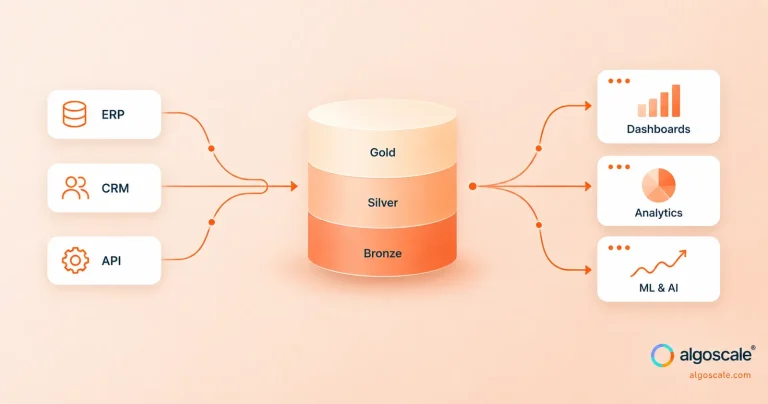
The medallion architecture (sometimes called the multi-hop architecture) is the data organisation pattern most widely adopted by Databricks Lakehouse practitioners. It structures data into three progressive quality layers Bronze, Silver, and Gold each representing a step forward in data quality, structure, and business readiness.
This pattern decouples raw data ingestion from business logic, making pipelines easier to maintain, debug, and reprocess. When a source system changes its schema or a business rule is updated, only the affected layer and its downstream dependencies need to be re-run, not the entire pipeline from scratch.
| 🥉 Bronze Layer | 🥈 Silver Layer | 🥇 Gold Layer |
| Raw Ingestion | Cleansed & Conformed | Business-Ready Aggregates |
| Exact copy of source data as-is | Validated, deduplicated, typed data | KPI-level aggregations and summaries |
| Append-only immutable records | Applied business rules and transformations | Domain-specific data marts |
| Supports all formats: JSON, CSV, Parquet, Avro | Joined across source domains | Optimised for BI and ML consumption |
| Enables full audit trail and reprocessing | Schema enforced via Delta Lake constraints | Slowly changing dimensions (SCD) applied |
| Typical latency: seconds to minutes | Ready for self-service analytics | Governed with row- and column-level security |
Why the Medallion Architecture Works
The medallion pattern succeeds because it matches the natural flow of data quality improvement: raw data is captured completely and immutably, then progressively refined through validation, enrichment, and aggregation. Each layer has a clear, singular purpose which makes pipelines understandable to new team members, auditable by compliance teams, and debuggable when issues arise.
Key Benefits for Modern Data Engineering Teams
| ⚡ Unified Batch and StreamingA single Delta table ingests streaming events via Auto Loader and serves batch analytics queries simultaneously with no separate systems, no data duplication. | 🔐 ACID Transactions on Object StorageDelta Lake’s transaction log brings database-grade reliability to cloud storage, eliminating the corrupt writes and partial reads that plague raw Parquet and Hive architectures. |
| 🤖 AI and ML at ScaleMLflow, Feature Store, and AutoML are natively integrated, enabling ML teams to train on governed data and deploy models with one-click serving endpoints. | 🌍 Open Standards No Lock-inDelta Lake, MLflow, and Apache Spark are all open source. Data stored in Delta format is readable by any tool that supports Parquet including AWS Athena, Google BigQuery, and Snowflake. |
| 📊 Petabyte-Scale Query PerformanceThe Photon vectorised query engine, combined with Delta Lake data skipping and Z-ordering, delivers sub-second query latency on tables with hundreds of billions of rows. | 🛡️ Unified Governance with Unity CatalogOne governance model for all data types structured, semi-structured, and unstructured across all workspaces, cloud regions, and compute engines. |
| 💰 Cost Efficiency at ScaleDecoupled compute and storage means you pay only for compute when running queries unlike data warehouses that bundle compute costs into storage tiers. | 🔄 Time Travel and AuditabilityEvery table modification is logged. Restore any table to any historical point in time essential for regulatory compliance, debugging, and reprocessing corrupted data. |
Real-World Databricks Lakehouse Use Cases
| Industry | Lakehouse Use Case | Business Outcome |
| 🏦 Financial Services | Real-time fraud detection pipeline: streaming transactions ingested at Bronze, scored by ML models at Silver, flagged alerts surfaced at Gold layer | Fraud detection latency reduced from hours to under 2 seconds; false positive rate decreased by 34% |
| 🏥 Healthcare | Patient data lakehouse: FHIR records, EHR exports, and wearable device streams unified in a single governed platform with HIPAA-compliant column masking | Clinical analytics cycle time cut from 3 weeks to 4 hours; PHI exposure risk eliminated through Unity Catalog policies |
| 🛒 Retail & E-commerce | Unified customer data platform: clickstream, purchase history, CRM, and inventory data joined at Silver layer; personalisation models trained at Gold layer | Recommendation model accuracy improved by 28%; marketing attribution reporting time reduced from 2 days to 30 minutes |
| 🏭 Manufacturing | IoT sensor data lakehouse: 50,000+ edge devices stream telemetry to Bronze; predictive maintenance models trained on Silver; equipment failure alerts at Gold | Unplanned downtime reduced by 41%; maintenance cost per unit cut by 22% |
| 📈 SaaS / Technology | Product analytics platform: event streams from web and mobile apps flow through medallion layers; product and growth teams query Gold-layer dashboards in Databricks SQL | Time-to-insight for product decisions reduced from 1 week to same-day; data engineering headcount frozen despite 5x data volume growth |
| 🎓 EdTech | Learning analytics lakehouse: student engagement events, assessment scores, and content interaction data unified for adaptive learning algorithm training | Learner completion rates improved by 19% within 6 months of personalisation model deployment |
Architecture Design Principles for a Production-Ready Lakehouse

A production-ready Databricks Lakehouse is built on deliberate architectural decisions made at the beginning of the project not retrofitted after performance or governance issues emerge. The following principles guide every AlgoScale Lakehouse engagement.
Principle 1: Design for Reprocessability
Bronze tables should always be append-only and immutable. Never overwrite raw data. If an upstream system sends corrected records, land them as new rows with a processing timestamp. This design ensures that every pipeline is fully reprocessable from scratch if business logic changes, schema errors are detected, or upstream data quality issues are discovered after the fact.
Principle 2: Schema-First Development
Define schemas explicitly for Silver and Gold tables before writing transformation code. Use Delta Lake’s schema enforcement to reject records that violate the expected schema at ingestion time not at query time. This prevents silent data corruption from propagating through the pipeline.
Principle 3: Governance by Design, Not by Retrofit
Unity Catalog should be designed before the first table is created. Define the catalog and schema hierarchy to reflect your organisation’s domain structure. Apply data classification tags at ingestion. Establish column masking policies for PII fields from day one. Governance systems retrofitted after a platform is in use consistently have gaps because data has already been shared without the right controls applied.
Principle 4: Cost-Aware Architecture
Every architectural decision in a Lakehouse has a cost implication. Use job clusters (not all-purpose clusters) for scheduled workloads. Apply OPTIMIZE and VACUUM commands on a schedule to compact small files and remove obsolete Delta versions. Use serverless SQL Warehouses for interactive queries to pay only for the seconds of compute actually consumed. Right-size cluster worker counts based on profiling data from actual production workloads.
Principle 5: Observability from the Start
Instrument pipelines with DLT data quality expectations from the first sprint. Use Databricks built-in lineage tracking to document every data flow from source to Gold table. Set up cluster and job metric alerts for anomalous run durations, excessive data skew, or unexpected shuffle sizes. A Lakehouse without observability is a Lakehouse where problems are discovered by end users rather than by the engineering team.
How AlgoScale Designs and Delivers Databricks Lakehouses
AlgoScale has designed and delivered Databricks Lakehouse architectures for organisations across financial services, healthcare, manufacturing, edtech, and SaaS. Our engagements consistently follow a structured methodology that balances speed-to-value with long-term architectural integrity.
Our Lakehouse Delivery Methodology
• Phase 1 – Architecture Assessment and Design (2–3 weeks): Current state analysis, data source inventory, governance requirements mapping, Unity Catalog blueprint, cluster and cost architecture design
• Phase 2 – Foundation Build (3–5 weeks): Cloud infrastructure provisioning, Unity Catalog setup, CI/CD pipeline for Databricks assets, Auto Loader ingestion patterns, Bronze layer for priority data sources
• Phase 3 – Medallion Pipeline Development (4–10 weeks): Silver layer transformations and quality expectations, Gold layer aggregates and data marts, DLT pipeline deployment, Databricks SQL dashboard build
• Phase 4 – ML and Advanced Analytics (4–8 weeks): MLflow experiment infrastructure, Feature Store setup, model training pipelines, Model Serving deployment, A/B testing framework
• Phase 5 – Optimisation, Enablement, and Handover (3–4 weeks): Performance tuning, FinOps review, team training across engineer/analyst/scientist tracks, documentation, and knowledge transfer
Building a Future-Ready Data Foundation with Databricks Lakehouse
The Databricks Lakehouse architecture represents the most significant evolution in data platform design of the past decade. By unifying storage, processing, governance, and machine learning on a single open platform, it eliminates the fragmentation and duplication that made traditional multi-tool data stacks so difficult to operate and scale.
Building a Lakehouse correctly with the right medallion architecture, governance framework, cost controls, and observability instrumentation requires both technical depth and architectural discipline. Organisations that invest in getting the foundation right unlock a platform that scales with their data, their teams, and their ambitions.
Whether you are modernising a legacy Hadoop environment, migrating from a traditional data warehouse, or building a net-new data platform, AlgoScale has the expertise and methodology to help you realise the full potential of the Databricks Lakehouse.