

Enterprise Data Services: What They Are and Why Every Enterprise Needs a Unified Partner
Most enterprises don’t struggle with data because they lack tools. They struggle because their data lives across a dozen systems, moved by a dozen different vendors, none of whom own the outcome end to end. A CRM export doesn’t match the finance report. A dashboard leadership trusted last quarter quietly drifted out of sync with the warehouse. Nobody can say with confidence which number is correct, and every strategic decision gets delayed by a reconciliation meeting.
That is the problem enterprise data services exist to solve. Done well, they cover the entire lifecycle: strategy, ingestion, governance, architecture, and the analytics or AI layer that finally turns raw data into something a leadership team can act on. Done poorly, enterprise data services become a stack of disconnected point solutions, each one solving its own slice of the problem while the enterprise-wide gap only gets wider.
What Are Enterprise Data Services?
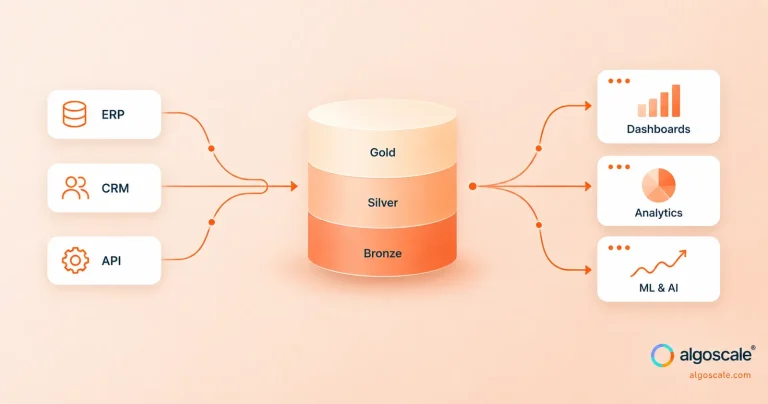
Enterprise data services refer to the full set of capabilities an organization needs to collect, integrate, govern, and activate its data at scale: data strategy and roadmapping, data engineering and pipeline development, data architecture (warehouse, lake, or lakehouse), data integration across CRM/ERP/operational systems, governance and quality frameworks, and the business intelligence or AI layer that surfaces insight.
The distinction that matters is scope. A single tool implementation is not enterprise data services it’s one component of it. An enterprise data services engagement is accountable for how those components connect: whether the pipeline built this quarter still feeds the governance model next quarter, and whether the dashboard leadership reads on Monday reflects the same definition of “revenue” that finance used to close the books.
Why Fragmented Data Vendors Cost Enterprises More Than They Save
Enterprises rarely start with one data problem. They start with several: slow reporting, siloed customer data, a stalled AI pilot, rising cloud spend. The instinct is to hire a specialist for each firm for the warehouse, another for BI dashboards, a third for AI. On paper this looks efficient. In practice, it creates the exact fragmentation that enterprise data services are meant to eliminate.
Two dashboards built by two vendors rarely agree on the same metric definition. A pipeline handed off from one team to another loses context the moment ownership changes. And when something breaks in production at 2 a.m., there is no single team accountable for the fix, just a chain of hand-offs and open tickets.
Core Components of Enterprise Data Services
A complete enterprise data services engagement typically spans six connected components:
• Data Strategy & Roadmap — business-outcome-first planning tied to measurable KPIs, not just a technology wish list.
• Data Engineering & Pipelines — ingestion, transformation, and orchestration built to survive schema changes, not just the first release.
• Data Architecture — lakehouse, data mesh, or warehouse design that scales with data volume instead of collapsing under it.
• Data Integration — unifying CRM, ERP, finance, and operational systems into one governed, trustworthy view.
• Governance & Quality — lineage, access control, and compliance frameworks that hold up under audit.
• Analytics & AI Enablement — dashboards, self-serve BI, and production-grade AI systems built on data that is actually ready for them.

In-House Teams vs. Point Vendors vs. an Integrated Partner
The delivery model an enterprise chooses shapes the outcome as much as the technology does. Here is how the three common approaches compare:
| Capability | In-House Team | Point Vendors | Algoscale |
| Single source of truth | Fragmented | Fragmented | Unified |
| Time to first insight | Months | Weeks–months | Weeks |
| Governance built in | Varies by team | Rarely included | Included by default |
| AI-readiness | Limited by bandwidth | Tool-specific | End-to-end |
| Accountability when something breaks | Internal, often stretched thin | Splits across vendors | One team, one contract |

How Algoscale Delivers Enterprise Data Services
Algoscale works as a single, accountable partner across the full data lifecycle rather than handing enterprises off between disconnected vendors. Engagements typically start with a maturity assessment, move through data architecture and data engineering work to build the foundation, bring disconnected systems together through data integration consulting, and layer governance and analytics on top so leadership finally works from one number instead of three.
For enterprises managing high-volume or unstructured data, this also extends into data lake and lakehouse consulting and big data services, so the same platform that supports today’s reporting can scale into tomorrow’s AI workloads without a rebuild.
Post-launch, engagements don’t end at go-live. Algoscale’s data management services cover performance tuning, compliance monitoring, and ongoing optimization, so the platform keeps pace as the business grows rather than degrading quietly until the next audit finds the gaps.

Signs Your Enterprise Needs a Unified Data Services Partner
• Two departments report different numbers for the same metric in the same board meeting.
• Every new AI pilot restarts data cleanup from scratch instead of building on existing pipelines.
• Reporting requests take days because dashboards depend on manual spreadsheet reconciliation.
• Cloud spend is climbing faster than the business value it produces.
• No single team can explain, end to end, how a number on the executive dashboard was calculated.
If two or more of these sound familiar, the underlying issue usually isn’t a missing tool — it’s the absence of one team accountable for how all the tools connect.
Making the Right Choice for Long-Term Data Maturity
Enterprise data services are not a single project with a defined end date. They are the ongoing infrastructure that every reporting cycle, every AI initiative, and every strategic decision depends on. Enterprises that treat it as a one-off implementation tend to rebuild every two to three years. Enterprises that partner with a team accountable for the full lifecycle — strategy through AI enablement — build something that compounds instead.
Algoscale’s enterprise data services team works with organizations across healthcare, financial services, retail, and manufacturing to build data foundations that are ready for both today’s reporting and tomorrow’s AI systems. Talk to a data services consultant to map your current maturity stage.