

A few years ago, most healthcare analytics initiatives focused on basic reporting visibility, including operational dashboards, patient tracking reports, and financial summaries shared across departments. That era is now behind us.
Healthcare organizations today operate across interconnected digital ecosystems involving Electronic Health Records, insurance and claims systems, pharmacy management platforms, laboratory systems, staffing and workforce tools, billing and revenue management software, appointment scheduling applications, IoT-enabled devices, and cloud-based patient engagement platforms.
As these systems keep expanding, reporting environments grow increasingly fragmented. Different departments build separate analytics workflows with different KPI definitions and reporting structures. Over time, organizations find themselves managing inconsistencies, governance gaps, operational blind spots, and delayed decision making.
In healthcare, these are not simply IT challenges. Emergency room congestion, staffing shortages, bed occupancy, and patient wait times can shift significantly within a matter of hours. When operational leaders rely on delayed or fragmented reporting, decisions become reactive rather than proactive, and that has a direct impact on patient experience and resource management.
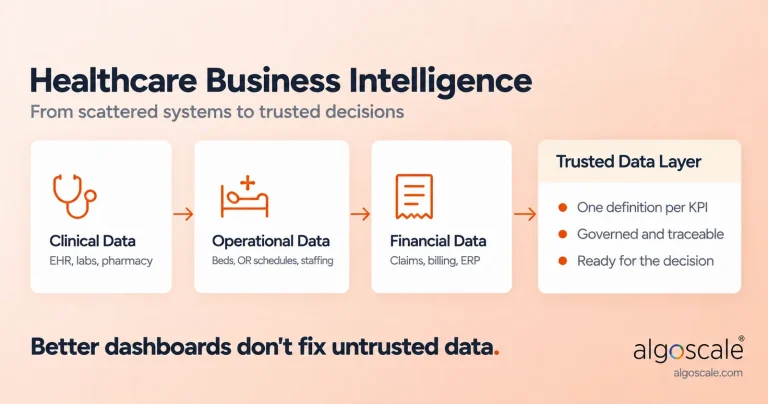
This is why Power BI consulting services are gaining meaningful traction across US healthcare enterprises. The challenge is not about adding more dashboards. It is about building a connected analytics foundation where clinical, operational, and financial data flows into one environment that both monitors current performance and supports longer-term planning.
● Algoscale Healthcare Analytics Dashboard: Patient Operations
What Is Power BI Healthcare Analytics?
Power BI healthcare analytics refers to using Microsoft Power BI as a centralized reporting layer that connects clinical, operational, and financial systems across a healthcare organization. Rather than running separate reporting tools across departments, healthcare providers use Power BI to consolidate visibility across a wide range of functions.
Most healthcare organizations already operate within the Microsoft ecosystem, including Azure cloud infrastructure, SQL Server, SharePoint, Microsoft 365, Dynamics 365, and Teams. Power BI integrates naturally across these platforms, which means organizations are able to modernize their analytics without needing to rebuild their entire infrastructure.
Algoscale is pleased to help healthcare providers implement scalable Power BI architectures that centralize reporting across all these systems and improve accuracy across departments. Our Power BI consulting practice covers everything from initial architecture design through to governance implementation and ongoing optimization.
The Scale of the Healthcare Data Problem
To appreciate why analytics modernization has become so important, it helps to consider the data volume a single mid-sized hospital network generates on a daily basis.
EHR platforms capture clinical records, treatment histories, diagnostic data, medication records, and care protocols. Billing and revenue cycle platforms generate financial records, claims data, and reimbursement information. Operational systems track bed availability, patient flow, admissions, discharges, and resource utilization. Workforce management platforms capture staffing levels, scheduling data, and labor costs.
When these systems fail to communicate effectively, healthcare organizations are left managing siloed environments where complete operational visibility becomes extremely difficult. This is why big data in healthcare has become one of the most important areas of investment in the industry. Providers need platforms capable of connecting all these systems, standardizing data definitions, and delivering consolidated visibility that clinical, financial, and leadership teams can genuinely rely on.
Traditional Healthcare Reporting vs Modern Power BI Analytics
| Feature | Traditional Healthcare Reporting | Power BI Healthcare Analytics |
| Data Sources | Mostly siloed per department | Unified across clinical, financial, operational |
| Reporting Speed | Batch or manual generation | Real-time and near real-time |
| Governance | Often inconsistent | Centralized governance frameworks |
| Compliance Support | Manual audit processes | Role-based access and audit logging |
| AI Readiness | Limited or none | Predictive analytics and ML integration |
| Scalability | Difficult to expand | Cloud-scalable architecture |
| Cross-department Visibility | Fragmented | Consolidated operational view |
| Decision Making | Reactive | Proactive and data-driven |
● Algoscale Healthcare Analytics Dashboard: Revenue Cycle and Claims

Revenue Cycle Dashboard: $48.3M in total YTD revenue (up 11.2%), claims approval rate of 91.4%, average claim processing time of 4.2 days (18% faster year-on-year), and revenue leakage at $1.94M. Monthly revenue trending upward from $3.6M in February to $5.7M in June, with Medicare accounting for 41% of claims at $19.8M.
Healthcare Analytics Use Cases with Power BI
Power BI delivers measurable value across a wide range of healthcare applications. Each of the following use cases becomes significantly more reliable when built on a properly governed data architecture, one with consistent definitions, accurate integrations, and validated data pipelines across every connected system.
| Use Case | Business Impact | |
| Patient outcome tracking | Improved treatment visibility | 374151 |
| Hospital operations reporting | Better operational efficiency | 374151 |
| Financial analytics | Reduced revenue leakage | 374151 |
| Bed occupancy monitoring | Faster resource allocation | 374151 |
| Emergency room analytics | Reduced patient wait times | 374151 |
| Claims and billing analytics | Improved financial accuracy | 374151 |
| Predictive patient analytics | Better planning and forecasting | 374151 |
| Staff productivity reporting | Improved workforce management | 374151 |
| Inventory analytics | Reduced operational waste | 374151 |
Signs Your Healthcare Organization Needs Analytics Modernization
1. Clinical and Operational Teams Are Working From Different Numbers
When patient flow data from operations does not align with the figures clinical leadership is using, or when finance reports a different revenue figure than billing, the problem is almost always architectural. There is no single source of truth, only multiple departments generating their own versions of the same metrics.
2. Reporting Still Depends on Manual Processes
If operational reports are still being assembled by pulling data from multiple systems, merging spreadsheets, and emailing summaries, the organization is operating well below its potential. Manual workflows introduce errors, create delays, and make it difficult to respond to fast-moving operational situations.
3. Leadership Cannot Get Real-Time Operational Visibility
Hospitals and health systems cannot afford to manage bed occupancy, ER throughput, or staffing shortages based on yesterday’s data. If leadership teams are relying on periodic reports rather than live dashboards, real-time decision making simply is not possible.
4. Compliance and Governance Are Hard to Enforce
HIPAA compliance, access controls, audit logging, and regulatory reporting all impose significant governance requirements on healthcare analytics environments. As analytics adoption expands across departments, enforcing consistent governance becomes harder without a centralized architecture. Algoscale’s healthcare IT consulting practice helps organizations build governance frameworks designed specifically for healthcare compliance environments.
5. AI and Predictive Analytics Are on the Roadmap but the Infrastructure Is Not Ready
Predictive analytics, including forecasting patient demand, staffing requirements, and readmission risks, requires clean, scalable, and well-integrated data environments. Most legacy healthcare reporting setups were never built to support these workloads. Algoscale’s data analytics consulting services help organizations build the infrastructure layer that makes AI initiatives genuinely viable.
6. Data From EHRs, Claims Systems, and Operational Platforms Does Not Talk to Each Other
Healthcare data is distributed across dozens of platforms, each with its own structure, terminology, API capabilities, and refresh schedules. Before Power BI can deliver accurate reporting, this data needs to be properly integrated and standardized. Algoscale provides data visualization consulting and data integration services that bring fragmented healthcare data sources together into centralized reporting environments.
● Algoscale Healthcare Analytics Dashboard: Workforce and Staffing

Workforce Dashboard: 3,412 total clinical staff (up 4.7%), shift fill rate of 96.8%, average overtime of 6.4 hours per shift (down 8%), and a staff turnover rate of 11.3% (down 2.1% year-on-year). ICU leads department staffing at 98% filled, with productivity scores ranging from 94.2 in the ICU to 71.2 in General Medicine.
Common Healthcare Analytics Challenges Before Modernization
| Disconnected Patient SystemsInconsistent reporting across departments and clinical teams | Manual Reporting WorkflowsSlower operational decisions and higher risk of data errors |
| Limited Real-Time VisibilityDelayed patient response and resource management challenges | Compliance ComplexityHigher regulatory risk across HIPAA and audit requirements |
| Poor Resource ForecastingStaffing inefficiencies and supply chain gaps | Fragmented Analytics EnvironmentsReduced data accuracy and conflicting operational visibility |
| Dashboard DuplicationConflicting metrics across departments and leadership teams | Lack of AI ReadinessDifficulty scaling predictive analytics and forecasting models |
How Algoscale Builds Healthcare Analytics Architecture
Healthcare analytics modernization is not simply about deploying dashboards. It is about designing an architecture that can grow alongside the complexity of healthcare operations over time.
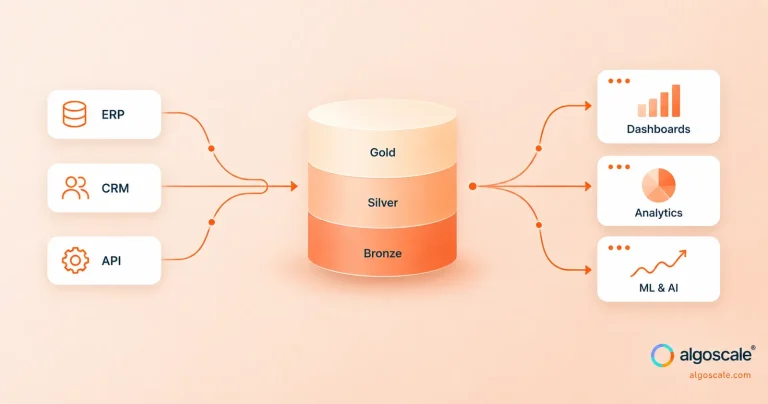
A scalable healthcare analytics architecture typically includes five layers working together:
• Data Ingestion: connecting EHR systems, claims platforms, workforce tools, and operational databases into a unified data flow
• Data Integration: standardizing definitions, resolving terminology inconsistencies, and ensuring clean data movement across systems
• Data Storage: a well-designed data warehouse that aggregates information from multiple source systems and feeds Power BI with reliable, consistent data
• Analytics and Visualization: centralized Power BI dashboards that give clinical, operational, and financial teams the visibility they need without manual data assembly
• Governance and Security: role-based access controls, HIPAA-aligned audit logging, and compliance reporting built into the architecture from the start
Designing this correctly requires expertise across data engineering, cloud infrastructure, governance, and analytics implementation. These are all areas that Algoscale’s healthcare analytics practice is well-positioned to support.
● Algoscale Healthcare Analytics Dashboard: Compliance and Governance

Compliance and Governance Dashboard: HIPAA compliance score of 98.7%, 2.14M audit logs generated (up 22% vs last quarter), 14 open compliance issues (down 38%), and only 3 data access violations (down 62%). Domain scores range from 99.1% for data access controls down to 91.7% for patient consent management.
Benefits of Power BI Healthcare Analytics
| Business Benefit | Impact on Healthcare Organizations | |
| Faster Reporting | Improves operational decision-making speed significantly | 374151 |
| Centralized Data | Eliminates silos across clinical and operational systems | 374151 |
| Real-Time Visibility | Enables proactive patient and resource management | 374151 |
| Improved Governance | Reduces compliance and regulatory risk across departments | 374151 |
| AI Readiness | Supports predictive analytics, forecasting, and ML workloads | 374151 |
| Better Scalability | Handles growing data volumes across multiple facilities | 374151 |
| Lower Manual Effort | Reduces time spent on report assembly and data reconciliation | 374151 |
| Workforce Insights | Improves staffing decisions and productivity management | 374151 |
How Algoscale Supports Healthcare Analytics Modernization
Algoscale works with healthcare organizations through end-to-end Power BI consulting engagements that address the full architecture, not just the dashboards on top.
Our healthcare analytics work spans the following areas:
• Centralized Power BI architecture design across clinical, operational, and financial systems
• Big data integration and healthcare data pipeline development
• Claims analytics, billing reporting, and revenue cycle visibility
• Workforce analytics and staffing productivity dashboards
• Real-time operational reporting for bed management, ER throughput, and patient flow
• Predictive analytics readiness and AI infrastructure preparation
• HIPAA-aligned governance, role-based access, and audit frameworks
• Microsoft Fabric consulting for organizations modernizing beyond traditional Power BI environments
One consistent challenge Algoscale addresses across healthcare clients is the gap between what leadership expects from analytics and what fragmented legacy systems are actually able to deliver. Bridging that gap requires more than better dashboards. It requires a thoughtful rethink of how data moves, how it is governed, and how different systems are connected. That is where the most meaningful work happens.
The Future of Healthcare Analytics
Healthcare analytics is moving toward unified, real-time, AI-ready environments capable of supporting clinical, operational, and financial decision making simultaneously.
Predictive analytics is already reshaping how hospitals manage staffing demand, readmission risk, and patient flow. Generative AI is beginning to enable conversational reporting interfaces where operational teams can query live data using natural language. Microsoft Fabric is expanding the analytics ecosystem around Power BI by adding native data engineering, governance, real-time analytics, and AI capabilities within a single platform.
For healthcare organizations that have already invested in Power BI, these developments represent a meaningful opportunity. However, that opportunity is only accessible for those whose underlying analytics infrastructure is clean, governed, and scalable enough to support it.
Algoscale is glad to help healthcare providers build toward that future through Power BI consulting, healthcare IT consulting, and analytics modernization strategies designed for the operational complexity of modern healthcare environments.