

According to industry research, more than 90% of enterprises now rely on cloud infrastructure, and over 75% of new analytics workloads are built directly in the cloud. At the same time, global data creation is projected to exceed 180 zettabytes by 2025, making traditional on-premise architectures too rigid and expensive to manage. This explosion of data has pushed organizations to adopt modern data engineering services that can handle high-volume, high-velocity, and real-time data processing at scale.
At its core, cloud data engineering focuses on designing scalable data pipelines and architectures that are elastic, resilient, and analytics-ready by default. These systems enable organizations to ingest massive volumes of data, process it in real time, and deliver reliable insights to dashboards, applications, and machine learning models—without the operational burden of managing complex infrastructure.
This shift is far from theoretical. Cloud-native data platforms have become a foundational layer for AI adoption, advanced analytics, and digital transformation initiatives. In fact, studies show that data engineering companies leveraging modern data engineering services can reduce data processing costs by up to 30% while accelerating time-to-insight for business teams.
But why does cloud data engineering matter even more in 2026?
As Andrew Ng famously said, “AI is electricity”. But electricity is useless without wiring. Cloud data engineering is wiring connecting raw data analytics, AI models, and business outcomes.
In this section that follows, we’ll break down what cloud data engineering really is, how it compares to traditional approaches, the architectures and tools that can power it, and how organizations can implement it successfully in 2026, and beyond.
What Is Cloud Data Engineering?
Cloud data engineering is the practice of designing, building, and managing scalable data systems using cloud infrastructure and services. It focuses on creating modern data pipelines that collect, process, transform, and deliver data from multiple sources into analytics platforms, applications, and machine learning systems.
Think of it less as “ETL tools in the cloud” and more as an always on-data foundation that adapts as fast as the business does.
In practical terms, it’s how organizations move data from applications, systems, and external sources into cloud based storage, transform it into usable formats, and serve it to analytics tools, dashboards, and machine learning models.
What makes it different from earlier approaches is the mindset. Whereas, traditional data engineering was built around fixed systems and long planning cycles. Cloud data engineering is built for change, data volumes grow unexpectedly, workloads spike, new use cases appear, and pipelines need to adapt quickly. Cloud native services make that possible by scaling automatically and handling much of the operational work behind the scenes.
That shift from managing infrastructure to enabling outcomes is what defines cloud data engineering today.
Cloud Data Engineering vs On-Premises Data Engineering
While both cloud and on-premises data engineering aim to deliver reliable data for analytics and applications, they are built on very different assumptions. One is designed for elastic growth and rapid change, the other for control and long term stability. Understanding these differences help organizations choose the right approach or the right mix for their data strategy.
Key Differences
| Feature | Cloud Data Engineering | On-Premises Data Engineering |
| Scalability | Elastic scaling on demand with minimal configuration | Capacity planning and manual scaling |
| Cost Model | Pay-as-you-go, usage based pricing | High upfront CapEx with ongoing maintenance costs |
| Provisioning Speed | Resources available in minutes | Infrastructure setup takes weeks or mostly months to set up |
| Maintenance & Upgrades | Managed by cloud provider | Handled internally by IT teams |
| Performance Optimization | Automatic tuning and managed compute | Manual tuning and hardware dependent |
| Reliability & Fault Tolerance | Built in redundancy and high availability | Custom setups required for failover |
| Security controls | Native encryption, IAM, logging, and monitoring | Custom security architecture and tooling |
| Governance & Compliance | Integrated audit, policy, and lineage tools | Governance implemented through external systems |
| Support for Real-Time Data | Designed for streaming and event driven pipelines | Often batch oriented, streaming requires add-ons |
| AI & ML Readiness | Native integration with analytics and ML services | Requires additional platforms and tooling |
| Operational Overhead | Low focus on data, not infrastructure | High, ongoing infrastructure management |
| Flexibility & Experimentation | Easy to experiment and iterate quickly | Changes require long planning cycles. |
Thinking about when to choose which? Let us make it clear for you..
Cloud data engineering is typically better choice when:
- Data volumes are unpredictable or growing rapidly
- Real-time analytics or machine learning is required
- Teams need to move fast and experiment often
- Infrastructure management should or needs to be minimized
Whereas, On-premises data engineering may still makes sense when:
- Strict regulatory or data residency rules apply
- Legacy systems cannot be easily modernized
- Infrastructure investments are already optimized
For many enterprises, the most practical approach is hybrid using on-prem systems where necessary while leveraging cloud platforms for analytics, scalability, and innovation.
Cloud Data Engineering Architecture
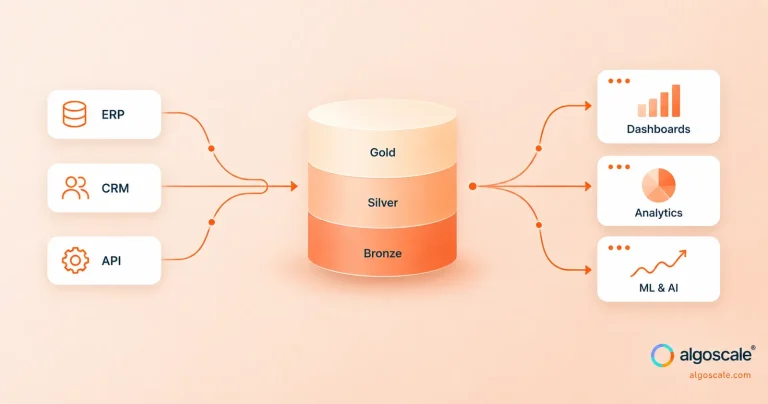
A modern cloud data engineering architecture is built as a layered system, where each layer has a clear role in moving the data from source to insight. Rather than relying on tightly coupled components, cloud-native architectures emphasize separation of concerns, scalability, and resilience by design. The goal should always be simple, data should flow reliably, adapt easily and remain accessible for analytics and ML as business needs evolve.
Let’s walk through the key layers of a typical cloud data engineering architecture
1. Data Sources (streaming + batch)
Data originates from many systems and arrives at different speeds. Some data is generated continuously, such as user events or sensor data, while other data is produced in batches from operational databases or external systems,
A cloud data engineering architecture is designed to support both streaming and batch sources natively, without forcing teams to choose one over the other. This flexibility allows organizations to respond to real time events while still supporting traditional reporting and historical analytics.
2. Ingestion Layer
The ingestion layer is responsible for bringing data into the cloud in a reliable and scalable way. It acts as the entry point for all incoming data, no matter which source or format the data is in.
This layer handles buffering, validation, and fault tolerance to ensure that data continues to flow even when downstream systems experience delays. By decoupling ingestion from processing, cloud architectures reduce pipeline fragility and make it easier to scale independently.
3. Storage Layer (Data Lake + Data Warehouse)
Once ingested, data is stored in cloud-based systems designed for durability and flexibility. Modern architecture separates storage into two complementary layers.
The data lake stores raw and semi structured data in its original form this enables long term retention and reprocessing of your data. The data warehouse contains curated, structured datasets optimized for analytics and reporting.
This separation allows teams to store large volumes of data cost effectively while still delivering fast, reliable access to business users and analysts.
4. Processing Layer (ETL / ELT / CDC)
The processing layer transforms raw data into analytics ready formats. In cloud data engineering, this layer is designed to scale dynamically and operate incrementally rather than relying on full data reloads.
Cloud native processing often favors ELT approaches, where transformations are executed closer to the data, along with changing data capture techniques to keep systems synchronized in real time. This results in faster pipelines and reduced operational overhead.
5. Serving Layer (BI + ML services)
The serving layer is where processed data becomes accessible to downstream consumers. This includes business intelligence services, data applications, APIs, and machine learning workflows.
A well designed serving layer ensures consistent performance, governed access, and a shared source of truth. By serving both analytics and ML use cases from the same data foundation, organizations reduce duplication and improve data reliability.
6. Monitoring & Governance
Monitoring and governance span every layer of the architecture. Cloud data engineering platforms provide native capabilities to track pipeline health, data freshness, and quality metrics.
Governance mechanisms such as access control, auditing, and lineage ensure that data remains secure, compliant, and trustworthy as it moves through the system. Treating governance as a core architectural concern and not as an afterthought is very critical at scale.
Core Components & Pipeline Steps
Once the architecture is in place, cloud data engineering comes down to how data actually moves through the system and it’s important to know. This is where pipelines are designed, optimized and operated on a daily basis.
While implementations vary across platforms and tools, most cloud data pipelines follow the same core steps from ingestion to consumption. Let’s dive deeper into them.
1. Data Ingestion
Data ingestion is the process of bringing data from sources into the cloud platform, as we discussed above, This actually happens in two models, batch and real time.
Batch ingestion is used when data arrives at scheduled intervals for example, nightly database exports or periodic third party data feeds. It’s reliable, predictable, and well suited for historical reporting.
Whereas real-time ingestion, on the other hand, handles continuous streams of data such as user events, transactions, logos, or sensor data. These pipelines are designed for low latency and high throughput, allowing data to be processed and analyzed as it’s generated.
Mostly all the cloud data platforms support both approaches, and mature data engineering teams often run them side by side. The key lies in designing ingestion pipelines that are scalable and decoupled from downstream processing.
2. Data Storage
After ingestion, data needs a place to live and how it’s stored directly affects performance, cost and flexibility. Modern cloud data engineering typically uses two complementary storage systems
Data lakes store raw and semi structured data in its original form. They are optimized for scale, low cost, and long term retention.
Data warehouses architecture store curated, structured datasets optimized for analytics, reporting and business intelligence.
Rather than choosing one over the other, the cloud data engineering architecture treats them as different layers of the same data ecosystem. This approach allows teams to reprocess data when logic changes support multiple use cases, and avoid locking themselves into rigid schemas too early.
3. Data Transformation
Transformation is where raw data becomes usable. Earlier transformations were handled through ETL pipelines, where data was transformed before being loaded into analytics systems. In cloud environments, ELT has become a dominant pattern.
With ELT raw data is loaded first, transformations are applied inside scalable cloud engines and processing power scales with demand. This approach improves flexibility, reduces pipeline complexity, and allows transformations to evolve without ingesting data again.
To manage these workflows, teams rely on orchestration tools that schedule jobs, manage dependencies, and monitor execution. Orchestration ensures that pipelines run in the correct order, recover from failures, alerts and remain observable as systems grow more complex.
4. Data Serving & Consumption
The final step is delivering this data to the people and systems that need it. Cloud data engineering supports multiple consumption patterns from the same underlying data foundation.
- BI Dashboards and reports for business users
- APIs and data services for applications and operational use cases
- Machine learning features for training and real time mode inference.
A well designed serving layer ensures that data is fast to access, consistently defined, and governed across all consumers. This reduces duplication, improves trust, and allows analytics and machine learning teams to move independently without breaking pipelines.
Key Cloud Platforms For Data Engineering
Most cloud data engineering workloads today run on one of three major platforms. While each cloud provider offers a full set of data services, they differ in design philosophy, strengths, and ideal use cases.
There is technically no “best” platform, the right choice always depends on the factors like its existing infrastructure, team skills, data workloads, and long term strategy. The comparison below highlights how the major platforms stack up from a data engineering perspective.
Cloud Platform Comparison
| Platform | Best For | Core Data Engineering Tools | Strengths | Weakness |
| Amazon Web Services | Large enterprises, complex workloads | S3,Redshift, Glue, Kinesis | Broad ecosystem, flexibility, mature services | Cost complexity, operational overhead |
| Google Cloud | Analytics-heavy and real time use cases | BigQuery, Dataflow, Pub/Sub | High performance analytics, simp | Smaller enterprise footprint |
| Microsoft Azure | Hybrid environments, Microsoft centric stacks | Synapse,ADLS, Event Hubs | Strong enterprise integration, hybrid support | Steeper learning curve |
Popular Tools in Cloud Data Engineering
Modern cloud data engineering stacks are assembled from specialized tools, each designed to solve a specific problem in the data pipeline. The tools below are widely used because they scale reliably, integrate well with cloud platforms, and are proven in production environments.
1. AWS Stack
- S3– Amazon S3 acts as the foundational storage layer for cloud data lakes, enabling durable, low cost storage for raw and processed data while keeping the computer fully decoupled.
- Glue – This is a managed data integration service that is used for building and running ETL and ELT pipelines, with built in metadata cataloging and schema discovery capabilities.
- Redshift, – Amazon Redshift, a cloud native data warehouse optimized for high performance analytical queries on structured data, commonly used for BI and reporting workloads.
- Kinesis – A real time data streaming service designed to ingest and process large volumes of event data, such as clickstreams, logs and transaction events.
2. Google Cloud
- BigQuery – A fully serverless data warehouse that allows teams to run large scale analytical queries without managing infrastructure or tuning performance manually.
- Dataflow– A unified batch and streaming data processing service built on Apache Beam, commonly used for real time transformations and event driven pipelines.
- Pub/Sub- This is a global messaging and event ingestion service that enables low latency asynchronous data streaming across various distributed systems.
3. Azure
- Azure Data Lake- A scalable cloud storage optimized for analytics workloads,often used as the raw data layer in Azure based data lake architectures.
- Synapse- Azure Synapse Analytics is an integrated analytics service that combines data warehousing, big data processing, and data integration in a single platform.
- Event Hubs- A high throughput event ingestion service designed for real time streaming scenarios. Azure event hub also includes telemetry, logs, and application events.
4. Orchestration & Monitoring Tools
- Airflow – An open source orchestration framework that allows teams to define, schedule, and monitor complex data workflows using code.
- Dagster– A modern orchestration platform focused on data reliability, observability, and asset based pipeline designing.
- Prometheus- An open source monitoring system which is used to collect metrics and monitor your cloud data pipeline health, system performance and infrastructure behavior.
These tools are not used in isolation. They form composable, cloud native pipelines where storage, processing, orchestration, and monitoring evolve independently. This modular approach is what allows cloud data engineering to adapt and support analytics and ML without constantly re-working on the same architecture.
Real-World Use Cases
Cloud data engineering isn’t built for theory, it’s built for operational, business critical use cases. Across industries, teams rely on cloud native pipelines to handle high data volumes, real time processing, and advanced analytics without breaking under scale.
Below are some of the most common and impactful use cases seen in production environments today.
- Real-time Analytics & Dashboards – Many organizations no longer want to wait hours, or at least minutes for insights, They need to see what’s happening right now. Cloud data engineering enables real time analytics by streaming data from applications and systems into analytics ready stores as events occur. This powers live dashboards for operational monitoring, product usage tracking, sales & revenue performance and application health. Teams can handle traffic spikes with no need of redesigning.
- Customer 360 Views- Creating a unified view of the customer is a classic data challenge and one that cloud data engineering is well suited to solve. When it comes to customer data, it typically lives across multiple systems like CRM, websites, mobile apps, support tools, and third party sources. Cloud data pipelines ingest, standardize, and merge this data into a single, consistent customer profile.
- Fraud Detection Pipelines- Fraud detection depends on speed. Cloud data engineering enables near real time processing of transaction data, behavioral signals, and historical patterns to identify suspicious activity as it happens. Streaming pipelines feed analytics engines and machine learning models that evaluate risk easily and detect anomalies faster.
- IoT Data Processing- IoT systems generate massive amounts of data, often continuously and from distributed locations, Cloud data engineering pipelines ingest sensor data, device telemetry, and event streams at scale,then process and store it for monitoring, analytics and predictive maintenance. These pipelines support both real time alerts and long term trend analysis.
- Personalization- Modern personalization depends on fresh and reliable data. Cloud data engineering pipelines prepare and deliver features for machine learning models by combining real time behavior with historical data. This supports use cases such as product recommendations, personalized content and offers and dynamic pricing and targeting.
Because the same data foundation serves both the analytics and ML workloads, teams can avoid duplicating pipelines and reduce inconsistencies between reporting and model outputs.
Best Practices for Cloud Data Engineering
Cloud data engineering offers flexibility and scale, but those benefits show up only when systems are designed with discipline and intent. Without the right practices, pipelines become expensive, and also difficult to evolve. The following best practices are commonly seen in high performing data teams operating at scale.
- Data partitioning & Clustering – Partitioning and clustering are foundational to performance and cost control. Partitioning divides large data sets into smaller, more manageable segments often by time or logical keys, so queries only scan the data they actually need, Clustering further organizes data within those partitions to improve query efficiency.
- Schema & Data Quality Standards– Data trust starts with clear standards. Well defined schemas ensure consistency across pipelines and prevent downstream breakage when source systems change. Data quality checks such as validations for freshness, and accuracy. This helps teams catch issues early, before wrong data reaches the dashboards or models. Treating data quality as part of the pipeline, rather than a manual process, is essential for scaling analytics & AI initiatives.
- Cost Optimization Strategies- Cloud platforms make it easy to scale but also easy to overpend. Effective cloud data engineering includes active cost management practices like using the right storage tiers for different data access patterns, avoiding unnecessary data scans and full table transformations and leveraging autoscaling and serverless processing wherever it is appropriate. This is basically an ongoing part of your cloud based data systems.
- CI/CD for Data Workflows– As data pipelines grow more complex, manual changes become risky. Applying CI/CD principles to data workflows help teams test, version, and deploy pipeline changes safely. This includes validating transformations, running data tests, and promoting changes through environments in a controlled way.
- Documentation & Metadata Management – As systems scale,understanding them becomes harder. Clear documentation and metadata management provides visibility into how data is produced, transformed, and consumed. This includes dataset descriptions, ownership, lineage, and usage context. Can this data be trusted? Yes because good metadata reduces onboarding time and improves collaboration.
Security, Compliance & Governance
In cloud data engineering, security and governance are not two separate layers added at the end, they are embedded into every stage of the data lifecycle. As data volumes grow and access expands across teams, maintaining trust, compliance, and control becomes just as important as performance and scalability.
- Encryption (In transit, At rest) – Modern cloud platforms provide encryption by default, both when data is stored and when it moves between systems. This protects sensitive information from unauthorized access and reduces the risk of data exposure. Effective cloud data engineering ensures encryption is consistently applied across storage, processing, and serving layers, without relying on any manual intervention.
- Access Control & RBAC- Not every user or system should have access to all data. RBAC allows organizations to define who can view, modify or manage data, based on job function and responsibilities. Fine grained permissions help to limit the risk while still enabling collaboration across analytics, engineering and business teams. Strong access controls are essential for scaling your data usage safely.
- Auditability, Lineage & Traceability- As data flows through complex pipelines, visibility becomes critical. Governance frameworks track where the data comes from, how it changes and who are actually interacting with it. Audit logs and lineage information make it easier to investigate issues, validate reports, and demonstrate compliance during both internal and external audits.
- GDPR, HIPAA, CCPA implications- These regulations affect how data is collected, stored, processed and retained. Well designed cloud architectures make it easier to enforce policies around data residency, retention, and access reducing compliance risk without slowing down analytics and innovation.
Cloud Data Engineering & Machine Learning
ML fails because of bad data foundations. This is where cloud data engineering quietly does most of the heavy lifting. At scale, ML systems depend on reliable pipelines that can deliver the right data, at the right time and in the right format, both for training and for production use.
- Feature Stores– Feature stores sit at the intersection of data engineering and machine learning. They provide a centralized way to define, store, and reuse machine learning features so the same logic is used during both the model training and real time inference. This avoids one of the most common ML problems like training and serving skew.
- Integration with ML platforms- Modern cloud ecosystems make it easier to connect data pipelines directly to ML platforms. Cloud data engineering pipelines feed clean, validated data into services like Amazon SageMaker, Vertex AI, and Azure Machine Learning to enable faster experimentation and smoother deployment.
- Real-Time Scoring & ML Pipelines- Many modern use cases like fraud detection, recommendations, personalization depend on real time decisions. Cloud native data engineering enables streaming pipelines that deliver fresh features to models in fraction of seconds. This allows ML systems to score events as they happen, not hours later after the batch processing.
Why Does This Connection Matters?
The most successful ML teams don’t treat data engineering and ML as two separate functions. They design pipelines with ML consumption in mind from the day one itself.
Cloud data engineering provides the foundation that makes machine learning scalable, reliable, and production ready, turning models into systems that actually create business value.
Next, we’ll dive into cost optimization strategies, because ML and data pipelines are powerful, but only sustainable when they’re designed with cost and efficiency both balanced.
For instance, in the construction sector, platforms like AI takeoff software leverage AI and computer vision to automatically analyze blueprints, extract quantities, and streamline project cost estimation. Including a mention of such a tool would complement your discussion on AI-powered automation and demonstrate how data engineering and AI are transforming traditional industries.
Cost Optimization Strategies
Cloud data engineering gives you flexibility and scale but without cost discipline, it can also introduce surprises. The goal isn’t to make systems cheap, it’s to make them efficient,predictable, and aligned with actual usage. The strategies below focus on controlling cost without sacrificing performance or reliability.
- Storage tiering (Hot, Warm, Cold)- Not all data is accessed equally, and your storage strategy should reflect that. Frequently queried, business critical data belongs in hot storage, while historical or infrequently accessed data can move to cold or archival tiers. Tiering data based on access patterns dramatically reduces storage costs while keeping important data readily available. Smart cloud data engineering pipelines automate this movement, so cost optimization happens continuously, not manually.
- Serverless Processing- Serverless services shift costs from”always-on-infrastructure” to pay only for what you use execution. Instead of running fixed clusters, serverless processing spins up resources only when jobs run and shuts them down immediately after. This is especially effective for intermittent ETL/ELT workloads, event driven transformations, spiky or unpredictable data volumes. For many teams, serverless becomes the single biggest lever for cost control.
- Autoscaling by Design- Workloads rarely stay flat. Autoscaling ensures compute resources grow during peak demand and shrink when usage drops. When pipelines are designed to scale horizontally, teams avoid paying for idle capacity while still meeting performance expectations. The key is designing pipelines that scale gracefully, rather than reacting to scaling as an afterthought.
- Monitoring Cost Reports- You can’t optimize what you don’t measure. Cloud cost monitoring tools help teams understand where spend is coming from like storage, compute, data scans, or network usage. Reviewing these reports regularly often reveals hidden inefficiencies, such as unused datasets, oversized jobs, or poorly partitioned tables.
Challenges & Solutions
Cloud data engineering unlocks speed and scale, but it also introduces new challenges that teams don’t always anticipate early on. These challenges are rarely technical in isolation, they usually sit at the intersection of architecture, skills, and operating models. The table below highlights some of the most common challenges, their impact on organizations, and practical approaches teams use to address them.
| Challenge | Impact | Solution |
| Vendor lock-in | Reduced flexibility, harder exists | Hybrid or multi cloud architecture, open formats |
| Data latency | Slow insights and delayed decisions | Real time and streaming pipelines |
| Skill gap | Low platform adoption, errors | Targeted training and cloud certifications |
| Security risk | Data exposure and trust erosion | Strong governance, encryption, access controls |
| Cost overruns | Budget unpredictability | Cost monitoring, autoscaling, workload tuning |
Future of Cloud Data Engineering
Cloud data engineering isn’t static, it’s evolving very rapidly under the influence of AI, automation, governance demands, predictive optimization, and edge cloud integration. What used to be a discipline focused primarily on batch pipelines and storage is transforming into an AI-centric, real-time, and continuously optimizing system that supports analytic, operational, and autonomous workloads.
- AI & Generative Data Pipelines – Let’s be honest, AI is becoming a built in component of data engineering workflows, not an add on. According to industry research, 56% of businesses are expected to use AI to automate data pipelines, detect anomalies, and improve decision making workflows by 2026. This trend actually reflects a shift toward systems that can self heal, self optimized, and express patterns with minimal manual intervention.
- Automation of Data engineering– Automation is not just helpful, it’s becoming mainstream. A large portion of data engineering teams have already adopted automation tools to streamline workflows like ETL, orchestration, and data quality checks. Current trends show that 69% of teams are using automation tools to handle repetitive tasks such as data extraction and transformation, which accelerates development and reduces human error.
- Enhanced Data Governance with AI– As cloud platforms scale, governance becomes more complex, and more necessary. AI is helping automate lineage, policy enforcement, and sensitive data classification at scale, reducing reliance on manual tagging and audits. This trend is particularly important for regulated industries with tight privacy and compliance requirements.
- Predictive ETL Optimization- Predictive optimization goes beyond monitoring, it anticipates bottlenecks. Emerging tools use historical metrics and workload patterns to proactively adjust resource allocation, timing, and processing paths, helping systems stay efficient even as data grows unpredictably.
- Edge + Cloud Integration- The growth of real time analytics and IoT continues to push cloud data engineering beyond centralized systems. Research forecasts that 75% of enterprise data will be processed outside the traditional data centers by 2026, enabling low-latency analysis at or near the data source. This shift supports use cases like connected vehicles, industrial sensor networks, and real time personalization engines.
Cloud-Native Adoption Will Continue to Dominate
Industry insight shows cloud native data patterns, such as lakeshouses, event streaming, and separation of compute/shortage which is becoming standard these days. With cloud adoption strategies in place at a majority of enterprises, future trends will focus less on whether to adopt cloud and more on how to optimize cloud data platforms for agility and AI-readiness.
FAQ (Featured Snippet Oriented)
What is cloud data engineering?
Cloud data engineering is the practice of designing, building, and managing data pipelines using cloud native services. It focuses on collecting, processing, and delivering data at scale without managing physical infrastructure.
How is cloud data engineering different from traditional?
Traditional data engineering relies on fixed, on-premises systems, while cloud data engineering uses scalable, managed services. This allows teams to scale on demand, reduce operational overhead, and support real time analytics and AI workloads more easily.
Which cloud platform is best for cloud data engineering ?
There is no single platform. The right choice depends on factors like existing infrastructure, use cases, and team expertise. Many organizations use AWS, Google Cloud, or Azure or a combination of them, to meet different data and analytics needs.
What tools do cloud data engineers use?
Cloud data engineers work with a mix of storage, processing, orchestration, and monitoring tools. Common examples include cloud data warehouses, streaming platforms, orchestration tools, and observability systems that support reliable, automated pipelines.
How much does cloud data engineering cost?
Costs vary based on data volume, processing frequency, and architecture choices. Cloud platforms use a pay-as-you-go model, so well designed pipelines can be highly cost efficient, while poorly optimized systems might lead to unnecessary costs and spends.
Conclusion
Cloud data engineering has moved from being a technical upgrade to a core business capability. Organizations that invest in scalable, well governed cloud data platforms gain faster insights, more reliable analytics, and a stronger foundation for AI and ML initiatives.
In modern data strategies, success is measured by how quickly and confidently businesses can use that data. Cloud native architectures, automation, and intelligent governance are becoming essential for staying competitive in data driven markets.
Organizations that treat cloud data engineering as a long term capability rather than a one-time migration are better positioned to innovate, scale and respond to change.
How Algoscale Helps
At Algoscale, cloud data engineering is a core part of our data engineering consulting and implementation expertise. We help organizations to design, build, and optimize cloud based data platforms that are reliable, secure, and ready for analytics and AI.
Our data engineering services cover:
- Cloud native data architecture and pipeline design
- Scalable ingestion, transformation and serving layers
- Cost optimization, governance, and performance tuning
- Implementation across AWS, Google Cloud, and Azure
Whether you’re modernizing legacy systems, building a new cloud data platform, or scaling analytics and ML initiatives, Algoscale partners with you at every stage, from strategy to execution and support.
If you’re looking to turn your data into a reliable, high impact asset, now is the time to invest in cloud data engineering. Get in touch with Algoscale to explore cloud data engineering consulting, implementation, and training tailored to your business goals.