


Here’s a scenario most data teams know too well.
The AI initiative has been greenlit. The budget is approved. Your data team is ready—and then three months in, everything stalls. Not because the models are wrong or the vision is unclear, but because the data feeding into everything is unreliable, inconsistent, or simply not ready.
This is where data architecture consulting services become critical. Because this is the most expensive problem in enterprise data today—and it almost always traces back to one thing: a weak data pipeline architecture underneath.
Unity Technologies found this out the hard way when faulty data pipelines corrupted the datasets training their advertising models, costing them approximately $110 million in lost revenue. They had a data pipeline problem.
Data teams across industries currently spend 60-80% of their time maintaining fragile pipeline systems, firefighting instead of building, patching instead of scaling. Meanwhile, Gartner predicts that 60% of AI projects will be abandoned through 2026 if they aren’t supported by AI-ready data.
The pattern is clear. And it’s costly.
Data pipeline architecture is the structural foundation that determines how data moves from where it is created to where it’s used reliably at scale and in a form that’s actually useful. If you get it right and everything downstream analytics, AI, reporting, operations work the way it should.
The global data pipeline tools market is growing from $14.76 billion in 2025 to a projected $48.33 billion by 2030, a number that reflects just how urgently enterprises are investing in getting this right.
This guide covers everything from components, types, patterns, tools, real-world use cases, and best practices written for technical leaders, data architects, and business decision makers who need more than a surface level overview.
What is Data Pipeline Architecture?
Data pipeline architecture is the design of how data moves from its source to where it is used. It includes collecting data, cleaning it, transforming it into a useful format, storing it, and delivering it for analysis or reporting. In simple terms, it is a step-by-step system that ensures raw data becomes accurate and ready to use. A good data pipeline architecture makes sure data flows smoothly, quickly, and without errors. It helps businesses make better decisions by providing reliable data for dashboards, reports, and applications. Without it, data can be messy, delayed, or difficult to use.
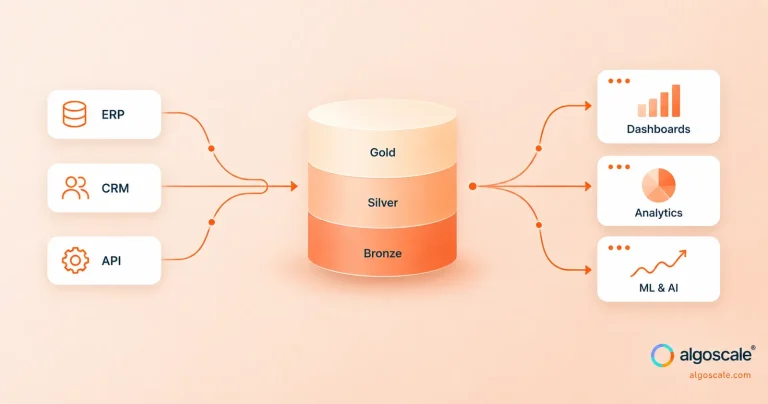
Diagram of Data Pipeline Architecture
Think of a data pipeline the way you’d think of a supply chain. Raw materials come in at one end. A finished, reliable product comes out of the other. Every station in between has a specific job, and if any one of them fails, the whole line stops.
Here’s every layer, what it does, and what breaks when it’s missing
1. Data Sources
Where everything begins
Every pipeline starts here, databases, SaaS applications, IoT sensors, event logs, third-part APIs, flat files. The diversity of sources is exactly what makes this layer complex. Structured, semi-structured, and unstructured data all arrive differently, at different speeds, in different formats.
Why it matters- If your sources aren’t properly mapped and cataloged, the rest of the pipeline is built on sand. Source schema changes, such as column renamed; a field dropped are the leading cause of silent pipeline failures downstream.
Tools at this layer –
Relational DBs | NoSQL Stores | REST APIs | IoT Sensors| SaaS Platforms | Event logs | Flat files/CSVs
2. Ingestion Layer
Getting data into the pipeline reliably
The ingestion layer pulls data from all those sources and moves it into the pipeline in a controlled, reliable way. This can happen in batches on a schedule, or continuously as events stream in. The architecture here determines how fresh your data is and how well the system handles volumes of spikes without falling over.
Why it matters- A poorly designed ingestion layer is where most data loss happens. Duplicates, dropped records, and ordering issues all start here, and they’re much harder to fix once data is downstream
Tools at this layer –
Apache Kafka | AWS Kinesis | Fivetran | Airbyte| Google Pub/Sub | AWS DMS | CDC Connectors
3. Transformation Layer
Turning raw data into something useful
Raw data is rarely ready to be used. The transformation layer cleans it, standardizes it, joins it across sources, applies business logic, and shapes it into a format that analytics and applications can consume. This is where ETL and ELT patterns diverge and where most of the complexity in a modern pipeline life is.
Why it matters- Bad transformations are invisible until they cause a wrong number in a report or a broken ML model. Every transformation should be version controlled, tested, and documented not just written once and forgotten.
Tools at this layer –
dbt | Apache Spark | Apache Flink | Apache Beam| AWS Glue |Dataflow| Python/SQL
4. Storage Layer
Holding data at scale without performance degrading
Once transformed, data needs a home. The storage layer is where it lives, in data warehouses for structured analytical queries, data lakes for raw and unstructured data, or Lakehouse’s that bridge both. The storage architecture you choose determines query speed, cost at scale, and how easily data scientists and analysts can access what they need.
Why it matters- Separating storage from compute is one of the most impactful decisions in modern pipeline design. It means you can scale query performance without scaling storage costs and vice versa.
Tools at this layer –
Snowflake | Google Big Query |Amazon S3 | Delta Lake| Apache Iceberg | Azure Synapse | Databricks
5. Orchestration Layer
Making sure everything runs in the right order
Orchestration is the coordination layer. It schedules pipelines, jobs, manages dependencies between tasks, handles retries when something fails, and gives engineers visibility into what ran, when, and with what result. Without it, pipelines are a collection of scripts that nobody fully understands or can reliably operate.
Why it matters- Most pipeline failures aren’t caused by bad code; they’re caused by tasks running in the wrong order or retires that don’t know about upstream state. Good orchestration makes failures recoverable instead of catastrophic.
Tools at this layer –
Apache Airflow | Prefect | Dragster |AWS Step Functions| dbt Cloud | Astronomer | Mage
6. Monitoring and Observability
Knowing when something’s wrong before the business does
This is the layer most teams build last and regret not building first. Monitoring tracks whether pipelines are running. Observability goes deeper: it tells you whether the data coming out of those pipelines is actually correct, fresh, and complete. Schema drift, volume anomalies, and null rate spikes. These are the silent failures that don’t break the pipeline but break the business.
Why it matters- The difference between a data team that’s trusted and one that does not usually come down to this layer. Teams that catch data quality issues before stakeholders are the ones that get more investment.
Tools at this layer –
Monte Carlo | Great Expectations | Acceldata |Datadog| Open Telemetry |Soda | dbt tests
7. Serving and Consumption Layer
Where data finally becomes a decision
All the above exists to serve this layer. Analysts building dashboards, data scientists training models, applications personalizing experiences, operations teams monitoring live processes, all consume data from here. The serving layer needs to be fast, accessible, and governed. The wrong person accessing the wrong data at this layer is where compliance risk lives.
Why it matters- A serving layer that’s hard to access defeats the purpose of everything built before it. Self-serve access, clear data contracts, and role-based permissions aren’t luxuries; they’re what determine whether the pipeline investment generates business value.
Tools at this layer –
Tableau |Power BI | Looker | Metabases | ML Platforms | Reverse ETL | REST APIs
Data Pipeline Architecture Diagram With Example
ETL vs ELT – The distinction that changes your entire transformation strategy
| ETL | ELT | |
| What it means | Extract → Transform → Load | Extract → Load → Transform |
| Where transformation happens | Before data enters storage | Inside the storage layer |
| Best for | Strict compliance, sensitive data, legacy systems | Cloud-native stacks, high-volume analytics |
| Tools | Informatica, Talend, AWS Glue | dbt, Spark, Big Query, Snowflake |
| Trade-off | Slower to load, more controlled | Faster ingestion, needs a powerful warehouse |
Neither is universally better. The right choice depends on your data volume, compliance requirements, and whether your warehouse has enough compute to handle heavy in-place transformations.
Common Data Pipeline Architecture Design Patterns
Not all data moves the same way. And not all pipelines should be built the same way either.
The mistake most organizations make isn’t choosing the wrong tools; it’s assuming one pipeline type can do everything. It can’t. Here’s every major type, what it’s actually good at, and where it starts to crack.
For Your Quick Reference
| Pipeline Type | Latency | Complexity | Real-Time? |
| Batch | Hours | Low | No |
| Streaming | Milliseconds | High | Yes |
| ETL | Batch-dependent | Medium | No |
| ELT | Near real-time | Medium | Partial |
| Lambda | Dual | Very High | Yes |
| Cloud-Native | Configurable | Low(ops) | Configurable |
1. Batch Pipeline – The classic workhouse
Data is collected over a period of time and processed all at once, nightly runs, hourly jobs, and scheduled refreshes. Simple to build, easy to debug, and cost efficient. Still the right choice for financial reporting, compliance exports, and anything where a few hours of latency doesn’t change the outcome.
Where it breaks down: the moment your business needs to act on data before the next scheduled run.
Best for: BI refreshes, overnight ETL tools, regulatory reporting
2. Streaming Pipeline- Real-Time, All the Time
Data is ingested and processed at the moment it’s generated in milliseconds of latency, continuous flow. This is what powers fraud detection, live personalization engines, and real time dashboards that actually show right now.
The tradeoff: streaming pipelines are significantly harder to build, test, and operate than batch. Exactly-once delivery, out-of-order event handling, and stateful computation all add layers that batch simply doesn’t have.
Best for: Fraud detection, IoT telemetry, live customer analytics
3. ETL Pipeline- Transform Before You Store
Extract → Transform → Load. Data is cleaned, masked, and restructured before it ever touches the destination. The traditional standard, and still the right call-in environments where data quality and compliance controls need to happen before storage not after.
Where it struggles: high-volume, cloud native stacks where ELT is faster, cheaper, and more flexible.
Best for: PII masking, regulated industries, legacy warehouse integrations
4. ELT Pipeline- Load First, Transform Inside
Extract → Load → Transform. Raw data lands in the warehouse first. Transformation happens inside it, powered by the warehouse’s own compute engine. This is the modern default for cloud native stacks with faster ingestion, more flexibility, and no transformation bottleneck upstream.
The catch: it demands a warehouse powerful enough to handle heavy in-place computation. If you can’t, ELT creates
Best for: Snowflake, Big Query, and Databricks environments; analytics engineering teams with different kinds of bottlenecks.
5. Lambda Pipeline- When You Need Both
Two parallel paths running simultaneously, a batch layer for historical accuracy, and a speed layer for real-time data merged at the serving layer. It’s the architecture enterprises reach for when they genuinely can’t sacrifice either accuracy or speed.
The honest tradeoff: two codebases, two processing systems, double the operational complexity. Lambda is powerful. It’s also expensive to maintain.
Best for: Enterprises where both historical depth and live data are non-negotiable
6. Cloud-Native Pipeline- Built to be Managed
Fully managed pipeline infrastructure on AWS, GCP, or Azure, no servers to spin up, no infrastructure to babysit. Scales automatically, integrates natively with the rest of the cloud stack, and lets data teams focus on logic rather than operations.
Where it falls short: highly regulated environments where data residency, auditability, and control requirements make fully managed services a compliance risk.
Best for: Teams prioritizing speed-to-value and low operational overhead
The Modern Data Pipeline Tech Stack
Choosing the pipeline tools isn’t a vendor comparison exercise. It’s an architecture decision. The wrong tool at the wrong layer doesn’t just underperform; it creates technical debt that compounds every quarter until someone must start it from the scratch.
The foundational modern data stack comes donw to four anchors: Airbyte for ingestion, Snowflake for warehousing, dbt for transformation, and Apache Airflow for orchestration. But that’s a starting point, not a prescription. Here’s the full picture, layer by layer.
Real World Use Cases by Industry
Good pipeline architecture is invisible. Nobody talks about it when it works. They only notices when it doesn’t and by then something expensive has already happened. Here’s what it looks like when it works.
1. Financial Services
The problem: A transaction fires across three countries in four minutes. The system has milliseconds to approve or block it, and that decision needs to be audited ready for a regulator.
What the pipeline does: ingests transaction data in real time, enriches it with third-party risk signals, runs it through an ML anomaly model, logs every decision with a full transformation trail.
The part most teams underestimate is the SOX compliance doesn’t just require the right answer. It requires proof of how you got there. The pipeline is both a fraud detection tool and a regulatory record. Those are two very different design requirements living inside one system.
2. E-Commerce
The problem: A customer browse at 11PM. By morning, the app already knows what they’ll likely buy and whether it’s in stock near them.
Amazon uses data pipelines to predict customer buying behavior, optimize inventory, and personalize experiences, not through three separate systems, but one unified pipeline serving different downstream consumers simultaneously.
The architectural challenge: real-time click streams events and large historical batch datasets need to merge coherently and serve results with sub-second latency. That’s not a problem. That’s a design problem.
3. Healthcare
The Problem: A patient in ICU is connected to twelve monitoring devices. A deterioration of alert needs to fire before the clinical team visually notices anything, not after.
Hospitals like Mayo Clinic use data pipelines to track and analyze patient data from IoT medical devices in real time.
What makes this harder than it looks: HIPAA’s Safe Harbor method requires stripping 18 specific identifiers before patient data crosses system boundaries. A missed identifier isn’t a bug. It’s a compliance breach. Every transformation step needs automated validation, not just testing in staging.
Modern healthcare data architecture needs intelligent pipelines that clean, standardize and label incoming data in real time, by converting it into representations that AI can learn from.
4. Manufacturing
The problem: Hundreds of machines on a factory floor generate data simultaneously. Some decisions need to be fired in milliseconds. Others need to flow upstream for fleet-wide predictive maintenance modeling.
Manufacturing IoT requires edge processing for real-time closed-loop control, with aggregated data flowing to a central Lakehouse for predictive maintenance and operational analytics.
The mistakes most teams make treating this as an ingestion problem. It isn’t. Sensor drift, intermittent connectivity, and schema variation across machine types mean the pipeline must handle noise and inconsistency at source, before any meaningful analytics are even possible.
Seen a use case that mirrors your business? Algoscale builds production-grade data pipeline architecture across financial services, healthcare, e-commerce, manufacturing, and AI-driven organizations — from design through to live deployment.
Common Challenges in Building Data Pipelines
73% of enterprise data initiatives fail to meet expectations, despite organizations spending an average of $29.3 million annually on data programs. The problem, almost universally, isn’t strategy or budget. It’s what’s happening inside the pipeline.
1. Schema drift- the silent pipeline killer- A field changes from string to integer upstream. A third-party API quietly updates its response format. Nobody notices until a dashboard breaks or worse until it produces wrong numbers that nobody questions. Most of the pipeline failures aren’t caused by complex edge cases. They’re caused by predictable issues like a field type to change upstream, an API format update, and a timestamp logic error from daylight saving time.
2. Data quality issues that compound downstream- Gartner research shows poor data quality costs companies around $12.9million annually, and that number only reflects what organizations can measure. 64% of organizations cite data quality as their top data integrity challenge, yet only a fraction run automated quality checks at every pipeline stage. This makes harder to trace where the problem orginated.
3. Pipeline observability gaps, finding too late– Organizations need four or more hours to detect data quality problems, and in most cases, detection happens because a stakeholder notices something wrong. Data pipeline monitoring is constantly the last thing teams invest in and the first thing they regret. Without visibility into data freshness, volume anomalies, and transformation accuracy, a pipeline is essentially running on trust, and it’s not a reliability strategy.
4. Scaling bottlenecks that only appear at volume– A pipeline that handles 10GB a day performs nothing like handling 10TB a day. Partition strategies, indexing logic, job concurrency limits, and storage tiering all behave differently at scale, and teams typically discover this mid growth when the re-architecting is maximally disruptive.
Legacy system integration, deeper than it looks – Most enterprises aren’t building pipelines on a clean slate. They’re connecting to ERPs, CRMs, and databases that predate modern data lake architecture, systems without undocumented schemas, inconsistent data types, and no native API support. Maximum, say 95% of companies state that managing fragmented data is their biggest business problem.
5. The talent gap, the challenge nobody budgets for– Building and operating a modern ETL pipeline architecture requires a rare combination of skills like data engineering, distributed systems, cloud infrastructure, SQL, Python, and increasingly ML pipeline design. Up to 90% of businesses are facing IT talent shortages, with a projected $5.5 trillion in losses by 2026 from the skill gaps alone.
6. AI readiness, pipelines that block ML initiatives– Despite $30M in average annual data spend, nearly 62% of organizations report their data maturity as low; this reveals how far enterprises still have to go to achieve self-service and predictive analysis. The ambition to run ML on scale exists in almost every organization. Inconsistent feature engineering, missing data versioning, and no lineage tracking mean most ML initiatives stall long before the models are the problem.
Best Practices for Designing Scalable Data Pipelines
The difference between a pipeline that scales and one that becomes a liability usually isn’t the tools. It’s the decisions made before the first line of code was written.
Here’s the checklist, be honest with yourself.
- Build modular, one stage, one job. If one failure takes everything downstream with it, the architecture is the problem.
- Define your schema before you build, not after schema drift will happen. Whether your pipeline handles it gracefully or breaks silently is decided upfront.
- Develop storage from compute scale only what you need, when you need it. This is the core principle behind every modern cloud-native platform.
- Automate data quality checks at every layer. Catch bad data from the source. Don’t let it travel three stages before someone notices.
- Instrument everything before it goes to production. Job status, row counts, latency, schema conformity, your monitoring stack should know something broke before your business stakeholders do.
- Version controls your pipelines like code. Treat pipeline changes with the same rigor as production software. Review, test, deploy, roll back.
- Set governance rules on day one. Ownership, access controls, lineage tracking, retrofitting these later costs five to ten times more than building them from the start.
Three or more uncomfortable? That’s where to start.
When to Bring Data Pipeline Consulting?
Not every data challenge needs an external partner. A strong internal team with enough runaway can solve a lot. But there are four specific situations where that stop being true.
1. Your AI roadmap keeps hitting the data wall
The models are ready; the use cases are approved. But every time something gets close to production, a pipeline gap or data quality issues kill the momentum. This pattern, AI ambition outpacing data infrastructure, is one of the most expensive problems in enterprise data right now.
2. You’re scaling and things that worked before suddenly don’t
Queries that ran fine at 10TB crawl at 500TB. Pipelines that were reliable at one volume become unpredictable at ten times the load.
This isn’t a bug; it’s an architecture problem. Teams that try to scale through it with quick fixes always spend more and take longer than the ones who bring in people who’ve done it before.
3. Legacy warehouse modernization is on the roadmap
The real risk here isn’t technical; it’s business continuity. Existing dashboards, reports, and downstream consumers all depend on the current system staying stable while the replacement is being built alongside it.
Without proven migration patterns and rollback strategies, these projects routinely run over time, over budget, and over stakeholder patience.
4. Real-time capability is a priority, but the depth isn’t there yet
Streaming pipelines are genuinely hard to build and operate safely. Once delivery, stateful processing, latency monitoring, all of it requires a level of depth most data teams are still building.
If there’s a deadline attached to a real time, learning through trial and error in a live environment isn’t a plan.
The Future of Data Pipeline Architecture
Five years from now, the organizations leading on data will be the ones making architecture decisions right now. Here’s what the direction looks like.
5. Pipelines can manage themselves
Agentic systems are beginning to monitor pipeline health, detect schema changes and delayed feeds, and apply fixes automatically. They can reprocess data, revert configurations, and raise alerts before humans even notice. Not full autonomy yet, but a meaningful reduction in the manual recover work that currently consumes your data engineering teams.
6. DataOps moves from best practice to baseline expectation
Automated testing, version control, CI/CD, pipeline observability, these used to be what advanced teams did. In 22026, they’re what every team is expected to do.
The organizations still deploying pipelines manually are already behind. The ones who’ve adopted DataOps as standard operating practice are shipping faster, breaking less, and spending far less time on incident response.
7. Real-time becomes the default — batch becomes the fallback
The question most enterprises are now asking isn’t whether to build real-time pipelines. It’s which batch pipelines to migrate first.
The infrastructure of Kafka, Flink, and cloud-native streaming services is more accessible than it’s ever been. The barrier to entry is dropping. The cost of staying batch-only is rising.
This is the moment where data pipeline architecture stops being a technical decision and becomes a strategic one. The enterprises building a clean, scalable, observable foundation now are the ones that will move fast when agentic AI and real-time analytics stop being aspirational and become operational.
Tired of Pipelines That Break in Production?
From ingestion to DataOps implementation, Algoscale works with businesses, startups, and enterprise data teams to design pipelines that hold up in production, not just in architecture diagrams.
Talk to Algoscale’s Data Engineering Team →
Conclusion
Your data pipeline is not a background concern. It’s the foundation for every analytics initiative, every AI project, and every real-time business decision is built on. Get it right; everything downstream accelerates. Get it wrong; your best engineers spend their time maintaining what should already be working.
You already know which stage you’re at.
Maybe it’s making your data stack AI-ready before the window closes. Maybe it’s a legacy system starting to crack. Maybe it’s the real-time capability you need now. Whatever it is — it starts with a clear-eyed look at where your current architecture stands and what a better one looks like for your specific context.
Algoscale specializes in exactly that.
Pipeline redesign, cloud migration, real-time streaming infrastructure, DataOps implementation, the full stack, built for production.
Don’t wait for a broken pipeline to block your next major initiative.