



Here is what happened when we went looking for prices. datahub.com/pricing returns a 404. collibra.com/pricing returns a 404. Atlan’s redirects to a form headed Start the conversation. Collate, the hosted OpenMetadata, does publish a pricing page, and it lists user counts and asset limits with no figure anywhere on it.
So four of the five tools below will not tell you what they cost until you are on a call. That is worth knowing before you spend a quarter evaluating them, and it is not the only thing page one leaves out.
Five data lineage tools, the open-source numbers pulled from the GitHub API on 28 October 2026, and the practitioner threads that say out loud what the vendor pages do not.
5 Best Data Lineage Tools: Quick Comparison
| Tool | Best For | Public Reviews | The Catch | Starting Price | Access |
|---|---|---|---|---|---|
| 1OpenMetadata | Lineage across a mixed stack | Reddit: a long-term user describes column-level lineage; the UI has a learning curve | Collate’s cloud tiers carry no price | $0 self-hosted | Apache-2.0 |
| 2DataHub | Wide estates with a platform team | Reddit: the loudest voice in the thread is its own PM | 1,400 open issues, and no pricing page at all | $0 self-hosted | Apache-2.0 |
| Algoscale | Estates wider than the graph | Case study: a VP of Finance on answering what the group billed | Not a product, a scoped engagement | Not public | Consulting |
| 3Collibra | Audit evidence in a regulated shop | HN: named as the enterprise-level answer, with Purview and Informatica | Lineage arrives attached to a governance programme | Not public (404) | Sales call |
| 4Atlan | Catalogs that feed AI tools | Reddit: on the shortlist, never the recommendation | Rebuilt around AI context; the pricing page is a form | Not public | Sales call |
| 5Apache Atlas | Hadoop, Hive and Cloudera estates | Reddit: known as the lineage that ships with Cloudera | 2,160 stars, and built for a stack many teams left | $0 | Apache-2.0 |
Scroll the table sideways for public reviews, price and access.
Not sure which of these fits your stack?
Tell us what you are running today and what you need it to do. We will tell you which of these we would pick, and why. We are not going to pitch you.
How We Compared These Data Lineage Tools
We did not install these for this post. Three of the five are Apache-2.0 and anyone can run them, which would make a better comparison than this one. It is not the comparison we wrote, and we are not going to imply otherwise.
What we did was open every pricing page on 28 October 2026 and screenshot what came back, including the two 404s; pull stars, open issues and last-push dates from the GitHub API rather than from somebody’s blog; and read ten comments across two r/dataengineering threads and Hacker News. Every quote links to the comment it came from, and where the person commenting works for the vendor, the post says so under the quote.
What we weighed, heaviest first
- How the lineage gets there – parsed from SQL is a different product from declared by hand
- What it costs, if anyone will say – four of five would not, and that is a finding
- Coverage across the estate – a graph that stops at the warehouse edge answers nothing
- Who maintains it after week one – stale lineage is worse than none, because people trust it
Data Lineage vs Data Catalog: What You Are Actually Buying
A catalog tells you what exists. Lineage tells you what feeds it and what breaks when it changes. Every tool on this list does both to some degree, which is why teams buy a catalog, use it for lineage, and then wonder why the graph covers only the part of the estate somebody remembered to connect.
There is a second split that matters more. Some lineage is parsed: the tool reads your SQL, your stored procedures and your dbt models and works out the edges itself. Some is declared: a human draws the line, and it is true until somebody changes a job and forgets. Parsed lineage covers work nobody documented. Declared lineage covers exactly as much as your team’s discipline.
One commenter in that thread put the risk plainly: a lot of lineage tooling looks interchangeable until you run it in production, and what separates them is whether the lineage ties into quality checks and schema contracts or is only a diagram. The same comment goes on to recommend a consultancy the commenter worked with, so read it with that in mind. The first half still holds.
| Your situation | What to reach for | Why |
|---|---|---|
| Nobody knows which dashboards a table feeds | Parsed lineage: OpenMetadata, DataHub | The edges come from the SQL, not from a wiki |
| An auditor wants evidence of where a number came from | Collibra | Lineage sits inside the governance record they expect |
| Analysts keep asking the data team what a column means | Atlan | Catalog first, built for people who are not engineers |
| The pipeline looked fine and the data was wrong | Data observability tools | Lineage shows the path, not the freshness or the volume |
1. OpenMetadata: Best for Lineage Across a Mixed Stack
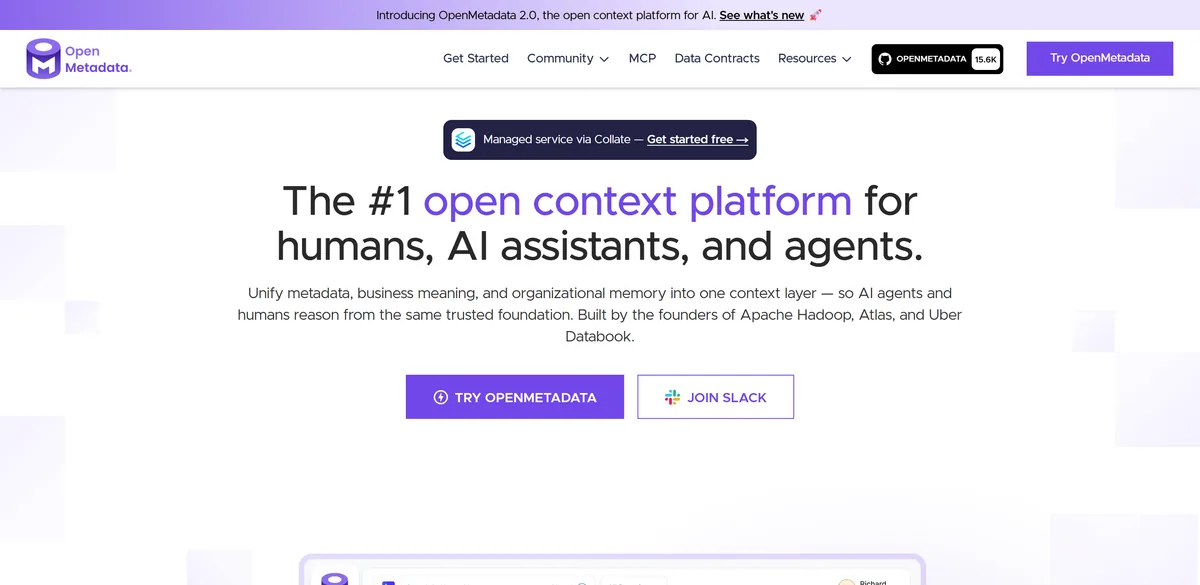
What it does: An open-source metadata platform that computes lineage by parsing SQL, stored procedures, dbt models and pipeline metadata, with Collate as the hosted version.
Who this is for: Teams who want lineage across a mixed stack without a procurement cycle, and who can run a service.
The engineer who started the benchmark thread on r/dataengineering was weighing twelve options, Collibra and Unity Catalog among them. The answer with the most detail behind it was this one, from a commenter who opens by saying they have been a long-term OpenMetadata user and then describes lineage at table, column, service and data product level.
That works because of the parsing. Lineage is computed from SQL, stored procedures, dbt models and pipeline metadata rather than from pipeline definitions alone, so it reaches queries nobody wrote down. Running it is the cost of entry; Collate exists for teams who would rather not.


Key Features
- Table, column, service and data product level lineage
- Edges parsed from SQL, stored procedures and dbt models
- Collate lists unlimited data source connectors on every tier, including the free one
- Apache-2.0, 15,604 GitHub stars, pushed 28 October 2026
Pros and Cons
Pros
- Runs on your own hardware for the price of the hardware
- Parsed lineage reaches work nobody declared
- The only detailed recommendation in the benchmark thread on page one
Cons
- Collate publishes tiers and limits but no price
- Reviewers describe a learning curve in the UI
- Its behaviour at very high volumes is asserted by the vendor, not demonstrated
What Users Say
OpenMetadata has very comprehensive table level, column level, service level, domain level, and data product level lineage
Data_Geek_9702 on RedditThe commenter opens by disclosing they are a long-term OpenMetadata user.
i haven’t found enough information about how it performs in environments with very high data volumes, lots of pipelines and multiple data platforms
Perfect_Put_9220 on RedditThe engineer running the benchmark, asking the question the vendor answers with a blog post.
Pricing
$0 under Apache-2.0 if you host it. Collate’s Free tier covers 5 users and 500 data assets on multi-tenant SaaS; Premium raises that to 25 users and 5,000 assets and adds SSO, PII classification and single-tenant deployment. No tier on the page carries a dollar figure.
Bottom Line
Stand it up on a test estate before you book a single demo. It costs nothing to find out whether the parsing reaches your SQL.
The most complete open-source lineage here, and the only one a page-one thread recommends in detail.
2. DataHub: Best for Wide Estates With a Platform Team
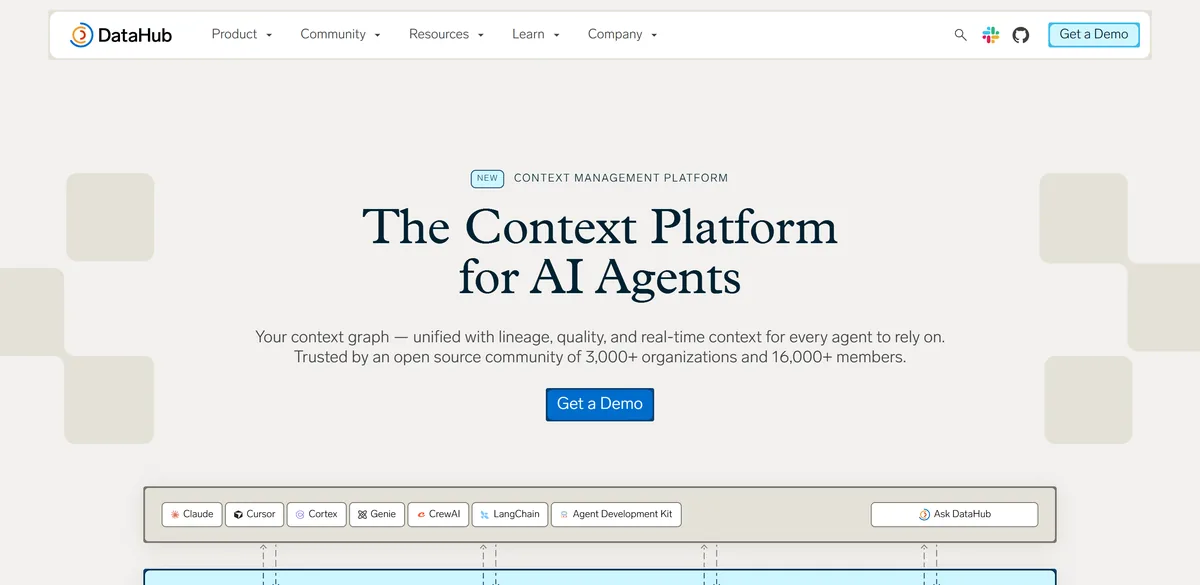
What it does: A metadata platform out of LinkedIn, now sold as DataHub Cloud, with lineage across warehouses, pipelines and BI tools.
Who this is for: Platform teams with a wide estate who want one metadata layer and can staff it.
DataHub came out of LinkedIn and still gets pushed every day, which for a metadata platform is the number that matters most. It also has the strangest presence in that benchmark thread: the most confident answer about DataHub came from DataHub’s own founding product manager, who said so in her first line.
Treated as a project rather than a pitch it is solid: Apache-2.0, 12,906 stars, 1,400 open issues. The cloud product has no price and no pricing page, and the site navigation has no pricing link to click.


Key Features
- Lineage across warehouses, orchestrators and BI tools
- Apache-2.0, 12,906 GitHub stars, pushed 28 October 2026
- DataHub Cloud for teams who would rather not run it
- A metadata model other tools emit into
Pros and Cons
Pros
- Open source, so the floor stays yours whatever the vendor does
- Ran at LinkedIn scale before it was a product
- Still committed to daily, four years after the first release
Cons
- The cloud product has no published price and no pricing page at all
- 1,400 open issues against 12.9k stars
- Running it yourself is a platform project, not an install
What Users Say
I have no doubt that DataHub would be a strong contender (if not leader) in each of the items
Brief_Actuator_8731 on RedditThe commenter introduces herself as DataHub’s founding product manager, so this is the vendor’s claim rather than a user’s.
did you also check out Datahub? I know they also have column level lineage.
Hot_Map_7868 on RedditA passing suggestion in the benchmark thread, not an endorsement from use.
Pricing
$0 under Apache-2.0 if you run it. DataHub Cloud is sold by demo request: datahub.com/pricing returned a 404 on 28 October 2026 and the site navigation carries no pricing link.
Bottom Line
Worth the look if you already have a platform team. Budget for the cloud conversation, because there is no page to read first.
A serious open-source metadata layer, sold on top by a company that will not show you a price.
Algoscale: Best for Making the Graph Cover the Whole Estate
What it does: The data engineering team that builds the pipelines and the governance underneath them, with lineage tracking as part of the build rather than a later project.
Who this is for: Teams whose estate grew faster than anyone’s record of it, usually after acquisitions or a decade of separate systems.
Every tool above is only as good as the systems it has been pointed at. The pattern we see is an estate that grew faster than anyone’s record of it: separate ERPs from separate acquisitions, a CRM nobody connected, and a graph that looked complete on the day it went in.
On an AWS warehouse modernisation for a security systems integrator, fourteen subsidiary ERPs plus a CRM, an HRMS and a planning tool went into one governed lake with twice-daily refreshes feeding more than twenty live Power BI dashboards. The lineage tracking was part of the build.

Key Features
- Embedded data governance: automated quality checks and complete lineage tracking
- Metadata-driven ETL on AWS Glue and Step Functions
- Warehouse and lakehouse builds on Azure, AWS, Databricks and Snowflake
- Continuous data observability and cloud FinOps after go-live
Pros and Cons
Pros
- Lineage is built into the pipeline rather than added to it afterwards
- Published case studies with figures and a named client role
- Covers the half of the problem a tool cannot: connecting what exists
Cons
- Not a product: no download and no free tier
- Scoped work costs more than a licence
- Unnecessary if your estate fits in one person’s head
What Users Say
We had grown to 14 companies and still couldn’t answer a simple question, what did we bill last month across the whole business? Algoscale gave us that answer, plus 20 dashboards we didn’t even know we needed.
VP of Finance & Business Intelligence on Case studyA named role rather than a named person, quoted from the published case study.
Pricing
Not public. Scoped per engagement.
Bottom Line
Worth a call if the estate is wider than the graph and nobody owns the gap.
For teams whose estate outgrew anyone’s record of it, where the lineage problem starts with the pipelines.
3. Collibra: Best for Audit Evidence in a Regulated Shop
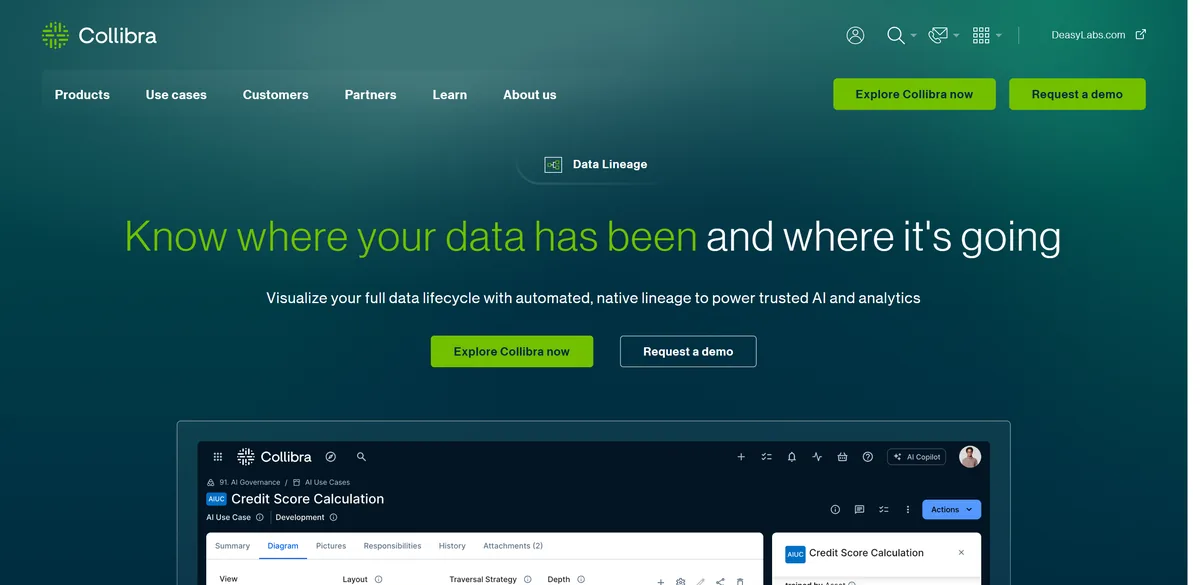
What it does: An enterprise governance platform where lineage sits alongside a catalog, a glossary, policies and workflow.
Who this is for: Regulated enterprises buying governance as a programme, where lineage is evidence for an auditor rather than a debugging aid.
Google’s AI Overview names Collibra first for this keyword, and on Hacker News it gets grouped with Purview and Informatica as the enterprise-level answer. The homepage calls the product an enterprise AI control plane, which tells you how large the thing you are buying is.
You cannot evaluate it alone. The pricing URL returns a page that was not found, the word pricing appears nowhere in the navigation, and the only commercial path is Talk to sales. If an auditor is asking where a number came from, it is built for that question. If lineage is the whole requirement, this is heavy.

Key Features
- Lineage inside a full governance suite: catalog, glossary, policy, workflow
- Automated, native lineage across the data lifecycle, per the product page
- Sold as an enterprise control plane rather than a lineage tool
- Talk to sales is the only commercial path on the site
Pros and Cons
Pros
- The governance story is complete in a way the open-source options are not
- Recognised by auditors and procurement, which shortens a different argument
- Lineage is maintained as part of a programme, not as somebody’s side task
Cons
- No published price, and no pricing page at all
- Bought as a programme: the lineage arrives with everything else
- Overkill if what you want is to know which dashboard breaks
What Users Say
make sure your data governance is on point. It should almost live outside of your software stack. Tools like collibra, purview, informatica, … that know you database, are your best tools at enterprise level.
dacryn on Hacker NewsFrom 2024, and about the category as much as the product.
Working on an AI/Governance and compliance system that also integrates with the cli for teams developing the actual code and the systems that are commonly used, GitHub, bitbucket, open policy agent, collibra etc..
dav43 on Hacker NewsQuoted as evidence that Collibra is a system other enterprise tools expect to integrate with, not as a verdict on it.
Pricing
Not public. collibra.com/pricing returned a page that was not found on 28 October 2026, and the site has no pricing link in its navigation.
Bottom Line
If the driver is an audit, start here. If it is a broken dashboard, start anywhere else on this list.
The enterprise governance answer, priced by conversation and bought as a programme.
4. Atlan: Best for Catalogs That Have to Feed AI Tools
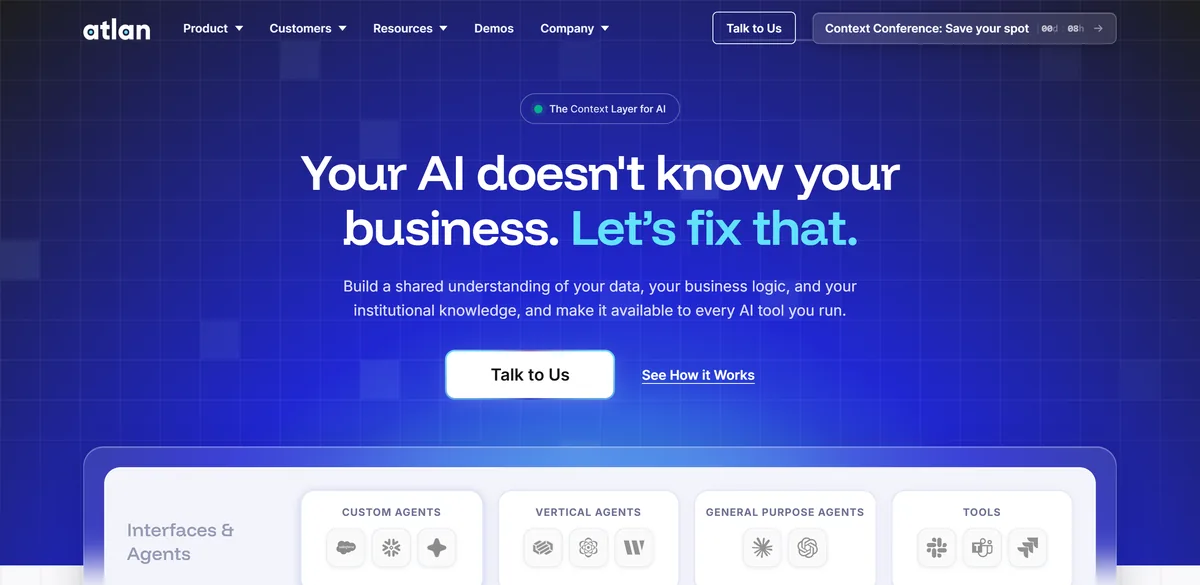
What it does: A metadata platform that Atlan now sells as a context layer for AI, with a catalog, an enterprise data graph and data lineage inside it.
Who this is for: Teams whose catalog has to serve AI tools and business users as well as the platform team.
Atlan has rebuilt its pitch around AI. The homepage now reads The Context Layer for AI, under a headline saying your AI does not know your business, and the navigation runs through an enterprise data graph, context agents and a context lakehouse. Data lineage is one capability inside that.
It still turns up on practitioner shortlists next to names twenty years older, which for a company this young is the argument. The pricing page redirects to a form asking for first name, last name, email, phone and company, so evaluation starts with a call.

Key Features
- Data lineage inside a catalog and enterprise data graph
- Positioned as the context layer other AI tools read from
- Layers over platforms such as Purview and Snowflake Horizon
- Sold as a managed platform through sales
Pros and Cons
Pros
- The clearest answer here if the catalog has to serve AI tools too
- Appears on practitioner shortlists beside much older names
- Nothing to deploy before you can see it working
Cons
- The pricing page is a sales form, so evaluation starts with a call
- You are buying a context platform that does lineage, not a lineage tool
- The AI framing makes it harder to tell what the lineage itself does
What Users Say
I wonder who’s next to really consolidate their platform play and compete with the old legacy MDM provider like Informatica. Data Observability or Catalog like Monte Carlo and Atlan.
knes on Hacker News
So far, I’m looking at: Alation, Atlan, Collibra, Informatica, Apache Atlas, OpenLineage, OpenMetadata, Databricks unity catalog, Coalesce Catalog, Manta, Snowflake lineage, Microsoft Purview.
Perfect_Put_9220 on RedditThe shortlist an engineer drew up for a benchmark, quoted as evidence of what gets considered rather than as praise.
Pricing
Not public. atlan.com/pricing redirected to a Talk To Our Sales Team contact form on 28 October 2026.
Bottom Line
Ask for the figure on the first call rather than the third, and ask what the lineage does when you take the AI framing off.
A catalog that does lineage, now sold as AI context, and priced by sales call.
5. Apache Atlas: Best for Hadoop, Hive and Cloudera Estates
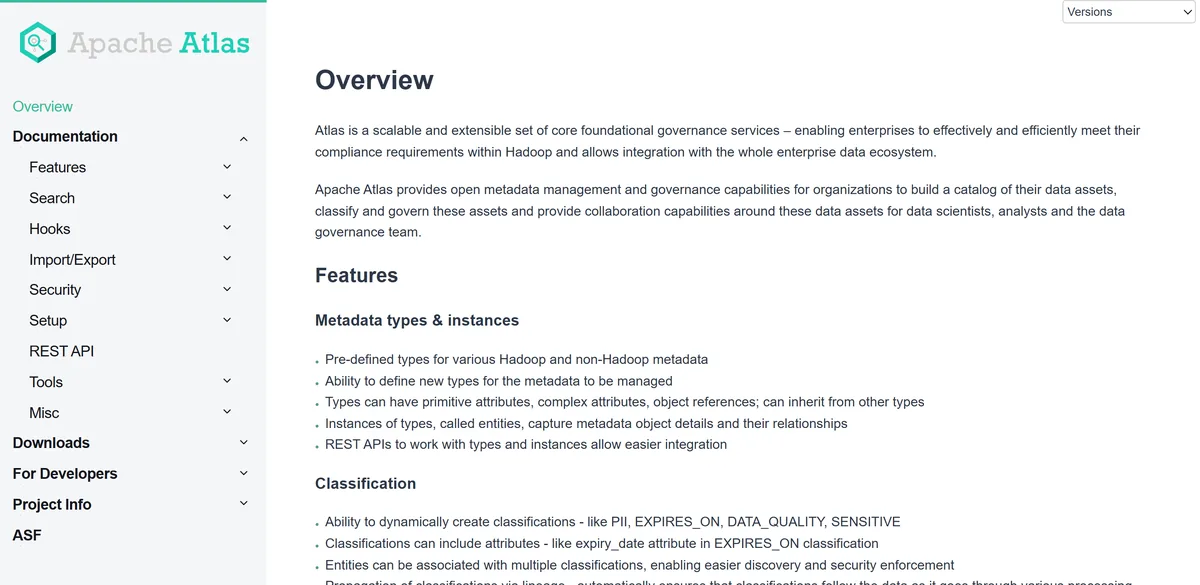
What it does: The Hadoop-era metadata and governance project from the Apache Software Foundation, which practitioners name as the lineage layer that arrives with Cloudera.
Who this is for: Teams on Hadoop, Hive or Cloudera whose lineage question is about an estate that already exists.
Most teams do not choose Atlas. They find it already installed, because it came with Cloudera. The same goes for Purview on Azure, Glue on AWS and Unity Catalog on Databricks. Before buying anything here, check what your platform already gives you. The cheapest lineage is the one you have.
As a project it is alive and small: Apache-2.0, 2,160 stars, last push the day before we checked. It is also owned by the Apache Software Foundation rather than licensed by a company, so nobody can relicense it out from under you. The design belongs to the Hadoop era.

Key Features
- Metadata types, classification, search and hooks for the Hadoop ecosystem
- Lineage captured as data moves through the platform
- Apache-2.0 under Apache Software Foundation ownership
- Extensible type system for custom metadata
Pros and Cons
Pros
- Free, and owned by a foundation rather than a company
- Often already present, which makes it the cheapest thing to try
- Still actively committed to: last push 27 October 2026
Cons
- 2,160 stars against 15.6k for OpenMetadata
- Built for the Hadoop stack rather than a warehouse one
- Teams arrive at it more often than they choose it
What Users Say
Honestly, most of the companies don’t really use data lineage tools, even though they can be super helpful at times..but some of them I know are: Cloudera data platform – Apache atlas, AZURE/FABRIC – Purview, AWS – Glue data catalog, SageMaker Lineage, Databricks – Unity Catalog
Harshadeep21 on RedditFrom January 2025, and the only reply that thread received.
Apache Atlas is owned by the Apache Software Foundation AND licensed under Apache 2.0.
einrealist on Hacker NewsMade in an argument about licence versus ownership, which is the distinction that matters here.
Pricing
$0. Apache-2.0, self-hosted, with no commercial edition to buy.
Bottom Line
Check whether it is already running in your cluster before you evaluate anything else here.
The free option that is probably already installed, built for a stack many teams have left.
Which Data Lineage Tool Should You Choose?
Choose OpenMetadata if:
- Your stack is mixed and the graph has to span all of it
- You would rather parse lineage out of SQL than ask people to declare it
- Somebody can run a service
Choose DataHub if:
- The estate is wide and a platform team owns metadata
- You want the largest community in open-source metadata behind you
Choose Collibra if:
- Lineage is evidence for an auditor
- Governance is already a funded programme, not a side project
Choose Atlan if:
- Analysts and business owners have to use it too
- You want a managed service and are fine starting with a sales call
Choose Apache Atlas if:
- You are on Cloudera, Hive or Hadoop
- It is already installed and the question is whether to replace it
Skip this category entirely if:
- Your platform already ships lineage you have not switched on. Unity Catalog, Purview and Glue all do some of this.
- The estate is small enough that one person can draw the diagram correctly from memory.
- The real complaint is that the data is wrong rather than that nobody knows where it came from.
What’s the Best Data Lineage Tool in 2026?
Start with OpenMetadata. It is free to try properly, the lineage is parsed rather than declared, and it is the only tool a page-one thread recommends in any detail. DataHub is the alternative if your estate is wider than your warehouse and you have a platform team to keep it fed.
Collibra and Atlan are both real products that cannot be evaluated without a sales call, which rules them out for a lot of teams and is exactly right for a few. Atlas is already in your cluster if you are on Cloudera.
Whichever you pick, the graph decays from the day it is installed. The tool cannot connect a pipeline nobody told it about, and a half-true lineage graph is more dangerous than none, because people believe it.
After You Choose: Keeping the Graph True
A lineage tool reports what it can see. Everything it cannot see looks, on the screen, exactly like something that does not exist. That is the failure mode: nobody notices for months, and then an impact analysis misses the one job that mattered.
Algoscale’s data engineering team builds the pipelines and the governance underneath them, with automated quality checks and lineage tracking embedded in the build. On a recent AWS warehouse modernisation, fourteen subsidiary ERPs plus a CRM, an HRMS and a planning tool went into one governed lake with twice-daily refreshes.
The client’s VP of Finance described the problem in the case study as not being able to answer what the group billed last month across fourteen companies. That is what a half-mapped estate costs, and it is the gap we are usually called in to close.
- Metadata-driven ETL on AWS Glue and Step Functions
- Embedded governance: automated quality checks and lineage tracking
- Warehouse and lakehouse builds on Azure, AWS, Databricks and Snowflake
- Continuous observability and cloud FinOps after go-live
Ready to put this into production?
Algoscale’s data engineers have built and migrated data platforms for retail, fintech and manufacturing teams. Book a free consultation and we will scope yours with you.
Frequently Asked Questions
Which tool is used for data lineage?
It depends on who is asking for it. Engineering teams mostly use OpenMetadata or DataHub, both Apache-2.0 and both able to parse lineage out of SQL. Regulated enterprises use Collibra, where lineage is part of a governance record. Teams on Cloudera already have Apache Atlas, and teams on Databricks, Azure or AWS have some lineage in Unity Catalog, Purview or Glue without buying anything. A catalog inventories what exists; lineage records what feeds it.
Which data lineage tools are open source?
Three of the five here. OpenMetadata (15,604 GitHub stars), DataHub (12,906) and Apache Atlas (2,160) are all Apache-2.0 and all pushed within the last two days as of 28 October 2026. Marquez and Egeria are smaller open-source options. OpenLineage is often listed alongside them but is a specification that tools emit into, not something you install and look at.
Does column-level lineage work automatically?
It depends on how the tool gets its edges. Automated data lineage, the kind parsed from your SQL, stored procedures and dbt models, derives column-level links without anyone declaring them, which is how OpenMetadata and DataHub build most of their graphs. Anything arriving through a connector that does not expose query history usually stops at table level, and the gap is rarely signposted in the UI.
Why does lineage documentation go stale?
Because the estate changes and the connections do not. A tool maps what it has been pointed at, so every new pipeline, script or BI dataset is invisible until somebody connects it. One r/dataengineering commenter put it bluntly: most companies do not really use lineage tools, even though they can be very helpful. The ones that succeed give the graph an owner.
Do data lineage tools publish their prices?
Mostly not. On 28 October 2026, datahub.com/pricing and collibra.com/pricing both returned 404s, atlan.com/pricing redirected to a sales contact form, and Collate’s pricing page listed user and asset limits with no dollar figure. The self-hosted editions of OpenMetadata, DataHub and Apache Atlas cost nothing to licence; you pay in infrastructure and in somebody’s time.