



Start with the thing none of the ranking pages mention. Over the last eighteen months Fivetran has been buying the alternatives. It signed to acquire Census on 1 May 2025, announced the acquisition of Tobiko Data, the company behind SQLMesh, on 3 September 2025, and completed its merger with dbt Labs on 1 June 2026.
So the shortlist of Fivetran alternatives is shorter than it looks, and shrinking. What follows is the part that is left, with every price read off the vendor’s own page this week and the unit stated each time, because rows, events, gigabytes and credits do not convert into each other without measuring.
Five tools, two r/dataengineering threads read end to end, and the migration accounts from people who actually did it.
5 Best Fivetran Alternatives: Quick Comparison
| Tool | Best For | Public Reviews | The Catch | Starting Price | Access |
|---|---|---|---|---|---|
| 1Airbyte | Teams who will run it themselves | Reddit: one team cut MAR 95%, another hit Oracle timeouts | Self-hosting is a real project | $20/mo cloud, free self-hosted | 14-day trial, no card |
| 2Estuary Flow | CDC priced in gigabytes | Reddit: low CDC pricing and a good reputation, in evaluation | Per-connector fees add up across many sources | $0.50/GB + $100/mo per connector | Free to 10 GB |
| Algoscale | Cutting the volume behind the bill | Case study: a VP of Finance on answering what the group billed | Not a product, a scoped engagement | Not public | Consulting |
| 3dlt | Python teams who own the code | Reddit: recommended unprompted, with prebuilt sources | Managed runtime starts at $12,000/mo | Free, Apache-2.0 | Open source |
| 4Hevo Data | A managed swap with a clear ladder | Reddit: second-hand only, with the detail from Hevo’s own page | Events are one more unit to convert | Free to 1M events, then $299/mo | 14-day trial |
| 5Stitch | Small, predictable replication | Reddit: slightly less expensive, and it depends on the use case | Priced in rows, the unit that hurt in the first place | $100/mo Standard | Free trial |
Scroll the table sideways for public reviews, price and access.
Not sure which of these fits your stack?
Tell us what you are running today and what you need it to do. We will tell you which of these we would pick, and why. We are not going to pitch you.
How We Compared These Fivetran Alternatives
We did not migrate anything for this post. Airbyte and dlt can both be run locally, and a real migration write-up would be more useful than this. It is not what we did, and we are not going to imply otherwise.
What we did was open every pricing page on 28 October 2026, screenshot it and write down the unit as well as the number; pull GitHub stars, open issues and last-push dates from the API; read two r/dataengineering threads end to end, one from September 2024 and one from January 2025, and link each quote to its thread; and take the acquisition dates from Fivetran’s own press releases. One commenter in the 2024 thread works at Estuary and is not quoted. Where a quote comes from a vendor, the post says so underneath it.
What we weighed, heaviest first
- Which unit the meter counts – rows, events, gigabytes and credits are not interchangeable
- Whether a real team has moved – a published price proves nothing about a migration
- What the free tier actually allows – you cannot test properly on a fourteen-day clock
- Who owns it now – Fivetran has bought three of this category’s names since May 2025
How Fivetran’s MAR Pricing Works, and Why a Cheaper Tool Can Cost More
Fivetran bills monthly active rows: a row counts once in a month no matter how many times it changes. That is generous for chatty tables and brutal for wide ones you resync. Its pricing page gives worked examples per connector, and its own examples range from $15.88 for Google Analytics 4 at 21,993 active rows to $424.54 for Marketo at 847,574. The free plan covers 500,000 monthly active rows.
The reason people get surprised is backfills. One practitioner in the thread put it exactly: the pricing model stings when you run full backfills on production tables with new columns. Add a column, resync the table, and a year of rows becomes active again.
Every alternative here prices in a different unit, so a like-for-like comparison means measuring your own volume first. A tool that is cheaper per unit can still produce a bigger invoice if the pipeline keeps moving everything. If the real problem is which pipelines run and when, that is an orchestration question.
| Tool | The unit | What that means for you |
|---|---|---|
| Fivetran | Monthly active rows | Backfills and new columns reactivate rows you already paid for |
| Airbyte Cloud | Credits, about 1 GB per 5 | Closer to volume than to rows, and self-hosting removes the meter |
| Estuary | GB plus connector instances | Cheap for big tables under CDC, expensive across many small sources |
| Hevo | Events a month | Predictable if your event count is stable; another conversion otherwise |
| Stitch | Rows a month | Directly comparable to Fivetran, and subject to the same backfill problem |

1. Airbyte: Best for Teams Who Will Run It Themselves
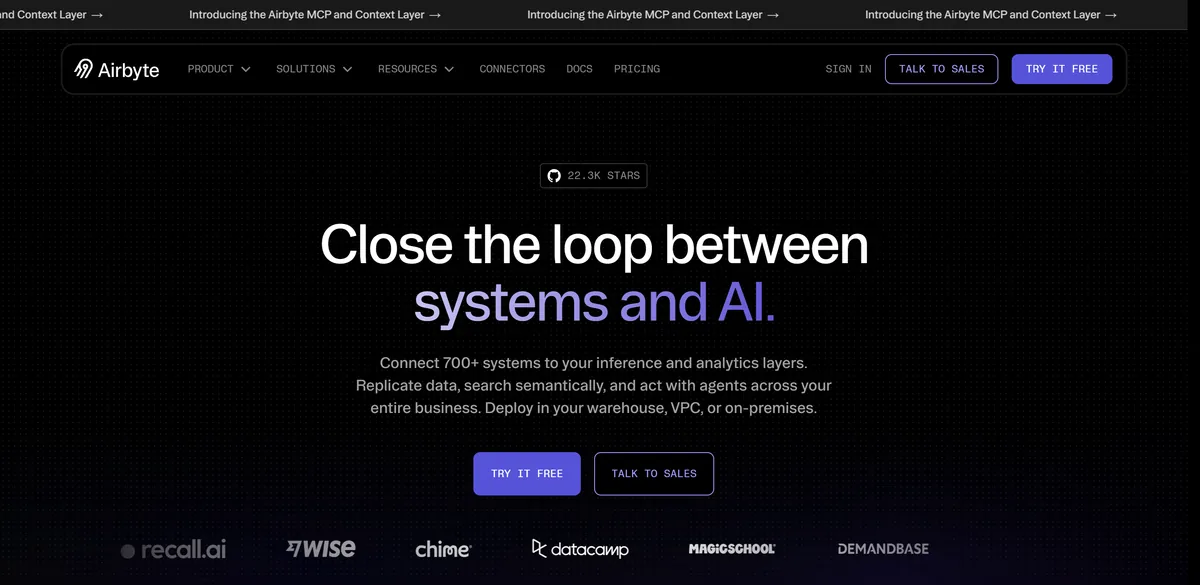
What it does: An ELT platform with a large connector catalogue, runnable on your own infrastructure or bought as a managed cloud priced in credits.
Who this is for: Teams with enough platform capacity to run it, whose Fivetran bill is driven by row counts they cannot control.
The thread ranking for this search has the account everyone wants: a sole data engineer who cut their Fivetran monthly active rows by 95% by moving to Airbyte OSS, keeping one connector behind. The same comment is honest about the cost: the Helm chart was not intuitive for their DevOps team, and data types changed between tools.
A different commenter in the same thread had the opposite experience on large tables, with an Oracle connector that timed out constantly. Both are true. Self-hosting moves the cost from an invoice to your own time, and how that trade lands depends on who you have.


Key Features
- Self-hosted or managed, with the same connector catalogue
- Cloud priced in credits, from $20 a month
- Change data capture on every Cloud tier
- 22,279 GitHub stars, pushed 28 October 2026
Pros and Cons
Pros
- The only option here with first-hand accounts of a Fivetran migration that worked
- Self-hosting puts the cost under your control
- Published credit prices all the way up the ladder
Cons
- Self-hosting is a real project: one team found the Helm chart unintuitive
- Another team found the Oracle connector unstable on large tables
- 2,688 open issues, the highest count in this comparison
What Users Say
We’ve recently been able to cut our Fivetran MAR by 95% (one connector we just haven’t found a good replacement for). We ended up going with Airbyte OSS… It wasn’t intuitive to our Dev Ops folks to get the helm chart running, but it’s been up and solid for us once working
noitcerid on RedditFrom the September 2024 thread; the same comment warns about data types changing between ingestion tools.
It would probably work well for tables that are not larger than 1GB – but in our cases we had huge tables and their Oracle connector was horribly unstable. It would timeout constantly due to data size.
pizzanub on RedditFrom the September 2024 thread. The same commenter does not recommend Airbyte OSS at all.
Switch to using Airbyte, host on AWS (put off by kubernetes requirements)
doomanddelight on RedditFrom a January 2025 thread, listing the options this team weighed.
Pricing
Cloud starts at $20 a month for 5 credits, about 1 GB of syncs. Credit packages run $189 a month for 40 credits, $449 for 100, $999 for 250, $1,799 for 500, $3,199 for 1,000 and $4,999 for 2,000. The trial is 14 days and 400 credits, about 100 GB, with no card.
Bottom Line
Run the connectors you actually depend on against it for a fortnight before you commit, especially the largest table you have.
The default move off Fivetran, with the caveat that you are taking on the operations yourself.
2. Estuary Flow: Best for Change Data Capture Priced in Gigabytes
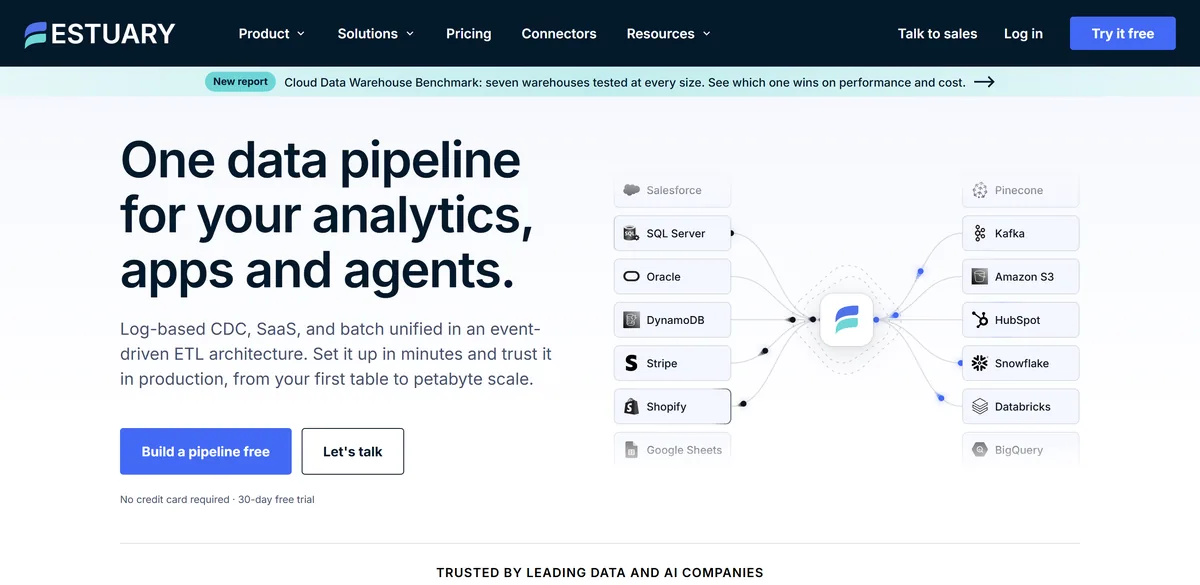
What it does: A streaming CDC and ELT platform priced by data volume and connector instance instead of by rows.
Who this is for: Teams whose Fivetran bill is driven by high-frequency change capture on a few large tables.
Estuary prices by data volume and connector instance, which matters because Fivetran prices by rows that changed. If your bill is driven by a few large tables under constant change capture, that is the single biggest lever available to you.
The free tier is real: 10 GB a month and two connectors, with the full platform. After that it is $0.50 a GB plus $100 a month per connector instance, falling to $50 after the sixth. The catch is arithmetic, as one commenter in the thread pointed out: you cannot map rows to gigabytes without measuring first.

Key Features
- Streaming CDC as the main event, not an add-on
- Priced per GB and per connector instance
- Free for 10 GB a month and two connectors
- Exactly-once delivery and automatic schema evolution
Pros and Cons
Pros
- The pricing unit matches what a CDC pipeline actually moves
- A free tier generous enough to test a real pipeline
- 30-day trial once you pass the Developer limits
Cons
- Per-connector pricing adds up if you have many small sources
- 985 GitHub stars: a much smaller community than Airbyte’s
- Comparing it to a Fivetran bill means converting rows into gigabytes
What Users Say
Estuary seems to have very low pricing for streaming CDC and a good reputation, I’d be happy to hear if anybody has experience with them
InfinityCoffee on RedditFrom the September 2024 thread: an evaluation in progress, not a report from production.
Fivetran is based off rows…whereas Estuary is based off data volume (mostly)… so i wouldn’t be able to just look at volume in GB loaded into our Snowflake warehouse and do a 1:1 comparison
Nervous-Chain-5301 on RedditFrom the September 2024 thread, and the practical problem with every comparison in this category.
Pricing
Developer is free for up to 10 GB a month and two connectors. Cloud is pay-as-you-go at $0.50 a GB plus $100 a month per connector instance, dropping to $50 for each instance after the sixth. Enterprise is custom.
Bottom Line
Measure a week of your real change volume in gigabytes first. The free tier is enough to do it.
If change data capture is what you are paying for, this is where to look first.
Algoscale: Best for Cutting the Volume Behind the Bill
What it does: The data engineering team that redesigns what the pipelines move, which is what the bill is actually made of.
Who this is for: Teams whose ingestion bill grew with the number of sources rather than with anything the business asked for.
Every tool here moves whatever you tell it to move. That is why migrations so often produce a smaller invoice for a year and then the same invoice again: the source count kept growing, the full-table syncs kept running, and nobody asked which connectors anybody reads.
We redesign what gets ingested and how often, then build it. On an AWS warehouse modernisation, fourteen subsidiary ERPs plus a CRM, an HRMS and a planning tool went into one governed lake with twice-daily refreshes feeding more than twenty live Power BI dashboards.

Key Features
- Ingestion redesigned around what the data is for
- Metadata-driven ETL on AWS Glue and Step Functions
- Embedded governance: automated quality checks and lineage tracking
- Continuous observability and cloud FinOps after go-live
Pros and Cons
Pros
- We sell none of the five tools here
- Published case studies with figures and a named client role
- Attacks the volume, which is the part a tool switch does not change
Cons
- Not a product: no free tier and no trial
- Scoped work costs more than a licence
- Unnecessary if you only have four connectors
What Users Say
We had grown to 14 companies and still couldn’t answer a simple question, what did we bill last month across the whole business? Algoscale gave us that answer, plus 20 dashboards we didn’t even know we needed.
VP of Finance & Business Intelligence on Case studyA named role rather than a named person, quoted from the published case study.
Pricing
Not public – scoped per engagement.
Bottom Line
Worth a call if your connector count has only ever gone up.
For teams whose ingestion bill is a design problem wearing a vendor’s name.
3. dlt: Best for Python Teams Who Want to Own the Pipeline
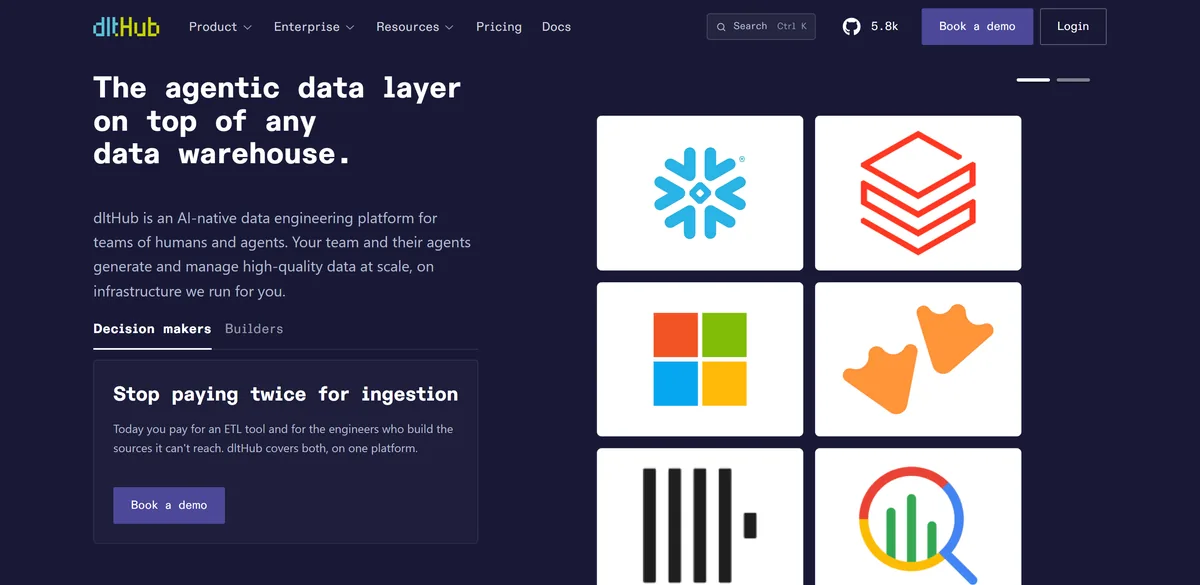
What it does: An open-source Python library for writing ingestion pipelines in code, with dltHub selling a managed runtime on top.
Who this is for: Python teams who would rather own the pipeline code than configure somebody’s connector.
dlt is a Python library, so a pipeline is code your team owns and reviews like any other code. When a source you need has no connector, you write one in an afternoon instead of filing a roadmap request. The library is Apache-2.0, and the pricing page commits to that in writing.
The managed side is where the surprise lives. dltHub, the hosted runtime, is $12,000 a month with 5,000 credits on a 12-month minimum. The free library and the managed product are priced for completely different companies.


Key Features
- Pipelines written as Python, versioned with your other code
- Schema inference and evolution handled by the library
- Apache-2.0 with 6,020 GitHub stars
- dltHub managed runtime for teams who want it operated
Pros and Cons
Pros
- Free, and the licence commitment is stated on the pricing page
- A connector you need and nobody has written is an afternoon, not a roadmap request
- Recommended unprompted by practitioners in the Fivetran thread
Cons
- You are writing and maintaining pipeline code
- The verified open-source connector list is limited
- The managed option starts at $12,000 a month on a 12-month minimum
What Users Say
dlt is awesome. They’ve got a lot of prebuilt things. StreamKap is great for CDC.
molodyets on RedditFrom the September 2024 thread.
Use dlt – (seems nice, but no DynamoDB source I can see)
doomanddelight on RedditFrom a January 2025 thread. The connector gap is the usual catch with a library rather than a catalogue.
Pricing
The dlt library is free under Apache-2.0. dltHub, the managed runtime, is $12,000 a month with 5,000 credits included on a 12-month minimum billed monthly, after a 14-day trial with $30 in credits.
Bottom Line
Try the library against one source this week. Ignore the managed tier unless you are an enterprise.
Python teams get this for nothing. Everyone else should read the managed price twice.
4. Hevo Data: Best for a Managed Swap With a Published Ladder
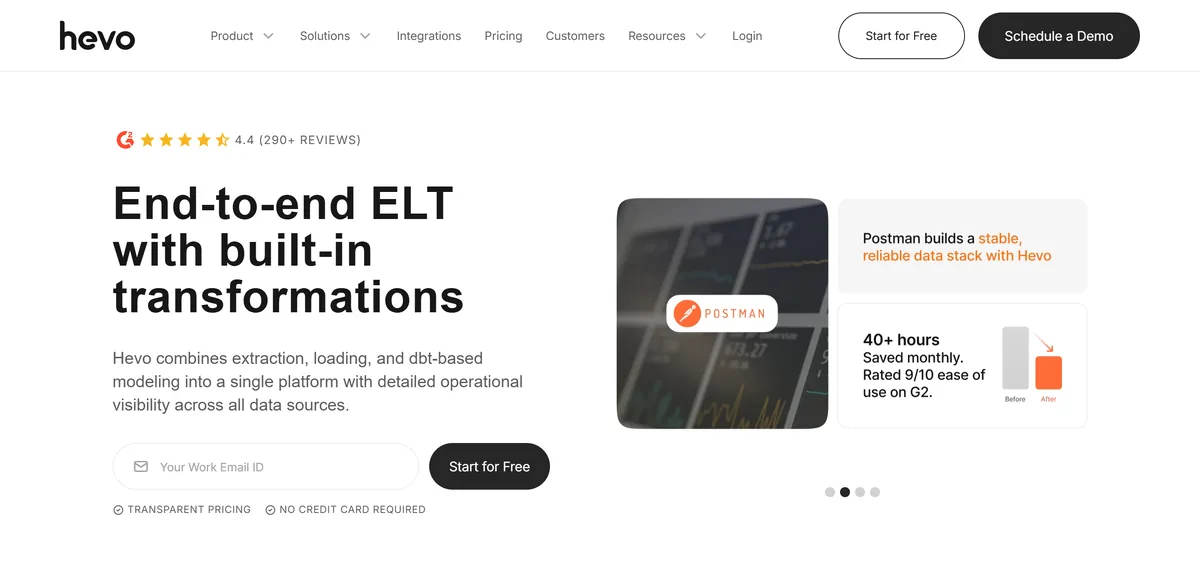
What it does: A managed no-code ELT platform priced by events a month, positioned as the straight swap for Fivetran.
Who this is for: Small data teams who want somebody else to run it and a number they can forecast.
Hevo is the closest thing here to a drop-in managed swap, and the pricing ladder is the clearest of any managed option: free forever to 1M events a month, $299 a month for Starter, $849 for Professional, less if you pay annually. Non-engineers can set up a source without asking the data team.
The evidence is thinner than the pricing. The Reddit mention is somebody repeating what they heard about another company’s migration, and the detail behind it comes from Hevo’s own case study panel. The 14-day trial will settle it faster than any of that.

Key Features
- No-code pipelines with 170+ connectors from the Starter tier
- Free forever up to 1M events a month
- Starter $299 a month, $265 billed annually
- dbt integration and 24×7 support included from Starter
Pros and Cons
Pros
- The clearest published ladder of any managed option here
- A free tier that is a tier rather than a countdown
- Non-engineers can set up a source without help
Cons
- Events are another unit to convert from your Fivetran rows
- 170+ connectors is a shorter catalogue than Fivetran’s
- The only public accounts are second-hand or the vendor’s own case study panel
What Users Say
I heard Postman switched from Fivetran to Hevo, and it worked out great for them. They saved around 30-40 hours of developer time each month
Far-Muffin-2672 on RedditFrom the September 2024 thread. Second-hand: the commenter says they heard it, and the comment reads like marketing. Treat it as a claim.
Postman builds a stable, reliable data stack with Hevo: 40 hours saved monthly, 40+ sources connected seamlessly
Hevo case study panel on Hevo’s own pricing pageThis is Hevo’s own copy, not a user. It is here because it is the only public detail behind the Reddit hearsay, and because the two numbers do not match each other.
Pricing
Free forever for limited connectors up to 1M events a month. Starter is $299 a month, or $265 billed annually, for 5M to 50M events. Professional is $849 a month, or $750 annually, for 20M to 100M events. Business Critical is a custom quote.
Bottom Line
Use the 14-day trial on your two worst connectors, since the public evidence will not settle it for you.
The managed swap with the most legible price, and the thinnest public evidence.
5. Stitch: Best for Small, Predictable Replication
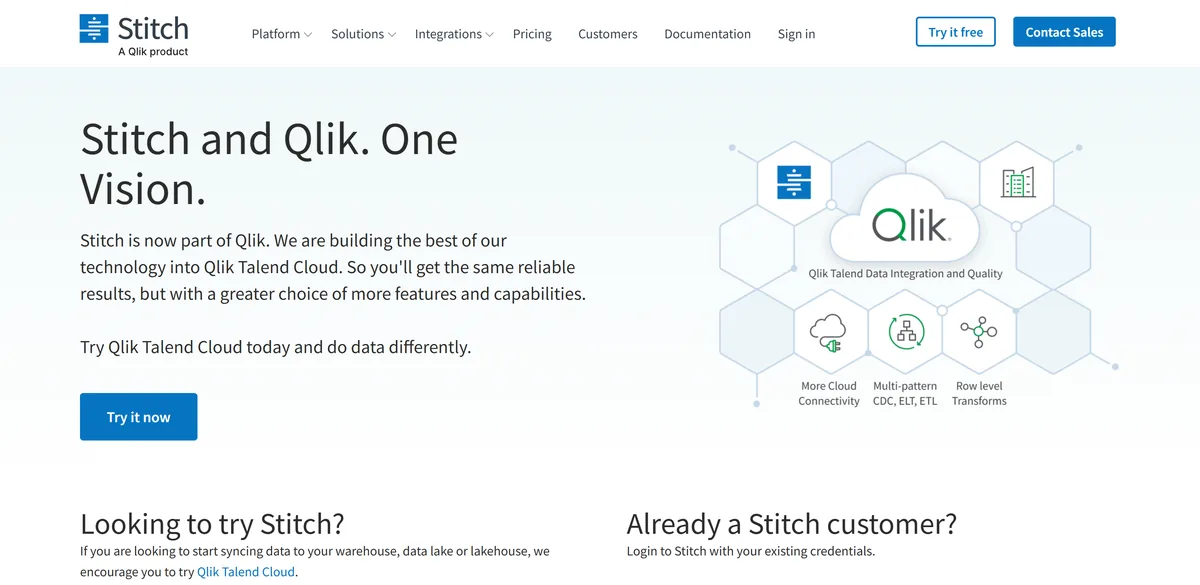
What it does: The original simple replication service, built on Singer connectors and now sold under Qlik Talend.
Who this is for: Teams with modest, predictable replication who want the smallest possible product.
Stitch is the oldest answer on this list and still the simplest: pick how many million rows a month you need, pay from $100, replicate to one destination. The Singer connector specification underneath it is open, which is why other tools in this category can read the same taps.
It has also been quiet. Stitch is a Qlik product now, after Talend bought it and Qlik bought Talend, and the feature set has not moved much in that time. What you get is a small, legible tool with compliance certifications on the cheapest tier, which is more than some of its louder competitors manage.

Key Features
- Row-based pricing: $100 Standard, $1,500 Advanced, $3,000 Premium
- Singer connectors, an open specification other tools also use
- SOC 2 Type II and ISO 27001 on the entry tier
- One destination on Standard, with add-on destinations available
Pros and Cons
Pros
- The simplest product here: pick a row count, pick a destination, done
- SOC 2 Type II and ISO 27001 on the entry tier
- Singer connectors are an open specification other tools can read
Cons
- Rows are the unit, so the problem that made Fivetran expensive can follow you
- One destination on Standard
- Owned by Qlik after the Talend acquisition, and the product has changed little since
What Users Say
i would look into stitch i’ve used it before to as an alternative to fivetran.. it’s slightly less expensive, but completely depends on the use case.
-zelco- on RedditFrom the September 2024 thread, and its only mention of Stitch.
Stitch (stitchdata.com) powers ETL for hundreds of customers, and we provide the Singer integrations as part of our product.
jakestein on Hacker NewsThe commenter works at Stitch, and the comment is from 2017. Quoted for the Singer relationship, not as a verdict.
Pricing
Standard starts at $100 a month, with rows selectable from 5 to 300 million, one destination, 10 standard sources and 5 users. Advanced is $1,500 a month and Premium $3,000, both billed annually.
Bottom Line
Count your rows first. If the row count is the problem, this charges you for it too.
Small, legible and certified, as long as rows were never what hurt you.
Which Fivetran Alternative Should You Choose?
Choose Airbyte if:
- Somebody can own the infrastructure
- Your bill is driven by row counts you cannot control
- You want the option to self-host later
Choose Estuary Flow if:
- The bill is change data capture on big tables
- You have few enough sources that per-connector pricing works
Choose dlt if:
- Your team writes Python and reviews each other’s code
- You keep needing sources nobody has a connector for
Choose Hevo Data if:
- You want managed and a number you can forecast
- Non-engineers need to add sources
Choose Stitch if:
- Replication is simple and the volume is modest
- You want the smallest possible product
Skip this category entirely if:
- You are under 500,000 monthly active rows. Fivetran’s own free plan covers that.
- The bill grew because the connector count grew. Switching vendors moves the same rows for a different rate.
- Nobody can say which of your existing syncs anybody reads. Find that out first.
What’s the Best Fivetran Alternative in 2026?
Airbyte, if you have somebody to run it. It is the one option here where a team has written down both what the migration saved and what it cost them, in the same thread, which is about as honest as this category gets.
Estuary if the bill is change data capture, dlt if your team would rather write the pipeline than configure it, Hevo if you want managed and predictable. Stitch remains the right answer for small, boring replication.
And watch who owns what. Fivetran bought Census, bought Tobiko Data and merged with dbt Labs inside eighteen months. The shape of this list will be different next year.
Before You Switch: What Your Ingestion Bill Is Made Of
An ingestion bill is a volume number multiplied by a rate. Vendor comparisons only ever argue about the rate, which is why so many migrations save money for two quarters and then stop saving it.
Algoscale’s data engineering team works on the volume: which sources earn their place, which syncs can be incremental, what can be dropped entirely, and then builds the pipelines with quality checks and lineage tracking in them.
On a recent AWS warehouse modernisation, fourteen subsidiary ERPs plus a CRM, an HRMS and a planning tool went into one governed lake with twice-daily refreshes. The client’s VP of Finance described the problem beforehand as not being able to say what the group billed last month.
- An audit of what each connector costs and who reads it
- Incremental and CDC pipelines in place of full-table syncs
- Metadata-driven ETL on AWS Glue and Step Functions
- Quality checks and lineage tracking built into the build
Ready to put this into production?
Algoscale’s data engineers have built and migrated data platforms for retail, fintech and manufacturing teams. Book a free consultation and we will scope yours with you.
Frequently Asked Questions
What is cheaper than Fivetran?
It depends on what your bill is made of. Self-hosted Airbyte removes the meter entirely and one practitioner reports cutting their Fivetran monthly active rows by 95% that way, at the cost of running it. Estuary is cheaper for change data capture on large tables at $0.50 a GB plus $100 a month per connector. The dlt library is free. Hevo starts free to 1M events a month and Stitch at $100. None of that is a saving if the pipeline keeps moving everything.
What is the open source alternative to Fivetran?
Airbyte and dlt. Airbyte has 22,279 GitHub stars and can be self-hosted with the same connector catalogue as its cloud. dlt is an Apache-2.0 Python library with 6,020 stars, and its pricing page states the library stays Apache 2.0 always. Meltano and the Singer specification underneath Stitch are the older open options.
How is Fivetran pricing calculated?
By monthly active rows. A row that changes in a given month counts once, however many times it changes, and rows are counted per connector. Fivetran’s own worked examples run from $15.88 for Google Analytics 4 at 21,993 active rows to $424.54 for Marketo at 847,574, and its free plan covers 500,000 monthly active rows. Backfills are what catch people out: resyncing a table after adding a column makes a year of rows active again.
Is Airbyte better than Fivetran?
It is cheaper if you run it yourself, and that is the whole trade. The r/dataengineering thread has both sides from people who tried it: one team cut their Fivetran MAR by 95% with Airbyte OSS and found it solid once the Helm chart was working, another found the Oracle connector unstable on large tables. Fivetran’s managed reliability is what you are giving up.