



Two things decide this choice and neither is on the first page of results. The first: Confluent, the company that sells managed Kafka, has owned WarpStream since September 2024, and WarpStream is one of the alternatives everyone recommends. The second: Redpanda’s core is not open source. It is BSL 1.1, and the licence says you may not offer it as a streaming service.
Nine of the ten pages ranking for this term are published by a company selling something in it. The only practitioner sources Google surfaces are a six-year-old r/scala thread and a Facebook group.
Five Kafka alternatives, every price read off the vendor’s page this week, every licence read off the repository, and the ownership written down.
5 Best Kafka Alternatives: Quick Comparison
| Tool | Best For | Public Reviews | The Catch | Starting Price | Access |
|---|---|---|---|---|---|
| 1Redpanda | Keeping your Kafka clients | HN: a Redpanda employee confirms BSL, free and source-available | Not open source; no price published | Free Serverless tier, no figure beyond it | Start free, no card |
| 2Apache Pulsar | A queue and a log in one | HN: queue semantics from one system, but more layers to run | Brokers, BookKeeper and ZooKeeper to operate | $0 self-hosted, $73/mo managed | Open source |
| Algoscale | When the broker is not the problem | Case study: a VP of Finance on answering what the group billed | Not a product, a scoped engagement | Not public | Consulting |
| 3WarpStream | Cutting the Kafka bill | HN: discussed mainly through the Confluent acquisition | Owned by Confluent since September 2024 | $0.01/GiB first 50 TiB, $100/mo Dev | $400 in credits |
| 4RabbitMQ | Work queues and RPC | HN: reliable for years without babysitting, and hard to reason about at depth | No replay, and lower throughput ceilings | $0, MPL 2.0 | Open source |
| 5NATS | The lightest messaging layer | HN: core is loved, JetStream draws real complaints | JetStream guarantees and a 2025 licensing fight | $0, Apache-2.0 | Open source |
Scroll the table sideways for public reviews, price and access.
Not sure which of these fits your stack?
Tell us what you are running today and what you need it to do. We will tell you which of these we would pick, and why. We are not going to pitch you.
How We Compared These Kafka Alternatives
We did not run a benchmark. Four of these five can be installed by anyone and a throughput comparison would be a better post than this one. It is not the post we wrote, and we are not going to imply otherwise.
What we did was read every pricing page on 28 October 2026 and screenshot what it says; read each licence in the repository, not off a marketing page; pull stars, open issues and last-push dates from the GitHub API; and read eleven Hacker News comments, each linked. Two of those commenters work on the product they are describing and the post says so under the quote.
What we weighed, heaviest first
- Who owns the project – one of these is owned by Kafka’s commercial vendor
- The licence, read from the repository – source-available is not open source, whatever the page says
- What it costs, if anyone will say – only one of the five publishes a rate
- What you stop running – the Kafka bill is usually operations, not licences
Kafka Alternatives vs Managed Kafka: What You Are Actually Choosing
There are three different decisions hiding behind a search for apache kafka alternatives. Keeping the Kafka API and changing the engine underneath it is one, and Redpanda and WarpStream are the answers there. Replacing the whole model with something of a different shape is the second, which is Pulsar, RabbitMQ and NATS. Paying somebody to run Kafka itself is the third, and that is Confluent Cloud or Amazon MSK.
The third one is out of scope here, but it is worth naming, because a lot of teams searching for alternatives are really asking how to stop running ZooKeeper at two in the morning. If the cluster is fine and the invoice is the problem, start with what the invoice is made of: inter-zone traffic, retention nobody chose, and partition counts set during a proof of concept in 2021.
If what you actually have is a scheduling problem rather than a streaming one, an orchestrator is the cheaper fix. We compared those in data orchestration tools.
| Your situation | What to reach for | Why |
|---|---|---|
| The bill is mostly inter-zone traffic and disk | WarpStream | Object storage removes both, at the cost of latency |
| You want the Kafka API without the JVM | Redpanda | Clients connect unchanged; check the BSL first |
| You need acks and retries, not a log | RabbitMQ | A queue broker, and much less to operate |
| You need both, from one system | Apache Pulsar | Subscription types cover queue and stream semantics |
| You want the smallest thing that works | NATS | One Go binary, with JetStream only if you need replay |
1. Redpanda: Best for Keeping Your Kafka Clients and Losing the JVM
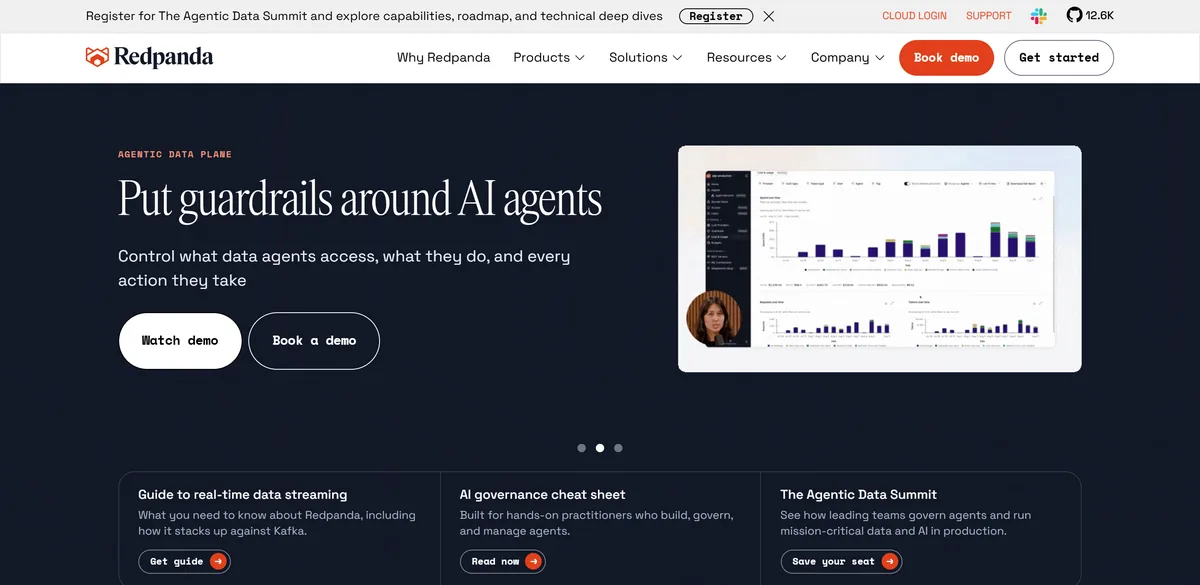
What it does: A Kafka-API broker written in C++ with no JVM and no ZooKeeper, sold as a cloud service and runnable yourself under a source-available licence.
Who this is for: Teams who want the Kafka API without the Kafka operational surface, and who can live with a licence that is not open source.
Redpanda is the shortest path off Kafka because it is not really a different product to your applications. It speaks the Kafka API, so producers and consumers connect unchanged, and the thing you stop running is the JVM and ZooKeeper, not your code.
What page one does not tell you is the licence. The core is under the Redpanda Business Source License 1.1, and the use grant says you may not run it as a streaming or queuing service. A Redpanda employee on Hacker News puts it plainly: free and source-available, which is a different thing from open source.


Key Features
- Kafka API compatibility, so existing producers and consumers keep working
- C++ with no JVM and no ZooKeeper to tune
- A Serverless tier you can start without a credit card
- BSL 1.1, source-available, 12,643 GitHub stars
Pros and Cons
Pros
- The migration story is the easiest here: the clients do not change
- No JVM heap to tune and no ZooKeeper quorum to babysit
- You can read the source and run it yourself
Cons
- The licence is BSL, not open source, and the grant bars reselling it as a service
- No dollar figure anywhere on the pricing page
- Last push 8 October 2026, three weeks quieter than the others here
What Users Say
Redpanda Community Edition is licensed with the Redpanda Business Source License (BSL). The core features are free and source-available.
deniscoady on Hacker NewsThe commenter opens with “Disclaimer, I work at Redpanda.”
an increasing number of open-source (or more accurately, source-available) software projects are either transitioning to the Business Source License (BSL) or adopting BSL from the outset. Examples include: 1. CockroachDB 2. Redpanda 3. MariaDB 4. HashiCorp 5. AutoMQ
chenyang on Hacker NewsQuoted for the licence point, not as a verdict on the product.
Pricing
Not public in dollars. The pricing page lists a Serverless tier you can start free with no credit card, capped at 100 MB/s write and 300 MB/s read throughput and 5,000 partitions with a 99.9% SLA, and quotes nothing beyond it.
Bottom Line
Run your existing consumers against it for a week. The migration question answers itself; the licence question is for whoever signs contracts.
The shortest migration off Kafka, as long as a source-available licence is something you can sign off.
2. Apache Pulsar: Best for Teams Who Need a Queue and a Log
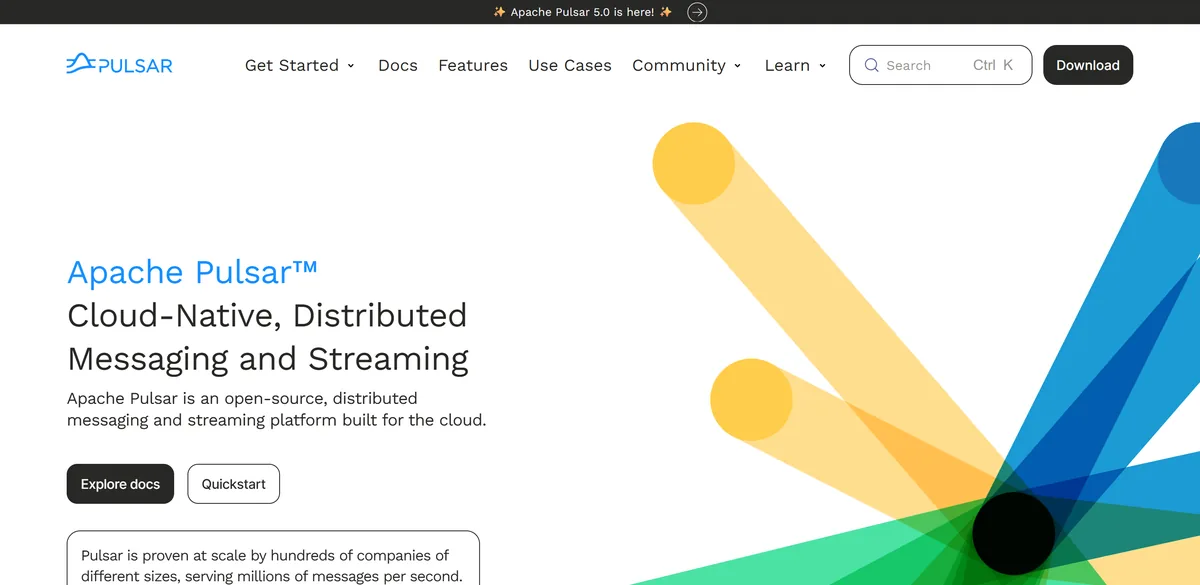
What it does: An Apache Software Foundation streaming platform that separates brokers from storage, with queue semantics and streaming in one system.
Who this is for: Teams who need both a durable log and per-message acknowledgement, and who would rather not run two systems.
Pulsar is the only option here that is a different design, not a cheaper Kafka. Storage and serving are separate, and the subscription model gives you per-message acknowledgement, retries and dead-letter queues alongside a replayable log. Teams running both a queue and a log often find they needed one system.
The cost is layers. Brokers, BookKeeper and ZooKeeper is more to operate than Kafka, and a 2021 commenter argued that Kubernetes is effectively a prerequisite. Standalone mode takes the sting out of the first hour, and StreamNative sells it managed from $73 a month.

Key Features
- Brokers and storage scale separately
- Subscription types that give queue semantics on top of a log
- Apache-2.0 under Apache Software Foundation governance, 15,354 stars
- StreamNative Serverless from $73 a month if you would rather not run it
Pros and Cons
Pros
- Replaces a queue and a log with one system
- Foundation-owned, so no company can relicense it
- Standalone mode makes the first hour easy
Cons
- More moving parts than Kafka: brokers, BookKeeper and ZooKeeper
- Kafka compatibility is a protocol handler, not the native API
- Smaller hiring pool than Kafka by a wide margin
What Users Say
if you need a durable log… i’d suggest apache pulsar. you effectively get streams with message queue semantics (per-message acks, retries, dlq, etc.) from one system
rileymichael on Hacker News
Pulsar has even more layers with Zookeeper + Bookkeeper that requires something like Kubernetes to run well.
manigandham on Hacker NewsFrom 2021, and the same comment argues Kafka had closed the gap.
A standalone Pulsar, is actually a great way to learn Pulsar. It is one command to get started: bin/pulsar standalone. It can also be used in production.
olavgg on Hacker News
Pricing
StreamNative, the cloud built on Pulsar, publishes Serverless from $73 a month, BYOC from $365 and Dedicated from $505. Pulsar itself is free to self-host. $0 to self-host: the project is Apache-2.0 on GitHub.
Bottom Line
Start with bin/pulsar standalone before deciding whether the extra layers are worth it.
Queue semantics and a replayable log from one broker, if you will run the extra layers.
Algoscale: Best for When the Broker Is Not the Problem

What it does: The data engineering team that builds the pipelines around the broker, whichever broker you end up with.
Who this is for: Teams whose streaming bill or streaming outages trace back to how the pipelines were written, not to the broker.
Before replacing a broker, it is worth asking what the bill is actually made of. Most of what teams call a Kafka cost is inter-zone traffic, retention nobody chose and partition counts set during a proof of concept in 2021. All three survive a migration.
We build the pipelines around the broker rather than selling you one. On an AWS warehouse modernisation, fourteen subsidiary ERPs plus a CRM, an HRMS and a planning tool went into one governed lake with twice-daily refreshes feeding more than twenty live Power BI dashboards.

Key Features
- Streaming and batch pipelines designed around what the data is actually for
- Metadata-driven ETL on AWS Glue and Step Functions
- Embedded governance: automated quality checks and lineage tracking
- Continuous observability and cloud FinOps after go-live
Pros and Cons
Pros
- Broker-agnostic: we sell none of the five here
- Published case studies with figures and a named client role
- Looks at the bill as a design question, not a procurement one
Cons
- Not a product: no download and no free tier
- Scoped work costs more than a licence
- Pointless if the broker really is the only problem
What Users Say
We had grown to 14 companies and still couldn’t answer a simple question, what did we bill last month across the whole business? Algoscale gave us that answer, plus 20 dashboards we didn’t even know we needed.
VP of Finance & Business Intelligence on Case studyA named role rather than a named person, quoted from the published case study.
Pricing
Not public – scoped per engagement.
Bottom Line
Worth a call before a migration, not after one.
For teams who suspect the broker is not really what is wrong.
3. WarpStream: Best for Cutting the Bill Without Leaving the Kafka API
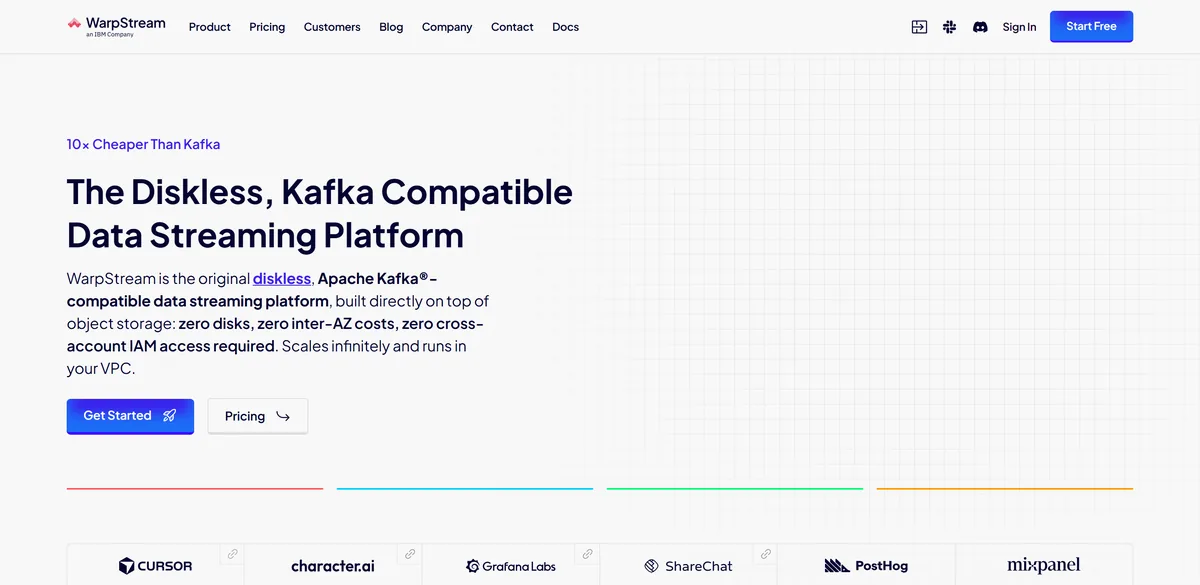
What it does: Kafka-compatible streaming that writes straight to object storage, with stateless agents and no local disks, now part of Confluent.
Who this is for: Teams whose Kafka bill is mostly inter-zone traffic and disk, and who can accept higher latency in exchange.
WarpStream writes straight to object storage. No local disks, no rebalances, no inter-zone replication traffic, which is where most Kafka bills live. It is also the only product here publishing a rate you could put in a spreadsheet: the first 50 TiB of writes a month at $0.01 a GiB, banding down to $0.003.
The part worth knowing before you shortlist it: Confluent announced its acquisition of WarpStream on 9 September 2024. The most-recommended way off Confluent’s product is now sold by Confluent, and no page-one competitor mentions it.

Key Features
- Kafka protocol with object storage as the only storage layer
- Stateless agents, so there are no disks or rebalances to manage
- Published per-GiB write pricing, banded down as volume grows
- Dev, Fundamentals and Pro cluster tiers at $100, $500 and $1,500 a month
Pros and Cons
Pros
- The clearest pricing of any product in this comparison
- Removes the disk and the rebalances along with the replication traffic
- Nothing stateful to operate
Cons
- Owned by Confluent, the company whose product you are trying to leave
- Object storage means higher latency than a local-disk broker
- The savings claims on the pricing page are the vendor’s own calculator
What Users Say
I presume this is part of the knock-on effects of Confluent (managed Kafka) buying WarpStream (Kafka emulated on S3 object storage).
NortySpock on Hacker News
This is more or less exactly what WarpStream is… Kafka API, S3 costs and ease of use
richieartoul on Hacker NewsThe commenter identifies himself as a WarpStream founder in the first line.
Pricing
Write throughput is billed in bands per month: the first 50 TiB at $0.01/GiB, the next 250 TiB at $0.0075, the next 1,250 TiB at $0.0055, the next 6,250 TiB at $0.004, and everything beyond that at $0.003. Cluster tiers are Dev at $100 a month, Fundamentals at $500 and Pro at $1,500, with Enterprise on request. New accounts get $400 in non-expiring credits.
Bottom Line
Put your real throughput into the calculator, then decide how you feel about Confluent owning it.
The clearest pricing in this comparison, sold by Kafka’s own commercial vendor.
4. RabbitMQ: Best for Teams Who Wanted a Queue All Along
What it does: A message broker built for queues and routing, not for a replayable log, and the thing many teams wanted when they reached for Kafka.
Who this is for: Teams doing work distribution, RPC and reliable delivery between services, where nobody needs to replay last Tuesday.
RabbitMQ is not a Kafka replacement and saying otherwise is how teams end up unhappy. There is no replayable log. A message is delivered, acknowledged and gone. What you get instead is routing, per-message acknowledgement and work distribution that one person can hold in their head.
Plenty of Kafka deployments exist because somebody needed reliable delivery between services and reached for the most-discussed tool. If that is the real requirement, this is $0 under MPL 2.0, pushed daily, and much less to run.

Key Features
- Queues, routing and per-message acknowledgement
- AMQP, MQTT and STOMP rather than the Kafka protocol
- MPL 2.0, 13,949 GitHub stars, pushed 28 October 2026
- Managed hosting available from several providers
Pros and Cons
Pros
- Simple to run next to anything here, and simple to reason about
- The right shape for work queues, retries and RPC
- Open source with a long operational track record
Cons
- No replay: once a message is acknowledged it is gone
- Scaling it is a different kind of work: queue depth and flow control, not partitions
- Commercial support comes through Broadcom, with no public price
What Users Say
I go with RabbitMQ in production. Mostly because it has been very reliable for years in production at a previous company, and doesn’t require babysitting. Its recent versions also has new features that make it is a descent alternative to Kafka if you don’t need to scale to the moon.
speedgoose on Hacker News
I even built quite a large system production with RabbitMQ… However, I find it extremely difficult to reason about them… all the nitty gritty details like performance, bottlenecks, crashing participants, network issues, queues filling up, protocol issues that lead to message cascades and DDoS
katzenversteher on Hacker NewsAbout message queues as a class, from somebody who ran a large RabbitMQ system.
Pricing
$0. The server and its tier 1 plugins are licensed under MPL 2.0, with some OCF files under Apache-2.0.
Bottom Line
If nobody on the team can name something that needs replay, this is probably your answer.
The honest answer for teams who needed a queue and bought a log.
5. NATS: Best for the Lightest Possible Messaging Layer
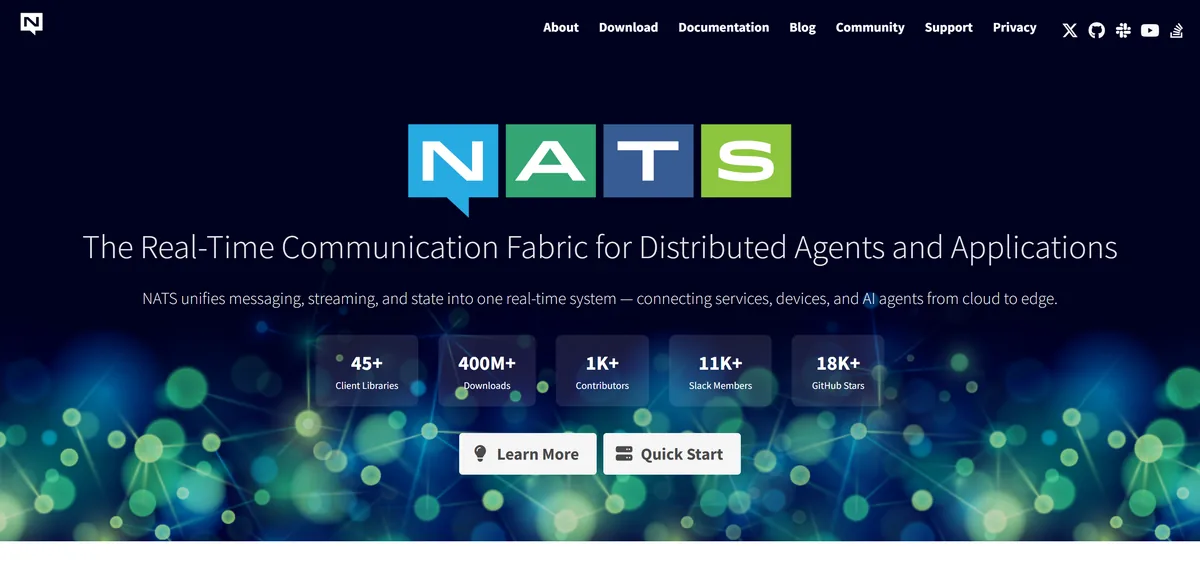
What it does: A lightweight CNCF messaging system written in Go, where JetStream adds persistence and replay on top of core publish and subscribe.
Who this is for: Teams who want service-to-service messaging without running a cluster of brokers, and who can test JetStream’s guarantees carefully first.
NATS is a single Go binary, which puts it in a different operational class from everything above. Core publish and subscribe is fast and genuinely simple, clustering is built in, and JetStream adds persistence and replay when you need the log behaviour.
JetStream is where the complaints are. Users report quirks in the delivery guarantees and buggy client SDKs, and per-stream Raft traffic adds up as counts grow. There is governance history too: Synadia moved to relicense in April 2025, and on 1 May the CNCF and Synadia settled.

Key Features
- Core publish and subscribe, with JetStream for persistence and replay
- A single Go binary with no external dependencies
- Apache-2.0, CNCF project, 20,947 GitHub stars
- Subjects and wildcards in place of partitions
Pros and Cons
Pros
- The least operational weight of anything in this comparison
- Clustering and leaf nodes are built in rather than bolted on
- Back under foundation stewardship after the 2025 trademark fight
Cons
- JetStream’s delivery guarantees draw repeated complaints from users
- Per-stream and per-consumer Raft overhead bites as counts grow
- The 2025 licensing episode is a reason some teams now hesitate
What Users Say
Core Nats is good and works well, but if you need stronger delivery guarantees you need to use Jetstream which has a lot of quirks, for instance it does not integrate well with the permission system in Core Nats. Their client SDKs are very buggy and unreliable.
sbstp on Hacker News
In my experience, Jetstream’s main performance weakness is the per-stream/consumer overhead: Too many and NATS ends up running too hot due to all the state updates and Raft traffic.
atombender on Hacker News
Pricing
$0. Apache-2.0, self-hosted.
Bottom Line
Test JetStream’s guarantees against your own failure cases before you commit to it as a log.
The lightest option here, with the most caveats attached to its durable mode.
Which Kafka Alternative Should You Choose?
Choose Redpanda if:
- Your applications must keep speaking Kafka
- Nobody wants to tune a JVM heap again
- A source-available licence is acceptable to legal
Choose Apache Pulsar if:
- You are running a queue and a log side by side
- Foundation ownership matters to you
Choose WarpStream if:
- Your bill is dominated by replication traffic
- Higher latency is a fair trade for the saving
Choose RabbitMQ if:
- The requirement is work distribution or RPC
- Nobody needs to replay anything
Choose NATS if:
- You want one binary and no cluster to feed
- You can test JetStream’s guarantees yourself first
Skip this category entirely if:
- Kafka is running fine and the complaint is the invoice. Audit what the invoice is made of before you migrate anything.
- You are on one cloud and happy there. Kinesis, Pub/Sub and Event Hubs are simpler answers than any migration.
- The team has two engineers. Every option here is still a distributed system.
What’s the Best Kafka Alternative in 2026?
If the API has to stay, it is Redpanda or WarpStream, and the deciding factor is whether you care more about the licence or about who owns the company. Redpanda is BSL and independent. WarpStream is priced in the open and owned by Confluent.
If the API does not have to stay, the question gets easier and cheaper. RabbitMQ if you wanted a queue, NATS if you want the smallest thing that works, Pulsar if you genuinely need both models under one roof.
The honest answer for a lot of teams is that none of these fixes what is wrong. A broker migration moves a cost; it does not remove one.
Before You Migrate: What the Bill Is Made Of
Migrations get approved because the streaming line on the cloud bill is embarrassing. They get regretted when the same line reappears under a new vendor six months later, because the number was never really about the broker.
Algoscale’s data engineering team builds and runs the pipelines around whichever broker you keep, with metadata-driven ETL, embedded quality checks and cloud FinOps after go-live.
On a recent AWS warehouse modernisation, fourteen subsidiary ERPs plus a CRM, an HRMS and a planning tool went into one governed lake with twice-daily refreshes. The client’s VP of Finance described the problem beforehand as not being able to say what the group billed last month.
- Audit of what the streaming bill is actually made of
- Pipeline and warehouse builds on AWS, Azure, Databricks and Snowflake
- Metadata-driven ETL with quality checks built in
- Continuous observability and cloud FinOps after go-live
Ready to put this into production?
Algoscale’s data engineers have built and migrated data platforms for retail, fintech and manufacturing teams. Book a free consultation and we will scope yours with you.
Frequently Asked Questions
What can I use instead of Kafka?
It depends on which part of Kafka you are trying to leave. To keep the Kafka API and change the engine, Redpanda and WarpStream both speak it. To change the model, Apache Pulsar gives you queue and stream semantics in one system, RabbitMQ gives you queues and routing with no replay, and NATS gives you a single Go binary with JetStream for persistence. If you only want somebody else to run Kafka, that is Confluent Cloud or Amazon MSK, which is a different decision.
Is there an open source alternative to Kafka?
Yes, three of the five here. Apache Pulsar is Apache-2.0 with 15,354 GitHub stars, NATS is Apache-2.0 under the CNCF with 20,947, and RabbitMQ is MPL 2.0 with 13,949. All three were pushed within two days of 28 October 2026. Redpanda is the exception people get wrong: its core is the Redpanda Business Source License 1.1, which is source-available rather than open source.
Is RabbitMQ better than Kafka?
They are different products. RabbitMQ delivers a message to a consumer, takes the acknowledgement and forgets it, which is what you want for work queues, retries and RPC. Kafka keeps an ordered log you can replay, which is what you want for event sourcing, stream processing and multiple independent consumers. If nobody on your team can name something that needs replay, RabbitMQ is probably the better fit and is considerably less to run.
Which Kafka alternatives keep the Kafka API?
Redpanda and WarpStream are both Kafka protocol compatible, so existing producers and consumers connect without a rewrite. Apache Pulsar supports the Kafka protocol through a handler, not natively, so treat compatibility there as something to test. RabbitMQ and NATS do not speak the Kafka protocol at all, so moving to either means changing application code.
What is the best Kafka alternative for AWS?
If you want to stop running brokers entirely on AWS, Amazon Kinesis is the native answer and MSK is managed Kafka, not an alternative. If you want to keep the Kafka API and cut the bill, WarpStream writes to S3 and removes the inter-zone replication traffic that dominates most AWS Kafka invoices, at the cost of higher latency. Redpanda runs on AWS too and keeps your clients unchanged.